NOTE: Every aspect of this workshop is dealt with, sometimes with ridiculous detail, in my completed upcoming book A Period Finisher’s Manual; certainly much more detail than the blog. In fact, the workshop has re-lit the fires of getting that beast finished and off my neck.
The first of the class exercises, which in fact became the foundation of a half-dozen exercises, was to take a 24″ x 48″ panel of cheap (not inexpensive, this is 2021!) luan plywood panel and get started building the finish on it using a 1″ flat watercolor brush. Trust me, the proof of the pudding is in the tasting and in the end this leads to a tasty treat.


Even before we started applying the finish was the surface prep. That alone was a paradigm threat as the prep work was accomplished by rubbing the wood surface with the tool most prominent two centuries ago – a pumice block. Sandpaper was expensive and to residents of a time where surface prep is done with a power sander, the performance of a pumice block is truly surprising.

With the surface abraded and smoothed, and the detritus cleaned, it was time to mix up and apply some varnish. Since I have hundreds of pounds of lemon shellac flour, that is what we used. We each mixed a jar of approximately 3-pound shellac varnish with the shellac flour and 190-proof liquor. (Approximately a lean 1/4-jar, then filled to the brim with alky.)


Soon enough we were applying the first of dozen coats of spirit varnish on the panels. I gave impassioned instructions about how to apply brushed spirit varnish so that there are no overlapping marks, and I must say that the participants each accomplished that task perfectly.

The first coat was immediately followed by a second, and a third, and a fourth. Then it was set aside until the end of the day.
Last weekend I hosted another Historic Finishing worship at the barn, an event commissioned by a group of guys who met at a woodworking class somewhere. Given the general level of disinterest in folks attending classes here I will no longer be scheduling any workshops other than ones that are commissioned. I am truly not complaining, just recognizing reality for what it is. As CS Lewis commented, “Reality is a ruthless instructor, it does not care if you agree with it or not.”
It took a long time to get the classroom cleaned out, prepped, and outfitted with a range of tools and exercises for the students. I’ll recount the experience over the next few days. It was a marvelous time, but since it was all about shellac and beeswax, how could it not be?
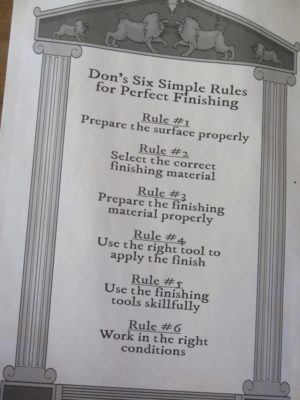
As always we will begin with a discussion of the Six Rules, handing ledger sized printouts for each to take home and guide their work the remainder of their lives.

I have distilled and refined the curriculum over the years into a dozen exercises, and think it is just about the max I can cram into 2-1/2 days. I suppose I should write this up some day in a syllabus format.
Stay tuned.
I think I am more or less back on track, compewder-wise. I took some advice from RalphB and placed a sledge hammer next to the keyboard and spoke to the compewder in calm but undeniably threatening terms. It has been behaving better ever since. Actually, compewder guru Tim had a session with it. — DCW
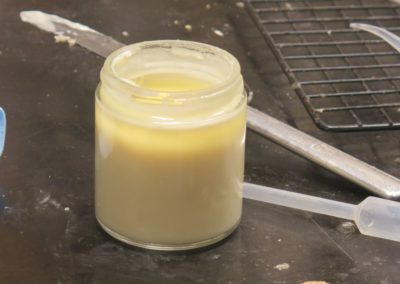
As we left the (mis)-adventure with the batch of Mel’s Wax having identified and solved the problem, I was left with a large batch of the misbehaving product to deal with. Of course my question was, “Can I recover this and make it useful?”
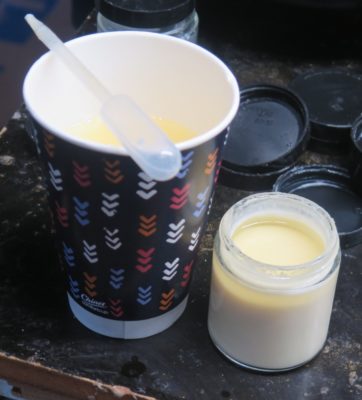
I first let the emulsions sit for a week or so then decanted off the excess solvent from the top of the jars with a pipette. The result was a couple of paper cups filled with nearly pure solvent which I merely disposed of as it was of no use to me. I was careful to not dip the pipette too far down into the liquid so as to leave the emulsion itself untouched. This cautious approach left a small amount of excess solvent fraction stratum on top of the liquid.
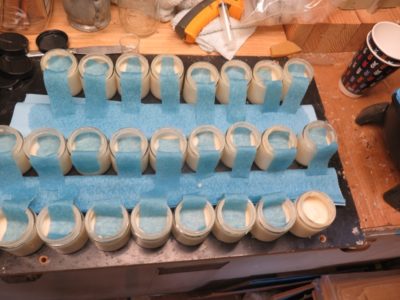
I decided to remove this excess fraction using techniques familiar with anyone who has ever undertaken some liquid chromatography, I simply wicked off the surface excess by draping in a strip of paper towel on top.
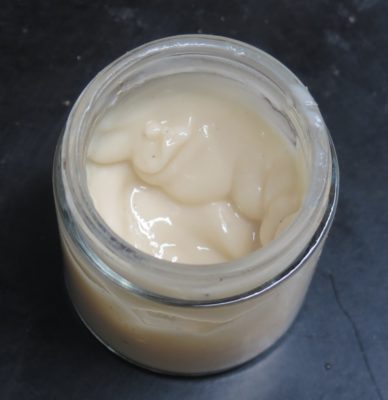

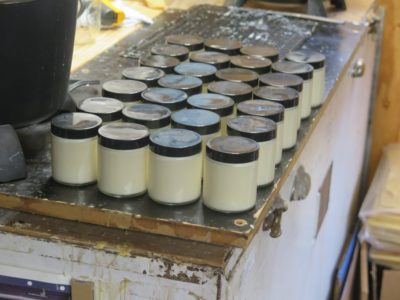
The ultimate result of this approach was to arrive at the balanced formulation with the emulsion performing and behaving exactly a it as supposed to behave and perform. Nevertheless this was not product I was going to sell given the log and winding road, so I now have couple dozen jars I will give away to friends and barn visitors.
Thanks to a recommendation from my friend Steve Voigt I will be trying a new source for the solvent and will re-calibrate the formulation for future batches.

I’ve got one opening for a student in the six-day “Make A Gragg Chair” workshop, the last week of August, and two openings for “Historic Woodfinishing” over Columbus Day weekend. If you are interested drop me a line at the “Contact” page.
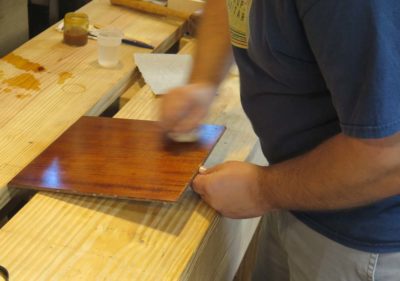
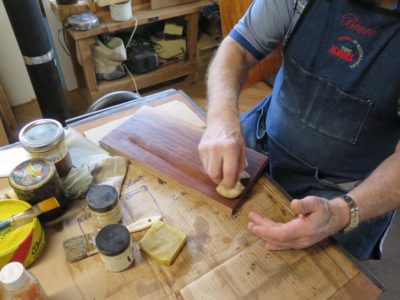
In keeping with my current “marketing” (non-) strategy for workshops, a while ago I was approached by a group of fellows commissioning a Historic Wood Finishing weekend workshop at The Barn. Once we set the schedule it turned out that there would be two slots open for anyone else who wanted to take the open places. If this interests you let me know. As always, the emphases will be on shellac and wax finishing for three days. The schedule for the workshop is October 9-11, 2021, and the tuition is $375.
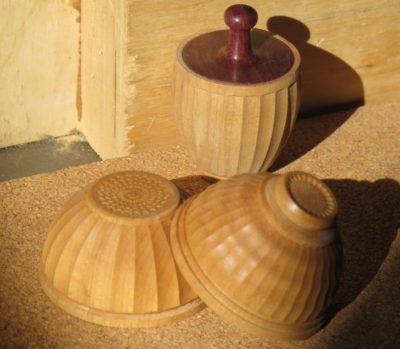
During his recent visit to help set up for next August’s Gragg Chair Workshop my pal John presented me with these three little vessels for me to experiment with as I build an inventory of fauxrushi experience. I can hardly wait to get to them. John has a Rose Engine Lathe and is always looking for new avenues of artistic expression with it. I made sure to send him home equipped with several wood chunks with which he can play, including a bolt from a holly tree, some tulipwood, and others. I await the results of explorations from his end.


With the two halves of the Kindle case ready, I glued on band of leather to bring the two of them together. The gluing was only to the faces of the case with the back edges unglued so that the case could be folded open with the two halves face-to-face.
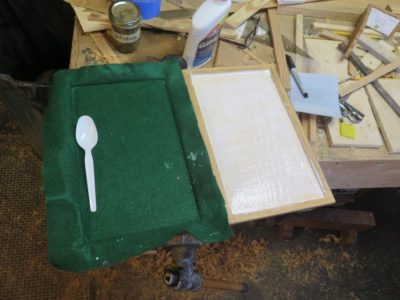

Once the two halves were put together I took some scrap felt from my rag bin and glued that into the cavity holding the Kindle. That was a nice effect, except for where I slipped with the razor blade while trimming the felt and cut off some of the cypress veneer. I hate when that happens, and will repair it when I get a chance.

With everything together and complete I spent a little time padding on some more shellac. I will probably repeat this periodically to build it up a bit more, but I wanted the case to get to work. I stuck on some velcro dots at the two corners to hold it together when not in use and called it “finished.”
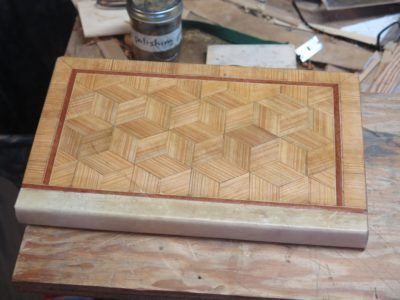

A few days ago blog reader (and the Lou Gehrig of the woodworking blogosphere) RalphB asked about my use of the pumice block to smooth the surface of my parquetry Kindle case. The use of pumice blocks is well documented in historical accounts, although explicit or specific details are often missing.
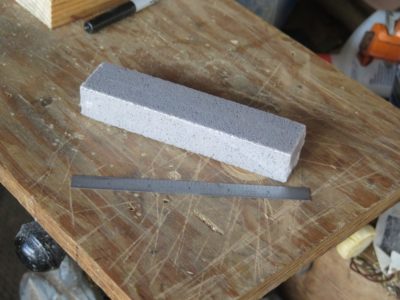
I use a pumice block from the plumbing section of the hardware store (I order them by the case). Normally they are used for deep cleaning of porcelain and enameled fixtures to remove mineral deposits and stains. They work equally well for evening out irregular wood surfaces such as those found when assembling parquetry or marquetry from sawn veneers, where regardless of the care in the initial veneer sawing a fair bit of irregularity is manifest.
I generally use a pumice block as the step following the toothing plane/Shinto rasp, moving the block in a circular fashion on the substrate, yielding a fairly smooth and even surface about what you might expect with 60 or 80 grit sandpaper. Following the pumice block with a card scraper and polissoir, the result is quite pleasing.
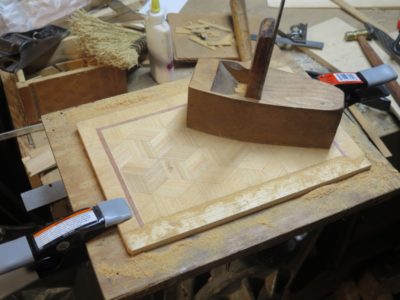
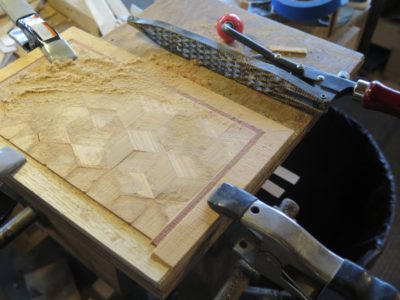
Once all the veneerwork was finished and the banding in place it was time to flatten all these irregular surfaces. Using a variety of tools, including a toothing plane and a Shinto rasp, I soon had things even enough to use a pumice block to smooth everything out.
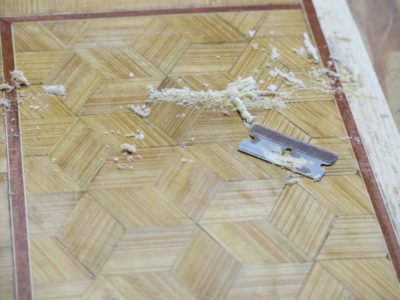
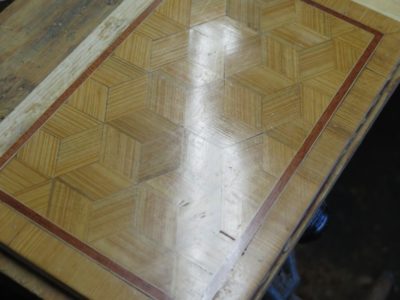
With my tacking iron I impregnated all the show surface with a generous application of molten Blend 31 wax to serve as a grain filler and foundation for a little bit of padded shellac yet to come. Using a fresh single edge razor I gently scraped off the excess wax to get down to the smooth surface, which was evident when I buffed the scraped surface with a piece of linen. Little places of voids were filled in with more molten wax after the buffing revealed them.

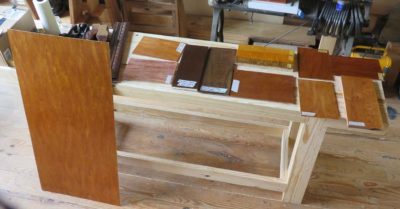
The two halves of the Kindle box are different because I was mostly trying to use leftovers from other projects.
In the aftermath of my “attempted suicide by lawnmower” I spent the afternoon in low intensity activity in the shop. Most of that time I spent finishing off the negoru finish on my sandpaper box. I cannot exactly recall where I found this box years ago but it suits my need perfectly for a place to house the 1/8th sheets of sandpaper that I use for most of my work. In the past few weeks I’ve been using this project and others as diversions to recharge my batteries when I get tired of writing.

For the past several few years the box has been performing its tasks while only partially dressed, wearing only a nice coating of my favorite primer called “Sanding Putty” from Fine Paints of Europe. Crazy expensive but worth every penny. In the past few weeks I’ve been using this project and others as diversions when I get tired of writing. I’m sorry I do not have a picture of the box at this point, the project was just a whimsy at the beginning. I have another box I am likely to use for the same finish, and when I do I will document it more carefully.
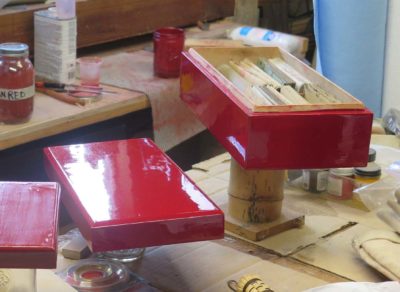
After sanding the primer I laid down two coats of Schreuder Hascolac red paint to provide the chromatic foundation for the final presentation. This also comes from Fine Paints of Europe but I think they have changed the product nomenclature since I bought mine. Like the Sanding Putty these paints are simply incomparable to anything else I found in the market. I wet sanded between coats with 600 sandpaper.
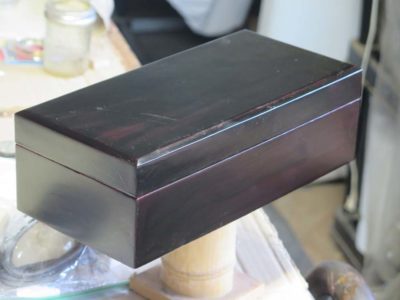
Once the foundation was ready (I usually wait a week between each coat of this oil paint) I wet sanded again and added a single coating of the Schreuder black paint.
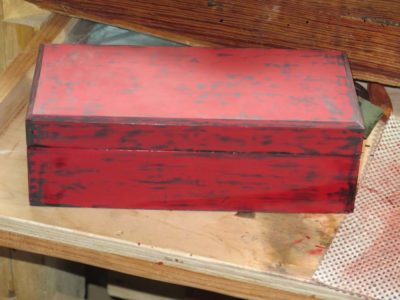
Then using 400 wet-or-dry sandpaper I abraded away most of the black to an appearance I liked.


This was followed by several applications of Epifanes Spar Varnish, a European analog to Waterlox Original Gloss Varnish. I had never used Epifanes before but it is highly regarded in the architectural restoration world and I had some so I thought I would give it a try. It certainly does lay down nice. As before I gave it a nice sanding between coats.
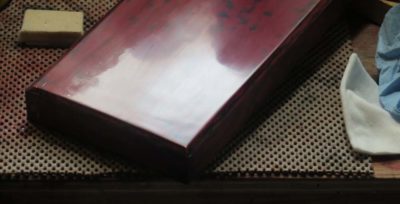
Once it was all done and the varnish was hardened, always an issue with spar varnishes as they are formulated to not get as hard as regular varnishes, I set out to polish it up. This began with a wet sanding of 1500 grit sandpaper, followed in turn with 1 micron and .05 micron agglomerated microalumina abrasives. For flat surfaces such as these I use homemade blocks of 1/2″ soft-ish felt glued to a thin plywood backing, with mineral spirits as my slurry liquid

All that is left is the very final polishing with whiting on my dampened fingertips, a maintenance coating of Mel’s Wax, and it will be done.

Not bad for just a time-killing whimsy.


Recent Comments