Last week my brother and I laid the new 2″ HDPE penstock (pipe) for my microhydroturbine system to power the barn (and the cabin if necessary). Last winter absolutely trashed the existing pipeline of Schedule 40 PVC.
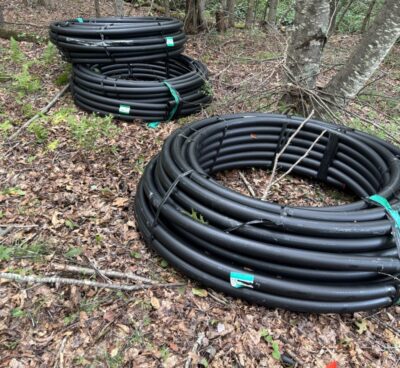
The 2″ HDPE came in giant ~6-foot coils, each of which weighed several hundred pounds. Once these were unraveled we had a rasslin’ match that looked like a monster movie with giant snakes. If you’ve never handled large dimension HDPE it is unbelievably tough and strong, slippery and cantankerous. Not to mention ridiculously expensive compared to Sch40 PVC, but I am expecting it to be worth the added investment. I got 15 years from the Sch40 PVC so this should outlast my time in Shangri-la.
Even two stout redneck brothers were no match for the Super Slinky. We wound up lashing the end to a long rope, feeding the rope along the path we wanted the pipeline to follow, and then pulling it up the ravine with my beloved little 4WD S10. The pipe was more than a match for two ~septuagenarians but was no match for 210 h.p. x 4500 lbs.
Here are the old and new, side by side. This level of damage to the old penstock was present in about 75% of the 1000+-foot length.
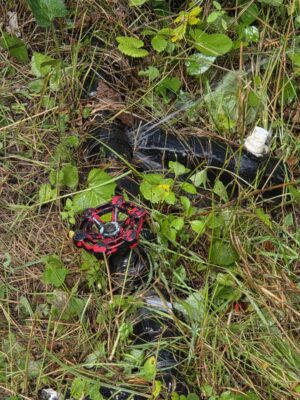
We finally connected the new pipeline into the system and had water flowing! I discovered that even at the bottom there was a crack in the PVC joints, so that needs to get replaced as soon as I can find the time. It’s working, now, but who knows for how long?
The work is not done by any means. I’ll let the new HDPE pipeline relax and lose its coilification to the greatest degree possible, then work the line from top to bottom leveling and lashing it. Reducing the up and down of the lay is critical to making the flow have as little turbulence as possible. If all goes well I will be able to run the system year round. Here’s hopin’.
Just as last week was all about loading up and teaching Historic Woodworking (more about that later) this week is all about unspooling, laying and connecting over a thousand feet of 2-inch Heavy Duty Polyethylene water line for my hydropower system. My brother is here for a visit and I am working him like a rented mule.
The water line is heavy but not brutally so, each of the four coils is probably about 350 lbs, but being coiled up for an unknown period of time it is set hard into the coil shape. Basically it is like straightening out a giant Slinky that wants to beat you up at every turn.
I’m not spending 100% of my time fighting the Rearrangeritis War. I still try to spend a couple hours a day writing, although not as fast as I would like, and portions of almost every day with chores around the homestead. One such chore is maintaining the driveway.
If you recall, several years ago I had the driveway to the barn rebuilt with hard packed “Limestone dust,” a pea gravel sized aggregate in common use out here in the hinterlands. (Shangri-la is immediately adjacent to a gravel quarry). The material packs to become almost concretious and serves its purpose well.
Then came the monster ice storm of last winter and the torrential rains of last spring. The frost-heave and runoff from these events took its toll not only on my microhydropower waterline, soon to be replaced en toto, but now I must spend moments of many days reconstructing the crown and shoulders of the roadway. The material is so hard it broke my hoe so I must break it down with a derelict adz, the only tool I have with the heft and robustness to accomplish the task. It was one of several old adzes I bought at a tool auction many moons ago. Two of the adzes are kept razor sharp, but this one is just a beefy hoe that I use for all sorts of digging fun. I repaired the original hoe but now use it mostly as a rake. The adz has the additional advantage of being three times wider than my pickaxe, which would have been my other option.
We’ve been blessed with a couple of days’ semi-impromptu visit from my brother and his wife, who taught school with Mrs. Barn about fifty(!) years ago. Since it was sorta last minute I didn’t have much of an activity agenda. We trimmed up the walnut trees in the yard, toured the garden and greenhouse, confirmed that the late frost had left all the apple trees fruit-less except for one small crabapple, then hiked up the hill to assess the microhydro water line in preparation for replacing it when they return in August. Goodness, the old Schedule 40 PVC line was trashed by the brutal ice storm last winter.
We walked along with me running the traveler along the ground to get a reasonable measurement of how much of the black poly pipe to order. Were two rolls of 2″ x 500′ going to be enough? Well, the rough measurement was 1,007 feet, so I will have to either use a little of the Schedule 40 at one end or the other or order another hundred feet of the black poly.
Meanwhile, just above the weir we could see a large tree had fallen across the original logging road so we walked another 150 yards to it. And what a tree it was! The amount of firewood we can harvest will be impressive.
The tree was struck by lightning and felled very recently (the leaves were withered but still green on the branches) and it was a big ‘un. At four feet off the ground the girth was eleven feet. Another very large tree had fallen right next to it, probably in the same storm.
So come August we will be hard at work. Sugar maple ain’t the best firewood but it’s better than nothing. Especially if you have tons of it.
Or as the distinguished Congresswoman from home state of Minnesota might say. “What Winter Hath Wrought, Eleven.”
Once things finally melted off from this past Snowzilla, I discovered another severe after-effect.
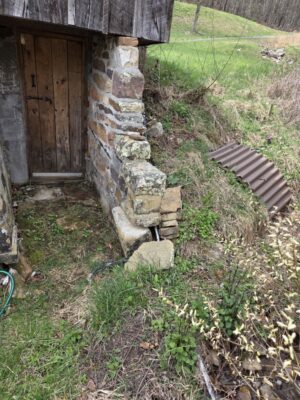
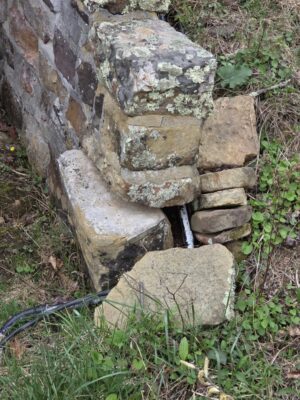
The stone foundation walls leading to the underground root cellar were pretty much wrecked by the ice-rain-sleet-rain deep freeze in late January. After more than a hundred years of being in place the base rocks were literally pushed out of place by the block of ice accumulating behind it. Yikes.
I’m hoping my brother is feeling strong as I plan to excavate and reinstall several hundred pounds of rock wall during his scheduled fall visit. It can’t be all firewood fun and games.
About once a month I get together with a small group of local friends primarily to talk about living in the hinterboonies and all the topics adjacent to homesteading. Lately the topic of communication has been prominent as we’ve been talking about using small walkie-talkie type tools to keep in touch in the event of the phone or power systems going down (not a crazy paranoia out here where one or the other goes out occasionally). Last week I talked about my six decades of experience listening. In that arena I’ve found listening to AM and shortwave to be useful and entertaining. Here is what I talked about, in part. I figured there had to be one or two of you interested in this topic. If I’m wrong? The sun will still come up tomorrow morning.
>>>>>>>>>>>>>>>>>>>>>>>>>>>>>>>>>>>>>>>>>>
If there are regional power/internet outages -– we have experienced week-long outages in both Maryland and here in Virginia, and getting news was nearly impossible – alternatives for knowing what is going on are useful. I have found that AM and Shortwave radio listening are really useful for that task. Most stereo systems have dreadful AM receivers and are not useful tools for AM listening. Instead I have tried out dozens of units over the decades and hands-down the best performance/best value are the portable radios based on the GE SupeRadio platform. Obviously GE started the platform as a consumer product but many, many other companies followed suit, either borrowing, licensing, or stealing the design and technology. I’ve seen many new models on the marketplace that look similar but have not tried them out. I would suggest looking ebayto find a gently used one or even occasionally a new-old-stock version, prices ranging from $15-75. I bought mine for about $20 back in the mezozoic era. They are still so cheap and available I honestly would not bother with anything else.
These models have good long internal AM ferrite rod antennae, and analog tuning.
A critical additional accessory is an inductive antenna, a/k/a an external tunable loop AM antenna. These devices are set adjacent to the radio, usually perpendicular to the unit, and increase the sensitivity by up to a hundred-fold by adjusting the potential of the copper wire loop with a rheostat, “tuning” the antenna to the station on the radio. They operate much like a magnifying glass for visible light, but only in the much longer RF electromagnetic frequencies. Just as a magnifying glass amplifies and focuses light, the tunable loop antenna focuses radio waves onto the internal antenna of the radio.
The loop antenna I showed was one of several I bought from Radio Shack 40-50 years ago for about $20 IIRC. I have not seen another one like it for at least 30 years. The only loop antennas I know still on the market are made by Grundigand certainly would work just fine. I’ve never looked to see how available they are. The Grundig tunable loop antenna is based on an earlier design called the Terk, a version of which is currently on the Walmart site for $45. The Cadillac of tunable loop antennas is called the Select-A-Tenna, of which I have two. I have not seen one of these since forever. Mine cost about $80 each new, and I still find them from time to time on ebay.
I cannot overemphasize the necessity for these inductive tunable loop antennas. They can make a pocket transistor radio pull in stations from unbelievable distances. Even at dusk during our meeting I was able to use my $20 radio and $20 antenna to easily pull in signals from St. Louis, Chicago and Detroit. In the middle of the night you can occasionally get stations from Canada all the way to South America.
This is an inexpensive and high-performance way to get information from a great distance away. The utility of that should be self evident.
The other radio platform I used was a shortwave receiver-only unit. This is where some real money can be spent. My experience has shown that the best quality/value brands are Sony, Sangean, and Grundig. They are not cheap, the one I showed you was probably $300 in 1980. I cannot remember if I brought my Sony 2002 or 7600 model. The Sangean 909 I showed you was bought at Radio Shack for about $200 way back then. A long lost treasure was my Sony 2010 monster portable multiband radio. Its motherboard got fried way back when. (CME? Hmmmm.) A $750 radio down the hole. It had digital tuning and I could even pick up signals from the eastern slope of the Rockies with that baby combined with a loop antenna.
Both the Sony and Sangean portable multiband radios I’ve normally used were digital tuners, many times programmable with station memories.
Very good deals on portable shortwave radios, usually referred to as “portable multiband radio” are available at ebay. I just saw one identical to my Sony 2002 (but in black rather than silver) for about $25 over there. I see a lot of similar-looking radios on the Walmart website but usually do not recognize the maker. If you know what to look for high-quality vintage radios are out there in great quantities, hundredson ebay right now.
As with standard AM radios, an antenna accessory is critical to the performance of a portable shortwave. You gotta, gotta, gotta have a wire reel or spool antenna that can be used in concert with the retractable FM antenna on the unit. I recall mine being about $7 from Radio Shack. CCraneradio has them for about $15, Amazon has a Sangean model for about $30.
Fix the wire antenna fitting to the extension antenna on the radio, then get the wire as high as you can while running as much as you can horizontally.
And don’t forget batteries. I buy lots of them, they last for a decade or two in cool, dry storage conditions. Rechargeable batteries are also an excellent option, I’ve found the Energizer brand to be excellent. You can get 110v plug in chargers but you should also have some off-grid charging capacity.
We’re now in the middle of asparagus season. Yummmmm.
That is all.
PS My favorite asparagus treat” freshly picked asparagus, steamed and still hot, laid over a spread of Gulden’s mustard on a piece of still-warm sourdough bread toast, topped with a slice of muenster cheese melted over the asparagus.
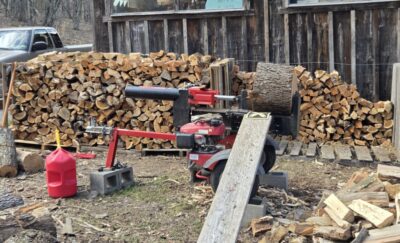
Last week I finally wrapped up processing all the windfall I’d harvested several weeks ago. The bounty was impressive, the cribs are three rows deep. The pile on the ground near the splitter are all the wonky pieces I will use next winter in the barn wood stove. The haul *should” get us through next winter when combined with the leftover wood still in the cabin firewood crib, but the harvesting and processing will continue through the summer and fall. When you heat with firewood, you can never have too much.
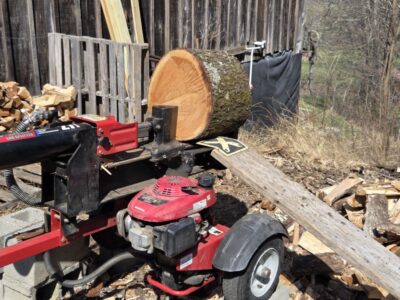
I am finding that in my 70s I am working just as hard and almost as long as ever but only manage to get about half as much done as I used to. After moving a pickup load of mulch for Mrs. Barn this morning, I popped up to continue building the firewood inventory for next winter and beyond. Currently I am working my way through the pile of approximately 300-pound cherry bolts, which must be handled with great care as I am not even remotely interested in experiencing a broken leg.
I roll them to the bottom of the ramp then cautiously navigate the way up until it plunks down to the bed of the splitter with a WHAM! I thought about raising the splitter upright but decided that wouldn’t really work any better. I quarter the bolts then move three of those aside (I can handle those at about 75 pounds’ apiece), splitting the remaining quarter into nine full sized pieces of firewood, then repeat the process for the other three.
Once I get done with the last of these it will be time to head back up into the woods to begin processing more windfall. I’m pretty sure we’ve got next winter covered (quite a bit left from this recent brutal winter), but you can never have too much firewood when you live in the mountains and it is your main heat source.
Not especially romantic or blog worthy, but it is a central theme for this time of year. Along with hauling mulch, of course. I’ll resume again in the fall when my brother returns for a visit.
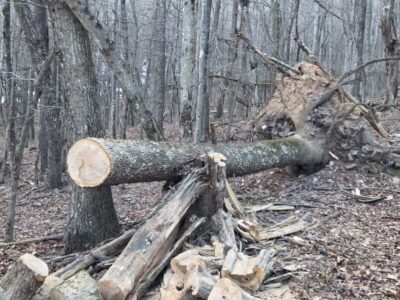
With a break in the brutal winter weather I got myself up into the woods to chop up that grove of black birch trees that came down last winter. The amount of firewood from this one incident of windfall is about what we should need next winter, but even when done here I’ll keep at it. It’s fun and good exercise.
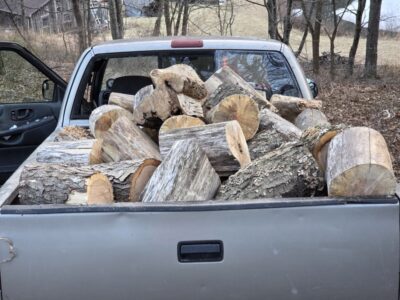
The work site was quite the mess so I spent most of the first day just clearing brush, then got to work chopping my way up the trunks. I got two good truck loads of 6-8″ 16-inch bolts with the occasional 10-12″ piece, but those were almost outside my lifting ability. I followed those two loads with two more today.
Once I get to the biggest section of this tree, about 20 feet from the root ball, the pieces will be 20-inches in diameter or more. Those will be so heavy I will have to roll them to the tailgate and up the ramp into the truck. If past experience is any indicator each one of the biggest sections will yield 32 pieces of firewood that are manageable in size.
Another couple days and another couple truckloads and I will be done with harvesting from this site. Then on to splitting and stacking. I’ll use a system new to me I’m adapting from Mike Wilson, whose yootoob channel is one of my favorites. Previously I just spent way too much time stacking carefully to make everything “just so,” crisscrossing each layer for good stability and air flow. This new system should cut my time by at least half with even better air flow.
Then on to harvesting some more windfall elsewhere on the homestead.
Good thing my little 4WD S10 is strong and nimble. It may be dissolving before my eyes and maybe not reliable for long trips anymore but I’ll keep it until it runs no more











Recent Comments