Probably like many of you, as I watch the paroxysm of manufactured “rage” throughout urban America I am almost continually running an OODA Loop especially when I leave Shangri-la and go out into the larger world. (OODA is the military acronym for Observe, Orient, Decide, and Act, a decision-making model for use in uncertain situations.) In the environment that is the USA 2026, OODA is in my mental background like a virus scan. Since many/most/all(?) of the “spontaneous” riots are conducted by trained out-of-state professionals provided by entities like Crowds on Demand, Inc. (a real LA-based rent-a-mob temp agency!), the need for OODA is an imperative. I for one am curious about the money trail for the rent-a-mobs.
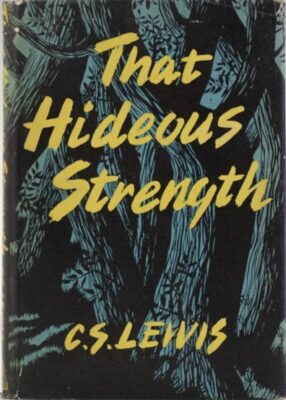
But ruminations on OODA are just the gateway for this post. Almost all of us of a certain age have had our awareness formed, at least in part, by two classic dystopian novels we read in high school — 1984 (1949, George Orwell) and Brave New World (1932, Aldous Huxley). However, my favorite novel of this (or any other) genre and roughly contemporary to them, and one that I am unreservedly recommending to you, is the far less known 1945 C.S. Lewis That Hideous Strength. When reading THS I find many of the parallels to 2026 to be inescapable. It is almost a fictional recitation of the seduction Hannah Arendt described as “the banality of evil” but set in the campus and village of a small British university. It brings to mind the old quip, “The smaller the boat the meaner the rats.”
The understanding from this trilogy of dystopian fiction is IMHO foundational to being a modern grown-up. Not the full foundation, but still foundational. Read or reread them for a refresher course in the human condition and of the evil that men can do. And if you are unfamiliar with That Hideous Strength, pick it up and be edified. Every time I reread it I find myself saying, “Holy cow, that’s just like now!” Yes, it is a semi-fantasy, but the parallels are too powerful to ignore. It is not a fast read, not because it is turgid or difficult, but because you might just find yourself pausing by necessity to consider the implications of the tale for our modern, debauched world.
For extra credit when exploring the dysfunctional human condition take a stroll through The Minor Prophets of The Old Testament, Hosea through Malachi. Since the books do indeed chronicle accurately the nature of the human condition, like me you are likely to pause and reflect that the truths therein are as current as tomorrow’s headlines.
We were recently blessed with another visit from our dear friends, Mr. & Mrs. Ripplin’John. They spent several days with us at the cabin and in the barn, and one of the days we took a day trip to Richmond to tour the Virginia Museum of Fine Art, a mid-sized treasure in the museum firmament. John is working his way through an MFA with an emphasis on decorative metal-and-wood objects, and the VMFA has a simply fantastic collection of Faberge along with a wonderful collection of 20th Century furniture.

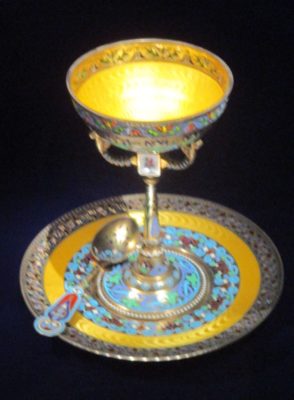
These two remarkable pieces were only two of many hundreds from the Faberge and related decorative metal objects. My fascination with the collection and the ambient light levels discouraged me from taking many pictures in these galleries.
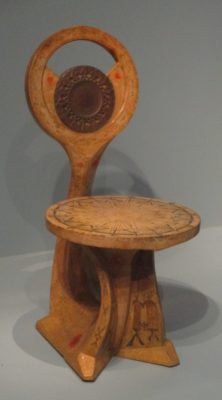
There were several captivating vignettes/galleries of Art Nouveau furniture, including this eye popping but hopelessly impractical chair by Carlo Bugatti, uncle of the car designer.

Just around the corner from that chair was this bedroom suite (I cannot remember at this moment whether it was from Galle or Marjorelle),

and this “office” or parlor set by an artist whose name does not come to mind at the moment. In fact the entire collection is an expertly assembled compilation of all the familiar names, but as I sit here I cannot instantly recall all of them.

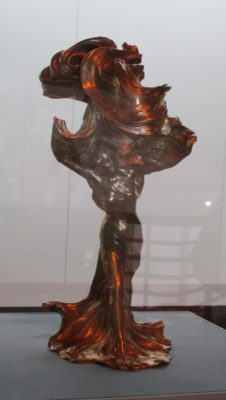
Out in the hallway were these spectacular objects, including a bust by the incomparable Alphonse Mucha and the figurine lamp that is so vibrant you can almost sense the wind billowing the fabric around the model, a la Cyd Charisse in Singing in the Rain.

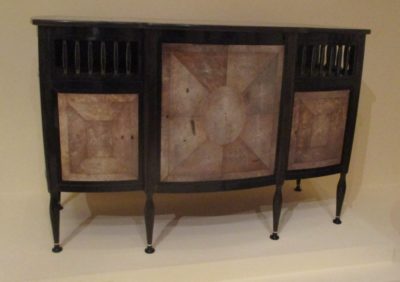

On the other side of the hallway were many more galleries with equally spectacular furniture and accessories.
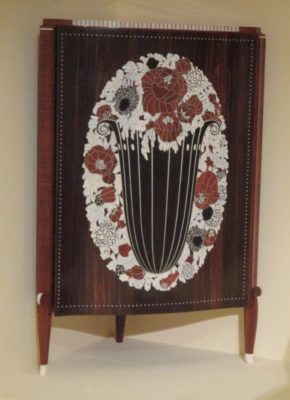
This Ruhlmann cabinet is every bit breathtaking as you would expect.

One of the pieces evoked a bittersweet memory. Several years ago Mrs. Barn and I were at an outdoor auction and I saw one of these Stickley box chairs from across the parking lot, and I took off like a bird dog. My first thought was, “I hope I’m the only person who knows what this is.” (The chair was in literally “as new” condition, and I say that like almost never, as though someone bought it a hundred years ago and then put it in the closet ever since. I mean it was in perfect, original condition. *Every part* of it, except for the feet which were sitting in a mud puddle at the time.) My second thought was, “Given that this is a ‘cash only’ auction, how much money did we bring?” In the end the second consideration was moot (~$1500) as the sale price was close to $8000, which answers the first question.

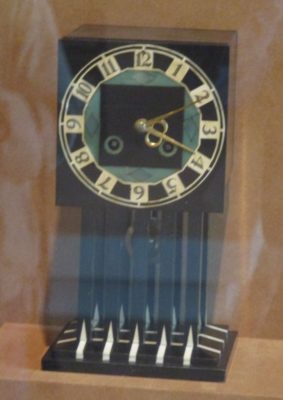

As a total Mackintosh fan-boy I absolutely loved this ensemble of a fireplace surround, a diminutive shelf clock, and several of his chairs. This chair was my favorite.
A grand day for sure, and I can recommend the museum especially for its furniture collections. Plus, there is no admission fee!


Recent Comments