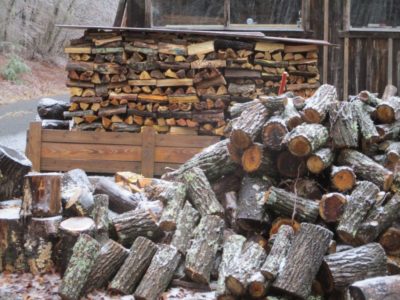
We are now firmly into the wood-stove-heating season, and it happens that this year we have a lot of black walnut to burn. Not anything furniture-worthy, I set all that aside for use in the shop later, but the branches and such. Since we felled several walnut trees two years ago there is a lot of that “clean up” to burn, and burn it we are. One thing is clear in my observation — walnut may be great for furniture making and bowl tuning, but as a firewood? Meh.
For the number of BTUs per unit volume of wood it really fails to deliver. Yes, of course it burns and provides heat as a result. But compared to everything else on the menu for wood burning it falls way short. Plus, it is really ashy, as bad as soft maple.
In fact, walnut comes in dead last in my hierarchy of firewood I can harvest from my own ~70 acres of forest.
The top of that list is occupied by locust, which seems to be almost as BTU-dense as the coal I burn in the shop stove. It can’t be, of course, but goodness I love the output of heat vs. volume and ash I get from locust. I’ve got a lot of it including two stupendous fallen trees up near the ridge property line near the cabin. Even one of those trees will suffice for a complete winter, so I am anxious to bush-hog enough to get my little 4WD truck right up to the windfall. In fact, the two remaining standing trunks are so big I need to hire my pal Bob to come and bring them down. I just do not possess the experience, skill, or saw to bring them to the ground.
Next comes oak, which we have a fair bit of but not as much as locust (firewood-wise). Given the amount of windfall of other species we have up the hill I do not cut much oak. But when I do, once seasoned it is a premium source of heat.
As is ash, of which I have very little. The characteristic of ash that makes it a good firewood is that it needs almost no seasoning to be ready for the woodstove.
Cherry and maple are also good source of heat, and we have a lot of both. The difference between them is that maple is a lot more ashy than cherry for the amount of heat provided. When we burn a lot of maple we have to clean out the stove about once a week. With cherry it would be every two weeks. For oak and locust it could be every three weeks. About equal to cherry is the surprise pick of black birch, which we get a tree or two every so often.
We do not have any tulip poplar so the last spot is occupied by black walnut. It’s just the way it is. We’ve got a very large walnut tree that is ailing and through which the power and phone lines travel. I hope the tree recovers, but if not there’s a huge pile of lousy firewood waiting to happen.
BTW I am almost done splitting and stacking the firewood for next winter and will likely wrap that up with a couple of good days after New Year’s and will weave more occasional firewood processing into my routine thereafter. A couple hours here, a couple hours there, and the mountain of cut wood will turn into a mountain of split and stacked wood.
…when I listen to this version of The Messiah at least once a day. It is so sublime that I will not desecrate it by trying to sing with it, and sometimes I cannot even bring myself to hum. It is that majestic.
There are many features of this performance that I find captivating. Of course the musicians and singers are simply superb. Alto Delphine Galou is my version of the old Benjamin Franklin quip, “Beer is the proof that God loves us.” (Admittedly some of the impact of this saying is lost on me as I do not possess the beer-drinking gene.) Mrs. Galou’s voice is one proof that God loves me.
I love the ensemble who performs the oratorio and the philosophy behind them. The Prague-based Collegium 1704 ensemble emphasizes period instruments, and it is simply amazing the sounds and configuration of those instruments. It’s no big deal to find c.1700 violins. Expensive, but not unusual. But c.1700 trumpets and other brass instruments? Wow.
The vocal ensemble is much smaller than typical for The Messiah, which tends to be a monumental production with a monumentally sized orchestra and choir. Aside from the four soloists there are twenty in the choir, with roughly the same number of instrumentalists. This allows for the massive inertia of most presentations to be overcome with this much more crisp and sprightly version.
Finally, the setting, again made possible by the smaller ensembles, provides a much livelier sound; the giant spaces necessary for huge performances muddy the music in my opinion.
I must not be the only one, the video has been watched almost 8 million time.
It always surprises me how many last-minute Christmas orders I get for the very limited range of products in the Donstore.
Be forewarned that Mrs. Barn and I will be coming and going A LOT over the next few weeks, so if you want me to send you something before Christmas make sure to get your order in by COB this coming Friday. After Friday, orders will be at least a week later, perhaps even two or three weeks.
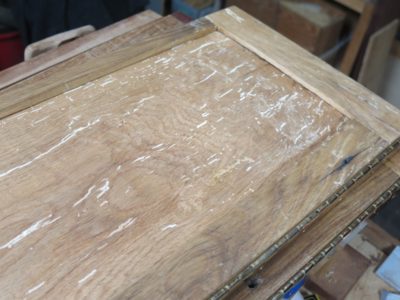
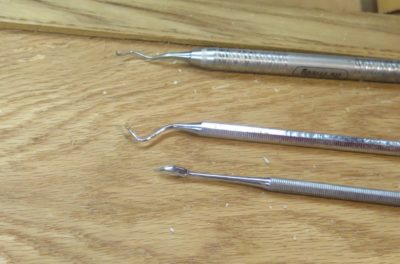
After much noodlin’ and experimenting I wound up in the place of resolving the problematic silica flatting agent deposits in the interstices of the antique wood of Mrs. Barn’s clothes cupboard doors. Unfortunately the destination was a place I did not necessarily want to go — picking out all the offending material with dental tools.
A few hours of work (I did not keep track as I popped in and out on the process) was all it took to get things back to a good place from which to proceed.
I really did not mind, for most of the past forty years I became accustomed to delicate, tiny-scale work, frequently under a stereomicroscope. I guess if you find such work intolerably tedious, art conservation is not a good career path for you. At least in this case I was not tethered to one of my microscopes, reading glasses and good directional lighting were all I needed.
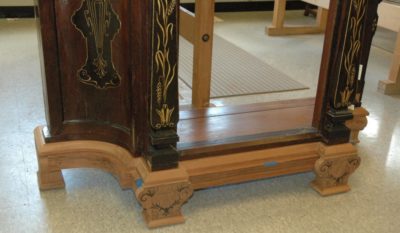
One project from the past came to mind as I was picking out all the bits of crumbly whitened varnish. It was a late 19th Century Alexander Roux cabinet that had been gifted to the Institution, needing a fair bit of work. The original base had rotted off due to the cabinet sitting on the mud floor of a basement, so it needed a new base along with all the bronze mounts. I sculpted the wax patterns for the new mounts and cast the bronze myself.
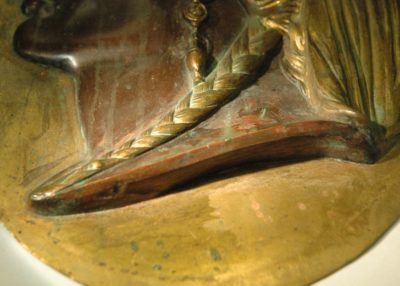
But, the most nettlesome aspect of the project was the intractable accretion of untold layers of linseed oil-containing furniture polish on top of all the surfaces including the patinated copper and bronze on a large cameo medallion that was the visual centerpiece of the cabinet (the main purpose of the cabinet was to hold either one piece of sculpture or a flower arrangement on the center of the top). Over the years the linseed oil had hardened into something akin to Scotty’s transparent aluminum due to imbibing metal from the substrate leaving an encasing residue essentially un-removable by ordinary means. The only effective technique was to formulate and slather an ultra-high pH Laponite gel, which coincidently removed the patination on the underlying substrate. That was not a desired outcome.
Eventually I wound up fabricating some ivory scrapers to chip off the deposit, working entirely underneath a microscope to protect the undulating surfaces of gilded bronze and patinated copper. The ivory scrapers looked like dental tools and were used because they would chip off the rock-hard contaminate yet not scratch the substrate. In the end I was exceedingly pleased with the outcome.
But back to Mrs. Barn’s cabinet doors. After removing all the deposits with the dental tools and scouring the surface with a wire brush, it was time to try applying a new coat of gloss oil resin varnish.
Whew. I can now proceed to completion, building up the finish to a matte presentation.
My parquetry design for the tool cabinet is a residual memory from the Roentgen Exhibit at the Metropolitan Museum in February 2013. Which itself makes for a somewhat amusing story.
I detest cities.
The bigger the city, the greater the animus.
It sorta explains why I live happily in a county of fewer than 2500 people, almost 200 miles from Ground Zero. That means I view NYC pretty much as a barbarian coven. During my career at the Institution I had to travel there several times to work at the national design museum, The Cooper Hewitt Museum, and near the end of my tenure to install the Chinese Pavilion exhibit in Queens. Mrs. Barn had to hear my griping about these trips and that fetid megalopolis for weeks before and after the fact (I never did get used to the stench of the place). I recall once riding the train with my pal MikeM to Manhattan for an editorial meeting at Simon&Schuster, and as we walked out on to the sidewalk from Grand Central station I instantly turned to him and said, “Okay, I’ve had enough. I’m ready to go home.” I may be twice his size but he is Sicilian, so he won the argument. That particular book in question never came to pass mostly because by the time push came to shove, I had lost interest.
A couple months after I retired, I announced to Mrs. Barn that we would be making a day trip to NYC to attend the mondo Roentgen furniture exhibit at the Met. Her dumfounded expression confirmed her suspicion that aliens had abducted her husband and replaced him with a metrosexual or some other life form. I was adamant that we would not stay overnight so we caught the 5AM train and arrived at Penn Station about 8.30. Rather than subject myself to the subway system or a cab ride I made her walk all the way to the Met. That’s 3-1/2 miles.
My friend M, a conservator at the Met, gave us a guided tour of the exhibit complete with a running commentary of some of the technical features of the pieces she had examined and conserved. It was a grand day, complete with lunch at the fancy schmancy Met restaurant and an afternoon session examining the contents of the Duncan Phyfe tool chest before a delicious meal at a restaurant en route back to Penn Station and heading home, arriving sometime around 2AM. The day was totally worth it, even for an urbaphobe like me.
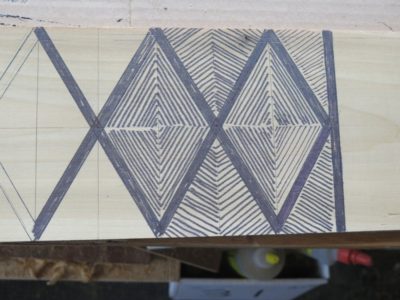
Anyhow, even though the Roentgens were best known for their innovative veristic marquetry creations, I found greater resonance with their parquetry. Some of those parquetry expressions never left my consciousness and when it came time to start noodling this tool cabinet the visual memories came flooding back. Almost immediately I gravitated to an alternating diamond-and-stringing concept for the presentation surface. As I mentioned before I was using 18thC white oak for my veneers rather than the exotics favored by Roentgen patrons.
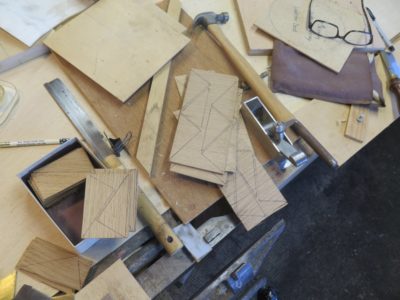
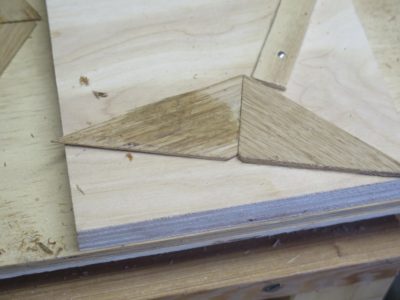
Equipped with my vision for segmented 60-120-60-120 parallelogram diamonds I started rough cutting the sawn veneers from which I could begin to assemble the diamonds which would then be sawn and trimmed en toto.
I recognized early on I had to devise a precise method to both saw the 30-60-90 triangle segments, and then to layout, saw and trim the completed diamonds perhaps even more precisely.
Several months ago while dining with Elderdottir at her house I was telling a friend of hers about my experience as a college radio station program host, when I hosted a weekly Tuesday evening jazz program and was in the rotation for every other weekend of late-night jazz on Saturday. One byproduct of this era was my acquisition of thousands of vinyl records, now in storage in the space above the master bathroom. Elderdottir’s friend was very excited about it (I believe she is a vinyl record buff herself) so we tried playing a record on the living room turntable. The turntable had not been used in almost thirty years and did not work well. On examination I could see the cartridge had been damaged, or at least the stylus had been damaged and was unusable.
In the intervening months I found a new stylus cartridge online an ordered it. FYI $25 cartridges are now $150. One of the items on my Thanksgiving Week agenda was to install the new cartridge and see if the turntable was still operable. It was, except for the “Cuing” function, which I hope is just womperjawed and creaky from sitting unused for three decades.
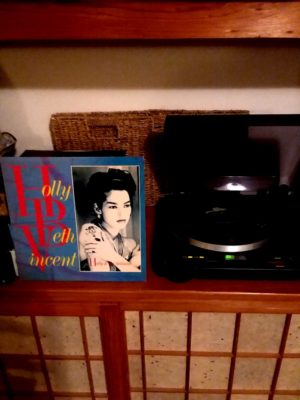
Elderdottir retrieved one of the two dozen large boxes of records from the storage compartment and when I looked through them I knew instantly which one had to be the first choice for the re-commissioning ceremony – the proto-punk Holly Beth Vincent album Holly and the Italians. Soon the living room was rocking.
Last I heard Elderdottir was planning on having friends over to listen to her dad’s old records while they drank tea. A wild bunch they are.
BTW I hope your Thanksgiving was as celebratory as ours, as we were reminded of the blessings and trials God has placed in our lives to draw us closer to Him, and this year was especially noteworthy as L’il T is now part of our lives (and he is progressing nicely!). Mrs. Barn has been cooking up a storm and in her glory, ministering to and surrounded by the family she loves (plus she and the Barndottirs play board games every evening, something that holds zero interest for me).
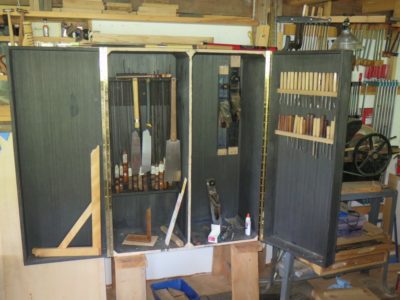
As I slowly move forward with my ultimate tool cabinet the reminders and memories of the Studley Tool Cabinet are ever operating in the background as I strive to integrate the maximum inventory of tools into the space. Fortunately (?) my tool cabinet will be five times more voluminous than Studley’s, which presents a multitude of opportunities and headaches. Sure, I can include five times as many tools, but like Studley the multi-layered layout must be accomplished by hand and trial-and-error. I expect that hugely time-consuming process will continue to infinity and beyond, or until I run out of tools to put inside.
Less problematic, at least in principle, is the decorative treatment of the presentation surfaces. There I have a starting premise and need only to fine tune the execution. My goal is to assemble a complex diamond-and-stringing parquetry surface evocative of the creative genius of Abraham and David Roentgen who, like many of the monumental French ebenistes, were Germanic. My parquetry surfaces will be based on some of their work, but without the over-the-top exuberance. As for decorating the interior surfaces, I have plenty of black dye, mother-of-pearl, and “bone,” both genuine and artificial.
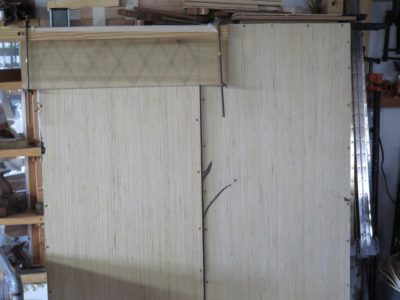
Since beginning the project my efforts have vacillated between fitting the tools inside and mapping out the parquetry process. For the latter I needed to create a very rough proof-of-concept panel that could provide useful information about tinkering with the size and proportions, and the process of executing whatever/wherever I wound up.
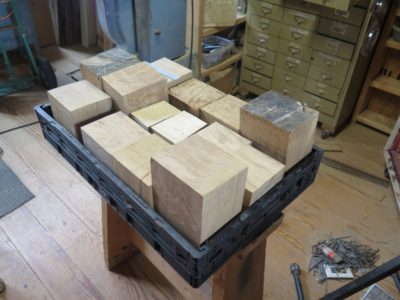
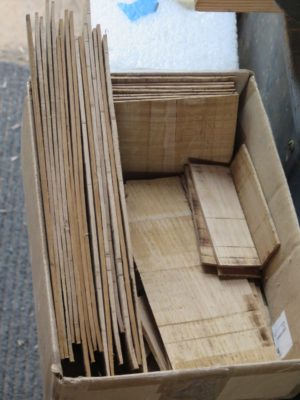
One of my foundational starting points was to use wood from Roentgen’s era for the veneers. Fortunately I had a large inventory of leftover white oak scraps from the FORP gatherings in Georgia, which employed timbers that were literally growing at the time the Roentgens were active. While none of the wood pieces were sizable, they were certainly process-able.
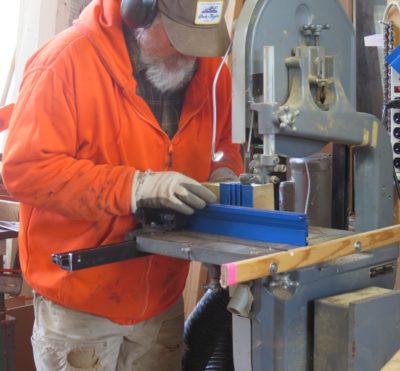
With a newly tuned bandsaw and brand-new, variable spaced teeth bandsaw blade I set to work making enough sawn veneer to execute the sample panel.
Stay tuned, this project will consume dozens of blog posts over the coming months.
My longtime broadcaster friend Brian Wilson invited me back on his show Something Completely Different Tuesday to discuss the elections, or perhaps more precisely, the electorate. Find it and listen at your own risk. If pungent opinionating and analysis is too much for you, avoid it.
Our little community is down to one chimney sweep, a not inconsiderable logistical problem when there are probably around a thousand fireplaces and woodstoves in use here. Getting on Rick the Chimney Sweep’s calendar early is an important consideration, and this year we did not get on the calendar as early as we should. But just in time for chilly weather he worked us in to clean out our beautiful stone chimney. Fortunately, our exhaust flue is not prone to build-up and combining that with the choice of fuel — always well-seasoned hardwood — gives us a lot of latitude, chimney cleaning-wise.
The easy part for Rick is to climb a ladder to the top of the chimney and sweep it from the top down a la Bert the chimney sweep from Mary Poppins. I’m not afraid of heights but Mrs. Barn insists that my amygdala is not as sensitive as it should be so I take more risks than I should. Thus, she is delighted we can hire someone to work at the height required.
Rick is, among other things, an enthusiastic spelunker so crawling around in the fireplace behind the insert suits him just fine. He gave our fire exhaust system a clean bill of health and said that we may not even need an annual cleanout.
His ministrations were just in time as the temps will drop precipitously over the next few days with snow coming next Tuesday and Friday. I expect we will fire it up in the next 36 hours or so if for no other reason than Li’l T and his parents are visiting for several days and we want to keep him warm.
As for the barn, it is easy enough for me to disassemble and clean the stovepipe, which I did last spring.
All set.
PS I’m about halfway through the task of splitting and stacking firewood for next winter, and by the time I finish with the entire mountain of wood in the parking area next to the barn I’ll be ready through winter 2024/2025.
One of my regular podcast listens is The Darkhorse Podcast hosted by husband-and-wife Biology professors Drs. Heather Heying and Brett Weinstein. Though our general worldviews are definitely not overlapping too much I enjoy their conversations immensely as they are informative, gracious, and usually good-humored. Their quiet earnestness and quest for truth (with little tolerance for b.s.) keep me listening.
Recently they discussed the inter-relationship between science (I loved how it was described as a tool rather than a sacred totem) and the structured problem solving inherent in artistic creation. Part of the reason for my interest is fairly obvious, my career was spent occupying the space resulting from the intersection of materials science and artistic and cultural artifacts in the world’s largest museum complex. At one point of my career trajectory, I was a principal in a project to create a high school interdisciplinary curriculum merging the hard sciences with the world of artifacts and art. As I said in the funding proposal for the beta-test, “When the scientific analyst describes a material as having such and such properties and the artist says he wants art materials to accomplish this or that expression, they are talking about the exact same thing but from a different perspective.” My organization’s priorities changed with new management and the project was never brought to fruition.
I think you just might find Bret and Heather’s comments to be interesting. This specific topic begins around the 23-minute mark.








Recent Comments