
Dystopian Trilogy (not woodworking)
Probably like many of you, as I watch the paroxysm of manufactured “rage” throughout urban America I am almost continually running an OODA Loop especially when I leave Shangri-la and go out into the larger world. (OODA is the military acronym for Observe, Orient, Decide, and Act, a decision-making model for use in uncertain situations.) In the environment that is the USA 2026, OODA is in my mental background like a virus scan. Since many/most/all(?) of the “spontaneous” riots are conducted by trained out-of-state professionals provided by entities like Crowds on Demand, Inc. (a real LA-based rent-a-mob temp agency!), the need for OODA is an imperative. I for one am curious about the money trail for the rent-a-mobs.
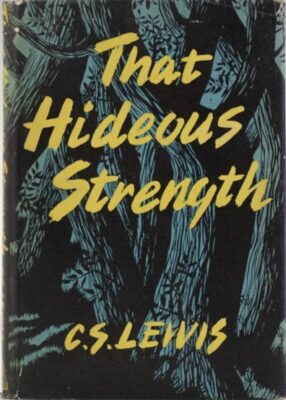
But ruminations on OODA are just the gateway for this post. Almost all of us of a certain age have had our awareness formed, at least in part, by two classic dystopian novels we read in high school — 1984 (1949, George Orwell) and Brave New World (1932, Aldous Huxley). However, my favorite novel of this (or any other) genre and roughly contemporary to them, and one that I am unreservedly recommending to you, is the far less known 1945 C.S. Lewis That Hideous Strength. When reading THS I find many of the parallels to 2026 to be inescapable. It is almost a fictional recitation of the seduction Hannah Arendt described as “the banality of evil” but set in the campus and village of a small British university. It brings to mind the old quip, “The smaller the boat the meaner the rats.”
The understanding from this trilogy of dystopian fiction is IMHO foundational to being a modern grown-up. Not the full foundation, but still foundational. Read or reread them for a refresher course in the human condition and of the evil that men can do. And if you are unfamiliar with That Hideous Strength, pick it up and be edified. Every time I reread it I find myself saying, “Holy cow, that’s just like now!” Yes, it is a semi-fantasy, but the parallels are too powerful to ignore. It is not a fast read, not because it is turgid or difficult, but because you might just find yourself pausing by necessity to consider the implications of the tale for our modern, debauched world.
For extra credit when exploring the dysfunctional human condition take a stroll through The Minor Prophets of The Old Testament, Hosea through Malachi. Since the books do indeed chronicle accurately the nature of the human condition, like me you are likely to pause and reflect that the truths therein are as current as tomorrow’s headlines.

Where have all the Libertarians gone? We are ALL seeing masked, anonymous, federal government agents murdering American Citizens in cold blood while they (the American Citizens) exercise their 1st and 2nd Amendment rights. This is not the government demanded by our Declaration of Independence. Gold medal for mental gymnastics though Don… The Russian team may have a spot for you… or China?
Come on…this is such a joke how evil this (N) I.C.E. shit is and it is such an insult to trained law enforcement/police and trained military personnel who undertake rigorous training and respect the laws of our country. Why isn’t there a beacon signal going up from Don’s (And “Mrs. “”Barn”‘s) Barn??
Thank you for that wonderfully absurdist satirical comment.
Don, apparently George Orwell did a book review of That Hideous Strength. Here’s a link to what I found: https://apilgriminnarnia.com/2020/09/10/george-orwells-review-of-c-s-lewis-that-hideous-strength-throwback-thursday/
Don,
I’m curious: what crowds in particular do you suspect to have been paid for in 2026, and by whom?
If the big concern is crisis actors and paid protestors and not the use of undertrained federal actors to intimidate, terrorize, torture, and murder citizens and immigrants, you might not be putting first things first. C.S. Lewis also wrote about getting first and second things in the right order.
My comment was intended to be a new comment and not a response to an existing one. Apologies for any confusion.