I am definitely on the road to.recovery from my bout with the
Fauci/Wuhan bioweapon. With that in mind I expect fulfillment of outstanding orders for polissoirs, waxes, and any other products by this coming Tuesday.
Your prayers and concerns expressed mean more than.you.will ever.know.
I’ve got a few orders pending in The Store, but please be advised I remain in a covid pneumonia ward in LA for a still undetermined time. I will attend to all matters whenever I return. Came for a family funeral, stayed for the bioweapon plague.
In other related news I will be suspending mfr and sales of Mel’s Wax for at least a year or I can figure out the problems with turning black for no apparent reason.
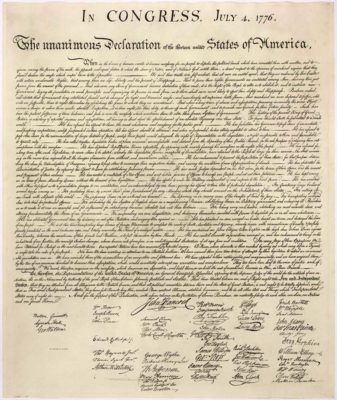
Some version of this post is presented annually at this time. Despite dozens of recitations, I can never read the last line out loud because I am overcome with emotion.- DCW
As our nation is seemingly rife with incurious, gullible and servile inhabitants, we would be well-served to reflect seriously on the document encapsulating the mission statement for the greatest nation ever known to man, the only nation ever founded on a creed rather than geography or lineage. I am unabashedly proud to be a partisan in the cause of Life, Liberty, and Property (the original wording) and find The Declaration to be the most noble civil document ever created by mankind. I pray you will read and reflect on the ideas expressed by men who pledged their lives, their fortunes, and their sacred honor to pursue the path of liberty. Reading it is much like reading the Minor Prophets of the Old Testament; more up-to-date regarding the human condition than tomorrow’s headlines.
========================================================
IN CONGRESS, July 4, 1776.
The unanimous Declaration of the thirteen united States of America,
When in the Course of human events, it becomes necessary for one people to dissolve the political bands which have connected them with another, and to assume among the powers of the earth, the separate and equal station to which the Laws of Nature and of Nature’s God entitle them, a decent respect to the opinions of mankind requires that they should declare the causes which impel them to the separation.
We hold these truths to be self-evident, that all men are created equal, that they are endowed by their Creator with certain unalienable Rights, that among these are Life, Liberty and the pursuit of Happiness.–That to secure these rights, Governments are instituted among Men, deriving their just powers from the consent of the governed, –That whenever any Form of Government becomes destructive of these ends, it is the Right of the People to alter or to abolish it, and to institute new Government, laying its foundation on such principles and organizing its powers in such form, as to them shall seem most likely to effect their Safety and Happiness. Prudence, indeed, will dictate that Governments long established should not be changed for light and transient causes; and accordingly all experience hath shewn, that mankind are more disposed to suffer, while evils are sufferable, than to right themselves by abolishing the forms to which they are accustomed. But when a long train of abuses and usurpations, pursuing invariably the same Object evinces a design to reduce them under absolute Despotism, it is their right, it is their duty, to throw off such Government, and to provide new Guards for their future security.–Such has been the patient sufferance of these Colonies; and such is now the necessity which constrains them to alter their former Systems of Government. The history of the present King of Great Britain is a history of repeated injuries and usurpations, all having in direct object the establishment of an absolute Tyranny over these States. To prove this, let Facts be submitted to a candid world.
He has refused his Assent to Laws, the most wholesome and necessary for the public good.
He has forbidden his Governors to pass Laws of immediate and pressing importance, unless suspended in their operation till his Assent should be obtained; and when so suspended, he has utterly neglected to attend to them.
He has refused to pass other Laws for the accommodation of large districts of people, unless those people would relinquish the right of Representation in the Legislature, a right inestimable to them and formidable to tyrants only.
He has called together legislative bodies at places unusual, uncomfortable, and distant from the depository of their public Records, for the sole purpose of fatiguing them into compliance with his measures.
He has dissolved Representative Houses repeatedly, for opposing with manly firmness his invasions on the rights of the people.
He has refused for a long time, after such dissolutions, to cause others to be elected; whereby the Legislative powers, incapable of Annihilation, have returned to the People at large for their exercise; the State remaining in the mean time exposed to all the dangers of invasion from without, and convulsions within.
He has endeavoured to prevent the population of these States; for that purpose obstructing the Laws for Naturalization of Foreigners; refusing to pass others to encourage their migrations hither, and raising the conditions of new Appropriations of Lands.
He has obstructed the Administration of Justice, by refusing his Assent to Laws for establishing Judiciary powers.
He has made Judges dependent on his Will alone, for the tenure of their offices, and the amount and payment of their salaries.
He has erected a multitude of New Offices, and sent hither swarms of Officers to harrass our people, and eat out their substance.
He has kept among us, in times of peace, Standing Armies without the Consent of our legislatures.
He has affected to render the Military independent of and superior to the Civil power.
He has combined with others to subject us to a jurisdiction foreign to our constitution, and unacknowledged by our laws; giving his Assent to their Acts of pretended Legislation:
For Quartering large bodies of armed troops among us:
For protecting them, by a mock Trial, from punishment for any Murders which they should commit on the Inhabitants of these States:
For cutting off our Trade with all parts of the world:
For imposing Taxes on us without our Consent:
For depriving us in many cases, of the benefits of Trial by Jury:
For transporting us beyond Seas to be tried for pretended offences
For abolishing the free System of English Laws in a neighbouring Province, establishing therein an Arbitrary government, and enlarging its Boundaries so as to render it at once an example and fit instrument for introducing the same absolute rule into these Colonies:
For taking away our Charters, abolishing our most valuable Laws, and altering fundamentally the Forms of our Governments:
For suspending our own Legislatures, and declaring themselves invested with power to legislate for us in all cases whatsoever.
He has abdicated Government here, by declaring us out of his Protection and waging War against us.
He has plundered our seas, ravaged our Coasts, burnt our towns, and destroyed the lives of our people.
He is at this time transporting large Armies of foreign Mercenaries to compleat the works of death, desolation and tyranny, already begun with circumstances of Cruelty & perfidy scarcely paralleled in the most barbarous ages, and totally unworthy the Head of a civilized nation.
He has constrained our fellow Citizens taken Captive on the high Seas to bear Arms against their Country, to become the executioners of their friends and Brethren, or to fall themselves by their Hands.
He has excited domestic insurrections amongst us, and has endeavoured to bring on the inhabitants of our frontiers, the merciless Indian Savages, whose known rule of warfare, is an undistinguished destruction of all ages, sexes and conditions.
In every stage of these Oppressions We have Petitioned for Redress in the most humble terms: Our repeated Petitions have been answered only by repeated injury. A Prince whose character is thus marked by every act which may define a Tyrant, is unfit to be the ruler of a free people.
Nor have We been wanting in attentions to our Brittish brethren. We have warned them from time to time of attempts by their legislature to extend an unwarrantable jurisdiction over us. We have reminded them of the circumstances of our emigration and settlement here. We have appealed to their native justice and magnanimity, and we have conjured them by the ties of our common kindred to disavow these usurpations, which, would inevitably interrupt our connections and correspondence. They too have been deaf to the voice of justice and of consanguinity. We must, therefore, acquiesce in the necessity, which denounces our Separation, and hold them, as we hold the rest of mankind, Enemies in War, in Peace Friends.
We, therefore, the Representatives of the united States of America, in General Congress, Assembled, appealing to the Supreme Judge of the world for the rectitude of our intentions, do, in the Name, and by Authority of the good People of these Colonies, solemnly publish and declare, That these United Colonies are, and of Right ought to be Free and Independent States; that they are Absolved from all Allegiance to the British Crown, and that all political connection between them and the State of Great Britain, is and ought to be totally dissolved; and that as Free and Independent States, they have full Power to levy War, conclude Peace, contract Alliances, establish Commerce, and to do all other Acts and Things which Independent States may of right do. And for the support of this Declaration, with a firm reliance on the protection of divine Providence, we mutually pledge to each other our Lives, our Fortunes and our sacred Honor.
Button Gwinnett
Lyman Hall
George Walton
William Hooper
Joseph Hewes
John Penn
Edward Rutledge
Thomas Heyward, Jr.
Thomas Lynch, Jr.
Arthur Middleton
John Hancock
Samuel Chase
William Paca
Thomas Stone
Charles Carroll of Carrollton
George Wythe
Richard Henry Lee
Thomas Jefferson
Benjamin Harrison
Thomas Nelson, Jr.
Francis Lightfoot Lee
Carter Braxton
Robert Morris
Benjamin Rush
Benjamin Franklin
John Morton
George Clymer
James Smith
George Taylor
James Wilson
George Ross
Caesar Rodney
George Read
Thomas McKean
William Floyd
Philip Livingston
Francis Lewis
Lewis Morris
Richard Stockton
John Witherspoon
Francis Hopkinson
John Hart
Abraham Clark
Josiah Bartlett
William Whipple
Samuel Adams
John Adams
Robert Treat Paine
Elbridge Gerry
Stephen Hopkins
William Ellery
Roger Sherman
Samuel Huntington
William Williams
Oliver Wolcott
Matthew Thornton
My compewder is working after a manner. But I am definitely in the market for a new one.
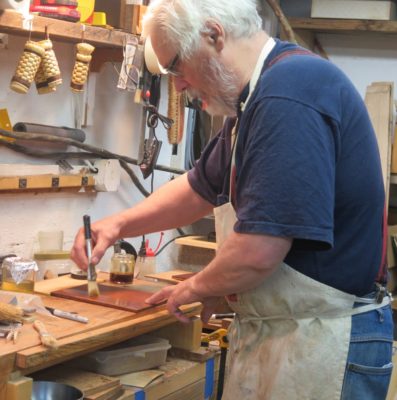
I’ve spent much of the past few weeks readying for tomorrow’s presentation at the SAPFM Mid-Year Annual Meeting in Fredericksburg VA. I’m now packing up everything and will hit the road shortly.
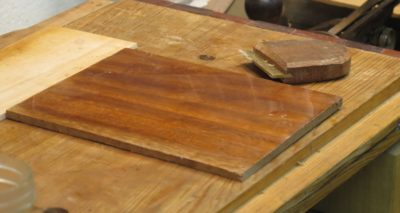
It’s all been about making sample boards based on the likely finishing resources available to colonial craftsmen, which by definition means it has been non-stop fun. The variety of finishes possible with a small menu of materials is astounding. Colophony, beeswax (shellac (of course), turpentine, whisky, naphtha, linseed oil, walnut oil, are all it takes for a party to break out.
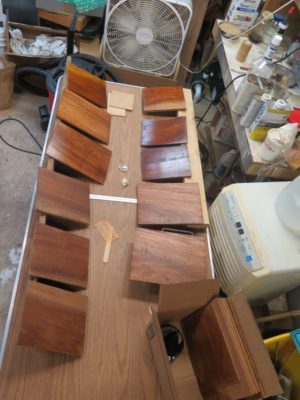
How could anyone not love finishing?
One added benefit of the exercise is that I am getting re-enthused to knock out the book. It has been hanging over my head for far too long!
Apparently my laptop (or its charger) just died. Since this is where I keep all my documents and pictures I may not be posting for a bit. Yes, everything is backed up on an external archive drive, but I do not have access to that at the moment. All I’ve got is my Kindle, which IIRC is incompatible with anything USB so I’m kinda stuck for now.
Check back later to see how things progress, if at all.
Stay tuned.
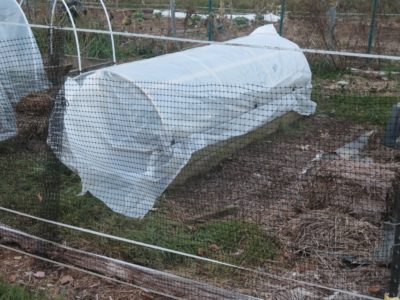
Another of the regular winter/spring/summer rituals here in Shangri-la is to re-think the carpentry needs for the gardens, and this year two new hoops over the raised beds percolated to the top of the pile. There had been hoops before but those were made in haste and only lasted ten years. The time had come for something a bit more robust. They get used year round, in the winter to serve as mini-greenhouses, in the summer to keep out the cabbage butterflies.


I decided to make the ribs with three lamina instead of two, so I ripped the requisite number of 1/4″ strips from pressure-treated 2x lumber. The actual forming/laminating process began with constructing a form that can serve to fabricate laminated hoop ribs from now until I become part of the landscape myself. I used scrap materials for the form and used clamps for making the first curved ribs. I used up all the clamps I had that would fit and kept them engaged for 24-hours (I used T3 adhesive).

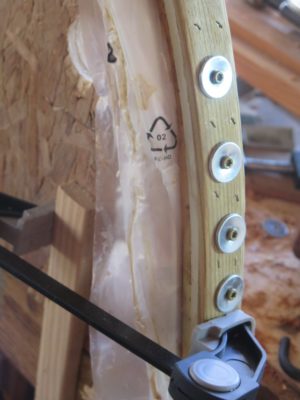
I got smarter. On subsequent ribs I used deck screws and fender washers to clamp the laminations to the form. With the addition of crown staples I was able to assemble two ribs per day.
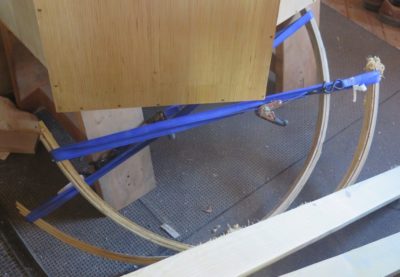
After removing the laminated ribs from the form I restrained them with ratchet straps to keep the correct shape and size, and set them aside. Once I had enough I could assemble the skeleton and cover it with the screening.
Stay tuned.
May you spend this day in reverence for our Heavenly Father and in celebration or remembrance of your earthly father. We commemorated the occasion last night as Li’l T’s dad will be on duty today. I got this t-shirt from his mom and a Peer Gynt Suite CD from the other barndottir. Glory abounded.
 .
.
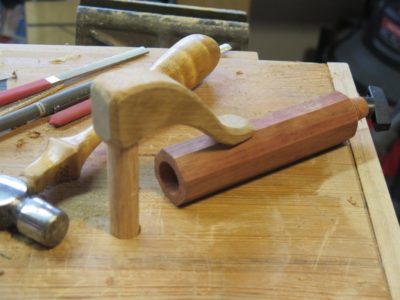
I’ve been hanging with my pal MikeM for a couple decades, and at least one of his consuming passions is rubbing off on me — hammers. Many times a Christmas package would arrive from Mike, and on more than one occasion it was a hammer or mallet he had restored or made. One of them, a polished vintage ball peen hammer head with a sublime curly maple handle, is in my personal tool pantheon and gets used every day I am in the barn (pic above). Every day.
Well, as they say, “Bad company trumps good character,” and Mike’s “bad” influence on me over the years in the realm of hammers has taken hold. (Just kidding folks, Mike’s friendship is a life treasure.) I now find making hammers one of the many delightful undertakings in the studio. I’m probably not approaching Mike Territory, but in response to a comment by a recent visitor in the studio, “No, I do not have a ‘hammer problem.’ I have a lot of hammers. Big difference.”

Many years ago I picked up several steel pieces at a flea market. These cylinders, which I naturally thought would make great mallets, were of unknown origin and a peculiar morphology. The flat ends were easily drilled and tapped. My original thought was this would be great for affixing faces to the striking surfaces.
The problem emerged when I tried to drill a hole on the cylinder surface for a handle. It was hard. I mean really, really hard. Too hard for any drilling device I had, up to and including carbide and cobalt drill bits. The rounded surface was so hard I could not even make a dimple with a machine punch and in fact the tip of the punch broke off when I tried. I have never encountered something this hard, and scratch my head about the manner of hardening this surface. It was probably case hardened on a precision rolling mill, but what was its purpose? I have no idea, but for several years its purpose was mainly to hold down the sill of one of the studio windows. Occasionally it would be used as a dolly or backing anvil, but nothing more.
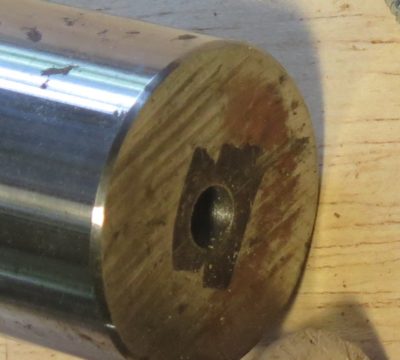
Recently, while in the tool-making “zone,” I decided to give up on the idea of creating a typical mallet configuration from the cylinder and exploit its differing hardness to create a joinery/carving mallet. This began with drilling a hole in the flat face.

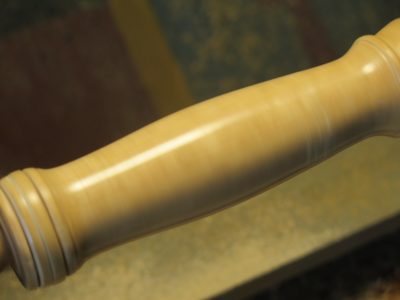
To match this I turned a white oak handle from some of my scraps, and drilled that as well. The finish on the handle was Blend 31 wax melted into the surface while turning on the lathe, then burnished with a piece of coarse linen. I like both the look and the feel of the handle, beautifully smooth but with just a hint of tack for gripping.
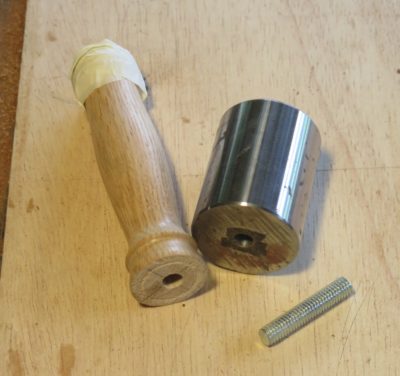
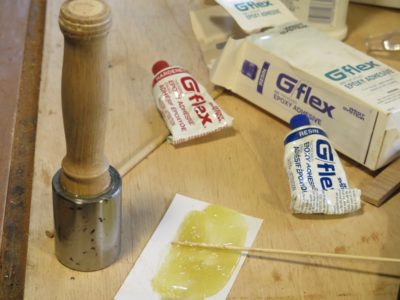
Inserting a threaded rod dowel with epoxy to assemble the two pieces completed the assembly process. I didn’t clamp the assembly and let the hydraulic vacuum of the thick epoxy hold everything steady while it hardened.
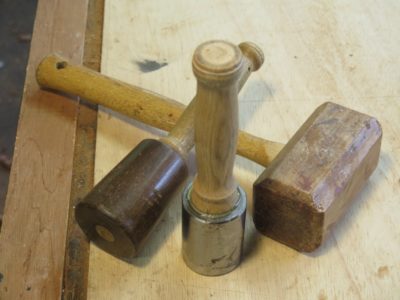
It is now an intriguing addition to my inventory of homemade mallets. I note that of these mallets there is a huge range of shape and weight. The tapered cylinder mallet on the left, made thirty-five years ago, weighs in with a lignum vitae head of a half pound, plus the handle. The tulipwood mallet on the right, made 25+ years ago, weighs in with a head of 3/4 pound. This new one with the steel cylinder has a head weight of two pounds. It just might be a beast. Because of its comparative diminutive size I was thinking of keeping it in my traveling tool kit. With that weight I am reconsidering that decision as it is almost two full pounds more than the lignum vitae one
I will probably wrap the new steel cylinder with leather to diminish any strike damage inflicted onto anything I whack with it.
Stay tuned.
When it comes to sawing lumber there are three distinct processes. Crosscutting is the most common to most woodworkers, wherein a longer board is made into a shorter board. Ripping is when a wider board is cut into two or more narrower boards (one of which may be purely waste material) and is the function for which the table saw was primarily created. Resawing, by which a thicker board is cut into two thinner boards, is generally the least employed of the three sawing methods. And if it is done, it is mostly reserved for table saw or bandsaw work.
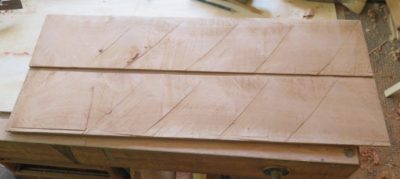
Because of my own peculiar interests and projects, I find resawing to be a regular function in my studio as I routinely saw my own veneers, both by hand and by bandsaw. Recently in my preparations for my presentation at the upcoming SAPFM Annual Mid-Year, as I was working on some luan plywood panels to create the set of sample boards reflecting my presentation content, namely the options available to rural colonial craftsmen, I was dissatisfied with the aesthetics of the outcomes. I decided to make some honest-to-goodness furniture lumber sample boards. The most readily available material I had was true mahogany of 8-9 inches in width and 1 to 1-1/4″ thick. In other words just a smidge wider than I could resaw with my upstairs bandsaw. My downstairs bandsaw with the riser block and beefier motor was out of commission for some maintenance. So, I decided to resaw the mahogany boards by hand. [N.B. I would have preferred to use walnut as that would reflect 18th C rural life in the mid-Atlantic region better than imported mahogany, but the lumber for that was at the bottom of a very big pile of lumber. Nuts to that.]
I used my 3/8″ kerfing saw on all four sides of the boards and got to work (the saw cuts a 1/16″ kerf 3/8″ from the edge of the board, not a 3/8″ kerf).
Back in the day when the Woodworking in America shindigs were a thing one of my favorite presenters was Ron Herman of Antiquity Builders of Columbus, Ohio, who would show up with a half-dozen boxes of carpenter’s saws of almost every iteration known to man, and talk about all things saws and sawing. I learned tremendous amount from Ron as he waxed eloquently of things he had been taught and subsequently learned from his many years of restoring and preserving historic buildings. One thing he said which remains embedded in my brain was, “Make sure the saw fits the job.” He would then walk the audience through the process of selecting from among the scores of saws he had for a specific task at hand.
Ron’s words were ringing through my ears as I undertook the slicing of my mahogany boards. The mahogany was dense, and some boards were denser than others. This required fine-tuning my tool selection to make sure the saw I was using was the best fit for the board itself, and given that the three boards I resawed were different densities, I wound up using three different saws (and tried several others) to get the job done. Such a conundrum is not present when I am resawing, for example, cypress when the grain is so uniform and the density so creamy I can go at it with my most aggressive saw. Or, when I am resawing hard cherry or maple. But when, as in this case, the boards are not uniform in density or even when different sections of the same board differ in character I was switching back and forth between saws.

At this point in my studio trajectory my default starting point for resawing is the Bad Axe one man Roubo saw, which works wonderfully well and did so in this case. For the densest of the mahogany boards this saw and its 4 t.p.i. configuration was the tool of choice for much of the work.

This time, inspired by this Salko Safic video I decided to try one of my c.1800 frame saws. With its 2 t.p.i. configuration it cut like a beast on fire but I had a bit of wander on the outfeed side. Perhaps with a bit more practice… Or, I could give Mark Harrell a call to ask for some advice on getting the saw to cut dead true. I had not tried using a four-foot saw by myself much before this, so perhaps all I need is more time in the saddle. It could also be that Salko is simply a better man than I.
I have two brand new saw plates for four-foot frame saws so maybe a new tool project is coming over the horizon.

The most Ron Herman-ish episode of the excursion was tuning my saw selection to the individual piece of wood. For the denser board my usual re-saw tool, the vintage 3-1/2 t.p.i. Disston “skated” over the wood a bit much, even after I gave it a quick tune-up with a file (about five minutes’ worth of work; it took longer to set up my saw sharpening rig than to actually do the touch up). Switching to the equally vintage 4-1/2 t.p.i. Disston, set up with the exact same specs did the trick. Both saws were what I call “skin prick sharp” (the teeth are so sharp they grab my skin when I gently press my finger against them) so really the only difference was the tooth spacing. The 3-1/2 t.p.i. saw worked like a charm on the less dense board.
I might not need Ron’s eight dozen saws in my inventory, but maybe a few more than my dozen-and-a-half could be called for. I’m always scouting for good vintage saws cheap at flea markets. All I want is an original depth plate and no kinks.

One final note: I make a point of keeping my saw plates well waxed, stopping to apply a thin swipe of paste wax whenever I feel things “grabbing.” It makes all the difference. Normally I use a paste wax made from my 31 Blend but that would have required walking to the other end of the studio to retrieve it. This tin was right there.
I find resawing to be an immensely rewarding exercise, and I do mean exercise. It takes a good while and a fair number of calories but the result is exhilarating when done well. To paraphrase Toshio Odate, “If I find a task pleasurable, why would I want it to be over quickly?”
He is a wise man.
After two years of mostly inactivity teaching-wise I’ve got several now on the calendar, all more or less in the vicinity. Over the next couple weeks I will be diligently preparing for my presentation at the SAPFM Mid-Year in Fredericksburg VA, on the topic “The colonial craftsman’s finishing kit,” with a special emphasis on locally available materials. If you are there you can come and see it, if not, not.

For this presentation I am creating a set of sample boards to reflect the information I am presenting.
No sooner do I return home from that than I will be assembling all the materials for the three-day Historic Woodfinishing Workshop near Charottesville VA. I’ve done this workshop several times and have settled on a well-defined syllabus to leave the students with greater confidence in the finishing process.
Over Labor Day weekend my friend Tim, for whom I built the ginormous workbench a couple years ago, will be hosting an 18th century craft shindig at his place just a few miles form here. He has asked me to demonstrate historic wood finishing and tordonshell work. Ought to be a boatload of fun.
It’s the best of all worlds in a way. I get to teach and interact with talented people in a range of skilled trades without having to even travel!


Recent Comments