Some version of this post is presented annually at this time. Despite dozens of recitations, I can never read the last line out loud because I am overcome with emotion.- DCW
As our nation is seemingly rife with incurious, gullible and servile inhabitants, we would be well-served to reflect seriously on the document encapsulating the mission statement for the greatest nation ever known to man, the only nation ever founded on a creed rather than geography or lineage. I am unabashedly proud to be a partisan in the cause of Life, Liberty, and Property (the original wording) and find The Declaration to be the most noble civil document ever created by mankind. I pray you will read and reflect on the ideas expressed by men who pledged their lives, their fortunes, and their sacred honor to pursue the path of liberty. Reading it is much like reading the Minor Prophets of the Old Testament; more up-to-date regarding the human condition than tomorrow’s headlines.
========================================================
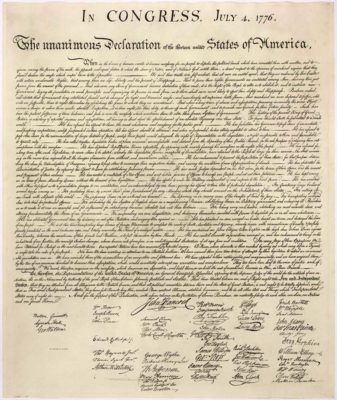
IN CONGRESS, July 4, 1776.
The unanimous Declaration of the thirteen united States of America,
When in the Course of human events, it becomes necessary for one people to dissolve the political bands which have connected them with another, and to assume among the powers of the earth, the separate and equal station to which the Laws of Nature and of Nature’s God entitle them, a decent respect to the opinions of mankind requires that they should declare the causes which impel them to the separation.
We hold these truths to be self-evident, that all men are created equal, that they are endowed by their Creator with certain unalienable Rights, that among these are Life, Liberty and the pursuit of Happiness.–That to secure these rights, Governments are instituted among Men, deriving their just powers from the consent of the governed, –That whenever any Form of Government becomes destructive of these ends, it is the Right of the People to alter or to abolish it, and to institute new Government, laying its foundation on such principles and organizing its powers in such form, as to them shall seem most likely to effect their Safety and Happiness. Prudence, indeed, will dictate that Governments long established should not be changed for light and transient causes; and accordingly all experience hath shewn, that mankind are more disposed to suffer, while evils are sufferable, than to right themselves by abolishing the forms to which they are accustomed. But when a long train of abuses and usurpations, pursuing invariably the same Object evinces a design to reduce them under absolute Despotism, it is their right, it is their duty, to throw off such Government, and to provide new Guards for their future security.–Such has been the patient sufferance of these Colonies; and such is now the necessity which constrains them to alter their former Systems of Government. The history of the present King of Great Britain is a history of repeated injuries and usurpations, all having in direct object the establishment of an absolute Tyranny over these States. To prove this, let Facts be submitted to a candid world.
He has refused his Assent to Laws, the most wholesome and necessary for the public good.
He has forbidden his Governors to pass Laws of immediate and pressing importance, unless suspended in their operation till his Assent should be obtained; and when so suspended, he has utterly neglected to attend to them.
He has refused to pass other Laws for the accommodation of large districts of people, unless those people would relinquish the right of Representation in the Legislature, a right inestimable to them and formidable to tyrants only.
He has called together legislative bodies at places unusual, uncomfortable, and distant from the depository of their public Records, for the sole purpose of fatiguing them into compliance with his measures.
He has dissolved Representative Houses repeatedly, for opposing with manly firmness his invasions on the rights of the people.
He has refused for a long time, after such dissolutions, to cause others to be elected; whereby the Legislative powers, incapable of Annihilation, have returned to the People at large for their exercise; the State remaining in the mean time exposed to all the dangers of invasion from without, and convulsions within.
He has endeavoured to prevent the population of these States; for that purpose obstructing the Laws for Naturalization of Foreigners; refusing to pass others to encourage their migrations hither, and raising the conditions of new Appropriations of Lands.
He has obstructed the Administration of Justice, by refusing his Assent to Laws for establishing Judiciary powers.
He has made Judges dependent on his Will alone, for the tenure of their offices, and the amount and payment of their salaries.
He has erected a multitude of New Offices, and sent hither swarms of Officers to harrass our people, and eat out their substance.
He has kept among us, in times of peace, Standing Armies without the Consent of our legislatures.
He has affected to render the Military independent of and superior to the Civil power.
He has combined with others to subject us to a jurisdiction foreign to our constitution, and unacknowledged by our laws; giving his Assent to their Acts of pretended Legislation:
For Quartering large bodies of armed troops among us:
For protecting them, by a mock Trial, from punishment for any Murders which they should commit on the Inhabitants of these States:
For cutting off our Trade with all parts of the world:
For imposing Taxes on us without our Consent:
For depriving us in many cases, of the benefits of Trial by Jury:
For transporting us beyond Seas to be tried for pretended offences
For abolishing the free System of English Laws in a neighbouring Province, establishing therein an Arbitrary government, and enlarging its Boundaries so as to render it at once an example and fit instrument for introducing the same absolute rule into these Colonies:
For taking away our Charters, abolishing our most valuable Laws, and altering fundamentally the Forms of our Governments:
For suspending our own Legislatures, and declaring themselves invested with power to legislate for us in all cases whatsoever.
He has abdicated Government here, by declaring us out of his Protection and waging War against us.
He has plundered our seas, ravaged our Coasts, burnt our towns, and destroyed the lives of our people.
He is at this time transporting large Armies of foreign Mercenaries to compleat the works of death, desolation and tyranny, already begun with circumstances of Cruelty & perfidy scarcely paralleled in the most barbarous ages, and totally unworthy the Head of a civilized nation.
He has constrained our fellow Citizens taken Captive on the high Seas to bear Arms against their Country, to become the executioners of their friends and Brethren, or to fall themselves by their Hands.
He has excited domestic insurrections amongst us, and has endeavoured to bring on the inhabitants of our frontiers, the merciless Indian Savages, whose known rule of warfare, is an undistinguished destruction of all ages, sexes and conditions.
In every stage of these Oppressions We have Petitioned for Redress in the most humble terms: Our repeated Petitions have been answered only by repeated injury. A Prince whose character is thus marked by every act which may define a Tyrant, is unfit to be the ruler of a free people.
Nor have We been wanting in attentions to our Brittish brethren. We have warned them from time to time of attempts by their legislature to extend an unwarrantable jurisdiction over us. We have reminded them of the circumstances of our emigration and settlement here. We have appealed to their native justice and magnanimity, and we have conjured them by the ties of our common kindred to disavow these usurpations, which, would inevitably interrupt our connections and correspondence. They too have been deaf to the voice of justice and of consanguinity. We must, therefore, acquiesce in the necessity, which denounces our Separation, and hold them, as we hold the rest of mankind, Enemies in War, in Peace Friends.
We, therefore, the Representatives of the united States of America, in General Congress, Assembled, appealing to the Supreme Judge of the world for the rectitude of our intentions, do, in the Name, and by Authority of the good People of these Colonies, solemnly publish and declare, That these United Colonies are, and of Right ought to be Free and Independent States; that they are Absolved from all Allegiance to the British Crown, and that all political connection between them and the State of Great Britain, is and ought to be totally dissolved; and that as Free and Independent States, they have full Power to levy War, conclude Peace, contract Alliances, establish Commerce, and to do all other Acts and Things which Independent States may of right do. And for the support of this Declaration, with a firm reliance on the protection of divine Providence, we mutually pledge to each other our Lives, our Fortunes and our sacred Honor.
Button Gwinnett
Lyman Hall
George Walton
William Hooper
Joseph Hewes
John Penn
Edward Rutledge
Thomas Heyward, Jr.
Thomas Lynch, Jr.
Arthur Middleton
John Hancock
Samuel Chase
William Paca
Thomas Stone
Charles Carroll of Carrollton
George Wythe
Richard Henry Lee
Thomas Jefferson
Benjamin Harrison
Thomas Nelson, Jr.
Francis Lightfoot Lee
Carter Braxton
Robert Morris
Benjamin Rush
Benjamin Franklin
John Morton
George Clymer
James Smith
George Taylor
James Wilson
George Ross
Caesar Rodney
George Read
Thomas McKean
William Floyd
Philip Livingston
Francis Lewis
Lewis Morris
Richard Stockton
John Witherspoon
Francis Hopkinson
John Hart
Abraham Clark
Josiah Bartlett
William Whipple
Samuel Adams
John Adams
Robert Treat Paine
Elbridge Gerry
Stephen Hopkins
William Ellery
Roger Sherman
Samuel Huntington
William Williams
Oliver Wolcott
Matthew Thornton
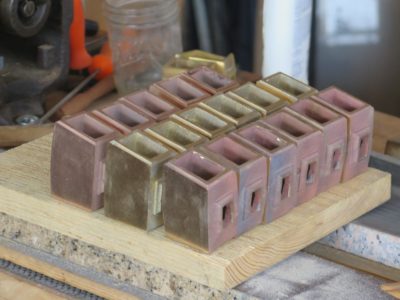
As I move forward with prototypes for producing my line of HO Studley mallets I am aided by a number of different assets. For starters I have in hand almost 20 of the castings from Bill Martley, in a variety of alloys, to work with in taking the rough metal castings to a point of “finished” that I would feel comfortable in providing to interested customers.
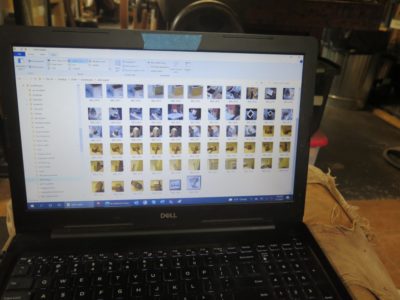
Second, I have a boatload of photographic images of the mallet from about every angle possible (it might seem adequate to have several dozen images, but they are never enough). Reviewing them does make me reflect on the unbelievable resource residing in my compewder; between my images and Narayan’s images I have almost 7,500 pictures on my hard drive .[As a snarky aside, I note that on occasion someone on the interwebz requests (or worse, demands!) that Narayan make all the high quality unpublished images available on-line for free, somehow not registering the facts that 1) the images are the creative property of Narayan and/or Chris, and 2) the images are the result of an investment of (literally) tens of thousands of dollars. If you have ever expressed this sentiment, grow up. — DCW]
Third, a topic I will address in a later post, I have several molds made directly from the original mallet.
Finally, and perhaps the strongest impetus foundational to this project, I have the enthusiastic approval of Mister Stewart to proceed with my effort to make replica mallets because, and I quote, “People should be using this mallet.” That endorsement is a great encouragement to me and I will produce a tool and make it available only once I am proud of it bearing my imprimatur. At some point very soon I will embark on designing the logos to be stamped or engraved into the mallet itself.
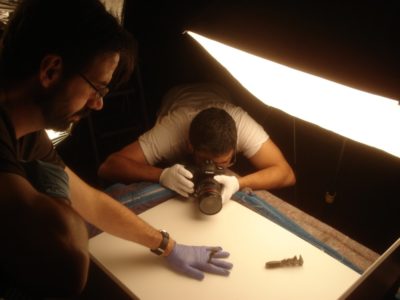
During the many episodes of us examining and photographing the tool cabinet and all its contents, one of the first projects Narayan and Chris conducted was to take “study shots” of every tool so that I could use these pictures as pneumonics for my own work in constructing the book. A second exercise was to formally photograph every tool with a scale included in the frame. Though a standard tool for documenting artifacts in the museum/conservation field from whence I emerged, it has never been more valuable to me than it is right now. Since my documentation for the mallet was not infinitely complete I still had a number of minute details I needed to establish in order to replicate the tool. To cross electron beams with Roubo, I wanted my replica mallet to be accomplished “With all the precision possible.”
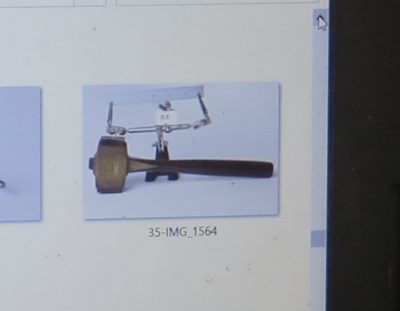
Thus the images with the scale in the frame are my “go to” tools for making sure I get the details exactly right. I can fiddle with the file to make sure the printed image is precisely the size of the original artifact, but it is much easier to simply employ the tools of photogrammetry to the task. Although I believe software packages like Sketch-Up do this automatically, I am old school having learned classical photogrammetry in Architectural History classes back in the 70s. Once again the learning of the past solves the problem of the present.
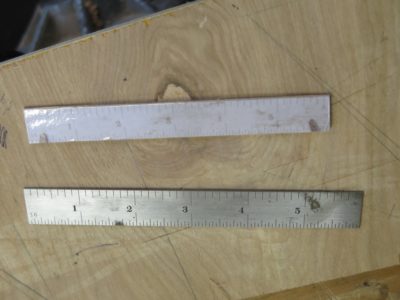
The top scale is one made from cutting out the photograph, the bottom scale is a 6-inch rule from my machinist’s tool kit.
Printing out one of the pictures representing the orientation I needed to make the handle (made from dalbergia, just like the original; I do not have much dalbergia so I might switch to swietenia mahoganii or another tropical hardwood at some point) with the scale included, I simply cut out the scale and used it to measure all the critical dimensions. As you can see the photographic representation of the scale differs greatly from the true scale, that difference is irrelevant because the image of the mallet itself is exactly the same scale as the photographed scale.
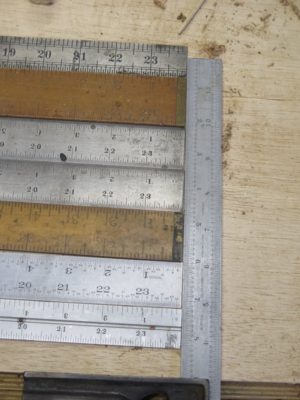
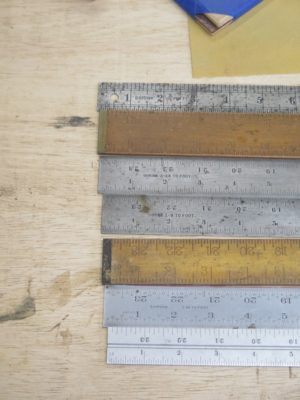
This exercise of using a “wrong sized” scale may be disconcerting to some, but it was the daily order of business when I was a patternmaker. The patternmaker’s tool kit includes a variety of rulers called “shrink scales.” These modified rules are used to lay out and construct a pattern to be used in making the molds for metal castings, and since each metal alloy shrinks a little bit when it solidifies the precise size of the pattern must reflect that reality.
At this point, especially as I create the handle, photogrammetry is more than a mere tool. It is the irreplaceable element.

It was a most satisfying day as the upright vise was finished and put into action. I first tapped the threads for the vise screw, and notched the handle for the screw itself. And, the concept of the entire device being easily and rapidly installed and removed with a single whack of a mallet showed itself to be true repeatedly as the day progressed.
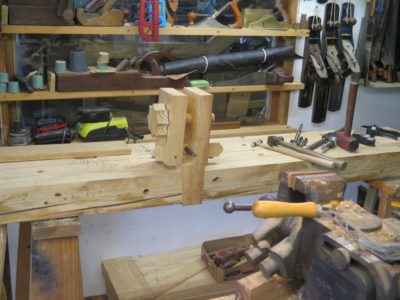


With the fundamentals set I made a parallel guide from some 12mm baltic birch plywood from the scrap box, tarted up a bit just because. Two sets of holes were drilled offset as is typical for such a component, and the pin was another piece from the scrap drawer.


I gave it a little test drive and love its performance; whether or not I like it as much in constant and ongoing use will be discovered once I get the other accouterments of the bench completed and put into regular rotation in the shop. One “concern” I have is that I made the off-set of the entire device toward the center of the bench rather than the outside, which would have allowed greater utility for clamping workpieces alongside the outer edge of the slab. Again, only time will tell if I should have done it the other way, and if so, whether Romastonian Bench Vise 2.0 is in the offing.
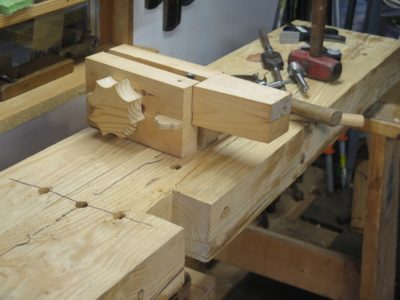
One of the ultimate beauties of the device is that it takes only a single whack to install or de-install it, and is solid as a rock when in place.
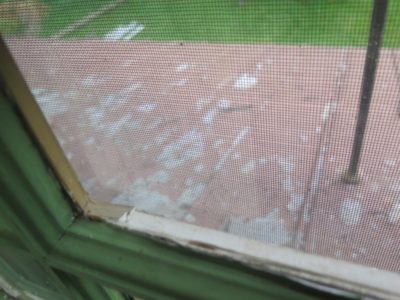
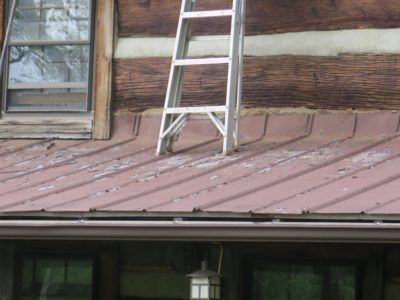
One of the things percolating to the top of the “Needs To Be Done on the Homestead” list over the past winter was the clearly evident need to bring some attention to the roof of the cabin. We had the standing seam roof washed and painted right after we bought the cabin twenty years ago but it was once again showing some age. I think the metal roof was probably installed around 1980 but there is no evidence one way or another. I only know it was looking tired in 2001.
My original thought for this summer was to get the old roof pressure washed and coated with roll-on epoxy paint. (My days of scampering around a steep roof are past, so the only certainty was hiring someone to do the task.) Asking around I got a sense of what that might cost but ran into a hurdle of finding someone who lives in the area to do the job. It was then that we saw the new roof going on the house of the farmer from whom we buy milk. It was a new, beautiful honest-to-goodness traditional standing seam roof, albeit with a baked enamel finish, and when I asked him about it he told me that one of the Amish families new to our area had done the job.
Not long after that I took Mrs. Barn and the older Barndottir to the new greenhouse just south of town, also operated by the same Amish family. While there I happened to speak to the father about our possible project and within a fortnight he was up to give me a bid. His estimate for removing the aged roof and replacing it entirely with brand new baked enamel steel roofing was almost the same price! The decision was not really hard to make.
Given the large number of aging standing seam metal roofs here in the hinterland he has been kept busy almost non-stop repairing and replacing them. He told me they moved here to be full-service carpenters (our county has one electrician, one plumber, and two home improvement enterprises so it was fertile territory) but his roofing work has pushed almost everything aside. We got on the schedule for a new roof in October. Then two weeks age we were notified that there was an opening in the calendar and our new roof project would begin the following day.
One of the drawbacks to living in such a remote are with such a sparse market of skilled tradesmen is that getting someone to do a job and do it in the time promised is pretty discouraging. So, when the roofers said they would show up at 9AM the following morning we were anxious to see if it would actually come to pass.
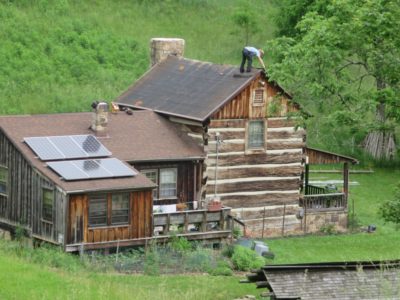
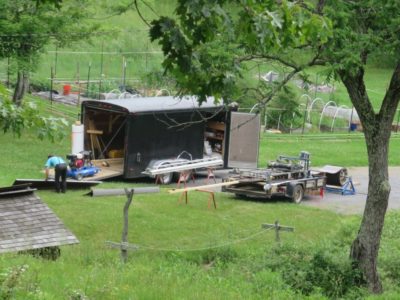
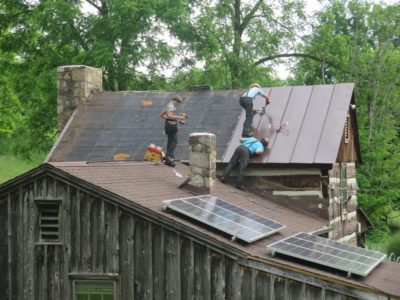
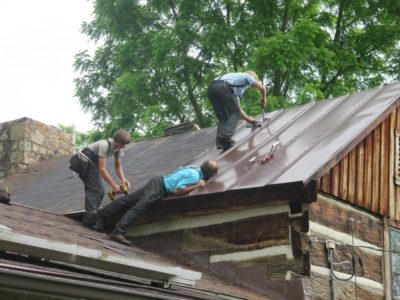
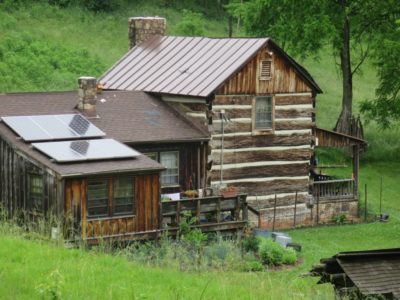
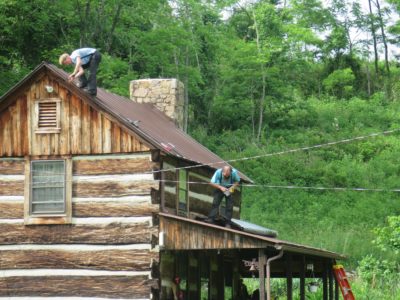
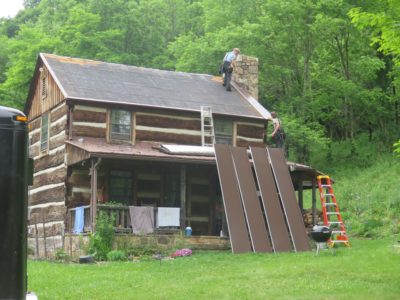
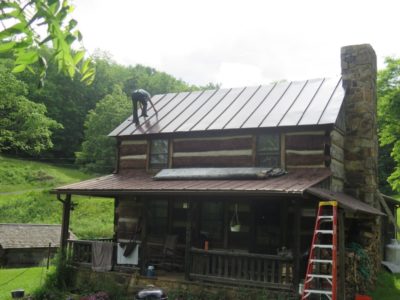
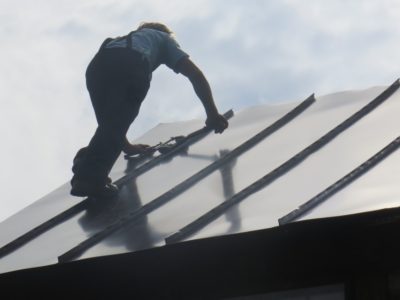
They arrived around 8.30AM. And, got the cabin roof stripped and installed in one day, using their mobile rolling mill to crimp all of the metal panels on the spot. Good thing as there was rain in the forecast. We knew in advance that they would be gone for three days attending a horse auction.
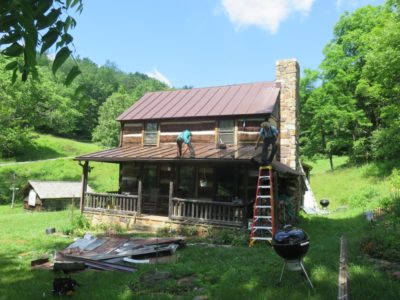
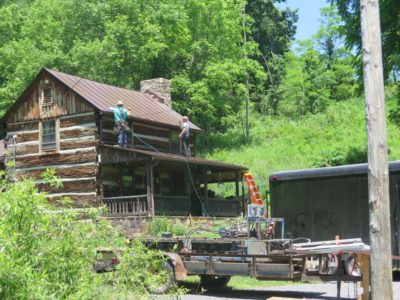
The second work day they also said they would be here around the same starting time. That was an untruth. They arrived at 7.20 and began installing the front porch roofing almost as fast as they were stripping off the old. By early afternoon they were packed up and gone with the flashing, storm clips and gutters installed and the job site cleaned up. I gladly handed over the check for the full payment.
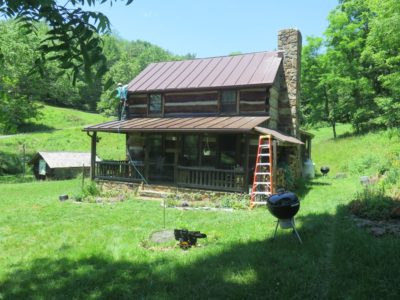
I for one am thrilled at the prospect of more skilled tradesmen moving in to the region and I am helping a newly arrived Amish blacksmith build a foundry in his shop using one of my smelting furnaces. Now that is going to be fun!
Last weekend we went to Mordor to celebrate Father’s Day with the Barndottirs. Since my mobility was returning surprisingly fast, I was cane free and pain free by Saturday, I took some leisurely laps around the perimeter of the yard with its more than a quarter mile per circuit. Yes I carried a cane but it was more for security on uneven ground than supporting my weight. I had my phone and took some admittedly inferior pictures to show you.
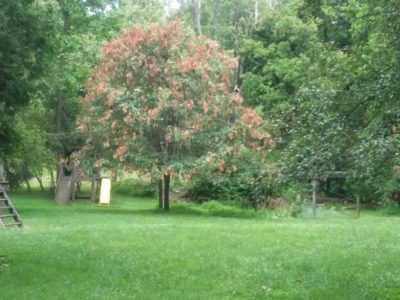
The absence of cicadas was notable. The stench of gazillions of decaying carcasses was diminishing and the cacophony was gone, but the evidence was all around. This juvenile oak tree was clearly a favorite burrowing place for the mating cicadas, fortunately the damage was probably not lethal to the tree.
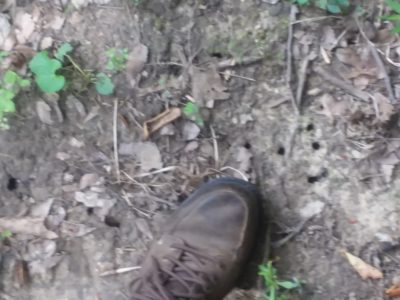
I came across this patch of ground tunnels visible enough to photograph. Presumably every square foot of the middle Atlantic is riddled with pockmarks like these. If this is true, then our property housed around four million of the critters.
Now we just wait another 17 years for the re-emergence of the next generation that is now maturing underground.
Back by popular demand – sandblasting! I am delighted to profile my complete sandblasting system.
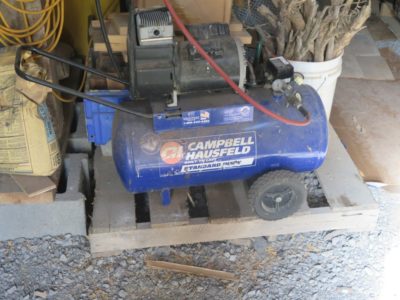
The starting point is my “nothing special” $75 Craiglist compressor in the basement of the barn, residing there because it is a diaphragm compressor head rather than a piston head and thus pretty noisy. The compressor unit is a 2 HP motor/head attached to a 10 gallon tank. The compressor is attached to the air-abrasive gun via a typical reguator/air hose system and quick-release pneumatic fittings. I generally operate my blasting gun at around 40 psi which gives me good control and adequate aggressiveness and is well within the capacity of the compressor.
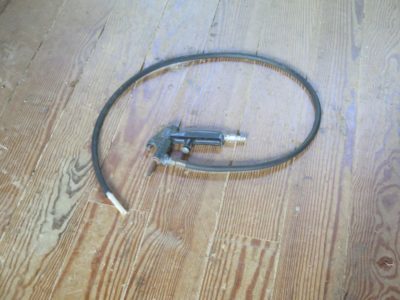
The blasting gun attached to the hose is a siphon-feed unit, ancient (probably Craftsman) but indistinguishable from some thing you could buy tomorrow at Harbor Freight.
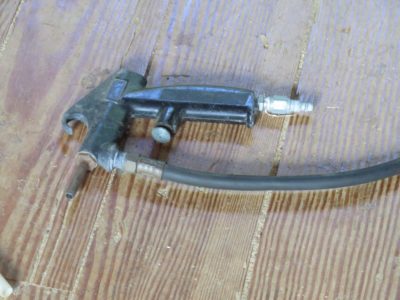
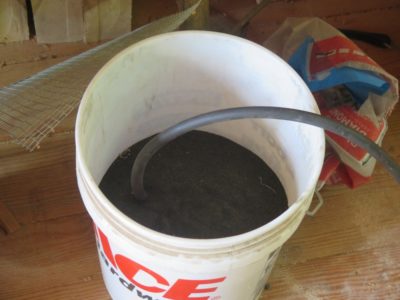
The system operates like this: The air running through the gun nozzle creates a partial vacuum in another feed-line fitting/tube which draws the abrasive medium through the siphon tube. In that effect it is identical to a paint spray gun, but instead of pulling up liquid paint and atomizing it through an atomizing nozzle it is sucking up the abrasive and focusing it through the gun output aperture. As a general practice I simply jam the end of the siphon tube into the bottom of the abrasive reservoir, almost always just a bag of the abrasive or a five gallon bucket if I am feeling fancy. I refill the bag/bucket with “overspray” abrasive gathered from the trash can. I’ve thought about getting a fixed metal “hopper” reservoir but the bag/bucket work just fine for me.
One final word: make sure to wear eye, hand, and face protection. Really. I generally use a face shield, light leather or rubber gloves, and a dust mask or respirator. You do not want to get even a smidge of this in your eyes or lungs.
===============================================
BTW I got my stitches out yesterday and much to the doc’s surprise I have had zero discomfort since Saturday, when I became pain free and cane free. As he commented, “This level of recovery is unusual for someone at your stage of life.” Apparently for geezoids like me the cartilage pain is compounded by an even more severe arthritis pain, which I do have some but not yet to the serious pain level. If arthritis is the foundational pain problem, repairing the cartilage will not diminish the pain to my current level of “0.” Still a little stiffness but that will disappear with motion and PT. I’ve been told to take it easy for a month, which I will probably sorta do. Off to mow the lawn.
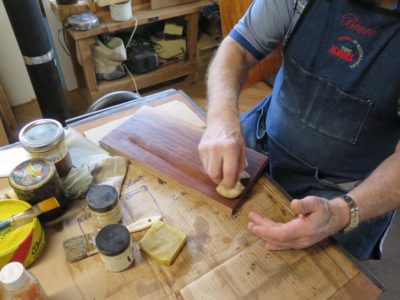
In keeping with my current “marketing” (non-) strategy for workshops, a while ago I was approached by a group of fellows commissioning a Historic Wood Finishing weekend workshop at The Barn. Once we set the schedule it turned out that there would be two slots open for anyone else who wanted to take the open places. If this interests you let me know. As always, the emphases will be on shellac and wax finishing for three days. The schedule for the workshop is October 9-11, 2021, and the tuition is $375.
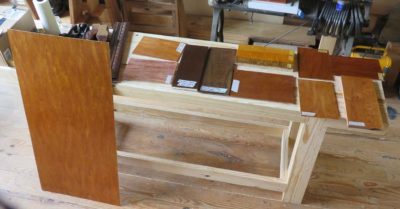
After much consideration of building a Benchcrafted Carver’s Vise to affix to my Romastionian Low Bench, in the end I decided to go a different direction. The BC vise was just too complex and robust (read: complicated/time consuming and heavy) and went simpler and lighter.
Yesterday was my first day back in the shop, where I went after packaging and sending a bunch of polissoir and wax orders. Mrs. Barn gave me a warning in the sternest possible terms about not injuring myself and treating my knee with care, probably a well-founded warning. Besides, she has more than forty years invested in us/me and she wants to protect her investment. I was cane-free and pain-free by Saturday afternoon, walking more than a mile at a leisurely pace, so I was sure that a low intensity day in the shop was appropriate. So late yesterday morning, able to see my breath in the chilly morning, I headed up the hill to continue work on the Low Bench vise.
The tapered open socket on the side of the bench was a perfect place to fit a small-ish vise for use while sitting on the end of the bench.
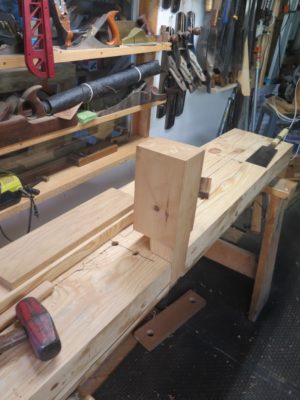
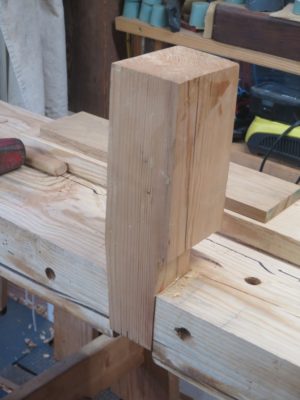
Beginning with a chunk of pine 4×6 from the scrap pile I cut and planed a tapered edge to fit perfectly into the side notch. To make this undertaking quicker I cut a shoulder on the inside of the blank so that the vise en toto would project to the inside of the notch. I decided this was a mistake ex poste, but there you have it. I spent the time necessary to get the nesting just right so that the vise block was set firmly in place with one whack on top, and released easily with a whack on the bottom.


Once I had the housing and tapered block fit just right I marked out the jaw to be cut from the solid block. To make the end result the most precise I chopped the mortise for the parallel guide through the whole mass, then drilled the holes for the screw holes. I drilled a larger hole through the moving jaw face, then the smaller hole for threading by clamping the block in place for the larger hole halfway through, then swapping out the larger bit with one 1/8″ smaller.
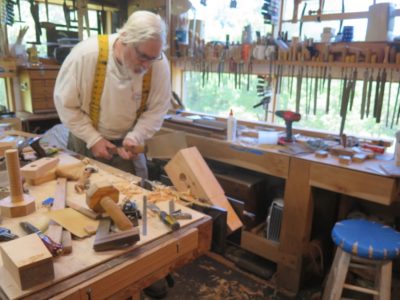
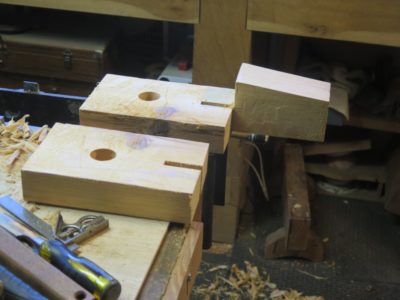
Sawing out the movable jaw was just a matter of careful sawing. Now everything was ready for final work and assembly.
One of the tools integral to a multidimensional shop is a sandblasting rig. All it takes is an air compressor and hoses, a blasting gun, and some abrasive to feed through the gun.
Since I have been doing some tool and metal restoration and finishing lately it was time for me to dust off my vintage sandblasting gun, itself an artifact of unknown age from my late Dad’s workshop. It still works like a charm for my needs. One aspect of sandblasting that often discourages new users is that the medium (the particulate abrasive used to scour the surface) tends to go everywhere and the entire space gets gritty in a big hurry. The typical solution to the problem is an enclosed blasting cabinet, and almost every commercial metals shop has one. But I am not a commercial shop and did not want to dedicate the space and money to get one for my occasional uses.
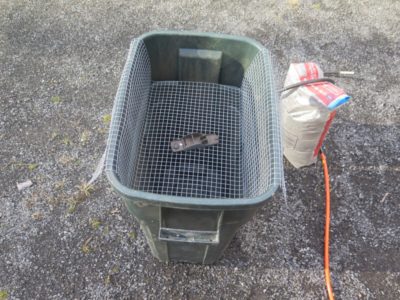
After giving the problem a bit of thought I came up with a solution that suits my needs perfectly, and that solution was to create a cradle inside a trash can to use as my blasting platform. With a piece of 1/2″ x 1/2″ hardware cloth from my scrap inventory I cut and bent it to fit down inside one of my trash containers such that the object being blasted was about nine inches below the top lip. Working that far down, and always blasting in a downward direction, meant that the gritty abrasive went to the bottom of the container. This not only prevents widespread deposits of the grit everywhere, it also allows for me to simply pour it back into the abrasive bag to reuse the next time I fired up the system. There is a bit of fine dust coming out of the chamber but I deal with that by simply taking the plastic trash can out into the driveway and let the air current waft it away.
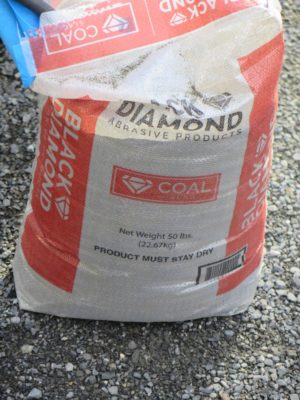
As for the abrasive medium itself I just buy it from Tractor Supply. I get two grit sizes but mostly rely on the fine grit. The coarse grit is reserved for anything really encrusted with rust or other accretions.
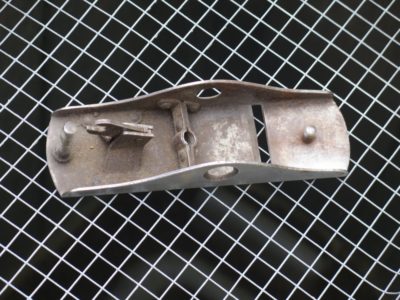

For restoring the hand planes as gifts my air abrasive system gets an old plane stripped of rust and old chipped paint and ready for restoring in about 90 seconds.
Yesterday was quite the day. Since I was the first entree on the menu for the ortho surgery suite my check-in time at Hotel Orthoscopy was 6AM. Given our distance from them and the instructions about home preps in advance, it meant that we needed to arise around 3AM. And given that middle-of-the-night reveille, it meant we went to bed while there was still daylight and got almost no sleep in the intervening hours.
One other concern on my end was that the mandatory covid test last Saturday tilted the balance in my annual battle against respiratory allergies. Sticking the boom handle up my nose to bang against the underside of my skull (okay, that might be a teensy bit of hyperbole) riled up my sinuses so much they were completely impacted for four days. We were legitimately wondering if they would even let me in the hospital with my nasal gurgling. Fortunately the two hot showers at 8PM and 3AM combined with my allergy meds helped enough to get me in.
Surgery was from 7.30 to 8.40 AM, and afterward the surgeon assured Mrs. Barn that all went well. Yes there was damaged cartilage to cut and vacuum but nothing to cause further concern. As he told her, it was simply the result of “a lot of birthdays.” When we spoke before surgery he said the rehabilitation would basically depend on my level of discomfort tolerance.
My time in the recovery room was relatively brief. They gave me one painkiller pill for the trip home and we were off to Shangri-la, arriving just before 1 PM. I was attentive to the knee on the trip home, and it was less painful than two hours in the car would normally inflict on me. Admittedly, this might have been a manifestation of “Better Living Through Chemistry.” Maneuvering into the cabin was no real problem; we had saved all the ambulation accessories from my broken hip so we were fully equipped to get me into the cabin and navigate inside.
I started the afternoon with a nap in the recliner. When I woke around 3 PM I noted the continued absence of pain. Huh, peculiar. I had a pile of dope to take but did not need it. Dinner came and went, we spent a typical evening on the couch watching a video, Skyping with the girls, texting friends and siblings, and still no pain. Where is the pain? I was not being heroically stoic, it simply did not hurt.
I did take a couple of OTC analgesics as a prophylactic before bed time and spent the comparatively uneventful night in the recliner. This morning? Still no pain. A little tenderness but nothing notable. Not entirely unexpected, after all they did poke holes in me and muck around inside.
Yes indeed, 24 hours after surgery the knee already feels better than it did 24 hours before surgery. I will baby the leg for another day then start working my way up to full weight and maybe even back up to the shop by Monday if Mrs. Barn lets me. Stiches out on Thursday next week.
Some miracles are inexplicable, others are explicable. All I know is that now there is no invisible orc sticking an icepick into the back of my kneecap with every step, and it does not take me 10-15 seconds to get my leg straightened when I stand.


Recent Comments