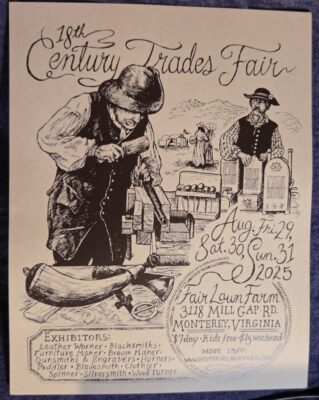
Again this year I will be one of the hands-on demonstrators at the 18th Century Trades Fair down in center county. The number of confirmed craftsmen is around 35, working in a magnificent Highland County setting. If you are so inclined it would be a grand day to spend with the family.
Despite having done this twice before I’ve still got a lot to do to get ready.
In case you are interested my latest conversation with Brian Wilson can be found at his Substack, Brian Wilson Writes. In fact, even if you are not interested, the conversation is still found there.
As always, it is not for the faint of heart and you have to track it down for yourself.
It’s pretty hard to get much more simple than a Japanese planing beam with its three components: the beam, the base, and the “X” legs. In my case I laminated two 11/4 pieces of vintage cypress (c.1840) for the beam and will use some of the same stock for the legs. But the base took a little more thought.
The answer came last year when my brother and I were processing firewood, in this case cutting up a large white oak that had fallen in a windstorm two years before, having been knocked down by two falling maple trees. It took us the better part of three days to trim and work our way down the twin trunks of the oak after doing the same for the maples. The main trunk was almost stick straight and as we neared the bottom I found by planing beam base. About four feet up from the root mass I cut a bole about 3-1/2 feet in length and about 22 inches in diameter, bark included.
It weighed about 350-400 pounds at that point and we wrestled it onto the truck and set it up on smaller bolts to let it dry for a bit on the ground underneath a piece of EPDM roofing placed over it.
Several months later I managed to get it upright and on to my hand truck and brought it into the barn, setting it horizontally on the floor in the unheated part for further seasoning. By the time I got to working it the weight had dropped perhaps 20-30 pounds but it was still really heavy. Nevertheless I wrangled it out of that corner with my log hook and rolled it out to the central room on the main floor where I began to cleave off the bark and majority of the sap wood with an adz and a slick, reducing the size to about 19″ diameter and reducing the weight further another 20+ pounds.
Afterward, somehow I wrangled it up onto my firewood-cutting cradle without injury, in order to clean up the surface mostly with a drawknife.
Mrs. Barn now has two trash bags of drawknife shavings to use for woodstove fire tending next winter.
In the end I wound up with a sublime section of tree, mostly straight and exceedingly dense white oak.
Stout, brother, stout.
Up next – cutting and fitting to the end of the beam.
One of my favorite “Favorites” at yootoob is the channel for this hybrid carpenter, standing with one foot firmly in the world of traditional craftsmanship and one foot in the world of modern industrial machines. To paraphrase Larry the Plumber, he’s a “Git ‘er done” sorta guy.
Given the demographic cliff Japan is going over, you have to wonder how many craftsmen like him will be around in a quarter century. As an aside it is interesting to note the number of traditional rural homes that are abandoned there due to that very same population decline.
This post is presented annually, revised a bit from time to time. Despite dozens of recitations, I can never read the last line of The Declaration out loud because I am overcome with emotion. – DCW
Tomorrow my fellow Patriots and I, however many of us there are, will commemorate and celebrate the 249th anniversary of the most profound statement of human aspiration ever known. We have already endured two violent wars of secession, the first from 1775-1783 and the second from 1861-1865, and I pray that our third one can be avoided by a peaceful segregation of a populace that no longer shares a common vision. This year I am especially drawn to the passage “mankind are more disposed to suffer, while evils are sufferable, than to right themselves by abolishing the forms to which they are accustomed.” This sentiment was later expressed by John F. Kennedy, as “When peaceful rebellion is made impossible, violent rebellion becomes inevitable.”
As our nation is seemingly rife with incurious, gullible and servile inhabitants, we would be well-served to reflect seriously on the document encapsulating the mission statement for the greatest nation ever known to man, the only nation ever founded on a creed rather than solely geography or lineage. It was and is of course imperfect, no institution created by fallen and sinful men and women can be anything else.
I am unabashedly proud to be a partisan in the cause of Life, Liberty, and Property (the original wording) and find The Declaration of Independence to be the most noble civil document ever created by mankind. I pray you will read and reflect on the ideas expressed by men who pledged their lives, their fortunes, and their sacred honor to pursue the path of liberty. Reading it is much like reading the Minor Prophets of the Old Testament; more up-to-date regarding the human condition than tomorrow’s headlines.
God Bless America, and may righteousness flourish and wickedness be overcome.
The unanimous Declaration of the thirteen united States of America,
When in the Course of human events, it becomes necessary for one people to dissolve the political bands which have connected them with another, and to assume among the powers of the earth, the separate and equal station to which the Laws of Nature and of Nature’s God entitle them, a decent respect to the opinions of mankind requires that they should declare the causes which impel them to the separation.
We hold these truths to be self-evident, that all men are created equal, that they are endowed by their Creator with certain unalienable Rights, that among these are Life, Liberty and the pursuit of Happiness.–That to secure these rights, Governments are instituted among Men, deriving their just powers from the consent of the governed, –That whenever any Form of Government becomes destructive of these ends, it is the Right of the People to alter or to abolish it, and to institute new Government, laying its foundation on such principles and organizing its powers in such form, as to them shall seem most likely to effect their Safety and Happiness. Prudence, indeed, will dictate that Governments long established should not be changed for light and transient causes; and accordingly all experience hath shewn, that mankind are more disposed to suffer, while evils are sufferable, than to right themselves by abolishing the forms to which they are accustomed. But when a long train of abuses and usurpations, pursuing invariably the same Object evinces a design to reduce them under absolute Despotism, it is their right, it is their duty, to throw off such Government, and to provide new Guards for their future security.–Such has been the patient sufferance of these Colonies; and such is now the necessity which constrains them to alter their former Systems of Government. The history of the present King of Great Britain is a history of repeated injuries and usurpations, all having in direct object the establishment of an absolute Tyranny over these States. To prove this, let Facts be submitted to a candid world.
He has refused his Assent to Laws, the most wholesome and necessary for the public good. He has forbidden his Governors to pass Laws of immediate and pressing importance, unless suspended in their operation till his Assent should be obtained; and when so suspended, he has utterly neglected to attend to them. He has refused to pass other Laws for the accommodation of large districts of people, unless those people would relinquish the right of Representation in the Legislature, a right inestimable to them and formidable to tyrants only. He has called together legislative bodies at places unusual, uncomfortable, and distant from the depository of their public Records, for the sole purpose of fatiguing them into compliance with his measures. He has dissolved Representative Houses repeatedly, for opposing with manly firmness his invasions on the rights of the people. He has refused for a long time, after such dissolutions, to cause others to be elected; whereby the Legislative powers, incapable of Annihilation, have returned to the People at large for their exercise; the State remaining in the mean time exposed to all the dangers of invasion from without, and convulsions within. He has endeavoured to prevent the population of these States; for that purpose obstructing the Laws for Naturalization of Foreigners; refusing to pass others to encourage their migrations hither, and raising the conditions of new Appropriations of Lands. He has obstructed the Administration of Justice, by refusing his Assent to Laws for establishing Judiciary powers. He has made Judges dependent on his Will alone, for the tenure of their offices, and the amount and payment of their salaries. He has erected a multitude of New Offices, and sent hither swarms of Officers to harrass our people, and eat out their substance. He has kept among us, in times of peace, Standing Armies without the Consent of our legislatures. He has affected to render the Military independent of and superior to the Civil power. He has combined with others to subject us to a jurisdiction foreign to our constitution, and unacknowledged by our laws; giving his Assent to their Acts of pretended Legislation: For Quartering large bodies of armed troops among us: For protecting them, by a mock Trial, from punishment for any Murders which they should commit on the Inhabitants of these States: For cutting off our Trade with all parts of the world: For imposing Taxes on us without our Consent: For depriving us in many cases, of the benefits of Trial by Jury: For transporting us beyond Seas to be tried for pretended offences For abolishing the free System of English Laws in a neighbouring Province, establishing therein an Arbitrary government, and enlarging its Boundaries so as to render it at once an example and fit instrument for introducing the same absolute rule into these Colonies: For taking away our Charters, abolishing our most valuable Laws, and altering fundamentally the Forms of our Governments: For suspending our own Legislatures, and declaring themselves invested with power to legislate for us in all cases whatsoever. He has abdicated Government here, by declaring us out of his Protection and waging War against us. He has plundered our seas, ravaged our Coasts, burnt our towns, and destroyed the lives of our people. He is at this time transporting large Armies of foreign Mercenaries to compleat the works of death, desolation and tyranny, already begun with circumstances of Cruelty & perfidy scarcely paralleled in the most barbarous ages, and totally unworthy the Head of a civilized nation. He has constrained our fellow Citizens taken Captive on the high Seas to bear Arms against their Country, to become the executioners of their friends and Brethren, or to fall themselves by their Hands. He has excited domestic insurrections amongst us, and has endeavoured to bring on the inhabitants of our frontiers, the merciless Indian Savages, whose known rule of warfare, is an undistinguished destruction of all ages, sexes and conditions.
In every stage of these Oppressions We have Petitioned for Redress in the most humble terms: Our repeated Petitions have been answered only by repeated injury. A Prince whose character is thus marked by every act which may define a Tyrant, is unfit to be the ruler of a free people.
Nor have We been wanting in attentions to our Brittish brethren. We have warned them from time to time of attempts by their legislature to extend an unwarrantable jurisdiction over us. We have reminded them of the circumstances of our emigration and settlement here. We have appealed to their native justice and magnanimity, and we have conjured them by the ties of our common kindred to disavow these usurpations, which, would inevitably interrupt our connections and correspondence. They too have been deaf to the voice of justice and of consanguinity. We must, therefore, acquiesce in the necessity, which denounces our Separation, and hold them, as we hold the rest of mankind, Enemies in War, in Peace Friends.
We, therefore, the Representatives of the united States of America, in General Congress, Assembled, appealing to the Supreme Judge of the world for the rectitude of our intentions, do, in the Name, and by Authority of the good People of these Colonies, solemnly publish and declare, That these United Colonies are, and of Right ought to be Free and Independent States; that they are Absolved from all Allegiance to the British Crown, and that all political connection between them and the State of Great Britain, is and ought to be totally dissolved; and that as Free and Independent States, they have full Power to levy War, conclude Peace, contract Alliances, establish Commerce, and to do all other Acts and Things which Independent States may of right do. And for the support of this Declaration, with a firm reliance on the protection of divine Providence, we mutually pledge to each other our Lives, our Fortunes and our sacred Honor.
Button Gwinnett
Lyman Hall
George Walton
William Hooper
Joseph Hewes
John Penn
Edward Rutledge
Thomas Heyward, Jr.
Thomas Lynch, Jr.
Arthur Middleton
John Hancock
Samuel Chase
William Paca
Thomas Stone
Charles Carroll of Carrollton
George Wythe
Richard Henry Lee
Thomas Jefferson
Benjamin Harrison
Thomas Nelson, Jr.
Francis Lightfoot Lee
Carter Braxton
Robert Morris
Benjamin Rush
Benjamin Franklin
John Morton
George Clymer
James Smith
George Taylor
James Wilson
George Ross
Caesar Rodney
George Read
Thomas McKean
William Floyd
Philip Livingston
Francis Lewis
Lewis Morris
Richard Stockton
John Witherspoon
Francis Hopkinson
John Hart
Abraham Clark
Josiah Bartlett
William Whipple
Samuel Adams
John Adams
Robert Treat Paine
Elbridge Gerry
Stephen Hopkins
William Ellery
Roger Sherman
Samuel Huntington
William Williams
Oliver Wolcott
It’s been more than six months since I put this project aside (not my longest hiatus for sure — my Ultimate Portable Workbench project has been dormant and partially assembled for several years now) and the time has come to move it forward. The Japanese planing beam is something I have wanted since first reading Toshio Odate’s book more than four decades ago (!), and more recently inspired by Adrian Preda’s video from three years ago.
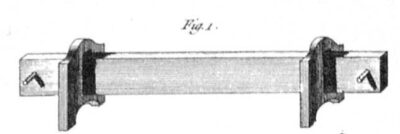
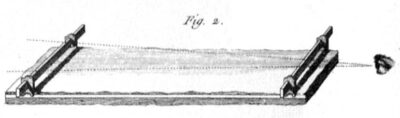
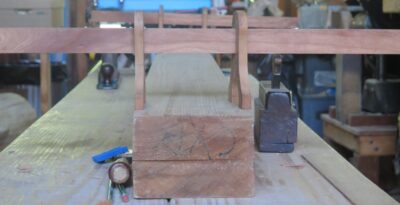
Given the many moons of settling and relaxing it was time to true the beam and remove the 1/16″ of wind it had from one end to the other. Since I am all about cultural appropriation I appropriated Roubo’s technology for flattening stock, beginning with his winding sticks on stilts.
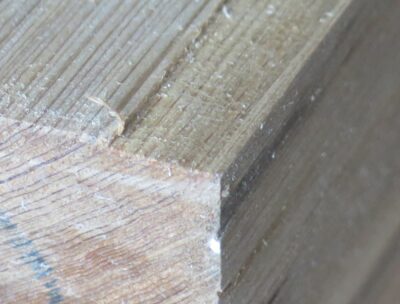
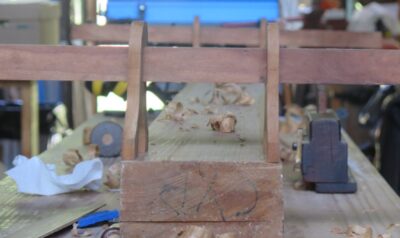
Using my shoulder plane I shot declining rabets on the necessary opposite sides until the winding sticks aligned. This picture is just a stroke away on each rabet to be done.
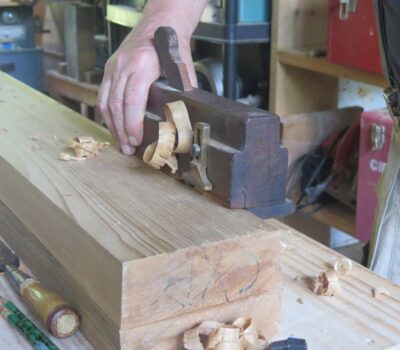
Using my #5 set up as a foreplane to work off of the tapered rabets I got the beam flat in a few minutes. With that done I rotated the beam 90-degrees in both directions and used a cabinetmaker’s square to square up those edges. I did nothing to the underside.
Up next — working on the ~400-pound bolt into the base.
I learned with sadness this morning of the recent death of Philippe Lafargue, my friend and collaborator for more than 35 years. I will write more about Philippe soon, but he was recently profiled in the lostartpress.com blog.
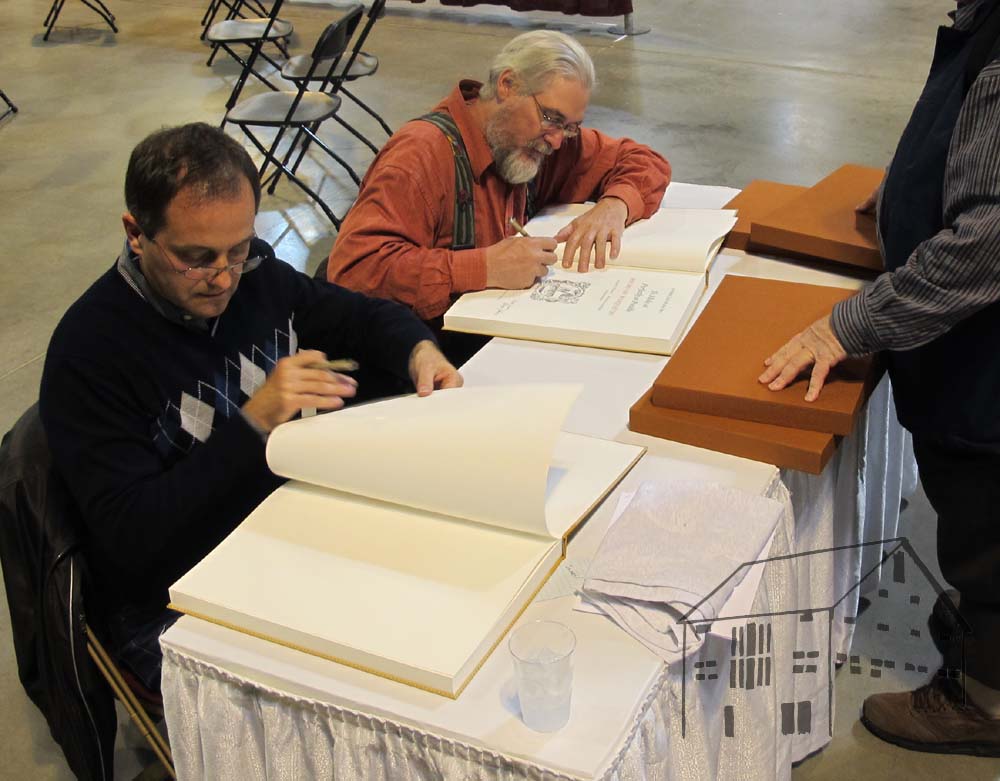
Our last in-person intersection was when the Deluxe Edition of the marquetry edition premiered in 2013, and we signed copies together at Woodworking in America. In the years since, Team Roubo was the very model of modern collaboration via the interwebz, as we would send updated versions of documents from the Virginia Highlands to Vermont to southern France effortlessly.
Michele and I will soldier on, but it will definitely not be the same.
My ongoing acquisition of cardboard for Mrs. Barn’s use in the various gardens — it is used as a weed-stopping underlayment underneath mulch — somehow led me to this video. The geek in me is often entranced by peculiar applications of the sciences, especially materials science, and this fit that bill precisely.
Ultra-light and ultra-strong panel fabrication is available in the aerospace and marine worlds, but at GREAT cost. I became acquainted with a student who worked for a custom outfitter of tailor-made airplane interiors, and the costs he recounted of both materials and fabrication/fitting processes was breath taking. Marine plywood, sometimes a couple hundred dollars a sheet, can be dwarfed in price by the composite veneered or laminated panels used in the super elegant interiors of megabuck private planes.
In addition to laying up my own plywood with some of the pile of veneers I have up in the loft, I will almost certainly try to explore this method to make panels for various applications. Sometimes amusing myself with “What if…?” questions is all the justification I need.
Things are getting closer to wrap-up with the greenhouse project, as I built the steps on the bank from the yard up to the terrace. I will probably build a second set of steps at the other end, but we are really getting close to the point where we can say we have a first-class functioning greenhouse. This was an “in process” image, the steps are now all done and a great addition to the endeavor. We no longer have to trek diagonally across a steep bank that is frequently slick with dew.
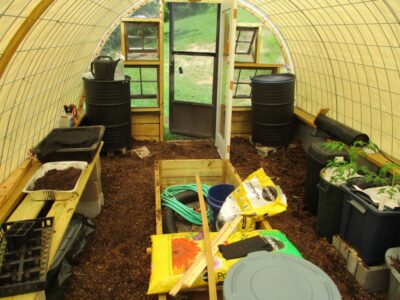
A couple weeks ago I followed Mrs. Barn’s protocol and covered the entire floor with cardboard once she had settled on a configuration for the space. This step really cuts down on weed encroachment once it is covered with a layer of mulch.
I also placed four black painted drums in the space, one in each corner. Once I install the spigot kits near the bottom of each drum they will serve two functions. First is to provide water to the plants since there is no hard plumbed water line, so these will have to be refilled by hose on occasion. Second, though, is to serve as heat sinks in the winter when the black paint and water inside the drum is heated in the winter time to keep the overnight temps moderated. At least that’s the plan. I also may wind up putting more thermal mass in the space, such as sand-filled concrete blocks painted black to absorb solar warming.
With that all done I hauled up a truckload of mulch to cover the carboard on the floor. It transforms the space visually and functionally as sometimes walking over layers of cardboard is a slippery proposition.
I will shortly add some benches to the covered-but-not-enclosed end of the structure where many plants will be kept as a intermediary space.
Our noodling between now and winter will be to get a handle on temperature controls for both heat and cold. Even though the enclosed space has a shade cloth over it the temperatures on a sunny day can get pretty extreme inside, much more than our one little 12-inch fan can handle. I’ve got another fan on order, and hope that two will do the trick. I am not pleased and cannot recommend the one we bought, but it is here and installed and works, some of the time.
The next update from the greenhouse will focus on Mrs. Barn’s experimentation with self-irrigating planters.







Recent Comments