Last month, for the first time in many years, I was able to offer an Introduction to Parquetry class at Joshua Farnsworth’s Wood and Shop near Charlottesville VA. We plan for me to offer the workshop again next year.
I had two exercises in mind for the students, all based on sawn veneer edge strips from boards.
The strips were then cut into identical 60-120-60-120 parallelogram “diamonds” or lozenges with a simple jig and a dovetail saw.
NB/ mea culpa – over the years I have attended and spoke at countless woodworking clubs and guilds, and invariably there is a show-n-tell session, and invariably they feature prominently some elaborate jig a member made to do this or that function. (Yes I know I used “invariably” twice in one sentence. That is a purposeful literary flourish.) In the old days I would just roll my eyes and tell myself, “That’s not woodworking.” Then we started the Roubo Transalation Project. Turns out the world of the ebeniste’ was all about jigs and patterns. To quote LBJ, “I reserve the right to be smarter than I used to be.”
Once the pile of lozenges got big enough, they laid out X and Y axes on a piece of paper to guide them then started assembling the composition by gluing down the lozenges to the paper with 135 gws hide glue.
Once the composition was large enough to cover the “field” of the substrate panel, in this case 1/2″ Baltic Birch plywood, the working face of the parquetry (ultimately the verso) was slathered with 192 gws hide glue, followed immediately by the face of the substrate panel.
Then the wo glued surfaces were brought together and clamped using another 1/2″ panel as the caul and a double layer of corrugated cardboard as a gasket.
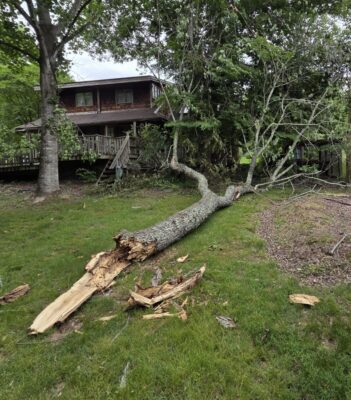
A few months ago I posted about a large chunk of a maple tree that came down (about 18″ at the bottom), and my cutting it up.
After I was back home my son-in-law and Li’l T moved the bolts into an abandoned goatpen house I built 25 years ago. It is a better structure than some of the church-camp cabins I stayed in as a yoot. The wood will remain there until I decide what to do with it.
I expect it will mostly become turned bowls but my lathe needs a substantial upgrade for that to happen.
Recently my brother and his wife were visiting, and their routine included a long evening walk. One of the walks was in the aftermath of an early evening rain, with this being the result.
Polishing, polishing, polishing. Unfortunately we were so busy and occupied with our tasks I did not get many pictures. Maybe next year I can be more attentive to that task.
I’ve not been to the world headquarters of Lost Art Press since forever (at this point our interactions are via email) but found interesting the video tour James Wright and daughter created on their recent visit.
The exercises proceed apace, building finishes and the skll set to accomplish them.
I fully expect to reprise this workshop at Joshua’s next summer, along with perhaps a couple other offerings. Introduction to Parquetry is taking place the end of next week, so come on and join us.
Recently for the umpteenth time (25th? 30th?) over the past four decades I taught my Introduction to Historic Woodfinishing workshop, this time at Joshua Farnsworth’s Wood and Shop School near Charlottesville. I have already related the transition from teaching at The Barn once my insurance underwriter yanked the plug on liability insurance for students, bringing the “school” component of The Barn on White Run to an end. Joshua graciously invited me to teach at his place, for which I am very much appreciative. I’m teaching a Parquetry workshop in a couple weeks, there are openings.
33
The odd thing about teaching workshops at The Barn is that I still have personal liability insurance, the building and its contents are insured as before, but no insurance for students attending classes. The underwriters would never say why that insurance was being canceled, but my agent thought it was because the nearest full-service hospital is almost 90 minutes away. Oddly enough I can still host visitors for one-one-one learning experiences, and in fact I have one of those upcoming as soon as we can work out our scheduling hiccups.
One of the great benefits to hosting all the workshops in my own Barn classroom was that everything I needed was right there. When I teach elsewhere I have to pack up everything for the course. Everything. All the supplies, tools, workpieces, everything. I learned my lesson the first couple times I taught almost forty years ago and sent the students a detailed list of everything they would need. Every class there was a student or two who arrived unprepared, saying “I didn’t think you meant that,” or “I decided to substitute this or that.” In every instance the whole class was delayed repeatedly while I tried to come up with a reasonable substitute, but it never worked out to my satisfaction.
Now I just bring everything necessary for the full experience of my syllabus. Yes, it takes me a week or longer to compile the pile, yes it takes a day to load my truck to overflowing, yes it takes me about four hours to get set up wherever I am teaching. But it yields the learning experience I want to impart.
And the title of this post? It took me 26 trips to move everything from my barn into the truck, then 26 trips from my truck up the stairs into Joshua’s shop. Three days later I had only 23 trips from his shop to my truck as the students consumed the “missing” three tubs worth.
Recently my friend B invited me to accompany him to a day in Waynesboro at the Virginia Institue of Blacksmithing for their “open shop” session during which he was going to fabricate a replacement part for his wood stove. It was a most impressive facility and I am browsing the class schedule to attend some myself.
There were more than a half dozen former and current students ranging from young teen, working with his mom on a project, to geezers like me. They were all working on projects doing broaching, hand forging, power hammering, riveting, plasma cutting, welding and a lot more.
On a recent trip to Maryland I needed to address the almost-giant crape myrtle that seems to grow a half-dozen feet a year. It is at that awkward stage, too big to snip from the ground or even a small step ladder, not quite big enough to get from an extension ladder leaning against the house. Using my small extension ladder against the tree trunks is a bit hairy as the ladder rocks back and forth depending on which of my feet is bearing my weight.
Then came a blinding flash of the obvious; what if I create a crook at the top of the ladder so it nestles nicely against the 6-inch trunk, and stays put while I am climbing up or down, or working?
So I pulled out a piece of 1/8″ x 1″ aluminum bar stock from my stash and bent it with just a bench vise and arm power to fit the space above the top rung. 1/8″ x 1″ aluminum is pretty wimpy stuff until you bend it and screw it to a fixed frame, then it gets pretty stout.
Viola! It sits nicely against the trunk, not wobbling back and forth, allowing me to climb, descend and work with my Japanese pruning saw with much greater comfort.
Another win for the blinding flash of the obvious.




 33
33


Recent Comments