In my never-ending quest to organize and reorganize the barn, I often find myself in a Christmas moment; “Wow, I forgot that I had this!” or more likely, “Oh, so that’s where I put this.” Four floors of tools, books, and supplies to sort will do that to you.

I recently had an instance that was and was not one of these times. I found myself relocating a chair frame I commissioned Philippe Lafargue to make for me probably more than three decades ago. It served for so many years as my reading and writing chair at S.I. and for some time at the barn.
Being a classically trained chairmaker at Ecole Boulle this project was like falling off a log for Philippe since virtually all of his fabrication work was curvy fancy French chairs. This severe boxy form was no challenge for him.
He was there long before the beginning of the Roubo Project, he translated the Table of Contents for me around 1987 when he was a post-graduate Fellow with me in the Furniture Conservation Studio. That ToC burned brightly for me, and when Michele Pagan and I started the project for real more than a decade later we knew that Philippe had to be part of it. Philippe was a classically trained 18th Century Ecole Boulle craftsman, where he completed the full four-year curriculum, simultaneously conversant in 18th craft technique and lexicon, a native Francophone and fully conversant in vernacular and academic English.
For the years of the project until his untimely death a few months ago (somewhat unnerving to us since his fatal illness was the same one that took Mel Wachowiak from me a decade earlier) his contribution was a vital connection to reality.
I am now diligently searching for someone to take up his portfolio. If you know anyone who fits the job description above, let me know. Really, let me know.

This was the last time Philippe and I were together in person, at the premier of the Deluxe version of Roubo on Marquetry during the 2013 Woodworking in America shindig. He eventually wound up back in France, fleeing his domestic life here in the States.
About once a month I get together with a small group of local friends primarily to talk about living in the hinterboonies and all the topics adjacent to homesteading. Lately the topic of communication has been prominent as we’ve been talking about using small walkie-talkie type tools to keep in touch in the event of the phone or power systems going down (not a crazy paranoia out here where one or the other goes out occasionally). Last week I talked about my six decades of experience listening. In that arena I’ve found listening to AM and shortwave to be useful and entertaining. Here is what I talked about, in part. I figured there had to be one or two of you interested in this topic. If I’m wrong? The sun will still come up tomorrow morning.
>>>>>>>>>>>>>>>>>>>>>>>>>>>>>>>>>>>>>>>>>>
If there are regional power/internet outages -– we have experienced week-long outages in both Maryland and here in Virginia, and getting news was nearly impossible – alternatives for knowing what is going on are useful. I have found that AM and Shortwave radio listening are really useful for that task. Most stereo systems have dreadful AM receivers and are not useful tools for AM listening. Instead I have tried out dozens of units over the decades and hands-down the best performance/best value are the portable radios based on the GE SupeRadio platform. Obviously GE started the platform as a consumer product but many, many other companies followed suit, either borrowing, licensing, or stealing the design and technology. I’ve seen many new models on the marketplace that look similar but have not tried them out. I would suggest looking ebay to find a gently used one or even occasionally a new-old-stock version, prices ranging from $15-75. I bought mine for about $20 back in the mezozoic era. They are still so cheap and available I honestly would not bother with anything else.
These models have good long internal AM ferrite rod antennae, and analog tuning.
A critical additional accessory is an inductive antenna, a/k/a an external tunable loop AM antenna. These devices are set adjacent to the radio, usually perpendicular to the unit, and increase the sensitivity by up to a hundred-fold by adjusting the potential of the copper wire loop with a rheostat, “tuning” the antenna to the station on the radio. They operate much like a magnifying glass for visible light, but only in the much longer RF electromagnetic frequencies. Just as a magnifying glass amplifies and focuses light, the tunable loop antenna focuses radio waves onto the internal antenna of the radio.
The loop antenna I showed was one of several I bought from Radio Shack 40-50 years ago for about $20 IIRC. I have not seen another one like it for at least 30 years. The only loop antennas I know still on the market are made by Grundig and certainly would work just fine. I’ve never looked to see how available they are. The Grundig tunable loop antenna is based on an earlier design called the Terk , a version of which is currently on the Walmart site for $45. The Cadillac of tunable loop antennas is called the Select-A-Tenna, of which I have two. I have not seen one of these since forever. Mine cost about $80 each new, and I still find them from time to time on ebay.
I cannot overemphasize the necessity for these inductive tunable loop antennas. They can make a pocket transistor radio pull in stations from unbelievable distances. Even at dusk during our meeting I was able to use my $20 radio and $20 antenna to easily pull in signals from St. Louis, Chicago and Detroit. In the middle of the night you can occasionally get stations from Canada all the way to South America.
This is an inexpensive and high-performance way to get information from a great distance away. The utility of that should be self evident.
The other radio platform I used was a shortwave receiver-only unit. This is where some real money can be spent. My experience has shown that the best quality/value brands are Sony, Sangean, and Grundig. They are not cheap, the one I showed you was probably $300 in 1980. I cannot remember if I brought my Sony 2002 or 7600 model. The Sangean 909 I showed you was bought at Radio Shack for about $200 way back then. A long lost treasure was my Sony 2010 monster portable multiband radio. Its motherboard got fried way back when. (CME? Hmmmm.) A $750 radio down the hole. It had digital tuning and I could even pick up signals from the eastern slope of the Rockies with that baby combined with a loop antenna.
Both the Sony and Sangean portable multiband radios I’ve normally used were digital tuners, many times programmable with station memories.
Very good deals on portable shortwave radios, usually referred to as “portable multiband radio” are available at ebay. I just saw one identical to my Sony 2002 (but in black rather than silver) for about $25 over there. I see a lot of similar-looking radios on the Walmart website but usually do not recognize the maker. If you know what to look for high-quality vintage radios are out there in great quantities, hundreds on ebay right now.
As with standard AM radios, an antenna accessory is critical to the performance of a portable shortwave. You gotta, gotta, gotta have a wire reel or spool antenna that can be used in concert with the retractable FM antenna on the unit. I recall mine being about $7 from Radio Shack. CCrane radio has them for about $15, Amazon has a Sangean model for about $30.
Fix the wire antenna fitting to the extension antenna on the radio, then get the wire as high as you can while running as much as you can horizontally.
And don’t forget batteries. I buy lots of them, they last for a decade or two in cool, dry storage conditions. Rechargeable batteries are also an excellent option, I’ve found the Energizer brand to be excellent. You can get 110v plug in chargers but you should also have some off-grid charging capacity.
… here’s a place to scratch it.
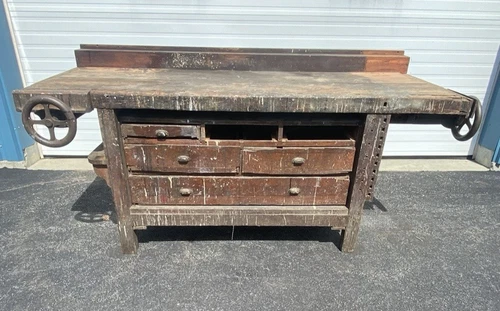
My friend JimM alerted me to this recent listing on ebay, for those of you with a hankerin’ to own a Studley-era piano maker’s workbench with two wheel vises.
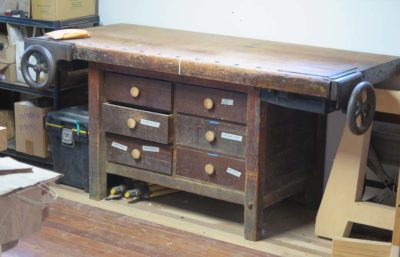
It’s remarkably similar to the one I own. Someday I will restore mine fully and pass it down to the next generation.
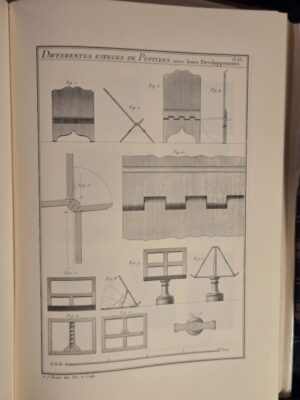
I’ll see your Roubo Plate 331 folding book stand and raise you about 1000%. Gotta see it to believe it.
Here it is.

We’re now in the middle of asparagus season. Yummmmm.
That is all.
PS My favorite asparagus treat” freshly picked asparagus, steamed and still hot, laid over a spread of Gulden’s mustard on a piece of still-warm sourdough bread toast, topped with a slice of muenster cheese melted over the asparagus.

Recently L’il T participated in one of the greatest American traditions and rites of passage; he started t-ball. Thanks to diligent practice with his loving dad (boy, did we luck out in the son-in-law department!) L’il T hits the ball practically every time.
We saw is first ever t-ball game last weekend and it was immensely entertaining. Describing it as “herding hogs on ice” would be accurate.
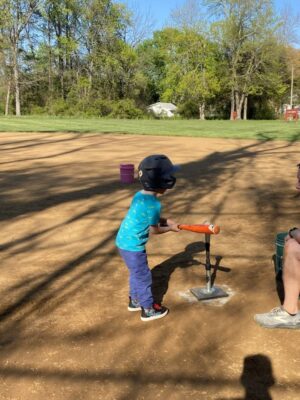
They’re starting them younger now, these tykes were 3 and 4. My brother and I remember playing t-ball at 7 and 8. I was an enthusiastic and pretty good player until late adolescence when my vision started going south. When your eyes can’t pick up the ball coming from the pitcher your baseballing days are over.

Last week I finally wrapped up processing all the windfall I’d harvested several weeks ago. The bounty was impressive, the cribs are three rows deep. The pile on the ground near the splitter are all the wonky pieces I will use next winter in the barn wood stove. The haul *should” get us through next winter when combined with the leftover wood still in the cabin firewood crib, but the harvesting and processing will continue through the summer and fall. When you heat with firewood, you can never have too much.
“What is truth?” asked Pilate.

Jesus of Nazareth died, proving he was truly a man.
Jesus the Christ walked out of the tomb like a boss, proving he was truly God.
There you go, Pilate.
Truth.
I’ll be one of the presenters at next month’s 2026 edition of Plane Wellness. If you are in the region of Butler PA May 16-17 and have the inclination, we would love to have you join us. I learned about the organization from a class student a couple years ago and wholeheartedly agree with their mission statement, Improving Mental Wellness Through Woodworking. And who could not use a little extra dose of mental wellness these days?
My presentation will include (of course) the finishing process and the beauties of polissoiring.
The list of presenters is impressive and include a lot of voices I do not know, so I am especially looking forward to being challenged, informed, and encouraged.
I hope to see you there.


Recent Comments