A Very Nice Taste of Plane Wellness
Rex Krueger has posted a very nice video snapshot of Plane Wellness’ Handtool Haven 2026, where I was one of the speakers and exhibitors.

Rex Krueger has posted a very nice video snapshot of Plane Wellness’ Handtool Haven 2026, where I was one of the speakers and exhibitors.
I didn’t need to make any more blocks of beeswax for the moment, so I concentrated on turning my purified beeswax into Blend 31.
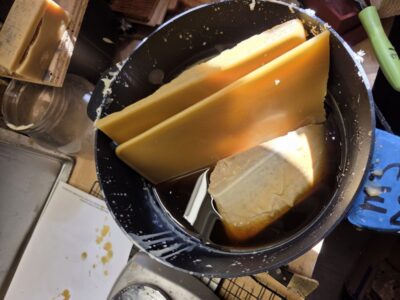
The preparation is indeed exotic (/sarc). I weigh out several hundred grams of shellac wax, then three times as much of the purified beeswax. It all goes into the cooker to melt together at a slightly higher temperature than is necessary for the beeswax alone.
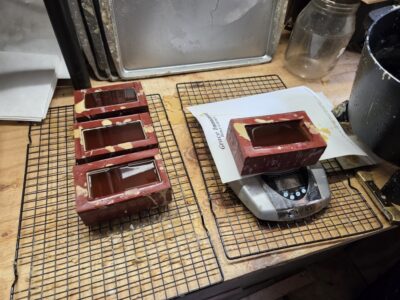
Once it was all melted uniformly I ladled it into the silicone molds I made a long time ago that have served me well all these years. Given the temperature of the room I can make a new pour every 30-45 minutes as the blocks cool and can be removed from the molds. They are still pretty warm at this point and need to be set aside to cool completely.
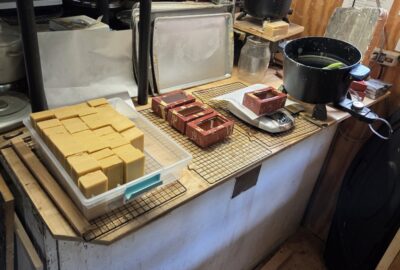
A good day’s production is almost 50 units. I make four at a time, and each extraction/pour takes about 5-7 minutes.
Now on to the wrapping and packaging of the wax to take it to Handworks 2026.
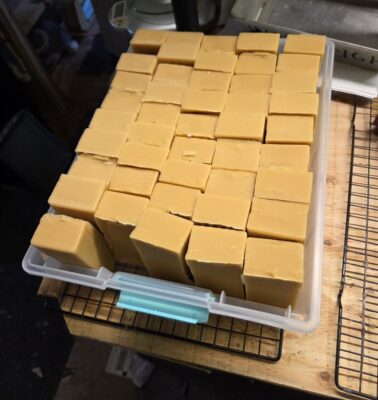
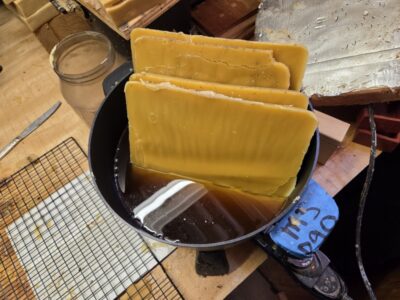
I re-melt the 75% clean blocks in my cooker and then filter them through my favorite medium for the task, Bounty *full sheet* paper towels.
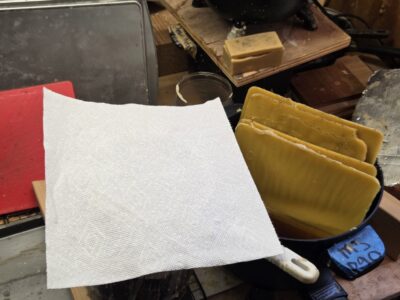

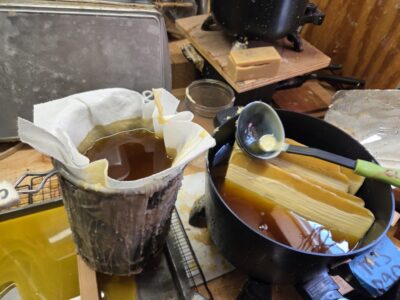
The paper towels are placed inside a kitchen pasta strainer for support, which is then placed inside a section of stovepipe that is held up on the edges of the cookie sheet, and then the molten wax is ladled through.

The output is drizzled into cookie sheets dedicated for that purpose.
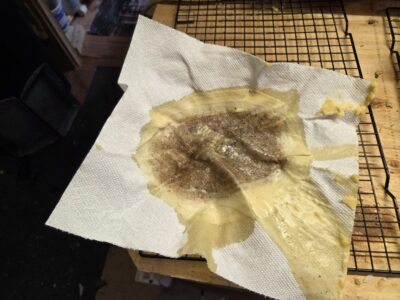
I replace the filter membrane for each new cookie sheet casting. This is what the used filter sheet looks like after one cookie sheet casting. This does not get discarded, it is re-used as a firestarter in the wood stove in the winter.
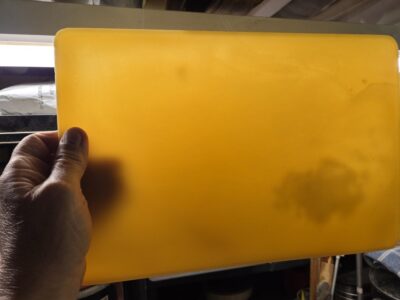
The result is a full-sheet roughly 1/4″ thick that is wonderfully clean and pure. Since the cast sheet is so thin it starts cooling immediately, resulting in an uneven thickness. It’s now ready for whatever comes next, casting the 1/4 lb. beeswax blocks, formulating and casting Blend 31, or playing with new concoctions.
Up next – Blend 31.
The latest installment of the forty-year-long conversation with my friend “retired” broadcaster Brian Wilson (who cannot shake the habit), was posted at his Brian Wilson Writes Substack. If you enjoy provocative strident discussions about forbidden topics, give it a listen. If you do not, don’t.
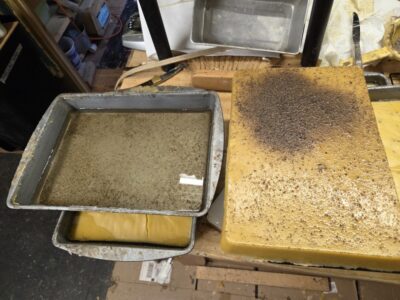
Once the molten beeswax cools in the cake pan after filtering for gross contaminates, the next day I pry out the now-solid blocks from the pan. The contents of the pan are in two phases, the water and the block of wax that forms on top of the water. By not disturbing the molten concoction once it is poured, the contents settle into their respective layers. That which is compatible with water goes into the water. That which is not water compatible remains in the wax block after having settled to the bottom of that fraction.
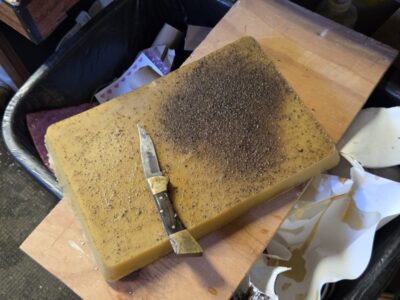
Flipping the now-solid block gives access to the contaminates that aggregate along the interface at the bottom of the wax.
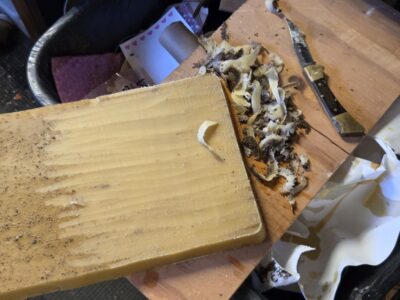
These contaminates are easily removed by ultra low tech methods; I simply scrape away and discard the bottom layer of the wax block that contains the particulate contaminate.
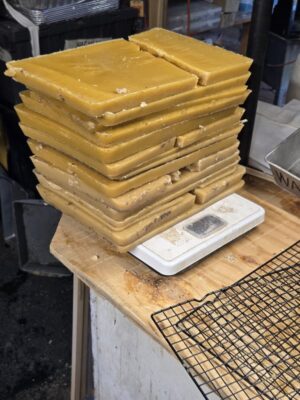
Behold, the almost thirty pounds of partly purified beeswax. At that point the material has had perhaps 75% of the particulates removed and is ready for the next step.
Stay tuned.
I spent a good deal of time and effort this past week processing beeswax and shellac wax in preparation for the upcoming Handworks 2026 in Amana IA over Labor Day Weekend. My polissoir inventory is lacking and my broom maker is struggling with some health issues so I do not know exactly how that will be resolved.
Since the shellac wax arrives already purified straight from the factory in India, all it needs is to be melted and cast in the silicone molds I made for this purpose.
The beeswax is a different story as it is the opposite of purified when it arrives. My end product is something that is purified using essentially old-fashioned technology.
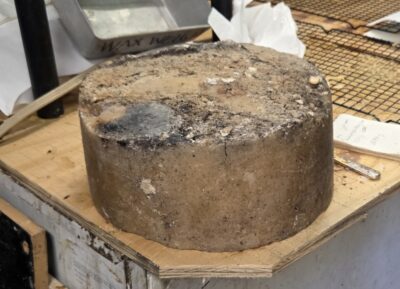
I start with a block of raw beeswax, straight from the honey processing plant. As I recall, the slang of the bee/honey trade is to call this mass of by-product “slum gum.” It’s got residues of honey, lotta dirt and bee body parts.
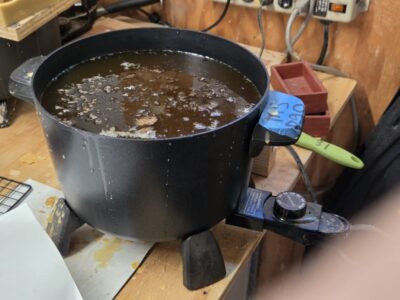
My first step is to break up the blocks of slum gum and melt the mass 50/50 in a water bath in my largest cooking pot.
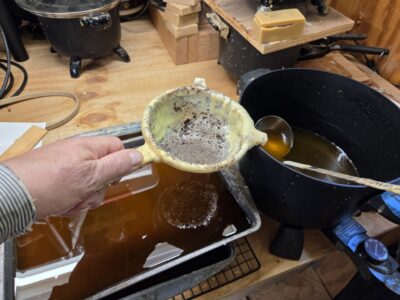

I then pour the molten mass through a kitchen strainer to get the larger particles and body parts out. Downstream from the strainer is a cake pan, into which the remainder goes to cool.

A day of work yields a stack of cake pans that cool over night.
Stay tuned for the second day.
I’ve got a 12-inch radial arm saw down on the first floor of the barn, but it has not seen one second of activity since it was moved here thirteen years ago. I’m just not doing anything that makes it necessary. However, on the second (main) floor I’ve got a 10″ chop saw that gets used regularly to make long boards shorter for whatever reason. For some tasks I use the cross-feed sled on the table saw but far more frequently I’m just chopping something up.
One of the great features of the chop saw is that it is quick and easy. One of the lousy features is that it made a huge mess even when I hooked up the “dust collector” outlet to the shop vac. Even when everything was hooked up properly sawdust went all over the place and it required a local cleanup with every use.
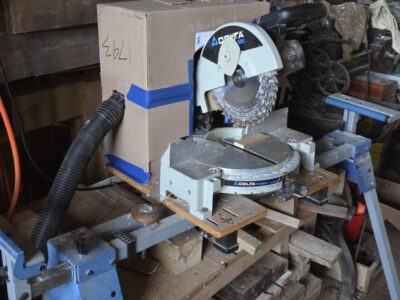
I finally got tired of this nuisance and made and installed the lowest possible tech solution, which reduces the sawdust cloud by about 99%. I looked through my mountain of boxes piled up on the third floor and found one that fit my needs. Equipped with a utility knife and a roll of masking tape I fabricated a box shroud to fit over the back side of the saw, complete with a port for the shop vac hose. At this point the only thing missing is a fitting to glue to the portal for plugging in the hose, but even with just a rough hole cut in the side of the box the collection is magnificent.
The Abraham boys and their posse are at it again and Handworks 2026 is barreling down the pike. It will be Friday and Saturday of Labor Day weekend, in the lovely village of Amana, Iowa. I’ll be there again close to dead center of the Festhalle, hawking my wares such as they are. Polissoirs, beeswax and shellac wax, videos, and original c. 1765 Roubo prints, etc.
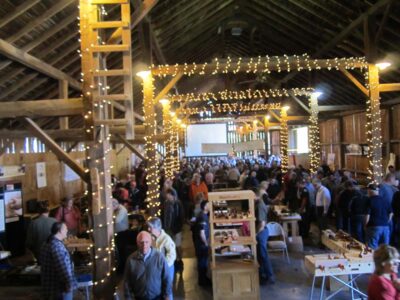
The Festhalle from Handworks 2013
It’s the most amazing tool festival of hand woodworking you will even encounter with visitors and makers from around the globe if the tradition holds.
I’m already ramping up my truckload of stuff to take with me, at the moment creating a pile on and under a workbench I will be taking and making wax processing part of almost every day from now on.
This just might be my last long road trip other than family priorities. We just don’t have the oomph for drives like that anymore.
I love tales like this. I knew of an instance in some southern swamp where they discovered an ancient sunken cypress trunk that was so valuable the salvage company had around-the-clock guards protecting it until they could find just the right buyer who had just the right project. I vaguely recall it went to a developer who was going to use it in all the public spaces is a huge skyscraper somewhere. I think the dimensions of trunk were 48+” diameter at the top and 180-plus feet long. That’s a mighty big tree.
I’d heard the asking price was $7 million.
Many years ago back in Maryland we had a micro-burst that uprooted a number for mature tulip poplar trees, the largest of which measured 24″ in diameter at the first branch, which was at the 60-foot mark. I was unable to find a sawyer willing to deal with it, so given the cycle of life it has now gone back to the earth.
© 2024 Don Williams

Recent Comments