With all the disruption of two robust independent electricity producing systems going belly-up at the same time I decided to add another producer into the mix, is essence to modify the “two is one and one is none” rubric for logistical planners into “three is two, two is one, and one is none.” In the absence of the hydro and solar electron hamsters I relied on my gas powered generators and a bunch of extension cords.
I decided to contact the local electrician to see if he could wire the generator into the service panel of the barn, and he suggested instead wiring it into the power system at the bottom of the hill, alongside the electrons provided by the hydro and solar units. I got a quote, smacked my forehead and said, “Of course!”, and authorized the work. Plus, since there was already a buried cable from the powerhouse to the cabin, could he perhaps also wire that into the system? Sure, he sez.
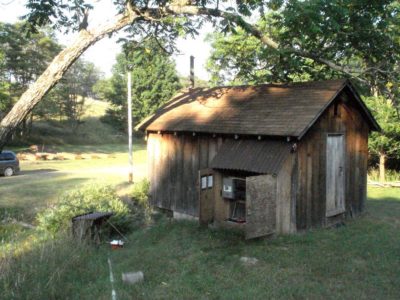
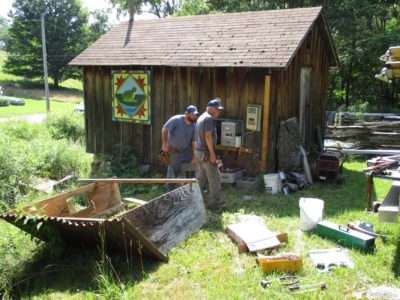
The day came when he and his son, also an electrician, arrived to do the work. The first step was to clear the work area, which translates into “ripping off the raggedy shelter over the electronics closet.” I’d been wanting to do this anyhow in order to build a more proper enclosure for all these components so this was the time.
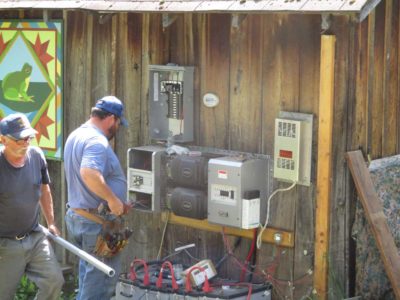
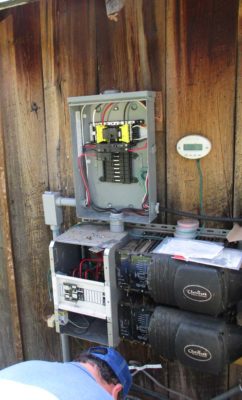
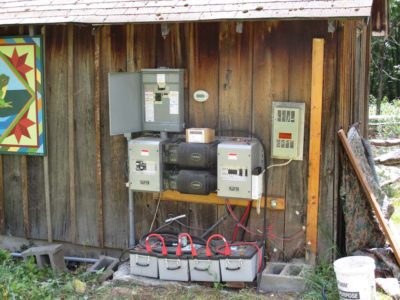
In no time flat they were abuzz with work, installing a new sub-service panel to provide for vastly improved current distribution.


After a bit of time they separated so one was completing the sub-service box to serve as a new router for the electricity and the other was making the modifications to the service panel inside the cabin, alowing it to be powered by the same auxiliary system.
By lunchtime they were finished and I test drove the system in all its iterations available at the time: inverter/battery bank power to the house or barn, gas generator power to the house or barn.
Brilliant!
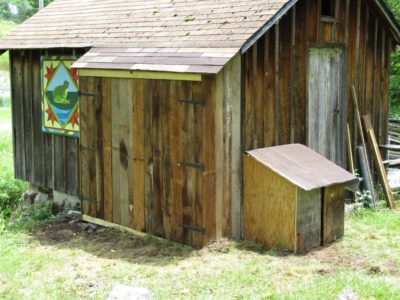
I spent a couple days making more proper housings for the system electronics and the generator and this chapter was complete.
This is a rare blog without pictures as there is literally nothing to show. It’s almost like Claude Rains telling you to move along because there is nothing to see. But it is not without exciting information (to me, at least).
The return of the hydro turbine core last week was a time of great celebration. I am delighted that I decided to return that unit to the manufacturer for the replacement of the rotor bearings; I did not want to be learning-on-the-job by trying something I had not really done before – replacing the bearings on an expensive, high-stress high-precision delicately balanced machine. I know that come a zombie apocalypse I will have to do it myself or find someone locally who can, so I purchase two extra pairs of the sealed bearings necessary for the task. Given existing performance projections that gives me another 25-30 years of functionality to the unit.
Reassembling the turbine unit took almost no time, 10-15 minutes or so. Reinstalling it into the system took about the same amount of time. Tracking down the location of the breached water line from unrelated storm damage that had occurred since I dismantled the turbine took the longest. A tree branch had fallen and cracked the penstock (the 2″ PVC pipe from the water capture to the turbine) disrupting the water flow to the turbine, and once the damage was found the repair took only a few minutes. I keep a good inventory of repair parts on hand since my water line is above ground, snaking through the forest for almost 1200 feet. I would love to have the water line buried but with our climate, topography and geology it would require digging a three-foot-deep trench a quarter mile in rocky sub-soil. Until I inherit a new family tree with gobs of money I will make do with the status quo.
Once the system was all together and running I knew instantly that something was dramatically different. For starters, the turbine unit was so quiet I turned it over just to make sure it was running! For the previous nine years ever since the system was installed, when the turbine was operating under full load it produced a whine that was distracting for quite a long distance. Since it was that way from Day One I had no idea it was not supposed to be so. But now? Eerily quiet, just barely audible even at the stillness of dusk. Although I know what to listen for I still have to strain a bit from the front porch to hear it working.
A second observation was that the output of the unit had increased a fair bit. I have not yet installed the new digital metering unit for that part of the system, but I can tell the difference in the integral monitor which is nothing more than a blinking light indicating the input current to the charge controller. All I can say is that it was blinking about twice as fast as I had come to expect for that particular water flow.
I wrote back to the fellow who replaced the bearings with these observations, and asked him if he noticed anything during his work (he succeeded the previous owner of the company since I purchased my unit a decade ago). He confirmed that he noticed one of the bearings was not seated properly and he took special care in aligning everything correctly. It appears that the misalignment caused both a whine in the turbine in operation and also some substantial drag on the turbine rotor shaft. Hence the “new” turbine is both quieter and more efficient in operation.
Who knows? Maybe the properly aligned bearings will last 20 years instead of 8-10.
Needless to say I am thrilled with this outcome, and await the developments in the solar panel controller malfunction situation.
Among the few public observers to whom I pay attention, Nassim Nicholas Taleb has a place at the table if for no other reason than his monumentally insightful book The Black Swan: The Impact of the Highly Improbable. Now, change gears to the old insight from the military logistics and supply realm, “Two is one, and one is none,” an exhortation on the value of redundancy for important operating systems and supplies. Well, that particular old black swan bit me in the nether regions recently as I found that I’d better start with a bigger number for electricity supply.
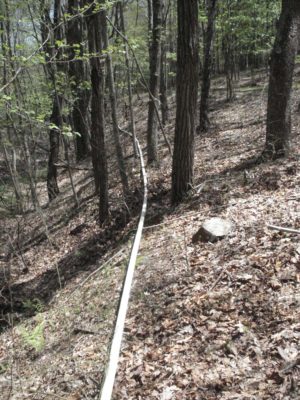

Since becoming my own Power Company for The Barn there have always been hiccups; a connection or section of water line breaks, storm debris clogs the hydro system intake or turbine nozzle, even a nearby lightning ground blowing the fuses on the solar array. In these cases the interruption of one or the other power source is not an activity-stopping hurdle, although it can be a bit of a nuisance and interruption to address.


In essence my system is a hybrid of the microhydrolectric turbine generating power 24/7 through much of the year, along with the array of six 235-watt solar panels cranking out juice whenever it is daylight and they are not buried under snow. When you are your own public utility, maintenance is never far from the “To Do” list.
My two electron sources are tied together in a complex control system designed and installed by Rich at Nooutage.com and my friend BillR, a retired electrical engineer with a robotics specialty. For the past half dozen years or so it has been humming along, providing all of what I need in the barn for general usage. Even in the dead of winter, when I have the hydro system mothballed during the coldest weather, the solar panels keep the batteries charged and I can operate pretty much normally if I am the least bit attentive. If I know I need to use a lot of electricity with a machine or a heating coil (processing beeswax in cookers, for example) I know I need to wait for a nice sunny day.
When I have a particular need for ultra high wattage consumption, like my smelting furnace of kiln, I have to fire up the smaller (3500w) of my two Coleman Suburu generators for that isolated need.
Flash forward to three weeks ago as we were spending a day in the studio recording another session for the Gragg Chair video. I had checked the system the night before as I do routinely, and it was working fine. Batteries were topped off, solar panels pounding out watts, hydro puttering along. (On a normal day each of the production components produce somewhere in the neighborhood of 5kwH, higher on a sunny summer day). Just as I was coming to the end of a session of steam bending some chair parts the room went dark. Quickly I hustled down the hill — I do not run any longer since breaking my hip three years ago — and saw that the system had shut itself down for no apparent reason. It booted back up manually, but still the work for the recording session was lost.
I was leaving town the next morning for a week so I put off conducting the investigation of the hiccup until I got back.
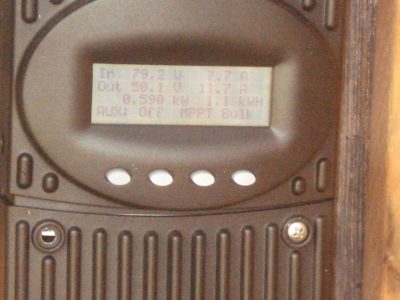
what it should look like
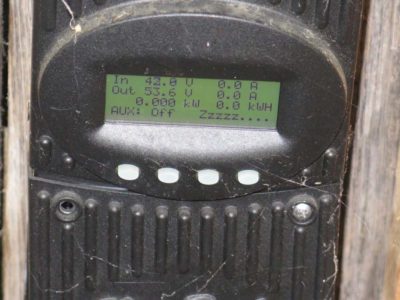
what it did look like
On returning I was able to confirm that the solar panels were contributing zero to the system performance. It. Jjust. Went. To. Sleep. The hydro turbine was still working as it should so the overall system function was adequate, but several days of chasing down the solar inactivity proved fruitless, despite numerous emails and phone calls with BillR, who assigned me several detailed troubleshooting tasks, and literally hours on hold with the tekkies at the solar control module manufacturer.
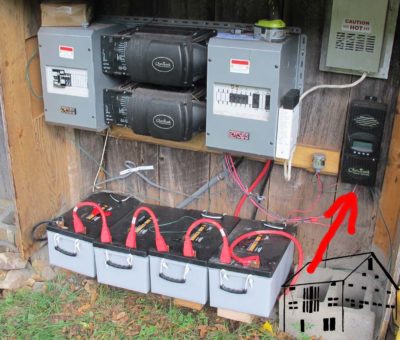
In the end the tekkies told me there was some sort of hardware failure and I needed to disconnect the solar control unit and send it to them for their ministrations. So I did.
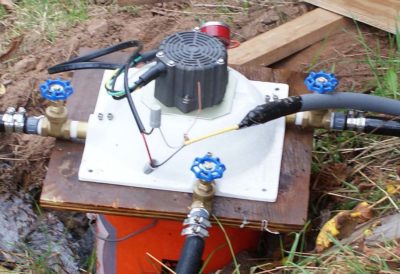
As all of this was unfolding, the hydro turbine suddenly (literally overnight) developed the growling rumble of worn out bearings. I took it off-line as soon as I noticed this, dealing with two $15 bearings is one thing but letting them run to destruction might have damaged the $2k turbine and that was not high on my list of risks to take. After speaking to the turbine manufacturer I decided to remove the turbine core and ship it back to him for new bearings. Replacing the bearings myself was not really an option as I do not possess some of the specialized tools required for the job, although I will have to address that shortcoming in the future.
Quick as a bunny I was without any power system input to the barn and things ground to a halt, including cancelling/rescheduling the Boullework Marquetry workshop that was slated for this weekend.
For now all I can do is wait on the turbine manufacturer to return the turbine core with then new bearings and hear back from the solar control module manufacturer for a report on that unit, and contact the local electrician to come and wire in my gas generator to the system.
I clearly need for “2 is 1” to become “3 is 2,” or maybe even “4 is 3.”
Stay tuned.
In a true Black Swan event both my redundant power sources failed at the same time. Maybe I should have called Nassim Taleb first.
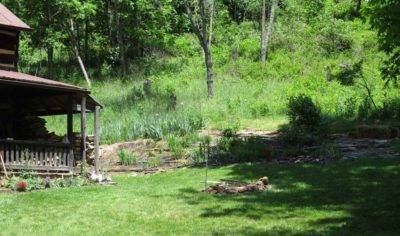
Mrs. Barn has been especially plagued this year by the wildlife endemic to our remote mountain retreat, most especially the bunny rabbits coming to nibble off the tops of her flowers in the bed she has been cultivating for many years on the hillside adjacent to the cabin.
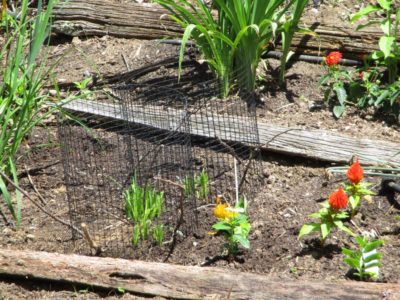
To mitigate the problem I made several cylindrical enclosures from 1/2″ hardware cloth to fit over the plants under attack, painted them black to make them less visible and placed them where they needed to be. In fact they are nearly invisible from a typical viewing distance, and so far they have done their job.
Now we are hoping the deer don’t take a liking to these plants. That might take, um, a more impactful pyrotechnical response.
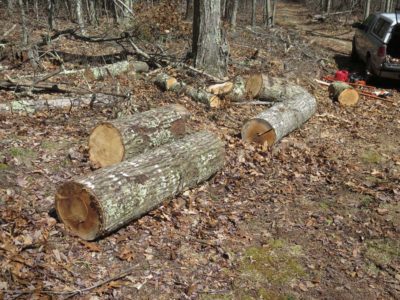
As we settle into the routine of life on the homestead it becomes ever more clear that it is always “firewood season.” We made it through the winter with a large amount left in the re-filled crib, having gone through the complete supply in the side crib and the front porch, refilling the former two months ago in case it was needed. It was not.
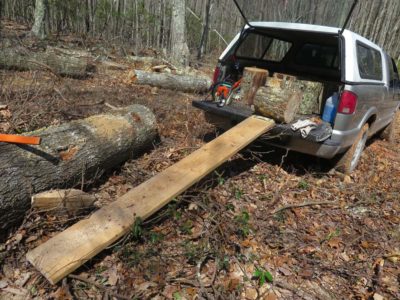
But still there are at least a half dozen large trees on the ground up in the woods, trees we felled last summer and simply awaiting my further ministrations. Now on nice days, and by that I mean “dry” days with good enough traction to get the truck up the mountain, I section and split a ton or two of firewood. I discovered a useful implement for the task, a ramp. I found that rolling the bolts of wood into the truck was dramatically preferable to hoisting them.
D’oh.
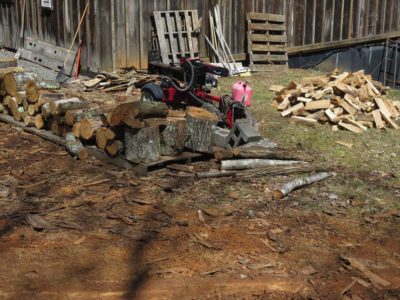
I enjoy reflecting on the fact that my goal of having two years’ worth of firewood ready to go at the beginning of winter might be fulfilled by autumn of this year. Plus, I am noting that late winter is the time to forage for firewood as the naturally fallen trees are so readily visible, as are ailing trees to be harvested this summer. I look forward to growing the pile to the size of a truck in the coming days.
Now, it only I could persuade Mrs. Barn of the need for a John Deere Gator or something similar. For the firewood. For the children.
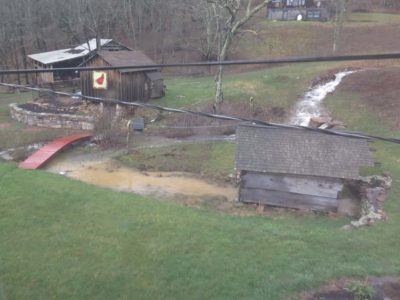
Last Sunday night we had torrential rains overnight, and this was the sight greeting me the next morning. The roar of the water was almost deafening, and we were hoping for a warm sunny day to help dry things out. It was not to be, as the day remained cold with snow flurries in the air all day long. There was no damage to the homestead, and the flow over the spillway ceased late in the afternoon.

The flurries kept up all night and in the morning there was a total of almost two inches on the cars.
Doggone winter is hanging on tenaciously.
Recently I was reviewing the manuscript for Joshua Klein’s great new book about polymath and furniture maker Jonathan Fisher for Lost Art Press as I had been asked to write the Forward. The book is an excellent reading and learning experience, and one of the descriptions of Fisher’s day-to-day life caught my particular attention. In addition to everything else he had to do was the onerous task of obtaining many tons of firewood requisite for each Maine winter.
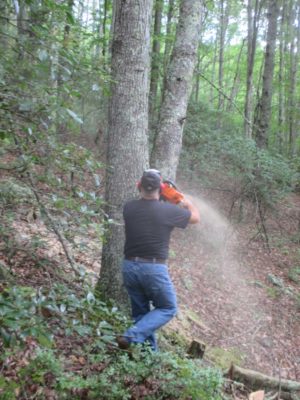
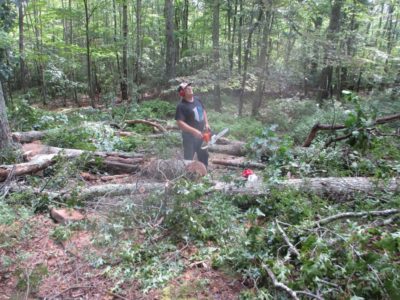
My friend Bob, who is a lifelong timberman, came for couple hours a few months ago and felled more than a dozen large ailing trees that had been damaged over the years. His help is incalculably important as I simply do not have the experience necessary to fell very large trees with confidence, while he has felled literally tens of thousands of trees and manages to drop them safely right where they need to go. Among this year’s prizes was a wonderful old oak with a long, straight trunk, that had been damaged in a storm last winter. I’ll be splitting and riving that one in a few weeks, I hope. More about that later.
Sometimes we just go where the trees are, but I am particularly interested in thinning the woods to the south and southwest of the barn to perhaps extend the daylight portion of winter days by an hour or more. Currently I lose direct light by about 3PM and I aim to push that to 4 or 4:30. That will be the best I can hope for unless we remove the crest of the hill occupying that space.

Once the trees are on the ground I can then return at my leisure to cut them into bolts and haul them down the hill. Inasmuch as I have the same objective as Jonathan Fisher, gathering tons of firewood each winter, I am more than delighted that almost a century ago the good folks at Stihl, Dolmar, and Festool worked independently to provide us with what we now have as the modern chainsaw. Ditto whoever combined a gasoline engine, hydraulic piston, and steel wedge to create log splitters.

With the side crib completely full with a double course of wood and the front porch filled with only a walking path to the front door we are ready for winter. I’m now working on my firewood pile for next winter with hopes of eventually getting a couple of years ahead. It’s the mountain way.

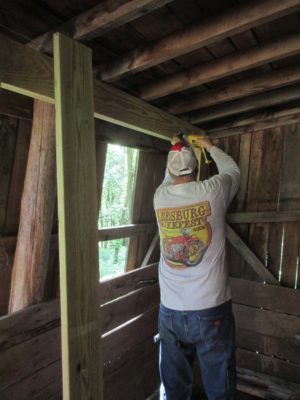
With the shed roof line as straight as we could get it (there was still a tiny bit of dip but I was fearful of literally tearing the building apart if we went any farther based on the screeching coming from the building itself) we began the steady process of assembling in-place the laminated post-and-beam to replace the sagging wall.
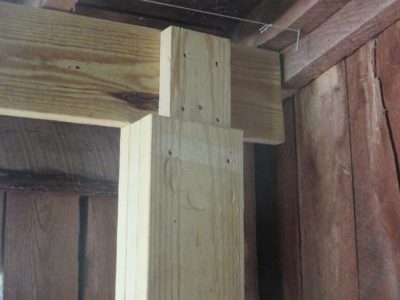
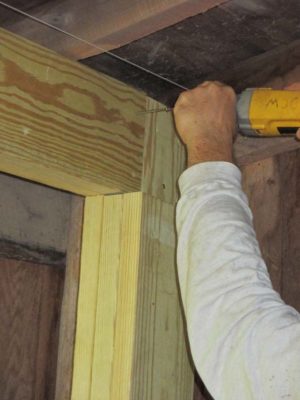
We started by assembling the posts complete from three laminae of 2x8s with the center board being off set the width of the beam dimension and notched a couple of inches to serve as the tenons so that the beams could be assembled in-place fairly simply. This also provided good purchase for the concrete we were using as the footer ex poste.
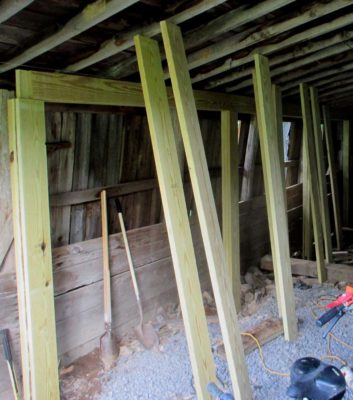
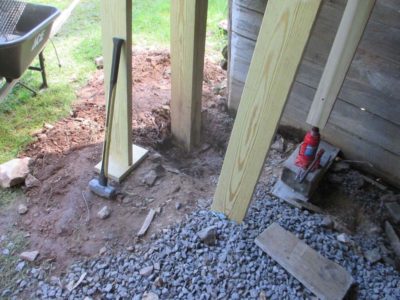
Since the rear corner being the highest, we shot for everything eventually becoming level with it. So as the posts were constructed moving forward, we had to dig out holes in order to make all of them the same length. Once the structure was complete I began the gentle lifting of the front corner with a post and hydraulic bottle jack. Even I was astounded to recognize that the front corner needed almost 16-inches of raising to get everything level-ish.
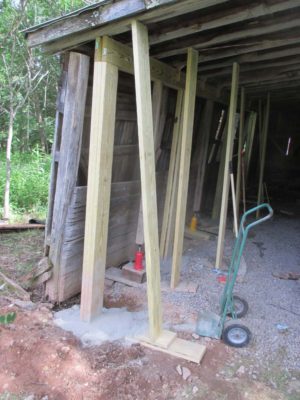
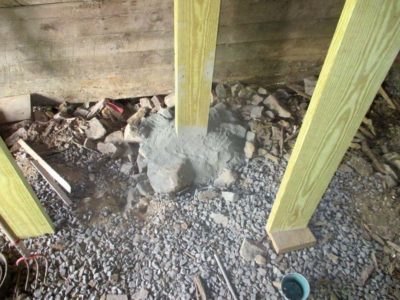
With that I filled each footer hole with dry concrete mix, and old trick I learned from a deck-builder friend of mine, who said that you could use dry concrete in holes like this and it would absorb moisture from the ground and set in fairly short order. I have used this method numerous times in the past and it turns out he was right.
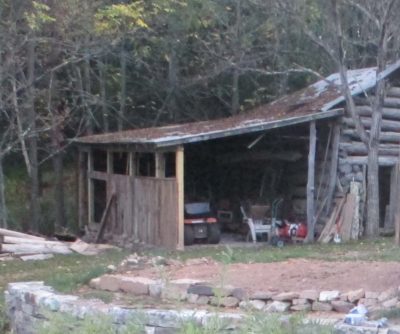
The following week I dismantled the original wall and salvaged almost all of the material to use as the new 3/4 wall. That new configuration, along with the new structure, has transformed the space from a sagging, foreboding cavern into a robust and airy storage space for the tools and machines necessary for maintaining the homestead. For the moment I have left the rear section of the wall un-built as we are debating the desirability of a door opening there.
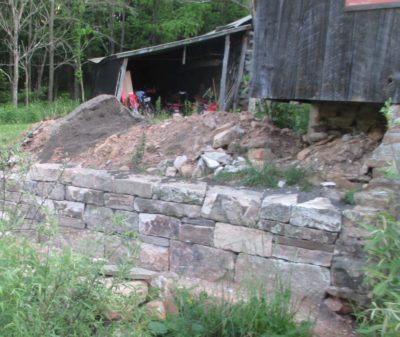
Back in the mezozoic era when I was in college, I hosted a late night jazz show on the college station. My theme song was a Dave Brubeck piece (as would be the case with any civilized person in that situation), in this case Unsquare Dance. For whatever reason this tune, or more precisely the title, leaped into my head when I first saw the juxtaposition of the new and magnificent stone wall with the whomperjawed lean-to attached to the ancient log barn behind the root cellar/granary. I’d always recognized it was a bit off-plumb, but goodness the comparison was sobering. My desire to get it straightened out needed to become action.

About that time my younger brother came for a week-long visit. We are pretty much two peas in a pod, although he is a better marksman than am I. He is an excellent carpenter and builder, so once I knew his schedule I ordered some 2x8x8′ pressure treated SYP to use in building the new wall structure.
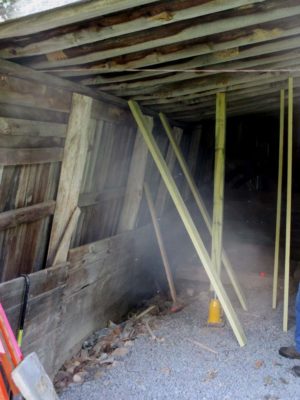
The strategy was to assemble stick-built laminated beam to serve as the top plate for a post-and-beam configuration, about a foot inside the original wall. But first we had to jack up the roof to some semblance of planarity, which we accomplished with hydraulic bottle jacks and extra 2x8s to wedge the roof to the height we wanted. It took a day of gradual lifting, but we finally had it ready to work on. The foot worth of swale was as gone as we could get it, and it was time for the hard work to begin.
The final day of bridge building involved cutting, painting, and installing the decking, which was made from the same 1×6 material used for the beams. Prior to installing the decking I mounted electrical wires to the underside of the structure. These are the wires that 1) carry electrons from the solar panels on the cabin to the power system, and 2) will eventually carry electrons back to the cabin from the system.
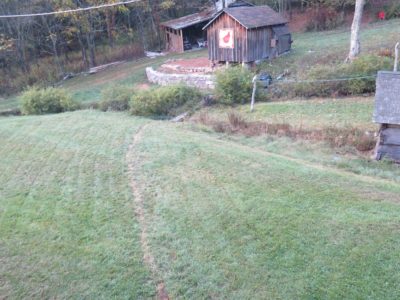
Before
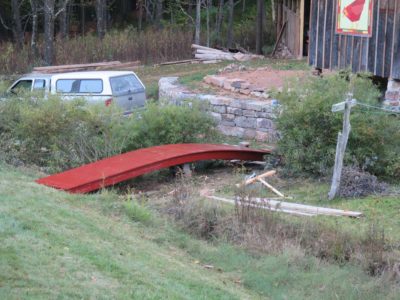
After
A little debris clearing, including the old plank walkways, and the job was done for now. I’ll let the paint weather a bit, then wait for a warmer sunny day to sand it and apply another coat of paint, sprinkling the sticky paint with play sand to give it better traction.
Between the new stone wall, arched bridge, and new wall on the lean-to on the old barn (more about that later), the vista from the side deck has been transformed.


Recent Comments