Three Saturday’s ago I went to our friends Pat and Valerie for their annual apple butter day. It’s a local tradition that we have gladly glommed on to.
Great fun and fellowship abounded.
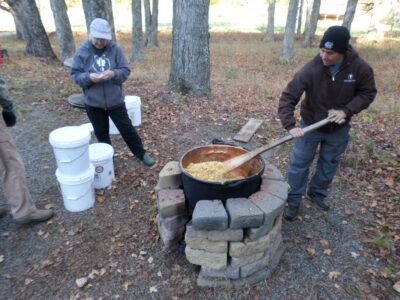
At the start, apple chips are just dumped into the copper cauldron and stirred with a canoe paddle.

There is a lot of standing around while we watch the person with the paddle. This is where the tall tales and gripes about taxes emerge.
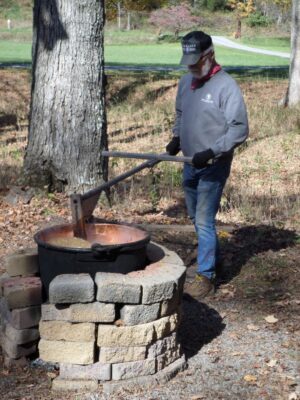

As it cooks down more apple chips are added and the stirring switches to a custom designed stirring paddle.
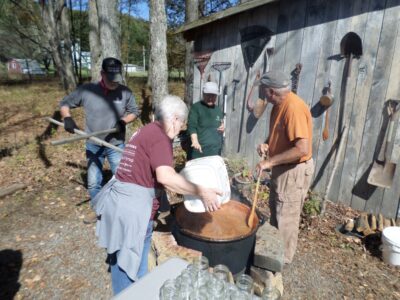
Hours later it is all cooked down and ready for adding the spices and sugar. Occasionally they make a batch of sugar free apple butter, that is the stuff we like. But this was a sugared batch.
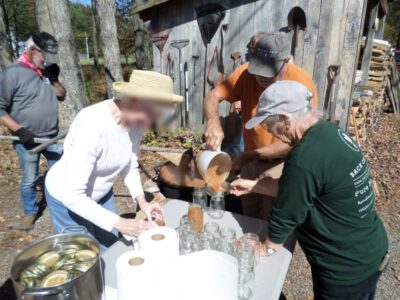
Once that is all cooked and stirred some more, Pat conducts an “all finished” viscosity test by depositing a dollop on the underside of a sauce pan. Too runny? Cook some more. When it is ready it gets canned in jars.

At this point my job was to carry the cases of still-hot jars into the sugar house for later labeling and, eventually, selling.
The big highlight is that after all the work is done, Pat’s sister breaks out the bin of fresh, still-warm biscuits we use to scrape the residue out the cauldron. The moaning of delight commenced.
Mmmm, mmmm, mmm.


With stout posts driven 36″+ into the ground I was ready to move forward and ordered the requisite 1/4″ hardware cloth to cover the entire floor space (to keep out all the little rodents that make Mrs. Barn’s gardening life one of frustration) and the pile of 2x8x10′ PT/SYP to build the knee walls and other components. Now that was a shock, as the price was 3X more than the last time I ordered any meaningful quantity of construction lumber. Those who are Inflation Deniers clearly do not comprehend either the definition of the term nor its manifestation. But Don, are you saying you are smarter than the President and Secretary of the Treasury and Chairman of the Federal Reserve and all those other “experts”?
Yup. Why that is would be another blog post, or better yet, in some other universe of discourse. Hint: it all boils down to the “Austrian” strain of economics.

I laid the hardware cloth and began screwing the 2x8s to the posts. I bought enough material for a four-course wall but Mrs. Barn decided three was better, so I managed to build my reserve inventory of that supply even more.

With the three courses in place, I fired up the chainsaw and lopped off the posts at the top of the knee wall. Carpentry by chainsaw is definitely a thing. Those scraps will become bench legs in the greenhouse configuration.
Setting the edge with string I lined up all the sill plates on top of the walls and posts, readying everything for the addition of the cattle fence panels that will form the arched roof structure.
Stay tuned.
We are smack-dab in the middle of a fortnight-plus stretch of simply spectacular weather, sunny days in the 60s and nights in the 30s and 40s. we are taking full advantage of the opportunity to get tons of outside work done. Matter of fact I have not been in the shop for nearly three weeks other than to package orders for mailing out.
Thanks to our connection to a stout young local lad, we’ve been able to keep up with the routine yard work much better than years past. One of the things we really appreciate is his mowing of the large hillside area directly above the garden. It keeps the underbrush under control and the expanse of green is a delight.
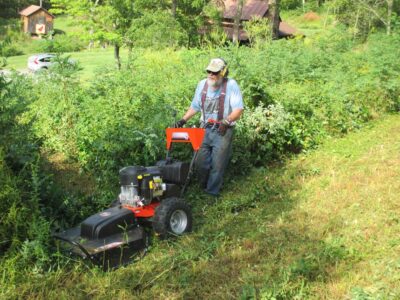
A picture from eight years ago when I first got the beast.
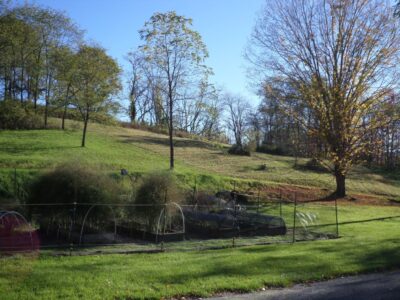
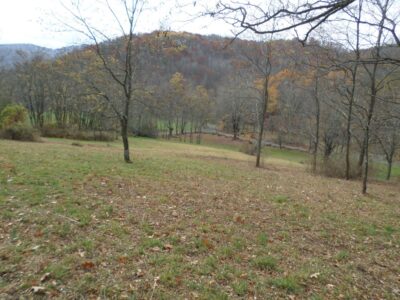
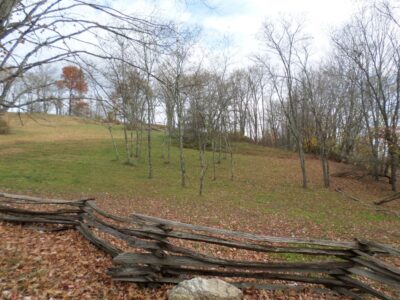
In order to expand that vista and perhaps make more space available for other things, an orchard is in the discussion, I spent several days with my DR Brush Mower whacking away at the ~4 acres of hillside adjacent to this mowed area. It’s the brown-ish area just beyond the green. I can only work on this about every third day as my shoulders need a lot of recuperation time these days.
For the first time since we bought the property almost 25 years ago that section of hillside is all cleared except for the woodland we are keeping. With this step our young fellow is certain he can keep that area mowed as well. There is definitely a difference between a cautious old man with a $4K lawn tractor and a fearless 16-year-old with a $10K lawn tractor.
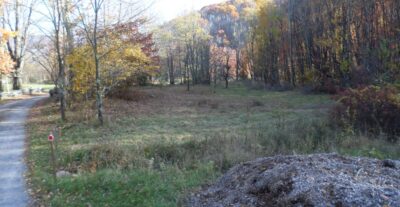
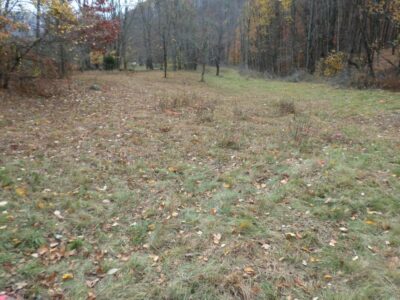
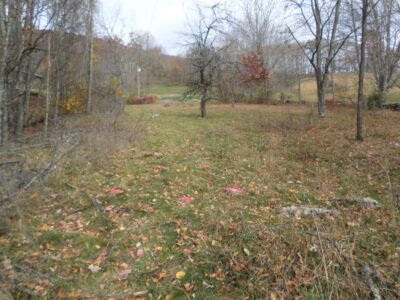
In addition I cleared a 1-1/2 acre section between the driveway and the creek, an area we always called “the orchard” since there were a few apple trees there. That field is chock full of large rocks and I walked it ahead of time, marking each big rock with fluorescent spray paint. It was still several hours of arduous work, with many more hours of work yet to come.
Because of our brutal drought this gardening season (no meaningful rain from April until September) Mrs. Barn spent untold hours delivering water to her thirsty garden, generally twice a day. Some of the plants still suffered but still she managed to grow and gather quite a bounty.
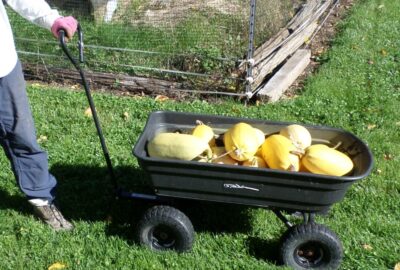
Here is a wagonload of spaghetti squash, one of our favorites. Maybe enough for all winter.
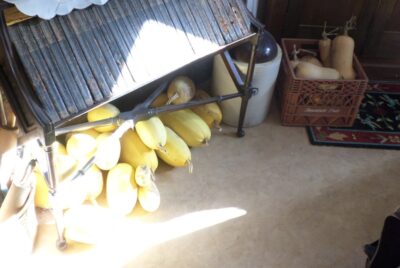
The winter’s inventory of squash resides under the vintage encyclopedias in the dining room
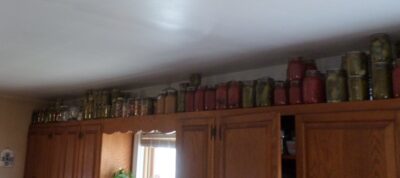
And a portion of the canned veggies and salsa.
We are very much looking forward to next gardening season with the new greenhouse fully in service. Real construction begins tomorrow!
Last Saturday was an exciting eventful day at the homestead as a long-delayed project got off the ground (well, in the ground).
A few weeks ago I was chatting with my friend KC about our way-behind-schedule plans for building a greenhouse on the terrace we had cut into the hillside two years ago. From my perspective one of the big hurdles was building up the enthusiasm and energy to dig 14 three-foot-deep holes for the 6-inch fence posts I was planning on using for the foundation to the knee-walls.
“No problem,” sez KC, “I’ll just bring over my post driver and we will get it done in a snap.” As a farmer/rancher with probably miles of fencing, KC owned a portable pile driver. It probably should not have surprised me, but I actually did not know such a machine ever existed.

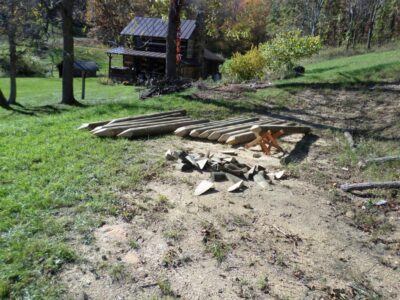
Last week I laid out the greenhouse footprint and cut points into one end of the posts. This made it much easier to get them into the ground straight, provided we didn’t encounter a large subterranean rock during the driving. Ironically the first post was the only one that drifted crooked during the whole process.
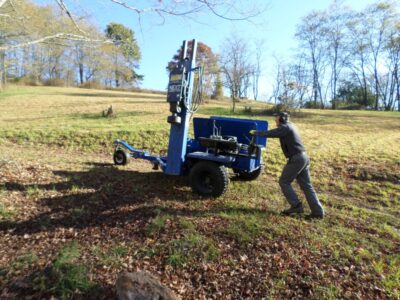
He showed up at 9AM as promised and left around 90 minutes later. I suspect it would have taken me a month or two to accomplish the same work by hand.
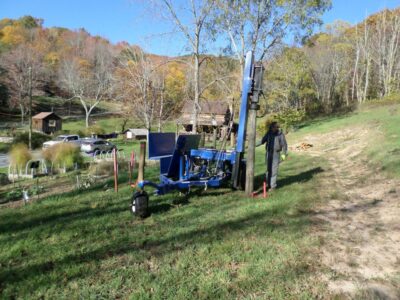
We placed the posts where I had marked the ground, set up the machine to capture the top, used a level for both the X and X’ axes, he threw the switch, and the ground started shaking. BAM, BAM, BAM with the speed of a jackhammer.

Like I said he was done and out the driveway about 90 minutes later.
The project will resume as soon as I can get a truckload of pressure treated SYP delivered to build the knee walls.
Well, at least for one small slice of my life.
Given my forays into the woods for cutting firewood I must necessarily haul all the tool requisite for the task. For a full day or two or three of cutting this includes stuff like cant hooks (the tools for rolling over logs), ropes and blocks for yanking on large logs, lotsa fuel and bar oil, and sometimes sledge and wedge and occasionally even a digging bar to get a big rock out of the way. And there are lots of rocks as they are this region’s dominant agricultural product (just kidding, it’s cattle).
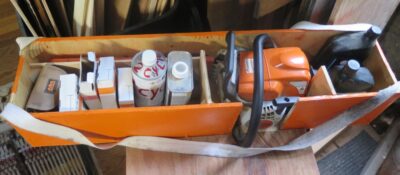
But there are other times when all I’m doing is a couple hours of clearing the understory or clearing a path to a larger trove. This is especially the purpose of my new box.
A fitted plastic case for my chainsaw is useless for anything other than protecting the chainsaw. I wanted to chainsaw container to do a lot more. At the same time the molded plastic case has the advantage of being lightweight and I like that feature a lot. To accomplish this I made the box out of 3/8″ plywood, not as light as the molded plastic but light enough. Combined with glue, glueblocks, and lots of triangulation it is a tough, stiff, “lightweight” carrying container for everything I need for a brief chainsaw session.
The box holds my chainsaw with a quarter inch to spare in length, four replacement chains, two quarts of lubricant oil, two quarts of fuel, my gloves, some sharpening tools, a roofing hatchet, ear muffs, Kevlar chaps, and probably a couple more things that do not come to mind right now.
BTW, the box is painted orange not out of Stihl brand loyalty, but rather I paint everything that goes into the woods with orange paint so I can find it quickly when I mislay it. Which happens a lot.
About once a month I walk up in the woods, almost always incorporating a survey of the microhydroelectric waterline. About three weeks ago we had a frog-choker of a rainstorm, probably the residue of one of the tropical storms. Since it had been very, very dry this summer I was looking forward to by hydro turbine picking up the pace, but instead it stopped altogether. I knew what that meant and so last week I trudged the quarter mile to the top of the systems to find the problem. Every time I service or repair the system it requires about four trips up and down a quarter mile of uneven terrain with a 10% incline. Quite a workout.
I’d hoped it was just leaf cloggage, but there was nothing wrong at that end.
So down into the ravine I went to gingerly navigate my way to the bottom and find the problem.

Here it is. During the rainstorm a tree came down and cracked the PVC penstock. PVC is comparatively cheap and easy to work with compared to polypropylene, but it is also comparatively brittle and I encounter some sort of break a couple times a year.
So I grabbed my penstock repair bag and returned to the scene of the crime, after first walking to the top again to turn the entire system off. I cut out the damaged area and grafted in new pipe with couplings and PVC cement, and in a jiffy it was as good as gold.
You might ask why I have my pipeline sitting above ground rather than buried. Well, given the nature of the terrain I can give twenty five thousand reasons, all of them named “Dollar.”
This year I am thinking about a deep dive into configuring the water line system to enable it to work all winter long. Gotta get the incline perfect, though.
Stay tuned.
Around this time each year I try to get the following winter’s firewood processed (e.g. 2025/2026). Fortunately I was being visited by my brother for a week, so we knocked out many tons of wood. Adding a second person to the crew does not double the productivity, it quadruples it! Especially when the second person is younger, bigger, and stronger than I am.
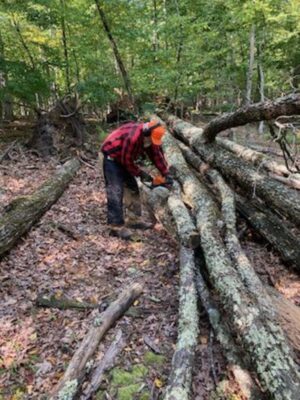
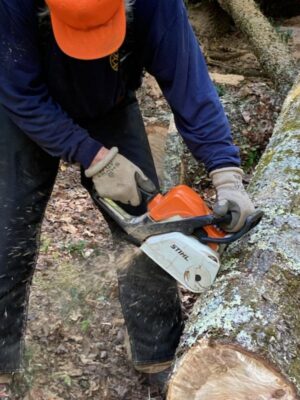
We spent three days working together, beginning with harvesting a cluster of four large-ish trees that came down in a wind storm a year ago. It was a near-perfect blend of trees/woods; maple, white oak, locust, and birch.
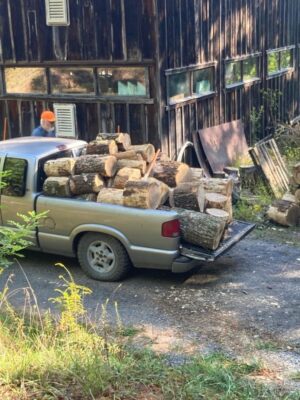
After first cleaning up the brush-y ends of the trees we just worked our way up the trunks, cutting them into ~16″ bolts. By the time my little S10 was loaded fully, it was definitely a low rider.
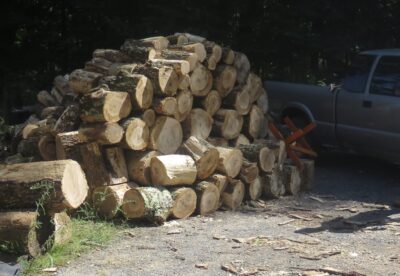
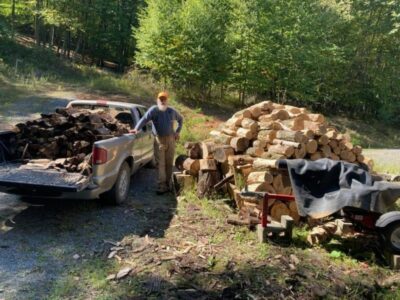
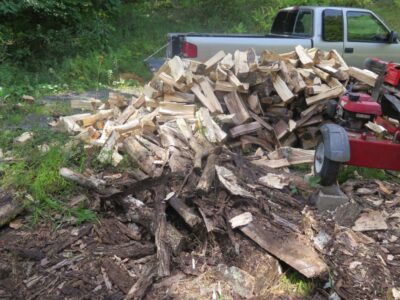
By the end of the second day we had a substantial wall o’wood to split and stack. Once we got the crib filled at the cabin I started to build the pallet stacks next to the barn. Of course, now that I want to spend a part of every day doing that we have a forecast for a week of daily rain after six months of drought. Sigh.
I continue working alone after he departed and the pace is demonstrably tortillian. But, I will soon have all the firewood for winter 2025/2026 processed and continue working on several other large windfall trees on the hillside, including a pair of gigantic locust trees so large I might have to borrow a larger chain saw to get them cut up.
My ultimate goal is to get firewood processed through the end of the decade.
Stay tuned.
For the past dozen years I have been mothballing the barn’s microhydroelectric system once we get a few consecutive days with daily highs below freezing, usually in late November, then de-mothballing the system once we get to spring-like weather. I learned a painful lesson the first year when I thought I could keep it running all winter long. The result of that error was replacing 600 feet of spiral fractured 2-inch PVC line when the water inside froze solid. Since following the newer strategy I mostly limp through the winter on the output of the solar panels.
As I reassembled the water line every spring, roughly a quarter mile of 2-inch PVC, and walk it top to bottom every year I would find some damage to repair, from ground upheaval (it is truly astounding how much the ground moves in the creek bed ravine over a winter here), extreme water flow during a heavy winter rain or snow melt, or (mostly) fallen trees. Thus, my bringing the system online was usually a two- or three-day event.
Not so this year. When I hooked up the water line from top to bottom, for the first time ever there was no damage! Yes, a few of the soft joints had loosened and needed to be snugged up, no big deal other than getting pretty soaked, but other than that it was a couple hours of good exercise hiking up and down the creek bed.
Let the water and the electrons flow.
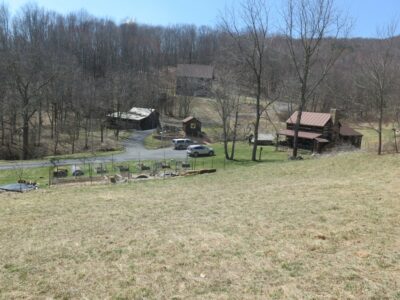
…for non-stop yard work.
It’s been something of a perfect storm with a very wet late winter culminating in two substantial snowfalls a couple weeks ago followed by warming weather and more rain, and the switch was thrown for everything to get going (we had the wood stove cranking out heat a mere seven days ago but were heating up to the mid-70s and sun yesterday). As a result we are in the midst of mowing, bush hogging, weeding, planting, burning, etc. with not a minute spent in the shop this week. If this perfect cycle of rain and sun continues, we will have to mow at least a part of every day for the foreseeable future. The grass I mowed on Monday is almost three inches higher today.
On top of that the rapid onset of spring/summer means that everything is producing pollen all at once. Combined with a stubborn sinus infection, it feels like I am breathing through jello much of the time.
Last summer we had the great good fortune of finding a college kid home for the summer to hire for the yard work. It was grand. We’re still looking for someone to help this year but so far no luck so it’s up to the old folks to get it done. As I’ve said many times, we work just as hard and just as long as ever but don’t seem to be getting nearly as much done.
As soon as I get this round of yard housekeeping done I will turn my attention to checking the penstock for the hydro system and making the requisite annual repairs, and moving forward on next year’s firewood.
Sigh.


Recent Comments