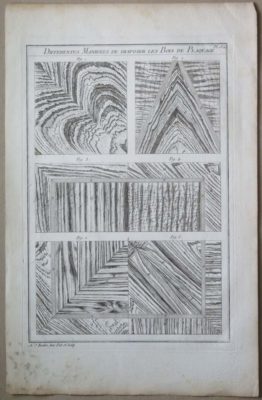
There might be no more visually exuberant print in all of L’art du Menuisier than Plate 284, “Different Ways to Arrange Veneers.” It is only one of many consecutive illustrations wherein Roubo is presenting the principles of composition for parquetry and as he calls it, “simple veneerwork.” The remaining plates in this series are ones I am keeping myself.
Like almost all the prints in my inventory this one was drawn and engraved by Roubo himself.
If you have ever wanted to own a genuine piece of Rouboiana, this is your chance. I will be selling this print at Handworks on a first-come basis, with terms being cash, check, or Paypal if you have a smart phone and can do that at the time of the transaction.
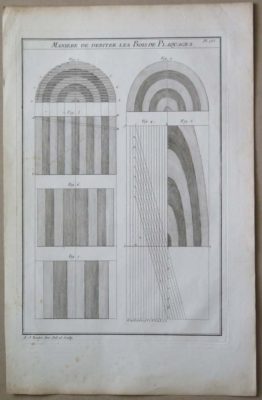
This morning’s offering from L’art du Menuisier is Print 283, “The Ways to Cut Veneers.” It is a delightfully esoteric visual didactic on the orientation of the lumber and the saw to yield the most interesting veneers for the ebeniste.
Like almost all the prints in my inventory this one was drawn and engraved by Roubo himself.
If you have ever wanted to own a genuine piece of Rouboiana, this is your chance. I will be selling this print at Handworks on a first-come basis, with terms being cash, check, or Paypal if you have a smart phone and can do that at the time of the transaction.
Print 282, “The Way of Preparing Frames To Receive Veneerwork,” from L’art du Menuisier is an exquisite introductory tutorial for the ebeniste who needs to know how the selection of veneer application affects the choices he makes in the construction details.
The page is not quite excellent with some minor staining mostly outside the image margins, but is definitely captivating for the concepts it is communicating. I particularly enjoyed the illustrations of incorporating the thickness of veneers into the manner in which doors are fitted into cabinet frames.
Like almost all the prints in my inventory this one was drawn and engraved by Roubo himself.
If you have ever wanted to own a genuine piece of Rouboiana, this is your chance. I will be selling this print at Handworks on a first-come basis, with terms being cash, check, or Paypal if you have a smart phone and can do that at the time of the transaction.
When making the pair of workbenches for use at Handworks this weekend, I decided preemptively to make them considerably lower than I would normally. This is because the bench going to the Library of Congress needed to reflect the stature of the users, which in my observation tended to be considerably less than mine, and I made the second bench more-or-less like the first one.
Going by the old “hanging pinkie knuckle” rubric both benches would be accurate for me at 30 inches. All that shows is that some words, like “rubric,” are not worth the letters it takes to spell them. My preferred bench height is in the 36-37 inch range. So I just do what I recommend you do for yourself; decide hat height is most comfortable and productive for you and make your bench that height.
Back to the benches in question. Since some of the LoC folks are a fair bit shorter than I am, and others are not that much shorter, I decided to make the bench short but with the option of adjusting them up easily and stably. Hence the need for a matched set of high-heeled slippers to go under each leg.
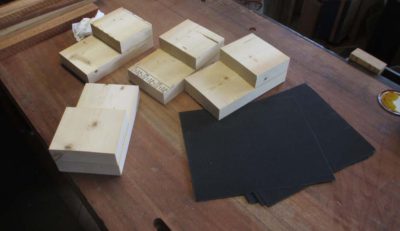
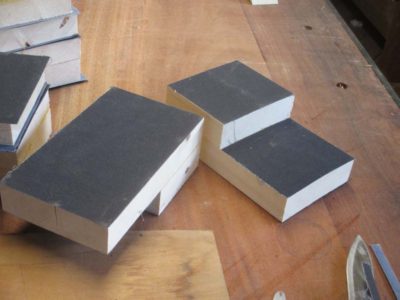
I started with a standard 2×6 and ripped it to 5″ wide, the width of the bench legs. Then I cut the ripped board into the necessary number of sections to make one piece 5″ wide by 4″ long and another 5″ x 8″ for each leg. I glued these together to make a stepped block, or the high-heeled slipper.
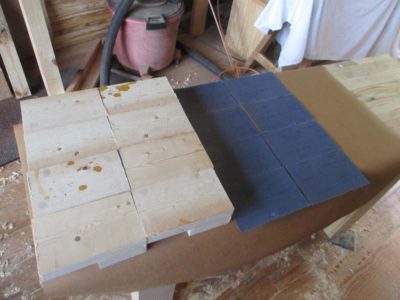
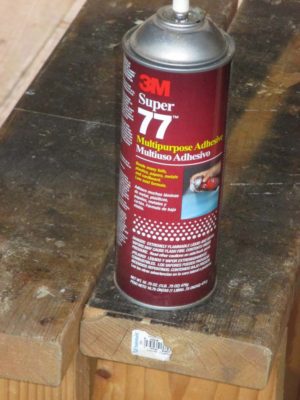
I faced each horizontal surface with medium emery paper (I am guessing about 150 grit) by lightly spraying all the contact surfaces with spray adhesives.
The result is a set of height adjusters that function well and are extremely stable and unobtrusive, allowing the bench to be set-up for working at heights of 30″, 31-1/2″, and 33″.
“Different Sorts of Wood and Their Positioning According to Hue,” Plate 277 in L’art du Menuisier, is one of the most astounding pages in the entire set. It confirms Roubo was both a genius and aesthete, representing various wood samples in vivid detail and readable even though they are in grayscale.
This page is one of the treasures from my inventory, and it is priced accordingly. It is in excellent condition, and was drawn and engraved by Roubo himself.
If you have ever wanted to own a genuine piece of Rouboiana, this is your chance. I will be selling this print at Handworks on a first-come basis, with terms being cash, check, or Paypal if you have a smart phone and can do that at the time of the transaction.
The item listed tonight is Print #275, “Small Commodes, Corner Cabinets, and Chiffoniers.”
The page has the charming misalignment of other pages from L’art du Menuisier when the paper and the engraved plate were not perfectly aligned, resulting in an image that is slightly askew. the print is in very good condition within the image boundaries, but there is some staining on the perimeter of the page and one corner has a slight loss, and the price reflects these.
The composition and engraving of the copper plate were done by Roubo himself.
If you have ever wanted to own a genuine piece of Rouboiana, this is your chance. I will be selling this print at Handworks on a first-come basis, with terms being cash, check, or Paypal if you have a smart phone and can do that at the time of the transaction.
Finally, we get to a picture of some furniture! In this page from L’art du Menuisier, #274, “Plans and Elevations of a Common Commode,” Roubo continues a tutorial that runs throughout the entire opus — the exposition on and exhortation towards the creation of stylistic beauty. Here he provides several options for interpreting what we would call a dresser, but they named commode.
The print is in excellent condition, with the expected oxidation of 250 years at the perimeter of the page. As with some others in my inventory it has the charming feature unique to hand-printing pages, namely that the plate and the page were not perfectly aligned and are thus slightly askew.
The composition and engraving of the copper plate were done by Roubo himself.
If you have ever wanted to own a genuine piece of Rouboiana, this is your chance. I will be selling this print at Handworks on a first-come basis, with terms being cash, check, or Paypal if you have a smart phone and can do that at the time of the transaction.
Josh Farnsworth has posted the third episode from his visit to The Barn a couple months ago. I hope you find it amusing.
Given this entree into reality television perhaps I too am qualified to someday become President. Then again perhaps not, inasmuch as I already know some about history, political theory, economics, the Constitution, etc. If recent decades have shown us anything it is that those things do not resonate with the electorate. So on second thought, I’ll just stay in the mountains.
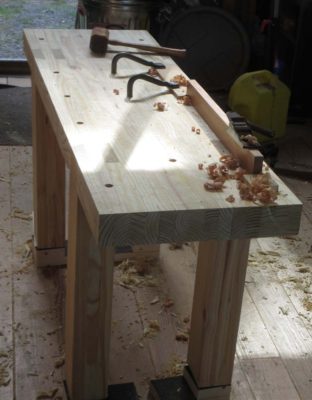
I was finally able to carve out another few hours to get the two workbenches ready to go for use as tables at Handworks.
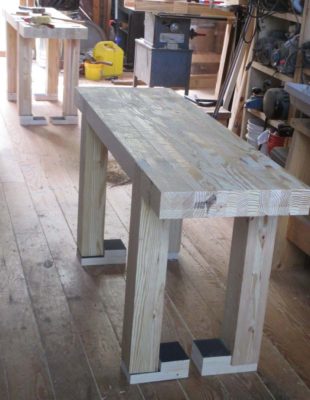
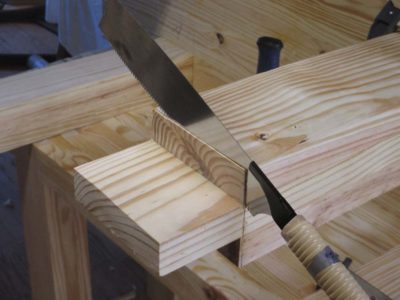
My first task was to get the last two legs fitted and trimmed, then I had both benches up on their feet. I trimmed the ends with my 10″ Milwaukee circular saw and spent about an hour total rough flattening the tops with a fore plane.
With that done I drilled a number of holes for holdfasts and fitted the planing stop on the one bench I will be keeping. I have to consult again with the LoC folks before doing any more to theirs.
And, it was a functional workbench. After Handworks I will do the final truing of the top, add a crochet and shelf to mine and stick it in the shop.
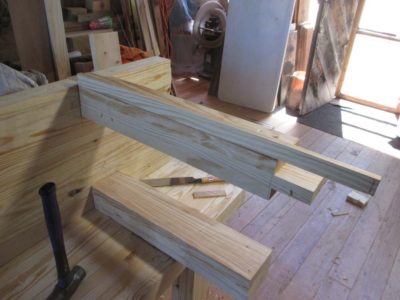
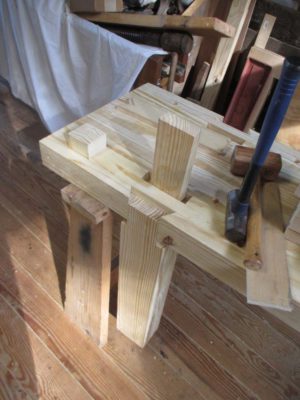
With that I stuck a pair of horses underneath one bench, and using a block saved just for that purpose, drove out the legs. Then I lifted the end of the second bench up on to the first bench top sitting on the horses and drove out the first pair of its legs. I slid the bench top onto the first one up to the second pair of legs and drove them out too.
The whole pile now sits close to the door, ready to head off to Iowa. And the time card read 24 hours.
In another of the detailed construction drawing sprinkled throughout L’art du Menuisier Roubo presents Print 273, “Developments [Details] of the Buffet Represented in the Previous Plate.” Here he shows the precise schematics and cross sections of the assembly and especially the interrelation of the joinery and the moldings used to create a beautiful armoir or buffet.
Like a great many of these pages Roubo both drew the illustration and engraved the printing plate himself.
Due to some staining just inside the left border of the print this one is probably in fair condition, as is reflected in the price.
If you have ever wanted to own a genuine piece of Rouboiana, this is your chance. I will be selling this print at Handworks on a first-come basis, with terms being cash, check, or Paypal if you have a smart phone and can do that at the time of the transaction.






Recent Comments