Many years ago, when I was Director of the Smithsonian’s Furniture Conservation Training Program, I was meeting individually with each student in preparation for their fourth-year fellowship, during which they were required to undertake a project that would result in their Master’s Thesis. The students had great latitude in their projects, some were purely historical aesthetics, some were about historical technology or craft, and some were analytical.
After our conversations I would arrange for each student to have a “mentor” to help them with guidance along the way. For those projects reliant on analytical data I brought in a highly respected statistician with a specialty in experimental design and data analysis to advise the students in designing their project, gathering data, analyzing that data and formulating the conclusions. One of the great beauties of DC is the abundance of research institutions and their scholarly communities. (The stories the statistician told me sotto voce about “research” shenanigans made me distrustful of any “science” ever since, even before the anti-“science” of the past three years. One tale literally revolved around a “researcher” bringing in a box of lab notebooks and dropping them on the statistician’s desk the with the instructions, “My conclusion for this project is XYZ so you need to review this data and arrive at this conclusion.” As the experimental designer told me then, “science” is not a thing, science is a process, and if the process is corrupt then the outcome [data and conclusions] is worthless. From that perspective I can barely withhold laughter when public luminaries now tell us to “follow the science.”)
Back to my student. The topic proposed for the thesis project was an evaluation of shellac properties, the particulars are lost to me at the moment. I only remember that the number of variables combined with the number of identical samples required for a statistically valid set of results would have require formulating and preparing approximately seven million samples. Needless to say, the student changed their project rather fundamentally.
Which brings me to work I am undertaking in the studio right now and probably for weeks or months to come. I am not the trained experimental scientist in this household — that would be Mrs. Barn — but I am fairly able to harness and focus my curiosities from time to time. My demonstration of making my artificial tortoiseshell several weeks ago has re-lit that fire for me and I have been working on refining the formulation and process ever since. Although my paper from two decades still stands up well, it only gets about >95% of the way to a really good imitation vis-a-vie the physical properties of genuine tortoiseshell. >95% is not the same thing as ~99%, which is where I want to go.
Like my student’s those years ago every variable change requires a group of samples to be formulated and made. Unlike the putative shellac researcher I am NOT weighing each variable as random and equal. I am not making the number of samples that might be required if the variables were purely random; I am testing one variable first, then applying the second variable once the first spec is established, then the third once the first two are established, etc. Even so I am creating hundreds of samples to assess for their properties based on a menu of options I must consider.
What grade of collagen should I use?
What concentration?
Which plasticizer (if any)?
At what concentration?
Which protein reaction catalyst to use?
In what proportion?
In solution or infused ex poste?
How long to cure?
At what temperature?
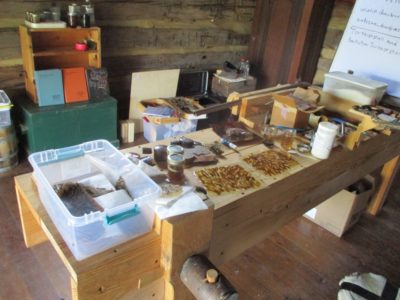
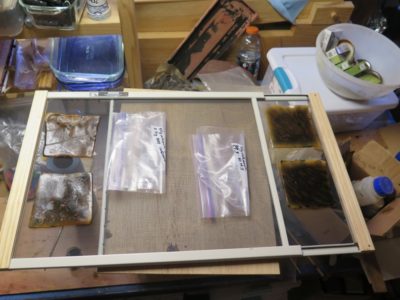
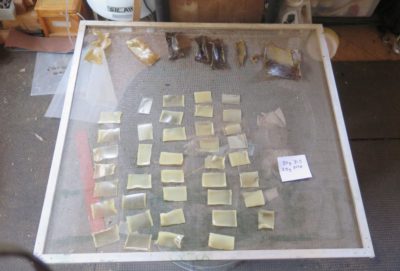
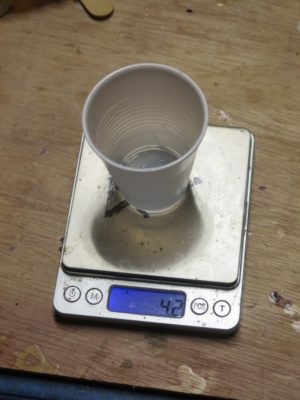
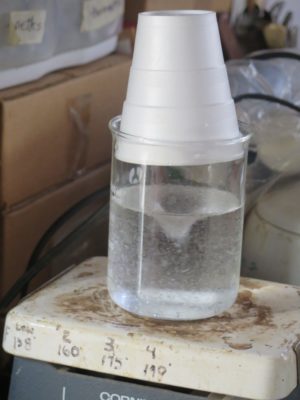
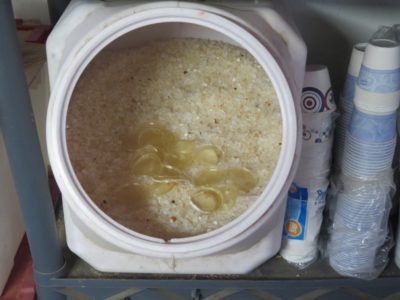
My tools for this undertaking are fairly simple and non-specialized; an analytical digital scale, disposable pipettes, disposable cups, a old microwave, an ancient ebay stirring hotplate, a rice steamer (most samples curl when they dry and need to be steamed flat), drying screens, and a desiccating chamber, a/k/a a Gammo pet food storage unit filled with conditioned silica gel. By far the most time for the sample involves drying them to the lowest moisture content possible, at which time the most extreme properties become manifest. Yes indeed, most of the time is watching samples dry.
There is simply no point in ongoing daily blogging about that, or in changing formulations by a hundredth of a unit proportion, but I will report back when I have results that I find encouraging in directing my final minute adjustments. In the meantime when there is radio silence on the blog, you can assume I am either splitting firewood for next winter and beyond, or tinkering with formula minutiae.
One of my real headaches at the moment has to do with a German chemical component that has a) become unavailable, or b) become unaffordable. My current dwindling inventory was a 100g jar given to me by the president of a chemical company almost twenty years ago, and in the intervening years I have seen the price go from a couple hundred dollars a kilo to several hundred dollars per kilo to a few thousand dollars a kilo to a quote yesterday of almost $100k per kilo. I’m really wishing I’d bought a big bucket of it fifteen years ago. Obviously, I am doing my best to work around that headache.
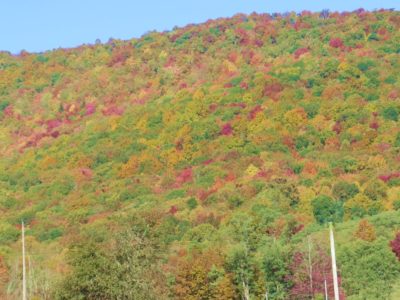
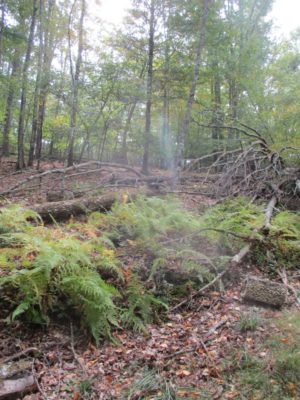
Even on a slightly hazy morning, the drive back from the hardware store featured a landscape of almost fluorescent colors on the mountain behind the cabin.
Autmn beauty is a fleeting thing here in the Virginia Highlands, a good year giving us at best three weeks of polychromy. This year we had about a fortnight plus a day or two.
Hard to not be distracted when this is the view from the window.
During that fat fortnight the drive up the road and the view outside the shop windows was glorious.
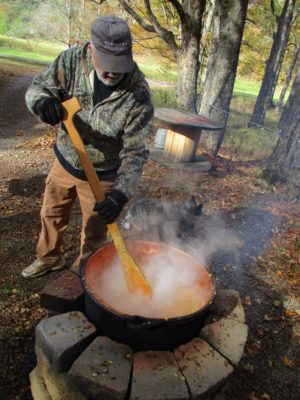
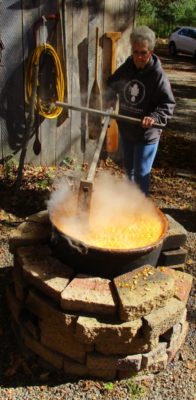
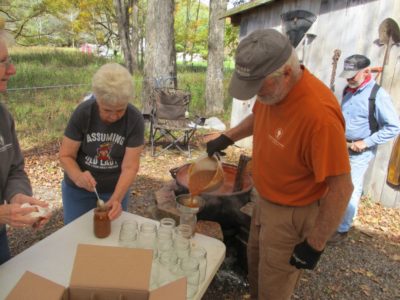
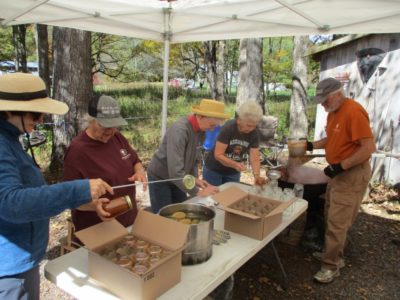
Another splendiferous happening during autumn in these parts is the annual making of apple butter the old-fashioned way. Twice we have been able to go to our friends Pat and Valerie to help cook, stir, and can apple butter in accordance with Pat’s mom’s recipe (I think), using a giant copper-lined cauldron resting above a wood fire. This year we had brilliant, crisp days for the event and garnered almost 150 pints each day.
The assembly line firing on all cylinders.
Perhaps the truest from of magnificence on these days is when we got to scrape caramelized apple butter off the bottom of the cauldron with fresh biscuits and popping the treat into our mouths.
In recent weeks I’ve been corresponding with a friend-I’ve-never-met about a wide range of topics, and the question came up (paraphrased), “How can I best help my teenager to pursue a life of skilled woodworking?” (The Dad is a brilliant woodworker but has a more-than-full-time profession). The young adult recently visited the North Bennett Street School and was much impressed.
But, what are the other options? It’s not a question I have given much consideration before now.
The family in question does not live in the US so moving to attend NBSS is only one option on the table. Any good fit for the youngster will be considered regardless of location. From conversing with the Dad I think anything from long-term apprenticing with an excellent mentor to finding a first-class skilled trade school is on the table. The only objective is to obtain a thorough grounding in the craft, so two-week workshops are not in the cards, nor is necessarily a BFA at a university as the goal is to impart the complete skills necessary to live a long and productive life as an artisan, not inflict malignant social/political indoctrination.
What are the other options for becoming a skilled furniture maker, boatbuilder, musical instrument maker, traditional timber framing, or anything similar? The things that come to my mind are Ecole Boulle in Paris, West Dean College and City and Guilds in the UK, some luthiery and violin-making programs, etc.
I will check more with the Dad to find out any particular proclivities of the prospective student, but if you have any good ideas please let me (and him) know about them.
Years ago when my sister’s family was visiting and we were giving the kids a walking tour of the property, one of my nephew’s exclaimed, “Uncle Don, it’s just like you live in a state park!” As you can probably deduce from some of the firewood-harvesting pics, the topography for much of the property is, shall we say with literary license, exuberant. One moment of inattention or one spot of poor footing can put you on the ground in a twinkle of the eye. Given my poor vision with almost zero binocular depth perception and my history of injury I am becoming increasingly attentive to keeping upright in the place I want to be moving or standing still.
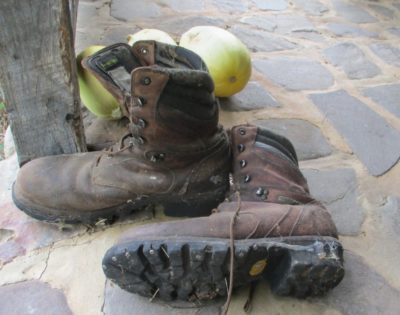
Traipsing around up and down and across the hills requires good footing and for all of these years I have relied on an old pair of lumberjack-ish boots. For standing, these are the most comfortable footwear I have ever worn, but as my excursions into the forest have become more purposeful, they were wanting. For starters, as the knobby soles became worn they were less able to grab the ground as needed, but even worse is the fact that they weigh about 8 lbs apiece making the traversing of rough terrain all the more problematic. Hiking around iffy ground with a brick lashed to each leg is not optimal.
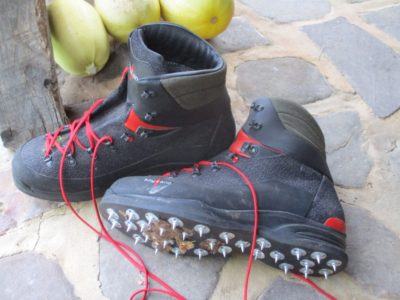
Since firewood-harvesting became integral to my routine here I started looking into spiked-sole lumberjack boots (the term for this type of boot or shoe is “calked;” I have no idea of this etymology) as a response to slippery footing.
After much browning of the interwebz I found this pair of “calked” boots built on a hiking boot platform, thus reducing their weight by around 50%. They are comfortable, lightweight, and grab the ground like they were, uh, spiked to the ground. They have transformed my time in the woods or when bush hogging the hillsides, or even just mowing the yard (although I must be attentive to where the water hoses are so as to avoid stepping on them). In these arenas, they are perhaps my most important tools.
Given my longstanding allergies to pollen and my fortnight in the hospital with pneumonia this past July I am increasingly attentive to what I breathe, especially when doing yard work.
For several years I wore a fitted industrial respirator when mowing and trimming, but even then I often had several days of wheezing and sneezing afterwards. While in the hospital in July I noticed that several of the caregivers wore powered air filtration helmets. They seemed like a near perfect solution to my problem. Their units were designed for medical/laboratory conditions and cost roughly $3k so that was not where I was going to go, but then I recalled the filter helmets often worn by wood turners and began my exploration there.
My first choice was the Axminster APF10 unit from England. It seemed to have the most streamlined configuration and the most comfortable fit. On inquiry I was informed that the company did not ship to the US so I had to remove them from consideration. (I am uncertain as to their current shipping regs; I might still like to get one, so if you are going to the UK and would be willing to pick one up for me there, let me know.)
In the end the only option left to me was the Trend Airshield Pro unit, which I did order. In some respects it is a fine unit, in other aspects not so much. There are other options, generally for the sandblasting and welding arena, but the prices for many of those units ($1500 and up) put them outside my immediate consideration.
When evaluating the Trend Airshield primary functionality, keeping the nasties out of my lungs, it does an excellent job. I have worn it several times mowing with nary a sneeze, wheeze, nor runny nose in the aftermath.
Alas, the unit is clearly designed for a static posture in use, in other words being used by someone standing in one place, not moving or bending very much. It is very top-heavy so the motions involved with mowing or trimming are problematic. It has fallen from its perch several times in use.
Getting the headband to fit properly remains a challenge, at least for my head, despite adjusting everything there is to adjust. On a comfortability scale from 1 to 10, I would rate the unit a minus 3. To get it snug enough to stay put while I am mowing or trimming or brush-hogging it is painful to wear as the front band imbeds into my forehead. I am working on devising a padding system to make it tolerable, but I am not there just yet. It seems that there is something just not right about the configuration.
As for the final consideration, namely price, at around $350 it seems expensive but a cost I am more than willing to bear given my respiratory allergies and desire for wheeze-free living.
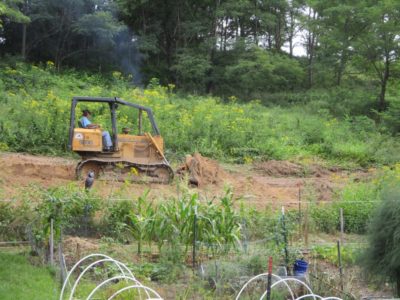
At long last Mrs. Barn has agreed that the time has come for me to build her a year-round playground. This required a new terrace to be cut into the hillside just above the garden plot, which in turn required a bulldozer to accomplish same. Since I do not own a bulldozer, rendering me as less of a man I know, I asked around and three friends independently gave me the name SteveB as the guy to do the job.
After several weeks of back-and-forth phoning he finally showed up a few weeks ago to do the deed. There is nothing quite so much fun as watching a good ol’ boy and his bulldozer at work.
I literally set up a lawn chair in the bed of my pickup and sat watching him all day.
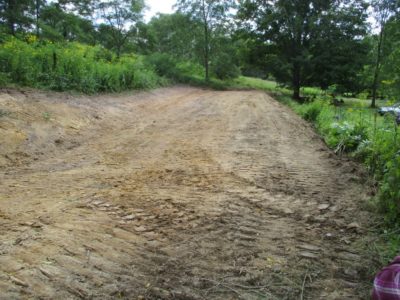
It took him about six hours, back and forth in the space, to finish the job.
Working just by eye he created a long, wide, flat platform and when he surveyed the project afterward, he confirmed that it was not perfectly flat; it was a couple inches higher at one end than the other. For a 150-foot-long run that struck me as pretty good.
The greenhouse I will be using as my model, belonging to my friend F.
So, what will go there? For starters I will be copying my friend F’s greenhouse, hoping to get that built over the next few weeks, weather and family commitments allowing. Once that is up and running I expect Mrs. Barn to spend almost every day there through the winter since she loves puttering in the dirt and hates the gloom of short days and cold weather.
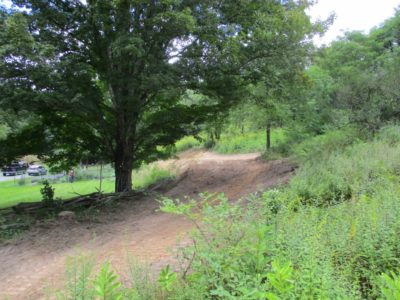
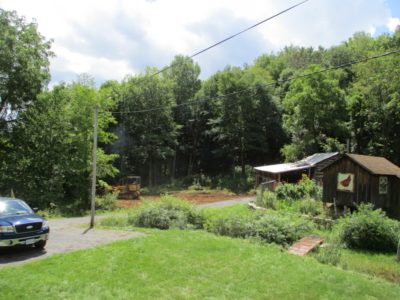
Once he was done with the new terrace SteveB he moved across the creek to smooth out the gnarly terrain in the space where we had felled a number of trees eighteen months ago to give better sunshine to the garden plot on that side of the creek.
That outcome was every bit as successful as the terrace, and we now have a wide range of options for using this plot of land. I’ll probably start with a parking spot and a small bed of gravel.
I seeded both patches of dirt and there are now flourishing stands of pasture grass there.
One of the curses(?) of occupying a space as large as the barn is that there is often little incentive to throw things away when their useful life is over. Even if some artifact is no longer functional, you see, its carcass may serve as the raw material for some new application. Such was the case with this simple project.
After many years of faithful service the old garden cart simply rotted away. The wood panels forming the box of the cart were friable to the point of needing no tools for the disassembly, gloved hands were all it took to take the detritus and toss it into the fire pit. The wheels and axel, however, remained robust albeit a bit rusty, and were kept in waiting in the basement of the barn for several years, just waiting for the new generation of use.
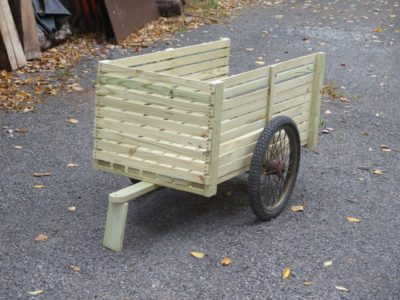
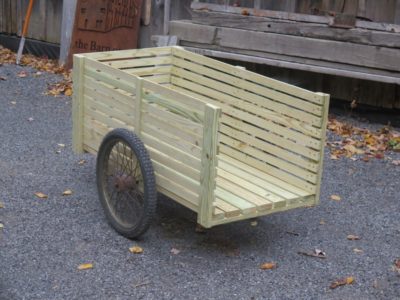
Once I got a new hefty riding lawnmower I realized that the homestead needed a tow-behind wagon for moving mulch, compost, etc., for Mrs. Barn’s gardening efforts. So I made one. Simple, sturdy and functional.
I ripped a pile of PT-SYP and assembled the unit with deck screws. I will make and affix the tail gate at some point soon, depending on weather and other projects. I’ll also fit it with a tarp liner so dirt and gravel can be hauled without falling through the cracks.
It was satisfying to get such a nice project in just a few hours of low-intensity work, requiring little precision and only a framing square and screw gun for assembly.
Generally, aside from my time with Mrs. Barn the overwhelming number of my conversations occur underneath my snow-white hair and between my years. That said, lately beginning with my three days of being on display at the 18thC Trades Show I’ve been talking out loud a lot. This week was a continuation of that theme.
On Tuesday I was at a local civic meeting and asked about my “newcomer’s” observations of our regional community and spoke at great length on the subject. Yup, even though we bought the cabin over 20 years ago, we are newcomers. That makes a certain sense in a community where dozens of families can directly trace their arrival here well over 200 years ago.
On Thursday my long-time friend and even longer-time broadcaster Brain Wilson interviewed me for his “Something Completely Different” podcast, discussing current events in the political economy. Say what you will, my perspectives are indeed “something different” than you are going to encounter in the corporate mega-media. You can track down the podcast fairly easily on your own, which saves me the aggravation of posting the link and then receiving gripes and moans about my mean, radical wrongthink ideas.
Friday morning was a long interview with Neal Bascomb from the Work/Craft/Life publication, discussing the H.O. Studley tool cabinet. Since I am always willing to discuss the collection and my relationship to it, the hour flew by. I will definitely post a link to that once it is published.
Friday afternoon brought a visit to the studio by my local friend, musician and luthier also named Neal, where we discussed at length the nature and manipulation of hide glue and the vagaries of guitar picks.
I feel all talked out, ready to resume my routine of silence listening to books, lectures, and interviews on my mp3 player while I make progress on projects in the studio and on the homestead.
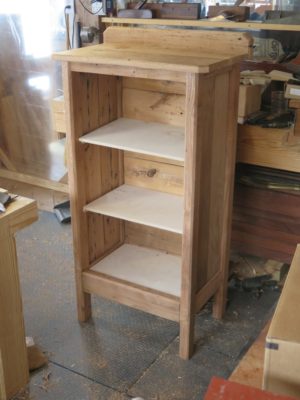
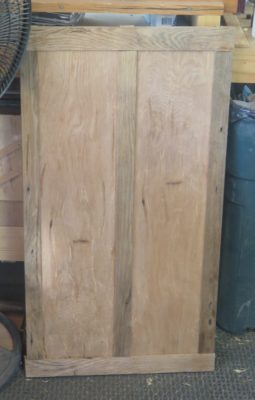
Last winter I started to finish the doors for Mrs. Barn’s clothes cabinet I built many moons ago using recycled chestnut lumber, warts and all, from an old, dismantled shack on the hill.
After preparing the doors (built as a single unit then sawn apart) with some scraping and burnishing with a polissoir, I laid down a seal coat of gloss Pratt & Lambert 38 varnish, a long-time favorite of mine, which I sanded lightly once it was hard (oil/resin coatings do not dry so much as they harden via chemical reaction).
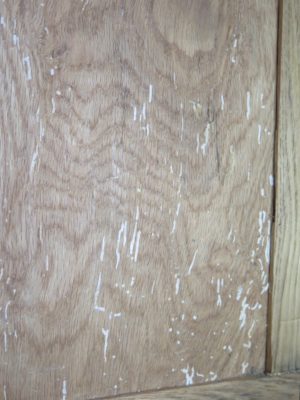
I applied what I thought would be the top coat of Pratt & Lambert 38 “Dull” varnish because that would leave the surface looking most like raw wood, and set the still-wet doors aside to resume work “some day.” Well, “some day” was a couple weeks ago. To say the least I was surprised at the outcome of my previous work.
The evidence of age and deterioration that I had purposely left on the surface as an aesthetic design element had turned completely white. What happened was that the wet varnish pooled in the recesses and the flatting agent, almost certainly a microscopically fine silica, was present to such a degree that it imparted total opacity to the finish film in those areas.
I’m pretty sure I know how to solve the problem, but I have never encountered something like this before.
In my frequent travels this past year to visit Li’l T and his parents and Barndottir the Elder I have almost always taken a traveling tool kit. Perhaps not enough for major home repairs or construction but certainly enough to get most woodworking tasks done. Fortunately, my SIL is an accomplished remodeler and the basement and shed at Barndottir the Elder’s home still has a pretty complete inventory of my tools, so I am almost fully set up regardless of which place I am.
My traveling tool kit is a very concise collection of woodworking tools with a couple of extra things useful for home repairs. Perhaps one day I will blog about the contents of the kit, which resides in a mahogany surveyor’s theodolite box with a couple drawers added on beneath.
Since space is always a premium in a kit like this I have become additionally enamored with Japanese saws, more particularly Z-brand saws with replaceable/interchangeable handles and blades. With one handle I can outfit it with any number of set-ups to accomplish everything from sawing timbers to fine dovetails and all points in between. I keep a cardboard “envelope” for the blades and pack them separately from the handle, so the spatial footprint is surprisingly small for such a large range of sawing utilities. In just the space of a handle I can carry a good set of saws.
Yet another reason to incorporate Japanese saws into your inventory of tools and skills.














Recent Comments