
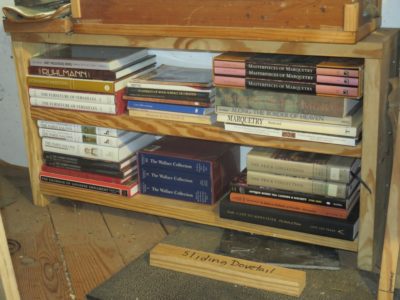
One of the notable absences from the studio ever since I started working there pretty much full time almost ten years ago was the physical distance from my books. Almost all of them were located up on the library balcony on the other side of the barn. Not far, but not close enough for the psychic comfort of 1) being part of the decor of the studio, and 2) being close enough that I could just grab one to browse or look something up whenever I was waiting for the glue to dry or something similar.
Yes, my gunsmithing books were already down in the studio on a shelf over that workbench, but even I do not browse gunsmithing books. They are ther for instructional/informational purposes.
In the studio, I need books for inspiration and peace of mind. It’s one of my many quirks. So, I relocated a goodly number into my immediate work space, and once I get finished with the tool cabinet and empty the plane shelves, will probably fill them with books too.
I feel better already.
With shop life resuming some vague semblance of normal after late winter and the presence of Li’l T on the scene, I’ve been able to return to working on the Ultimate Portable Workbench. I’ve now reached the stage where I need to layout the holes for the vise screws, and for the holdfasts as well. You see, I’ve decided that even though this is a portable workbench where low weight is among the highest goals, a set of holdfasts can be a much-valued addition. Hence, my exploration of wooden holdfasts. More about that next Wednesday.
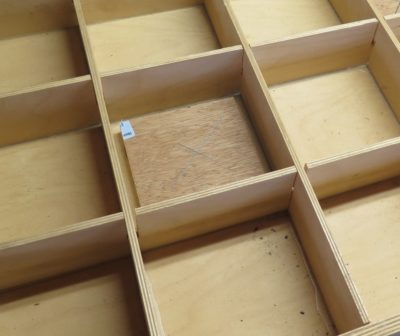
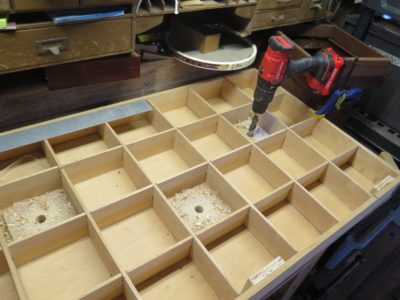
For now my main objective was to locate the holdfast holes so that I could add some backing blocks to the insides of the top and bottom plywood skins. This started by just arbitrarily selecting the locations and marking out the centers of grid boxes and drilling 3/4″ holes.
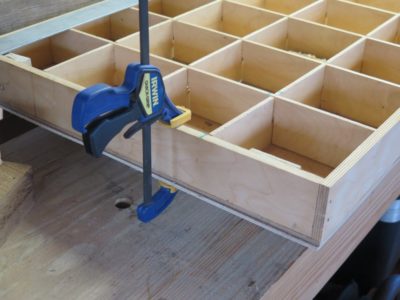
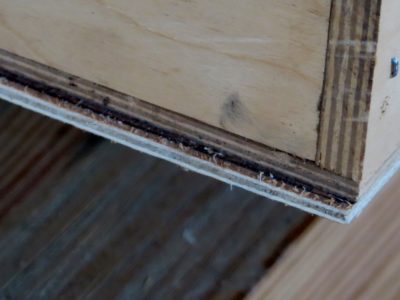
I then clamped the second skin to the underside of the half-constructed torsion box in order to simply use the holes in the first skin to drill the holes in the second skin.
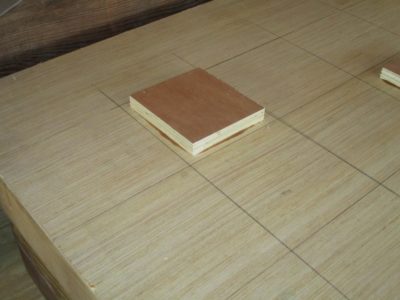
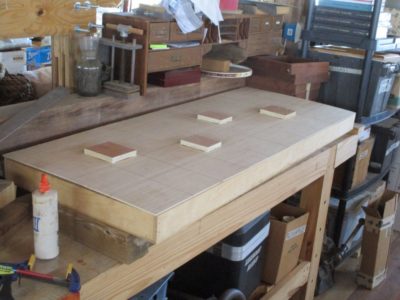
With that step accomplished I marked the grid pattern on the underside of the second skin so I knew where to put the backing blocks. Once again I used T3 adhesive, in part because I had a lot on hand and because I could not always be sure of the environment for the bench.

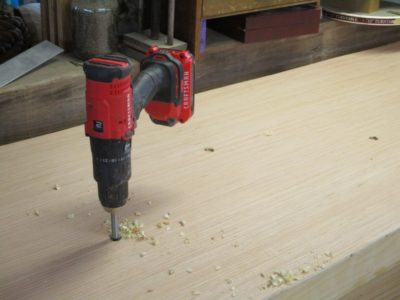
Once the blocks were secured I just used the holes in the skin to guide the drilling of the holes through the block. This process allowed me to get perfectly aligned upper and lower collars in place so that holdfasts could be used in this feather weight bench.
Once that was finished I set the second skin aside and moved on to the threaded holes for the vises. I had already glued backing blocks in those locations.
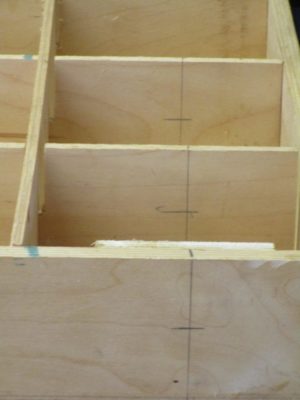
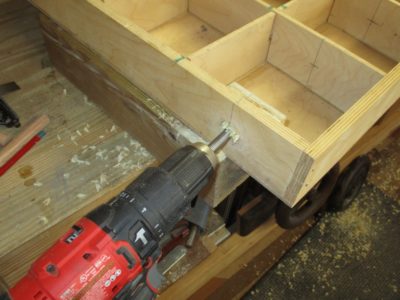
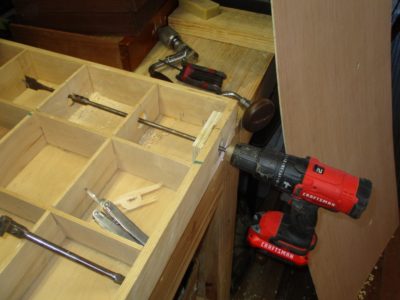
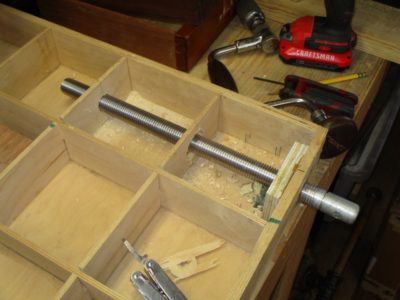
I drilled the holes through the apron and the grid using a combination of drill bits to accomplish the desired ends. The hole in the apron was 7/8″, in the grid web the holes were 1″ to accommodate the 1″ vise screws.
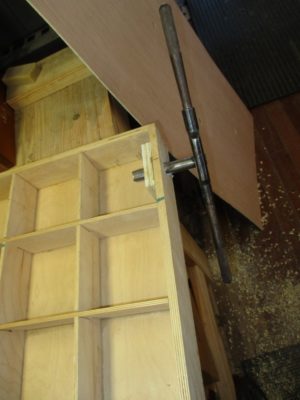
Fortunately I have a set of extra large taps and dies, rescued from the trash eons ago, so making the matching threaded openings was a snap.

A couple months ago for my birthday Mrs. Barn gave me this remarkable tool to keep handy. I’ve had many headlamps over the years as my fading eyesight is always seeking more lumens, but this one is the first that I’ve tried that is actually comfortable, high performance, and long lasting. The combination of the LED illuminator plus the 2 AA batteries being located at the rear of the unit giving it a perfect balance, I can wear it all day long with comfort. I cannot tell the lifespan of the two ordinary batteries as I have not yet had them go dark after almost 60 hours of use.
She says she bought it at the local feed-and-seed coop, so I am guessing it may be available at Ace Hardware stores.

One of the features of much early work (2008-2012) on the barn was the truth that I was always racing to get things done over a weekend before heading back to Mordor. Since It was weekend-based I was pretty much limited to what materials I had on hand. If I needed some of “X” but only had some of “Y,” well, I had to make do with “Y.”

This pretty much explains the framing around the door to the first floor. It was a Sunday evening, so I had an hour, some scrap white pine lumber, and a tube of construction adhesive, and I had to get a door in place before heading home. Flash forward and it should be no surprise that the doorway was needing an extreme upgrade.
This time I had as much time as I needed, an inventory of pressure treated lumber, a bag of concrete screws, and as much construction adhesive as I might need. The starting point was un-hanging the door and removing the “framing” which took me a half-hour at most.

I ripped and crosscut the pressure treated lumber, grabbed the appropriate masonry drill bit and my Craftsman hammer drill, and got to work. A few hours later I was fitting the final pieces.

Now the doorway is set for decades to come.
While we were away for a glorious weekend of Easter worship and fellowship, an arctic locomotive roared through Shangri-la, dumping eight inches of snow and driving down temperatures to near 20 degrees.
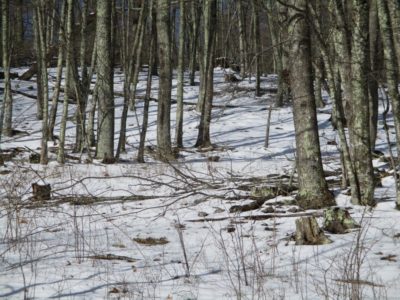
By the time we got home on Tuesday much of the snow had melted (this image is from Wednesday), and we are expecting almost 80-degrees over this coming weekend. Too late for the apple blossoms, though. I guess the weather did not realize we are more’n halfway to May.
I’m rethinking the “Comments” function on the blog. On one hand, several of the regular commentors, whose contributions I value highly, always have their comments dispatched to the “Trash” file for no apparent reason which means I have to review all the Trash contents regularly to retrieve them.
On the other hand the ratio of total comments to the blog are easily 500:1 spam, including recently hundreds of Russian spam-bot entries per week, along with the hundreds of submissions in Korean, Chinese, Arabic, Cambodian, etc., scores of offers for watches, sneakers, handbags, and a crap load of other stuff that I do not want occupying my space. Yes, the WordPress spam filter catches them but since it also moves real comments into the Trash bin along with them I still have to go through the garbage anyway.
If we are unable to incorporate a bot filter I may probably discontinue “Comments” at some point. Thus far in the years of blogging I have received 540 valid comments for almost 1600 blog posts versus I’d guess 25,000 Trash and Spam postings. You do the math.
Stay tuned.

For the longest time I’ve had a hankerin’ to have a small mobile sawmill. At first I did not get one because we were living in the suburbs of Mordor and a sawmill in the land of Orcs made no sense. Then, when we bought Shangri-la in the hinterlands, the property sorta came with “a guy,” Tony, the best friend of the previous owner who, like the previous owner, was a skilled tradesman.
Tony had been a big city construction tradesman who relocated here decades ago and was accomplished at all kinds of activity ranging from small handyman projects to restoring and building complete houses and all points in between. He did a lot of the renovation of our cabin, with high-quality work that was so inexpensive I could not afford to work on my own house! I learned he could do this because so much of his small work, like ours, used leftover materials from the big projects, or — and here is the part pertinent to this tale — harvesting and milling his own materials.
Once again, there was no real reason for me to get a mobile sawmill because Tony had one and would saw material for me whenever I needed it.
A couple years ago Tony retired and moved and his warehouse of materials and machines was auctioned off. In fact he gave me several truckloads of vintage wood.
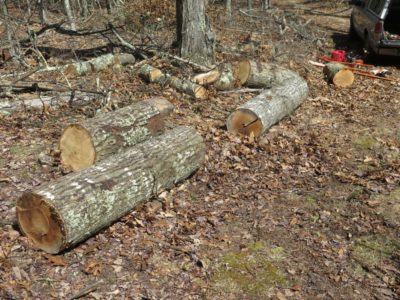
I have done precious little harvesting of furniture grade wood from our own forest, and that which I did harvest was oak to be micro-processed for making Gragg chairs. Then last year we cleared a building lot sized area adjacent to the log barn to clear up sunshine for one of Mrs. Barn’s gardens, and among the trees being felled were some decent sized walnuts. Most of that was cut up for firewood or turning blanks or to become hand-sawn crotch veneers, but I left a few large-ish log sections just in case I could figure out a way to get them milled.
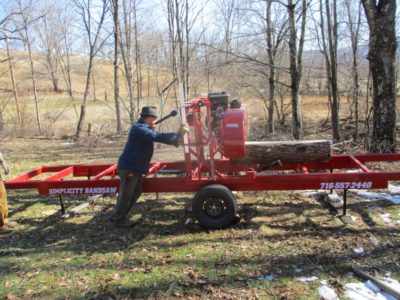
Out of the blue came a call from my friend Sam, a talented restoration carpenter who does work all over the larger region, to tell me he had bought a mobile sawmill to enhance his business capabilities.
Drat, foiled again.
Sam recently came to saw up the walnut logs with his new machine. I guess I still won’t be getting a sawmill.
In January, which can be a lot more brisk than you might expect in Virginny given our altitude (~3100 feet) and breeziness (we are in a wind power “red zone”), I experienced a dearth of heat output from my coal/wood stove for a week that required me to keep the kerosene rocket stove going most of the time to keep the temperature comfortable in the studio (50-ish). I gave the problem a fair bit of thought and diagnosis, and my settling on the wrong answer was reminiscent of a conversation I had eons ago with a statistician whose job was to help academic researchers design their projects to yield the most authoritative results.
The statistician recounted numerous incidents wherein an “expert researcher” would show up in the office with a box full of lab notebooks and say something like, “Here is all my data. My conclusions are X, Y, and Z, so make the data fit those conclusions.” Virtually every institution of structured inquiry has statistical specialists like the one I knew, and I expect they have all been presented with scenarios like the one I just described. Given the current prevalence of junk science being the coin of the public policy realm, we are all subject to faulty questions being asked, slipshod “research” being conducted to fulfill the question, and dubious “results” being crammed down our throats as being “settled science.”
As Michael Crichton once remarked, “There is no such thing as settled science. If it is ‘settled’ it is not science. If it is science, it is not settled.” A recent dark-humor internet meme explained the status quo; “97% of all scientists arrive at conclusions their funders desire.” This has become ever more evident in our recent past. Follow the toxic stew of money, power, and prestige, and you can predict where nearly every “science” story thread will eventually end up. Put another way, it is likely I/we would be better off believing the exact opposite of everything reported publicly, in keeping with the tenets of the Gell-Mann Amnesia Hypothesis (look it up).
What does this have to do with my stove?
Everything and nothing, as I had arrived at the wrong answer when diagnosing the performance of the heating system. I was confusing the natures of coincidence, correlation, and cause. In short, I was short-circuiting the loop of synthetic thinking, whereby the inaccurate/incomplete merging of the noumenon (that which can be conceived) and the phenomenon (that which can be observed) was leading me to a faulty conclusion. I should have known better, for three decades all of my teaching has been built on a foundation of synthetic thinking.
My first stop on the faulty thinking express was to observe that the original gaskets on the stove doors, now over a half-century of service (the phenomenon), were falling apart and definitely needed to be replaced. In doing so I surmised that the efficiency of the stove (the noumenon) would be dramatically enhanced by getting the stove door gaskets back up to spec.
I found a source for the odd sized gaskets and replaced all the aged ones. In the aftermath of that I could see that the doors fit more snugly and the fire box was very tight. The next day after allowing the gasket cement to harden, when I fired up the stove the firebox built up much quicker heat but the studio temp was no better. Besides, there was a lot of smoke in the interior space and not as much as there should be coming out the top of the chimney. Smoke tendrils were coming out of every teeny crevice in the exhaust pipe.
Hmm, sez I, somehow there must be a bird or mouse nest somewhere in the stovepipe preventing good air flow up the pipe, disrupting the proper function of the system. This line of thinking was my second stop on the crazy train of faulty problem solving. I reluctantly disassembled the stove pipe to the point where it exited the building envelope.
Nothing. All I had accomplished was to get really dirty.
The next day the weather was a little warmer but I still needed some heat and thus fired up the stove again. Not only was the interior smoke worse, there was water dripping from somewhere up above down the stove pipe all the way to the stove on the first floor. Whatever I had done to this point was the wrong thing. Not only was the problem not solved but it seemed to be getting worse. It’s almost as if I was a gubmint science policy advisor.
Clearly there was need for a third excursion on the Coincidence, Correlation & Cause Express.
I disassembled the section of the stove pipe penetrating the barn wall and the upward crook/rain cap outside the building. The end of the pipe, outside the building, was fully impacted with a dam of sooty frozen sludge. You see, I had failed to correlate the series of blizzard-y snow storms we’d had a month before, which combined with our absence for a fair bit of the intervening time allowed snow to blow underneath the rain cap and into the top of the stack and compile there. At some point in the timeline the snow so filled the up-crook of the smokestack that it allowed only the bare smallest amount of smoke to escape around the perimeter of the snow plug, and even that was facilitated only by the heated exhaust warming the metal pipe just enough to allow a little gaseous exhaust to escape. And, the harder I tried to get the system up to proper performance the more I was causing the soot/snow plug to melt into a serious dam of sludge in the elbow of the up-crook, blocking all exhaust flow close to 100%. Once I got all that cleaned out (I cannot recall a messier job) and reconfigured the stove pipe to prevent a reprise in the future, the stove was cranking enough heat into the studio that I was peeling layers as I worked.
I had misread the components of the coincidence, correlation, and cause equation, and thus unknowingly dispensed with any hope of accurate problem solving via synthetic thinking.
It was a great reminder to me to be skeptical about almost everything I observe and think, read or hear, and, I hope, it was a good lesson learned.
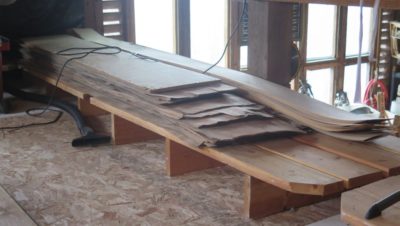
Over many years due to some fortuitous opportunities, including the generosity (?) of fellow woodworkers cleaning out their stashes of stuff, I have managed to acquire an awful lot of veneers. Those that are unusual or rare go one place in the barn, but the large majority is mundane and gets stacked on a pair of cot bases on the floor directly overhead of my studio space. There is nothing special about this pile of veneers other than the fact that for the most part this is vintage, heavier weight material than you would routinely find today. Most of it is in the range of 1/20″ to 1/30″, in poplar, walnut, maple, ash, cherry, and birch.
Even If I was manufacturing furniture, I would never use all this up.
So, what to do?
I’ve been contemplating making small, elegant boxes, mostly with either parquetry/marquetry or fuaxrushi presentation surfaces. Some of the boxes would be straightforward cubic shapes, others bombe’. What better foundation for these decorative techniques than ultra-high-quality veneer-core plywood? I have long believed that a static substrate of high-quality plywood is superior to a dynamic solid wood substrate with its inexorable rheological response to environmental moisture change. I could spend the big bucks to get marine or aircraft plywood, or I could just make my own.
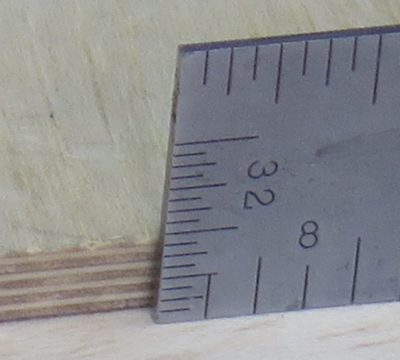
So, I will. I have had excellent success in the past making small epoxy/veneer plywood panels for little projects and will now make that my SOP for fancy little jewel boxes. For larger pieces, say 12″ x 18″ or maybe a little larger, I will need to make a veneer press. For bombe’ panels I will need to construct forms and devise a vacuum press.
In the end, it is all just more fascinating stuff to do in the adventure that is life at the barn.


Recent Comments