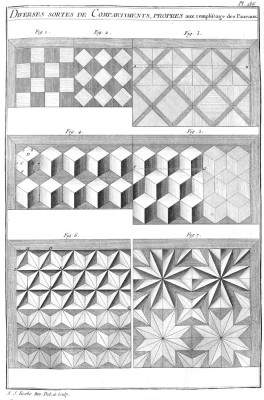
 The historic technique of marquetry — the application of veneers in a decorative manner — is so huge that several course opportunities will barely touch the surface. The techniques taught and practiced in the class are exercises based in great part on my own experience and the research done in producing To Make as Perfectly As Possible: Roubo on Marquetry based on L’Art du Menuisier, the monumental 18th century Parisian woodworking treatise by A. J. Roubo, and other historical ante-types documented by other scholars.
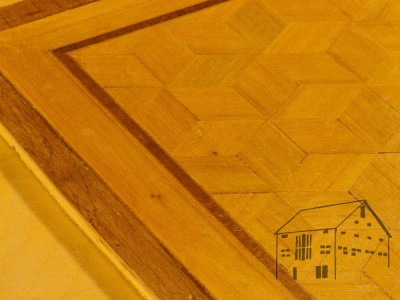
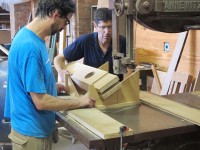
Starting with slabs of lumber we’ll make a parquetry and banded panel guided by Roubo’s Plates 286 and 287. We will saw our own veneer (mostly with a power band saw but if you are really motivated we can try my several veneer frame saws) and construct the necessary sawing and planing templates needed for the project.
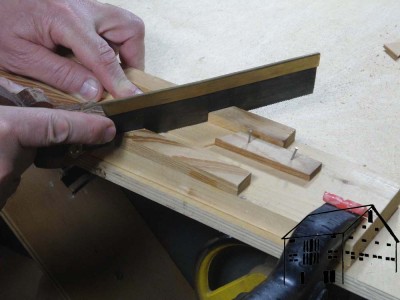
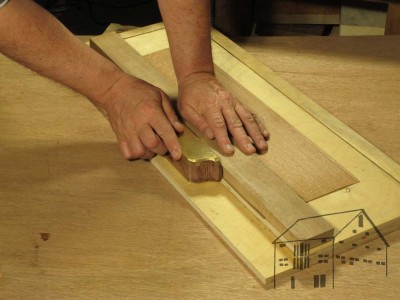
This workshop is limited to six students and will be three days long, July 18-20, 2014, with a registration of $375. A tool and supply list will be sent to all participants in advance of the event.
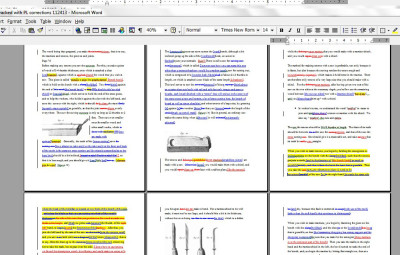
…and book manuscripts. Three things you probably do not want to see being made. Here is a screen capture of how I spend large chunks of every day these days reviewing hundreds of pages of To Make As Perfectly As Possible: Roubo on Furniture Making.
A recent blog over at Lost Art Press provides Roubo’s view of the role of woodworking atop the craft hierarchy.
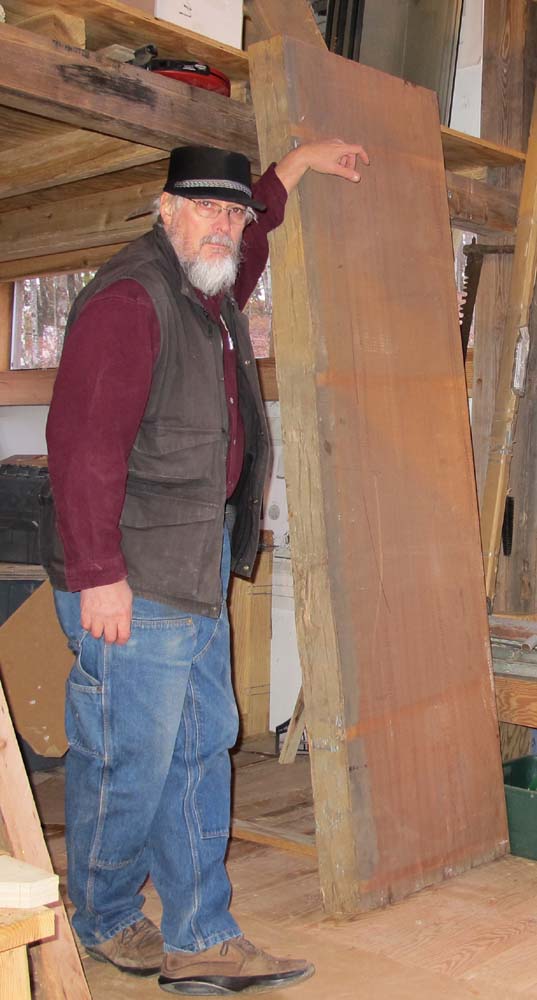
Several months ago when Chris Schwarz blogged about the closing of Midwest Woodworking , a local institution for more than a century, I immediately contacted him about the possibility of obtaining a slab of mahogany so that I could build the Studley-style workbench that I am pretty much morally obliged to make, especially given my acquisition over the summer of a workbench with a pair of wheel-vises (more about that in the coming days).
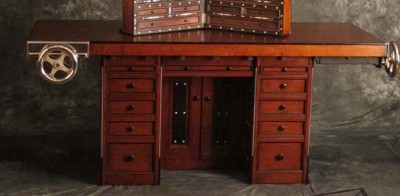
Much to my delight he was able to obtain such a slab o’ wood, albeit in a 14+-foot length that we have split with each one getting a 7+-foot long by 4″ x almost 24″ wide hunk of lumber. Of course, since the time of placing my order those many months ago I have learned through careful examination that Studley did not build his bench from a slab, but rather through stacked laminations with exquisite Cuban mahogany faces.
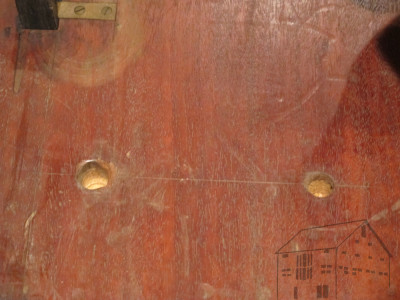
Since I am metaphysically obliged to follow his footsteps, I now have a massive hunk of wood without a defined destination.
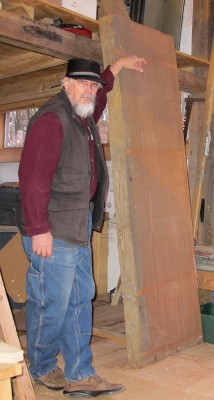
So, I have this massive slab, and some vintage 6″x6″ black walnut, I’ve been thinking about another Roubo bench, using sipo (the mahogany analog) for the top,and black walnut for the legs and stretchers, with an ebonized crozet and planing stop, and a couple of Peter Ross holdfasts. It would be the only one like it in the neighborhood…
I was scheduled to be on stage first thing Saturday morning, starting at 8.30. I was somewhat concerned about the long-ish time slot of 8.30 – 12.30 for my talk “The Transition From Hand Tools to Machines” since I had given a version that before and it was only about 75 minutes long. Megan thought I might start at 9, add a bit more information, and have some Q&A and that way maybe fill up two hours.
Even while driving in to the Convention Center it was apparent that this plan would not work. At about 8.20 Megan called and said “The crowd is here and they are restless.” Fortunately I was just pulling into the parking garage and was at my appointed place at my appointed time.
In fact the expanded time slot allowed me to explore many of the topics in much greater detail than before, and even after a halftime break the audience remained large and attentive. Wilbur Pan posted a concise if tongue-in-cheek review of the session here.
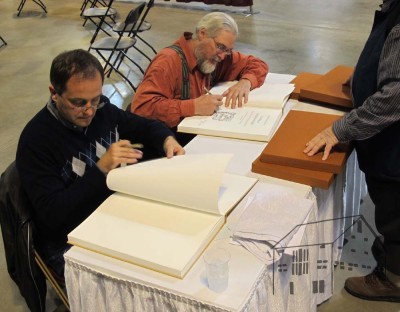
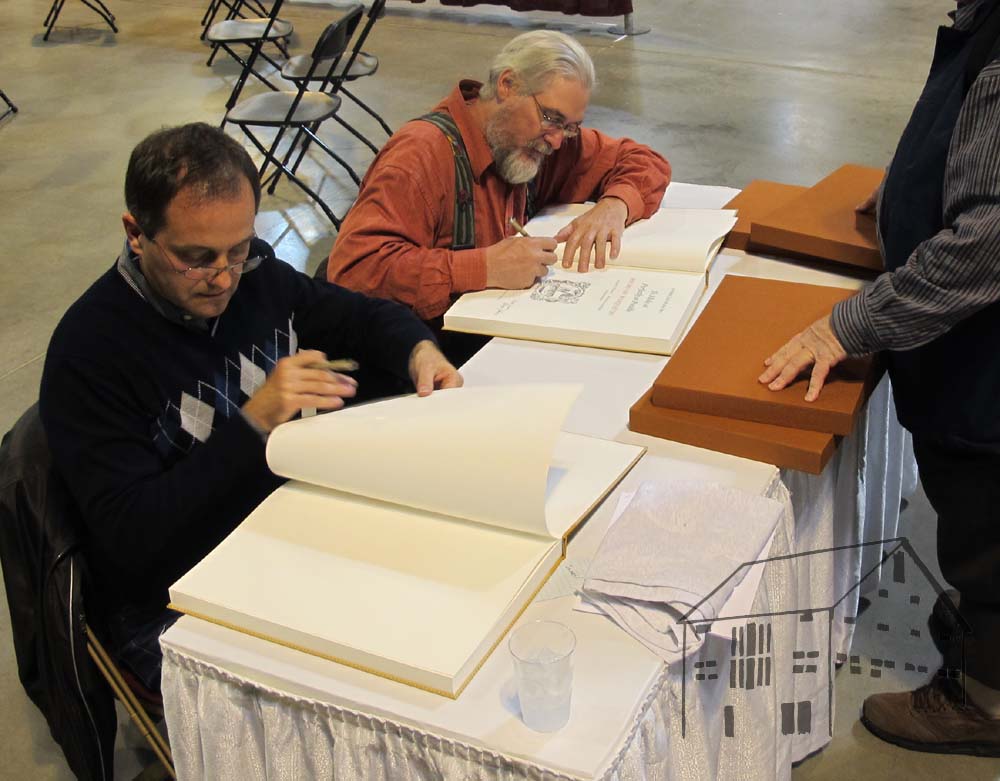
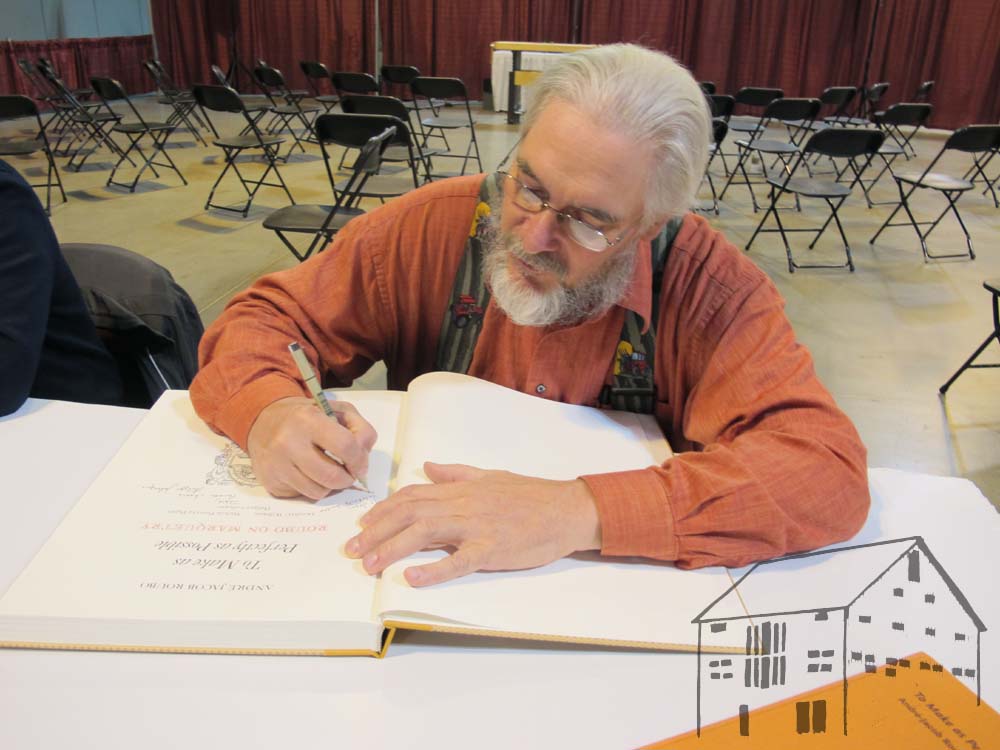
Three-plus hours later I stopped talking and made my way down to The Marketplace where Philippe Lafargue and I were to go on display and spend the afternoon signing hundreds of copies of To Make As Perfectly As Possible: Roubo On Marquetry. After a quick lunch we took our stations at a table adjacent to the Lost Art Press booth and met the long line of folks waiting patiently for our signatures.
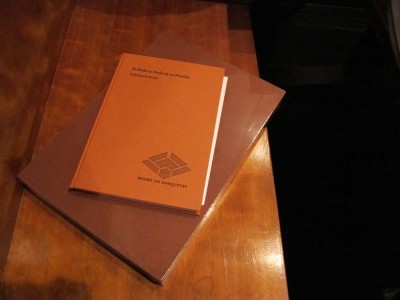
The book’s Standard Edition is something like 9×12 inches, and the Deluxe Edition twice as big, which means we were wrangling a lot of awkward poundage of books, signing until our arms nearly fell off. We were quite literally taken aback by the enthusiasm and encouragement of the crowds patiently waiting in line to spend time with us.
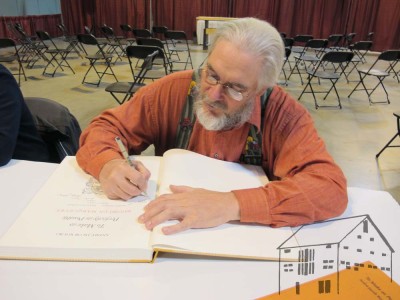
It was a serious time of celebration and delight, and the only way it could have been better if our collaborator Michele Pagan had been able to join us as well. Her absence due to an unavoidable previous commitment was noted by everyone.
Late in the afternoon I returned Philippe to the airport for his flight home, promising each other to get together sooner than another decade, then concluded the evening at a raucous celebration at the Schwarz household. Bed could not come soon enough after that.
Among the multitude of things that I am and things that I am not, two come clearly to mind in this initial recap of my recent foray into Cincinnati/Covington for Woodworking in America.

One thing I am not is a calligrapher, by that I mean someone whose handwriting is legible to anyone but me. Mine may be to penmanship what Jackson “Jack the Dripper” Pollack is to real painting. On the flip side of that truth is the added reality that I am someone who actually crafts a lot of my words with pen and pencil on a piece of paper. I would be pleased if my handwriting were elegant, but not enough to actually practice and accomplish it.
At WIA since I was going to be signing something approaching a literal ton of To Make As Perfectly As Possible books I wanted to make sure I was using a permanent archival pen for the occasion. A quick ask-about revealed the presence of a stationary and pen store called Appointments just over the river in Cincinnati, and I headed across the Ohio River on the Robeling bridge, itself a delightful stroll on a sunny afternoon.

It was at Appointments that I met Douglas Kennedy, a tool geek of the first order. His tools are writing implements. To say that he was interested in writing tools would be like saying I am interested in shellac. While his store did not have the specific tool I was seeking – that was later found at an art and drafting supply store nearby – I nevertheless spent a half hour with Mr. Kennedy looking at and test driving a number of truly wondrous writing tools. It turned out that he had a lot of tools I wanted, and did in fact leave with a couple including a Cross Tech3+ “triple,” a pen body that includes a black stylus for writing, a red stylus for editing, and a 0.5 mm mechanical pencil. In fact, recognizing that I was looking for excellent tools rather than expensive tools he catered to my interests completely. As we parted company I could only think “here was a craftsman fully engaged in the use of fine tools.”
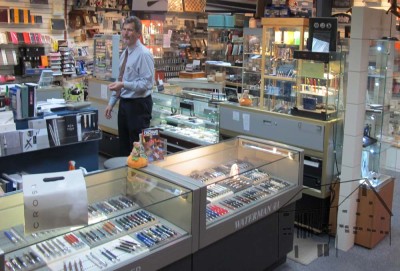
If you are in the Cincinnati area and need counsel on fine writing tools, Douglas Kennedy is the man to see.
As I left Appointments on my way to the art store he told me about, I was walking along the sidewalk and came to the window behind which Gus Miller was crafting hats at the Batsakes Hats shop at Sixth and Main. I was hooked.
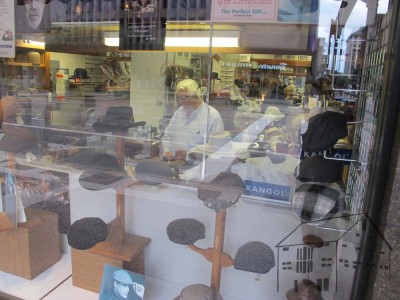
You see, a second thing I am not is a fashionista. On an annual basis I spend literally dozens of seconds purchasing attire, mostly at the local thrift store or on line – I know my body measurements, why should I have to try anything on? – but what I am is a hat guy. The vision of Gus Miller crafting hats and the stacks of inventory in the background compelled me to round the corner and go in. Sure enough, Mr. Miller and his lovely wife had just what I needed, even though I didn’t even know I needed it two minutes before I saw him.
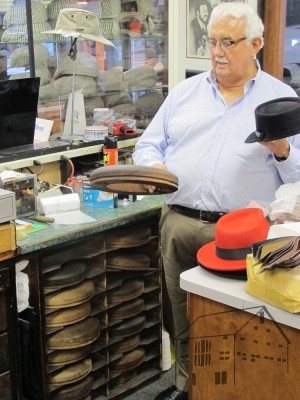
While in the store they showed me not only their inventory but the tools he uses with consummate skill. Another tool geek encountered, but again with a wholely disparate set of tools from my perspective, as he crafts, shapes, and modifies hats for his loyal customer, including this new loyal customer. (Yes, I know that the dictionary says the word is “wholly” but dictionaries are idiotic some times and I refuse to stop using the more rational “wholely” and some day it will lead to a death match conflict with an editor) I walked out the door with a really cool-looking Borsalino “flat” that looks like it was made with my head in mind. It is already my everyday hat. Given Lost Art Press’ proximity to Batsakes the odds are near 100% I will be visiting again.

That evening was the gathering of Roubo-istas at the book release party for To Make As Perfectly As Possible as scores of us crammed into an artisan’s pizza place Chris Schwarz knew about.
The fellowship there was almost overwhelmingly delightful as both Deluxe and Standard Editions were distributed to loyal and patient acquisitors, tool geeks all. I was much humbled by the enthusiastic support for our projects, but none more so than when folks like CraigF and TimH took the trouble to drive for hours to attend and congratulate us, even though they would not be attending the WIA conference.

My appreciation for that encouragement cannot be fully articulated in words, even with a really nice pen while wearing a cool hat.
Reposted from the Lost Art Press website
================================================
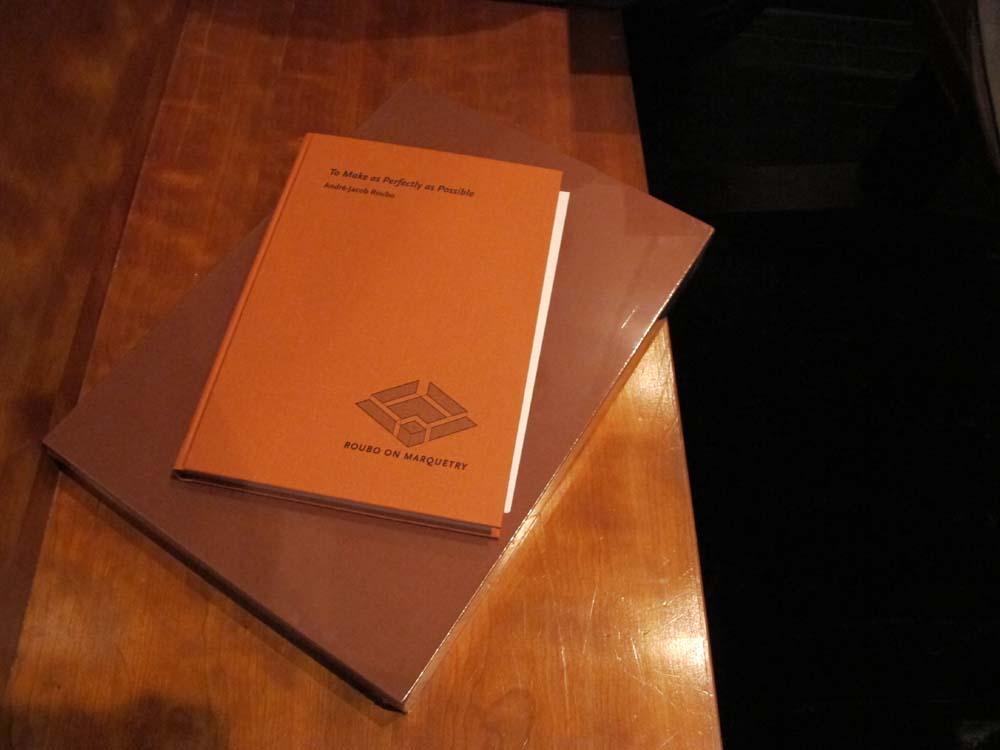
 The standard edition of “To Make as Perfectly as Possible: Roubo on Marquetry” is now available for pre-publication ordering. If you order before Oct. 10, 2013, when the book ships, you will receive free domestic shipping.
The book is $43 and is available in our store here.
We had announced earlier that the book would be $40, but because of some last-minute changes to the printing specifications, we had to raise the price to $43. Apologies.
About the Book
“To Make as Perfectly as Possible: Roubo on Marquetry” is the first English-language translation of the most important woodworking book of the 18th century.
A team of translators, writers, woodworkers, editors and artists worked more than six years to bring this first volume of A.-J. Roubo’s work to an English audience. (Future volumes of Roubo’s other works on woodworking are forthcoming.)
While the title of this work implies that it is about marquetry alone, that is not the case. “To Make as Perfectly as Possible” covers a wide range of topics of interest to woodworkers who are interested in hand-tool woodworking or history.
In addition to veneer and marquetry, this volume contains sections on grinding, sharpening, staining, finishing, wood selection, a German workbench, clock-case construction, engraving and casting brasses.
But most of all, “To Make as Perfectly as Possible” provides a window into the woodworking world of the 18th century, a world that is both strangely familiar and foreign.
Roubo laments the decline of the craft in the 18th century. He decries the secrecy many masters employed to protect craft knowledge. He bemoans the cheapening of both goods and the taste of customers.
And he speaks to the reader as a woodworker who is talking to a fellow woodworker. Unlike many chroniclers of his time, Roubo was a journeyman joiner (later a master) who interviewed his fellow tradesmen to produce this stunning work. He engraved many of the plates himself. And he produced this work after many years of study.
The Lost Art Press edition of “To Make as Perfectly as Possible” is printed to high standards rarely seen in the market today. Printed and bound in the United States, the 264-page book is printed on acid-free #60-pound paper in black and white. The pages are Smythe sewn so the book will be durable. And the cover is made from heavy 120-point boards covered in cotton cloth. The book is 8-1/2” x 12”.
In addition to the translated text, essays on the text from author Donald C. Williams and all of the beautiful plates, “To Make as Perfectly as Possible” includes an introduction by W. Patrick Edwards of the American School of French Marquetry, an appendix on the life of Roubo and a complete index.
The book’s table of contents is below and here. You also can download a sample section of the book here on sawing veneer with this link: Roubo sample pages.
“To Make as Perfectly as Possible: Roubo on Marquetry” is available direct from Lost Art Press and from our select retailers.
To Make as Perfectly as Possible
The Different Woods Appropriate for Cabinetry
Section I.
Description of the Woods of the Indies, and Their Qualities, Relative to Cabinetmaking
Alphabetic Table of the Foreign Woods
Why Not Dalbergisterie?
Descriptions of French Wood Appropriate for Cabinetry
Colors in general, and the Woods from the Indies and from France with Regards to their different colors and their nuances
The different Compositions of Dyes appropriate for dyeing Woods, and how to use them
Section II.
On the sawing of Wood appropriate for Cabinetmaking
On Sawing Veneer
Description of Cabinetmakers’ Tools
Section III.
The Frames [Cases] appropriate to receive Veneerwork, and how to prepare them and construct them
Of Simple Parquetry, or the Composing of it in General
The Parqueteur’s Tool Kit
Section I.
The diverse sorts of Compositions in general: some detail and the Arrangement of wood veneer
Various sorts of Compositions, straight as well as circular
Make Banding With Roubo’s Template Blocks
The manner of cutting and adjusting the pieces so they are straight, and the proper Tools
Cutting and Assembling Cubic Hexagons
The manner of cutting curved pieces, and the tools that are appropriate
The 18th-century Shoulder Knife
Section II.
The manner of gluing and veneering Marquetry
Why Does Hammer Veneering Work? And How Can it be Made Better? 117
Section III.
The way to finish Veneer Work, and some different types of polish
Finishing Marquetry
Ornate Cabinetry, Called Mosaic Or Painted Wood, An Overview
Section I.
Elementary principles of Perspective, which knowledge is absolutely necessary for Cabinetmakers
Section II.
On the manner of cutting out, shading and inlaying Ornaments of wood
The way to engrave and finish wooden Ornaments
Section III.
How to represent Flowers, Fruits, Pastures and Figures in wood
Floral Marquetry
On the Third Type of (Veneered) Cabinetry in General
Section I.
Description of the different materials that one uses in the construction of the third type of veneered Cabinetry
On the Nature of Tortoiseshell
Mastic and ‘Mastic’
Section II.
Works for which one uses the third type of Cabinetmaking
Section III.
How to work the different materials that are used in the construction of Marquetry, like Shell, Ivory, Horn, etc.
Section IV.
The manner of constructing Inlay and finishing it
I. General Idea of the different types of Mosaic
Metal Casting
II. Ornaments in Bronze in general
III. The way to solder the Metals which one uses for different works of Cabinetry
IV. Description and practice of a Varnish appropriate to varnish and gild copper and other metals
Conclusion to the Art of Woodworking
Appendix: André-Jacob Roubo
Index
— Christopher Schwarz
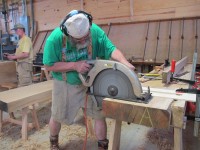
In reflecting back on my very productive recent days, laboring diligently to prepare The Barn to house our several tons of books, I have the nagging suspicion that I was the target of some subliminal mockery. I got some of the two dozen glazed doors cut and a few installed (and the stock for all of them ready to assemble). Still, just beyond earshot I thought I sensed, feeling more than hearing, a gentle guttural Gallic guffaw, cruelly chiding me with, “Roubo, Roubo, Roubo.”
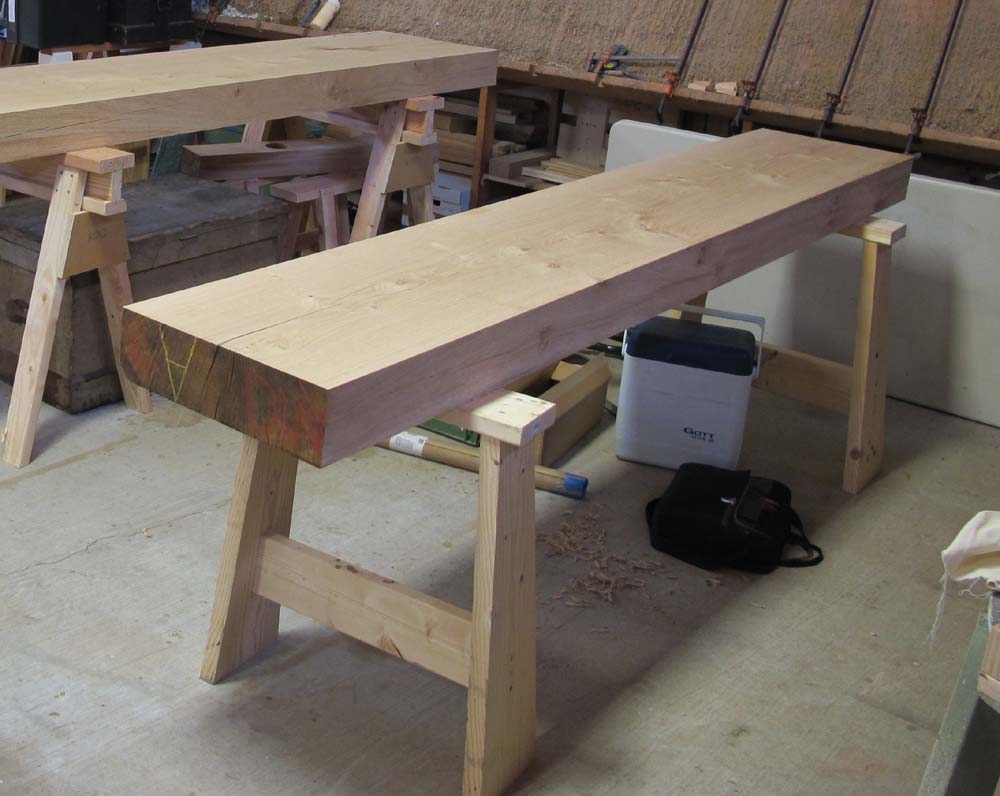
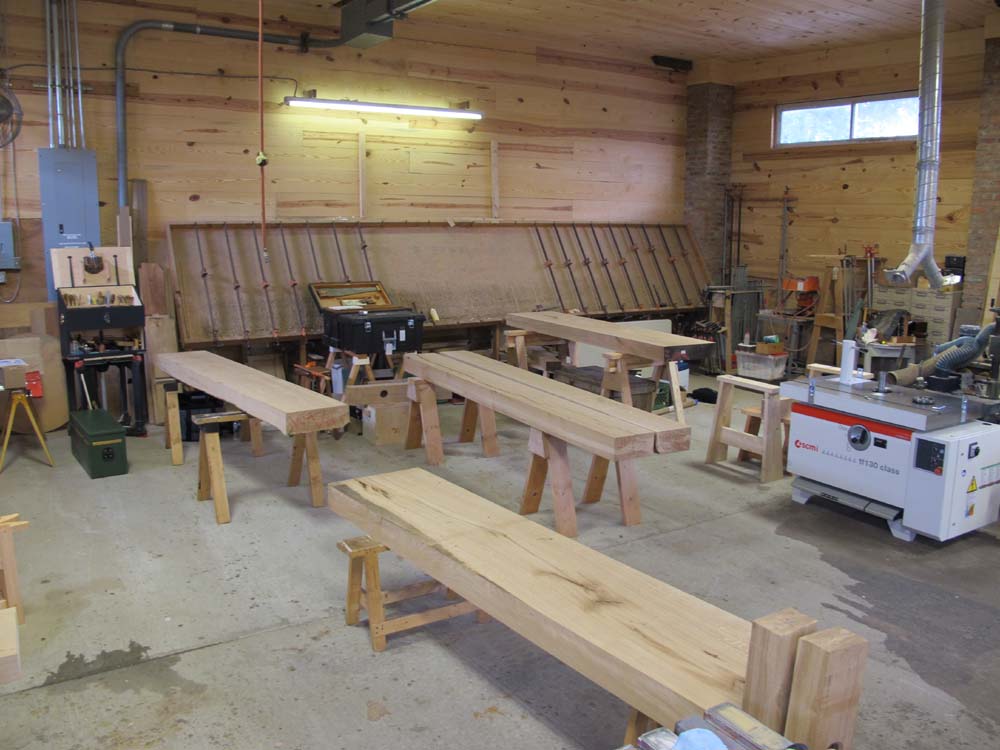
Yes, only steps away from where I toiled from dawn to dusk were the ~600 pounds worth of components for The Bench, sitting patiently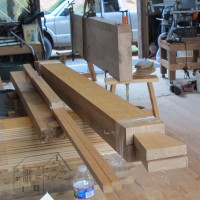 waiting for my attentive affections. The top is already bound to a triple block and tackle, as it is the only way I can maneuver it at all. Based on my rudimentary understanding of mechanics and some back-of-the-envelope calculations, the top itself weighs about 450 pounds (my fully-clothed weight of about 230 is just barely enough to levitate the unit, hence the top weighs a smidge less than twice that weight).
Unfortunately given my upcoming schedule it is unlikely that I will be able to focus my efforts on completing The Bench before early October. It is immensely gratifying and frustrating to receive the periodic emails from my fellow FORPXI congregants regaling the group with the tales of completing their shrine, er, workbench, from the recent gathering in Barnesville, Georgia.
My day will come. My only steps thus far are to prepare the space where it will reside. Directly in front of two banks of north-facing windows, it will be the centerpiece of my work for the next three or four decades.
Jameel Abraham, the godfather of the French Oak Roubo Project, posted this excellent video of the event.
This link should work.
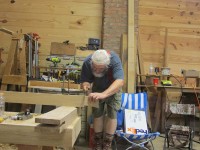
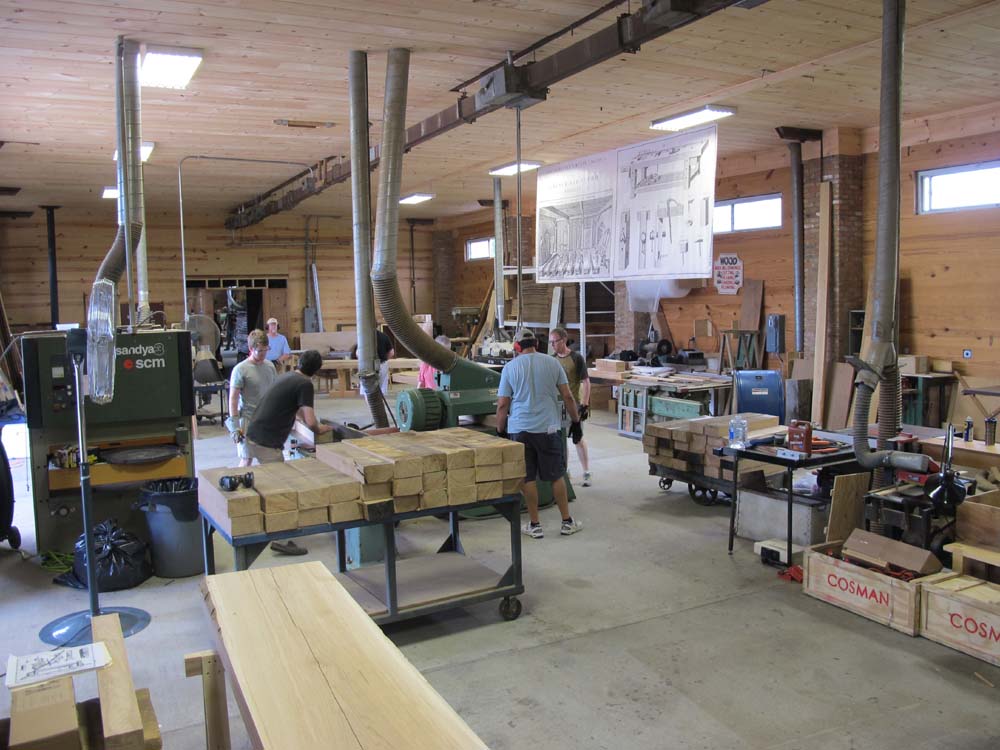
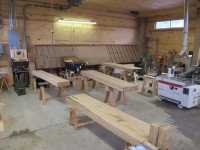 I’m back home again after an exhausting and exhilarating week of “vacation” in Barnesville, Georgia, a guest at the remarkable millwork and lumber brokerage facility of Wyatt Childs, Inc. The purpose of the visit was to participate in the much-touted “French Oak Roubo Project,” or FORP for short. The event was the brainchild born from a chance intersection between vise-manufacturer and all-around smart guy Jameel Abraham and Bo Childs, with plane maker Ron Brese as the matchmaker.
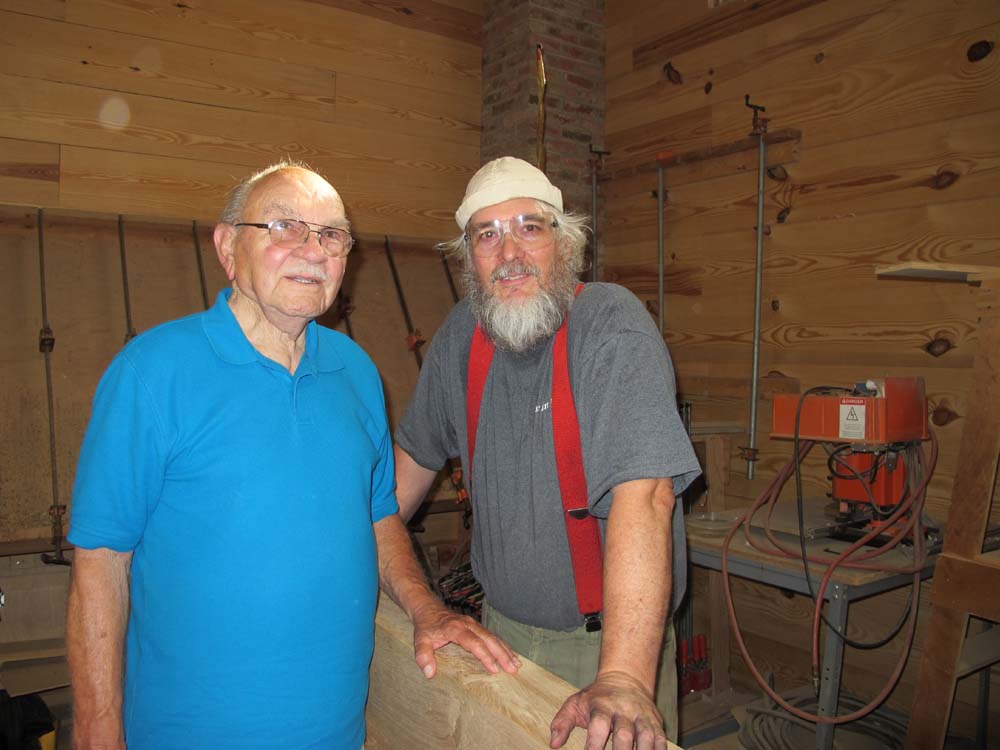
The enthusiasm and excellence on display were indeed (and will no doubt remain) a critical 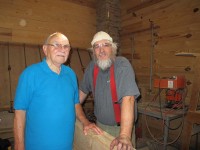 motivating force in my own quest to become a skilled woodworker. I encourage you to find folks like this to hang with on your own path to excellence. A genuine highlight of the week for me was to get a visit from my oldest mentor, who has retired just north of Atlanta. He is the best woodfinisher I ever met, and “To Make as Perfectly As Possible: Roubo on Marquetry” is dedicated to him and his father, the man who first introduced me to Roubo.
Several of the participants have blogged excellently already – Jameel and Ron, Chris Schwarz, Justin Leib, and Jeff Miller – so my remarks are decidedly brief.
I believe FORP 2013 may be viewed some day, and that day is not far off, as one of the seminal events in the renaissance of the modern/historical “blended” woodworking movement.
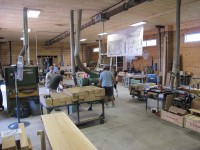 All week the attitude was not whether we were rich or poor, famous or anonymous, etc., but rather that we were all woodworkers, accomplished and passionate about our activities. And we were all doing, not merely hearing or watching. While it was not a worship activity, there can be no denying that it was a profound fellowship experience.
Thanks Jameel and Bo for making this happen.

 The historic technique of marquetry — the application of veneers in a decorative manner — is so huge that several course opportunities will barely touch the surface. The techniques taught and practiced in the class are exercises based in great part on my own experience and the research done in producing To Make as Perfectly As Possible: Roubo on Marquetry based on L’Art du Menuisier, the monumental 18th century Parisian woodworking treatise by A. J. Roubo, and other historical ante-types documented by other scholars.





Recent Comments