Hollywood Part Deux
Joshua Farnsworth posted the second video chapter of his recent visit to The Barn.

Joshua Farnsworth posted the second video chapter of his recent visit to The Barn.
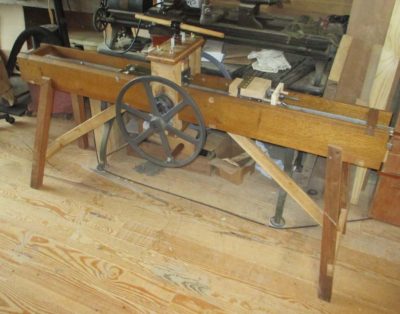
My long time friend and colleague Cor(nelis) van Horne had a project that justified his making a ripple molding machine himself. I think the project involved making several full sized room doors with basketweave ripple molding somewhere in the design. Recently Cor retired and moved back to his native Holland, and gifted the machine to Winterthur Museum with the condition that it be used for educational programming. Chief Furniture Conservator Mark Anderson contacted me with the offer to use it in the upcoming Ripple Molding Machine workshop and I accepted. One of the things we will be doing during the gathering in two weeks will be to get the machine fully assembled and tuned up so that we can crank out some molding for everyone to go home with.
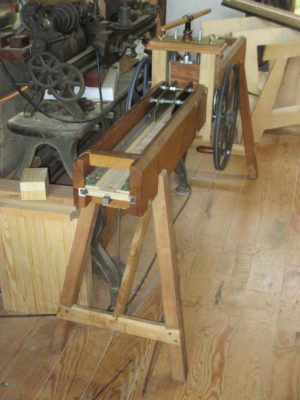
I spent a half hour putting the legs back on and some other minor assembling, mostly to get all the pieces together and out of my way.
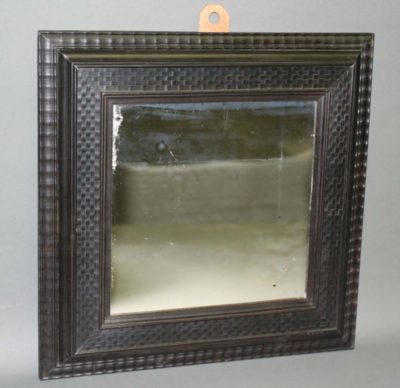
Here is a picture of a frame Cor made with some of the moldings he made with this machine.
“Calling Minnesota Fats, calling Mr. Fats.”
One of the peculiarities to me of the Roubo encyclical on furniture making L’art du menuisier was his attention devoted to gaming and game tables. Perhaps the Parisians were as debauched as we are today, only they didn’t have internet gambling and office sports betting pools. And speaking of “pool” the games of billiards were numerous and complex, far surpassing the pocket billiards (pool) that I am familiar with from movies and the Student Union in college.
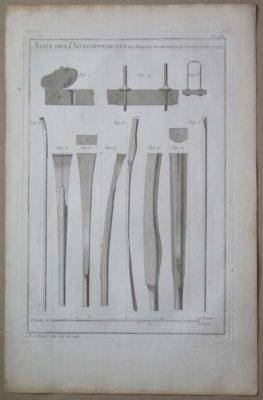
Plate 256, “A Continuation of Description of a billiard table and the Instruments that are Necessary to this Game” is a peek into the arcane world of billiards, which is a series of games of precision bumper ricocheting on sometimes huge playing tables. Plate 256 presents a world so foreign to me that the devices represented are completely unknown (to me). So if you know of billiard enthusiast who wants a bit of original First Edition Rouboiana this is your chance.
This page is in near-excellent condition with a little more border staining than most of the ones I have, but the image field is in darned near perfect condition. The staining would be completely hidden by the mat when you get it framed.
The plate was drawn and engraved by Roubo himself.
I will be selling this print at Handworks on a first-come basis, with terms being cash, check, or Paypal if you have a smart phone and can do that at the time of the transaction.
$150
A woodworker walks into a brew pub, glances around, and spots another woodworker across the room. As the first man approaches the second, words ensue. In a few seconds the second woodworker clenches his hand into a fist and sticks it right under the nose of the first man.
This might be Mickey Spillane’s telling of a episode a the recent Lie-Nielsen tool event in Covington KY. Of course there is much more background to the tale.
The two woodworkers in question were Dr. MichaelCD and me. Michael is a professor and practitioner of the healing arts, particularly as they relate to the repair and rehabilitation of injured hands and wrists. We have been corresponding regularly since I broke my arm last year. His counsel has been a Godsend, especially once he convinced me that I was working too aggressively on my rehab exercises and was actually retarding the progress. Once I learned to ease up a bit the progress was much faster.
While at the LNT event he gave my wrist and hand a through going-over. The break to my radius bone was so close to the wrist (about 1″ up from the base of the thumb, in the narrowest part of the forearm) and of such a nature that the cast had to be quite snug and restrictive with my hand at a peculiar angle to facilitate the bone knitting properly. As such it pushed all the swelling downward into my wrist and hand, hence my struggles at rehabbing them. As the orthopedist noted when examining the x-ray, my lifetime of working with my hands has resulted in every joint being afflicted with arthritis and they did not take well to the incursion of the extra fluid mass being inflicted on them. (At the same session the bone doc asked me when and how I broke my wrist. When I replied with a quizzical look he pointed to the x-ray image. “All this debris here and here indicates a broken wrist, and the fragments are well-worn so it was a long time ago.” Huh, who knew?)
At the end of the day in Covington I bestowed Michael with a whisk broom and the best meal we could find close by, a time of grand fellowship. That’s the way health care should be. Now if only they could figure that out in Mordor on the Potomac. In parting he gave me a new finger flexibility regimen that I have been following with much success.
Oddly enough the part of arm/wrist/hand rehab that is usually the hardest (rotating the hand relative to the elbow) went very well and fast for me, while the more simple and easy recovery (hand and finger dexterity) is something I still wrestle with. It gets better every day as I notice something new I can do; roll the toothbrush in my hand, put in my contact lens, use a credit card reader, unscrew the gas cap in the truck, and finally today, using a spring clamp for the first time with that damaged hand. At this rate I expect these hurdles will be distant memories by the time I hit the First Anniversary.
But for now, thanks to Michael I am well past the 90% recovery mark, and find my effectiveness in the shop at almost 100%. To top it all off, my left arm and hand are by necessity much more facile than they were a mere six months ago, in the end yielding greater aggregate hand skill than I started with.
How much more blessing can a fellow take?

We have a wonderful companion to the previous print in my inventory of First Edition prints from L’Art du Menuisier, this one being “Diagrams and Illustrations of a table and a camp bed with their Developments.” Again this page is in near-excellent condition with just the teensiest bit of staining along the top and bottom edges (this would be completely hidden by the mat when you get it framed.
The plate was drawn and engraved by Roubo himself.
If you have ever wanted to own a genuine piece of Rouboiana, this is your chance. I will be selling this print at Handworks on a first-come basis, with terms being cash, check, or Paypal if you have a smart phone and can do that at the time of the transaction.
$250
I recently spent a day turning small-ish spindles for a project now on the home stretch. The overall length of the spindles was roughly 12″ with a maximum diameter of ~3/4″ and a minimum of ~1/2″. This was one of those times I really appreciated the four-jaw chuck I bought many moons ago as I could easily switch from square stock to round stock in a matter of moments.
Given the delicacy of the spindles, and despite the fact that I was using some excellent old-stock true mahogany, I could not hog off the material and needed to be fairly conscientious about the detailing which included several beads that were just a smidge shy of 1/8″. I had previously tried many turning chisel combinations for the effect without easy success, and even ordered a so-called 1/8″ beader made by Sorby. Though a fine tool, apparently one of us does not know how to measure 1/8″ so I just hung it back up on the rack hoping to someday have a project where I need to turn some fat 5/32″ beads.
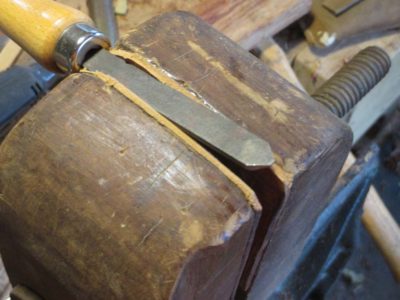

For a brief moment I thought about re-making the tool into something more useful for this project, but instead I cast my eyes on the worthless parting tool (is that redundant?) in the rack. I do not find the spear-point parting tools to be at all useful, and certainly not this dog, so I instead I decided to turn it into the beader that I needed. So I did, with my Dremel and slipstones and a half hour. It now works exquisitely. I tried it out on a practice piece and was very pleased. You can see how Ihad aready turned some of the beads into chum by other methods.
For other detail work on these spindles I took a few surplus plow plane irons and ground and honed them into shapes that fitted my needs perfectly (including a parting tool that is worth the title). I have some additional plans for more unused plow plane irons and will document that at the time.
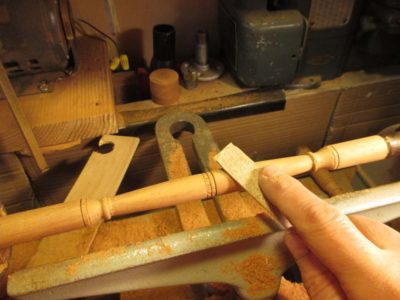
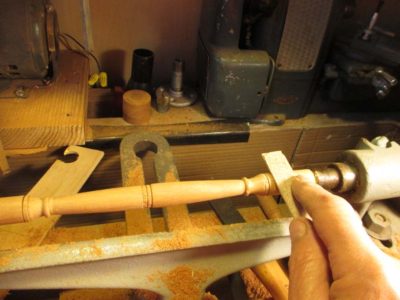
One final old favorite that became a treasure was the pile of tongue depressor sanding sticks I made some time ago. These are great for providing delicate shaping (using the 60-grit side) and a fine surface with the 180 grit side, keeping my fingers out of harm’s way the entire time.

Given the presence of this print in Chris Schwarz’ book Campaign Furniture this might be one of the more attention-getting offerings from my inventory during the upcoming Handworks 2017 IN LESS THAN A MONTH! we have Print 249 from the First Edition of L’art du Menuisier, “Plan and Elevations of a Campaign Bed with Its Developments.”
The intricacy of this print speaks for itself. The page is in excellent, near pristine condition. As an added charming feature the plate and the page were not perfectly aligned so the hand-printed image is ever so slightly askew compared to the page margins.
The Plate was drawn and engraved by Roubo himself.
If you have ever wanted to own a genuine piece of Rouboiana, this is your chance. I will be selling this print at Handworks on a first-come basis, with terms being cash, check, or Paypal if you have a smart phone and can do that at the time of the transaction.
$350
With the passing of winter (fingers crossed) and the hydroelectric system de-mothballed, I undertook my annual ritual of tuning up both ends of the penstock, or pipeline that carries the water from the small dam at the top to the turbine at the bottom.
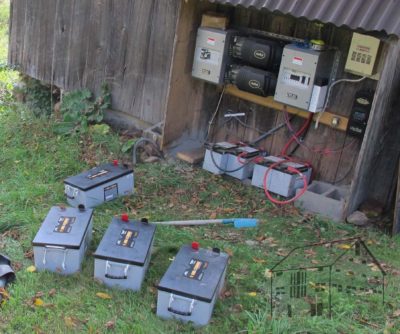
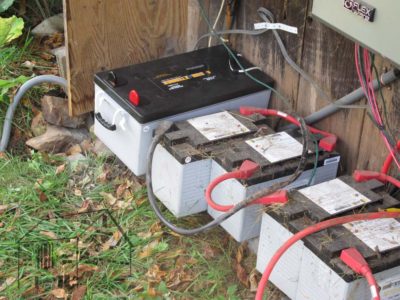
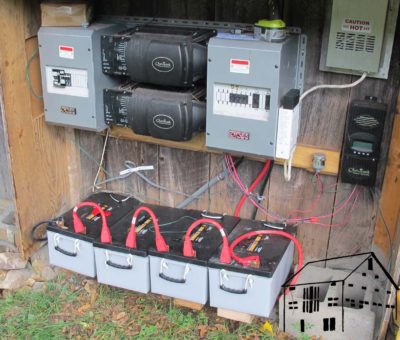
My first big upgrade a few years ago was to swap out the original four large capacity Tractor-trailer deep cycle batteries for four ultra-mega high performance deep cycle batteries for storing the generated electricity. Each of the new batteries has the capacity of the entire previous battery bank, so with this step I increased my power storage 16-fold. BTW each of the new batteries weighs 192 pounds, and these are the largest capacity 12v batteries available in the US.
A couple years ago I swapped out the rock-and-concrete catching dam at the edge of the property for a rock-and-sandbag one three hundred feet closer. I did this to save myself the intense maintenance involved in that last hundred yards of run which provided only another ten feet of drop. It just was not worth the added effort, being more than 25% of the penstock maintenance for a return of about 8% in the power output. Besides, the new site was perhaps the nicest narrowing of the creek with a huge rock on one bank and a great source of stacking rocks for the other.

Once again this year my debris filter needed replacing, something I will just have to plan in doing every other Spring unless I can find some stainless steel 1/4″ hardware cloth.

It only takes me four or five minutes to make a new one, and it swaps out with the older one in about fifteen seconds. I spend way more time walking up to the site and anything else.
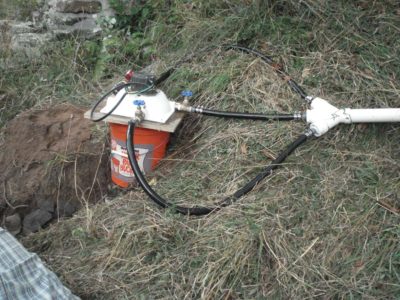
On the bottom end of the penstock I also refined some revisions I’d made in previous years. The turbine came with three graduated fixed nozzles when I bought it, 1/4″, 5/16″, and 3/8″, to provide for a nearly infinite variability in the system flow control. This required pipe fittings leading the three high-pressure hoses going to each of the nozzles, and the Y-pipe fittings were a maintenance headache. Previously I’d cut the options down to two nozzles and their fittings, but I realized that the only one I really needed was the largest one and reconfigured the routing again.

Now it’s just a straight shot leading to a single hose and nozzle.
The output of the hydro system is running about 10-12 kwh per day, which is way more than I need for most any day. Even running a planer for three hours or the wax cookers all day is no problem, especially on a sunny day when the solar panels kick in another 8-10 kwh.
My next system projects are to build a heavy-mass turbine housing to dampen the whine of the turbine, which interferes with the gurgling of the stream, and build a new powerhouse for all the electronics inherent in the system..
Last month I was visited by Joshua Farnsworth, Ray Pine, and George Lott, for a wonderful day of fellowship, filming, and yakking about woodworking and rural living.
Joshua shot a bunch of video to be edited and compiled and the first one was posted last night. You can find it here. Clearly I have a face for radio and a voice for writing.
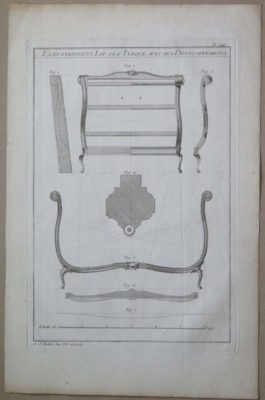
Finally we are getting to some of my prints wherein Roubo actually illustrates furniture rather than arcane geometric exercises (I can only speculate from the abundance of the latter in L’art du Menuisier that Roubo had not yet discovered girls). Here is Print #248, “Illustrations of a Turkish-style Bed and its Developments.”
The artistry, rather than the mere technical mastery, of Roubo as both a draftsman and engraver are on display here as he shows the composition and design aesthetics required for creating “D’un Lit a la Turque.” Frankly I am uncertain of what makes this a Turkish Bed, as opposed to the Polish Bed, the English Bed, the Martian Bed, etc., he presents in adjacent sections of the book. Regardless, it is a lovely illustration and the page is in excellent condition, in fact I would say that there may be several in my inventory in as good a condition, but none better.
If you have ever wanted to own a genuine piece of Rouboiana, this is your chance. I will be selling this print at Handworks on a first-come basis, with terms being cash, check, or Paypal if you have a smart phone and can do that at the time of the transaction.
$200
© 2024 Don Williams

Recent Comments