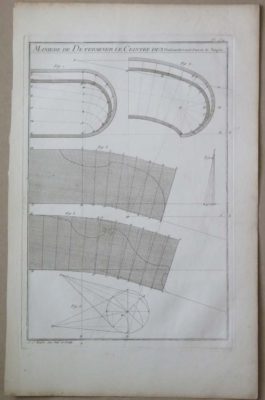
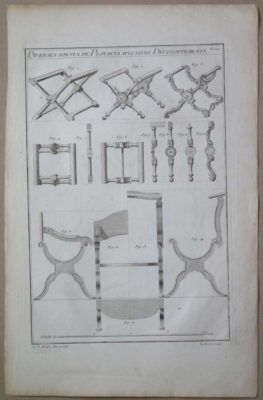
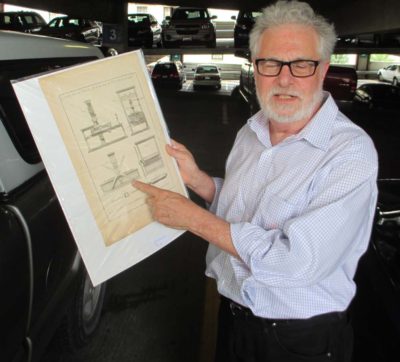
Today’s offering in the l’Art du Menuisier First Edition inventory I will have at Handworks 2017 is Plate 234, “The Manner of Determining the Desired Centers for All Kinds of Seats.”
In the days prior to CAD/CAM computer programs, i.e. 7th Grade Drafting Class with Mr. Teft for me, the ability to use geometric constructions to lay out your projects was integral to their fulfillment. Back in Roubo’s day this included intricate and sometimes arcane exercises of which Plate 234 is one. A cursory browse through the Book of Plates reveals that this was to Roubo what Price Theory is to me; something that keeps us awake at night and our brains perilously close to hyperdrive in contemplation; he included around five dozen of these exercises in l’Art du Menuisier.
The print has a crisp plate mark and is in excellent condition, notwithstanding a bit of a jagged left edge from the original assault of barbarism when extracting the page from the First Edition bound volume. It was both drawn and engraved by Roubo.
If you have ever wanted to own a genuine piece of Rouboiana, this is your chance. I will be selling this print at Handworks on a first-come basis, with terms being cash, check, or Paypal if you have a smart phone and can do that at the time of the transaction.
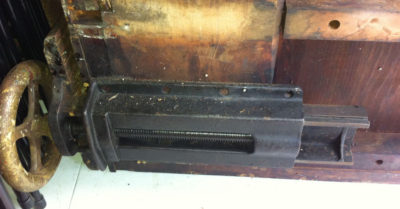
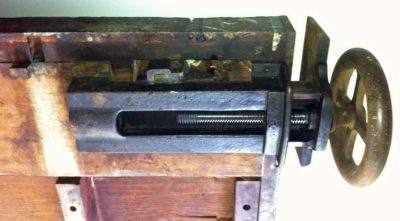
Through my explorations of all things Henry O. Studley many mysteries have made themselves known, like details of his personal, financial, and craft life. Another one that I have made known as far and wide as I can has to do with the art form of piano-maker’s vises, which based on my observations are uniform in concept and performance but individual and slightly idiosyncratic in their construction details.
I am truly delighted to have contributed t the growing interest in the question and have been contacted many times over the past few years with folks regaling me with their own speculations and discoveries themselves. (Such contacts, if serious, are always welcome).
Here is one such communique from last week, which I present to you as completely as I can while respecting the privacy of the correspondent.
You may recall that a) we spoke briefly during your trip to New England when you were researching vises, and b) that about a year and a half ago, I found & acquired a piano maker’s bench in Worcester.
I have been rebuilding the bench, and writing about it on OWWM.org I am aware, both through your work (book) and conversations with **** ******, that to date, none of the vises found have had any maker’s mark on them. As I cleaned and repainted my vises, I did not find any such marks either; only some numbers stamped on some of the parts. I had not yet removed or cleaned the back plates, though, until this week.
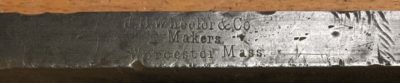
The other day, while cleaning & measuring the plate for the front vise, I found a number stamped on one long edge, & gave it little thought. Yesterday, though, I was working with the tail vise plate, and out of curiosity looked to see whether I’d find a number on that as well – and instead, what I found was a maker’s mark! This was stamped along what was the bottom edge of the plate, which was covered in rust, grime and paint drips. I then checked the other edge of the other plate, and sure enough, there it was, though this time it was on the top edge, and more obscured by dents & dings, as well as the rust, etc.
The maker is J.S. Wheeler of Worcester, MA. Wheeler was a maker of machinery, mostly for metal working, and was known for it’s metal planers – which makes some sense, as we both have noted that these vises were machined on planers.
Anyway, thought you’d like to know, and would love to hear your thoughts.
Tim
This is indeed exciting news to me, and revives my hope that more Studley-type information will continue to flow my way. On a related subject I got another recent email from a friend who was discussing the possibility of acquiring a reciprocal metal planer himself.
Finally I will note with a bit of irony that this growing body of information and an enthusiastic cadre of acquisition probably means the only way I will round out my set is to get off my kiester and get underway with making them with Jameel.
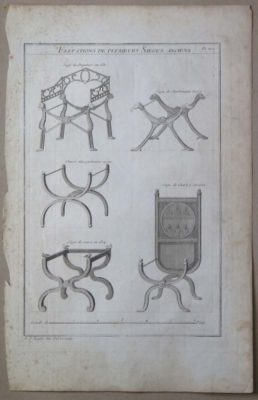
The next print in the l’Art du Menuisier First Edition inventory I will have at Handworks 2017 is Plate 224, “Many Types of Folding Stools and Their Development/Variations.” I find prints of this type to be particularly charming as the copper intaglio plate and the page were not aligned when they went through the roller press, resulting in an image that is askew. This phenomenon is not uncommon and gives further proof that this was a hand printed image on hand-made paper.
The print is in excellent condition. It was drawn by Roubo and engraved by artist Pierre-Gabriel Berthault, whose name appears frequently underneath the images of l’Art du Menuisier.
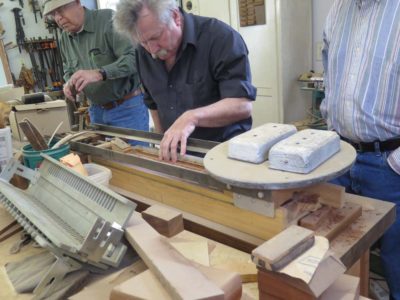
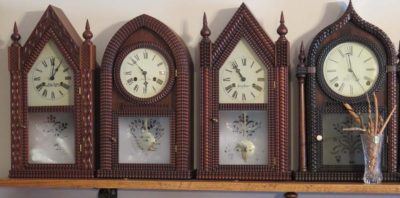
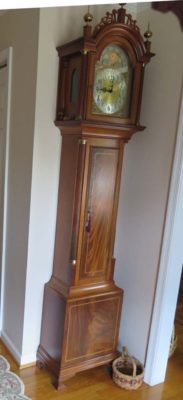
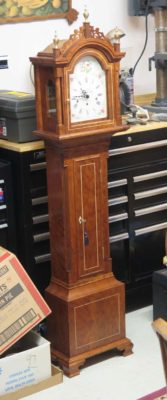
Last month my long time acquaintance RichardB organized another field trip to JerryR’s shop and examine again the ripple molding cutter his dad Irv made a jillion years ago. Both Irv and Jerry made/make exquisite clocks and incorporate(d) the moldings into their designs.
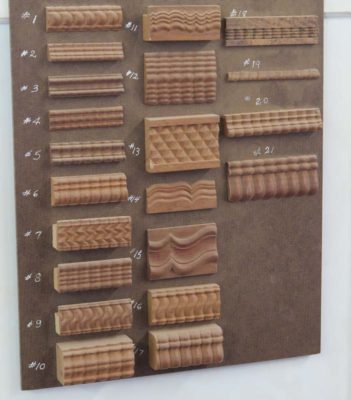
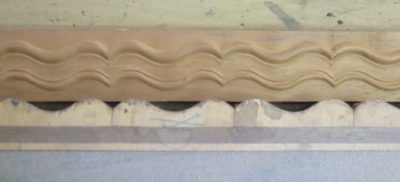
A selection of the moldings Kurt made on his machine.
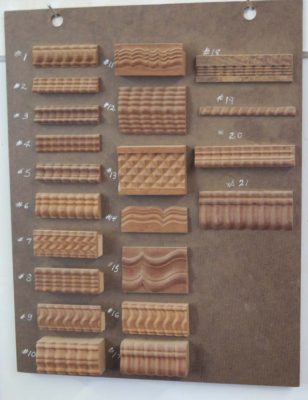
Jerry’s sample board.
The catalyst for this gathering was the visit of KurtN who has built his own version of such a machine and was, like me, continuing research on the topic. We were also joined by tool historian and collector extrordinaire BobR for a grand day of fellowship and exploring the elegance of craft technology.
I found it useful to once again spend time with the machine, as it was extremely helpful in formulating and refining the strategy for the upcoming gathering to manufacture a ripple molding machine at The Barn late next month. In fact we have enough folks coming that we might try to divide into two working groups to make two machines.
Here’s a gallery of the day.
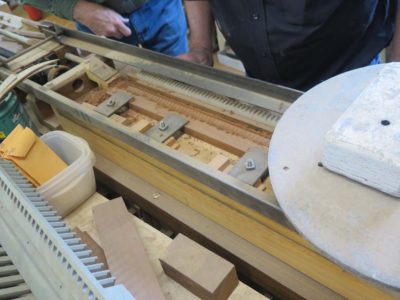
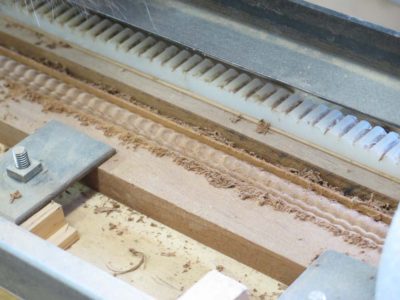
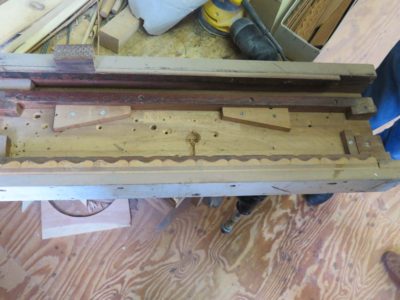
Jerry’s machine features a traveling cutter head carriage with free weights on it to to provide the downward cutting/scraping force.
I could not tell if the up-and-down patterns were made from Delrin, HDPE, nylon or whatever.
The machine is set up to cut up-and-down patterns and side-to-side patterns. I hope we can incorporate the same features when we make ours next month.
The underside of the carriage with the cutting iron, fashioned in this case from an old file.
The electric worm drive motive power was a feature I definitely expect to incorporate into ours, although for demonstration purposes we may make it hand-powered as well.
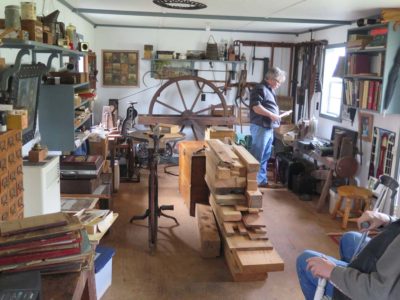
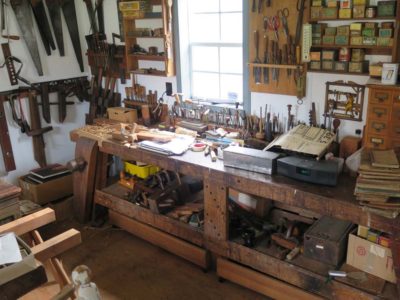
We took a few minutes to tour another shop building Jerry has set up to document his family’s woodworking over the past several generations. Yes, that is a ten-foot Moravian style workbench.
A collection of mantle clocks Irv and Jerry made, with copious ripple moldings.
As I blogged earlier I will be selling many original First Edition 1772/1774 Roubo l’art du Menuisier prints at the upcoming Handworks 2017. I bought these prints at an auction featuring a huge inventory from an antiquarian bibliophile who had mutilated scores of exquisite ancient books by cutting out the print images from the bindings. As unfortunate as this act of barbarism was, it did bring these masterpieces to the marketplace.
The only other option for me to examine them closely would have been to purchase a complete set of First Edition l’art du Menuisier for perhaps $10-15k or travel to Ft. Mitchell KY to see Chris Schwarz’ excellent set. Since the latter remains an option to me for the foreseeable future, I’m jettisoning most of mine.
If you have ever wanted to own a genuine piece of Rouboiana, this is your chance. I will be selling my prints to Handworks attendees on a first-come basis, with terms being cash, check, or Paypal if you have a smart phone and can do that at the time of the transaction.
Roubo was the draftsman for all the prints, and the engraver for a large number of them. All these were hand-printed intaglio prints on hand made rag paper, almost certainly personally overseen by Roubo himself.
This is the first of the prints which I will be presenting in the order of their print numbers, Plate 222, “Illustrations of Many Ancient Chairs.” This image of chairs from the 7th Century through the 15th Century was both drawn and engraved by Roubo himself. The print is one of the rougher of those I purchase, with the left edge being pretty irregular as the removal from the binding was, shall we say, inelegant, and the page itself stained especially around the perimeter, reflected in the price of $100.
If you have any questions about this print you can contact me here.
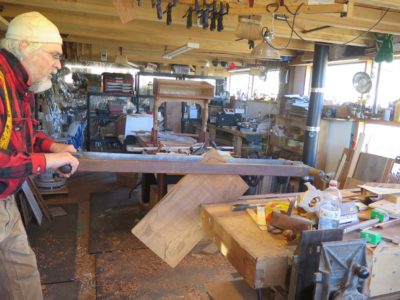
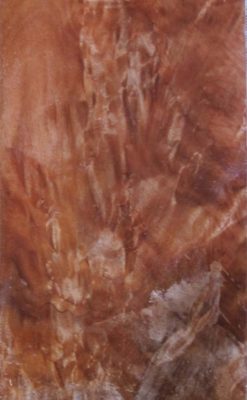
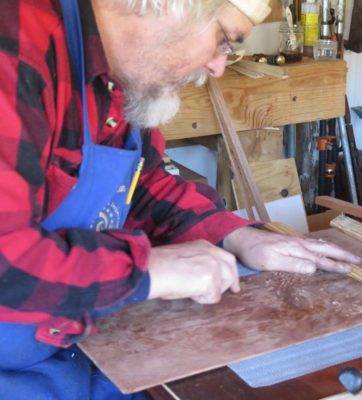
I’m nearing the tail end of a long term project involving in part the sawing and preparing, and ultimately using, mahogany crotch veneers. Given my skill is not yet Roubo-esque I sawed the veneers to a fat 1/8″ because I had no room for error, in other word I would have to begin all over again with another piece of lumber if I could not get this to work out right.
The weight of the veneer made it a delight to work with, that is until I had to thin it down to the final thickness.
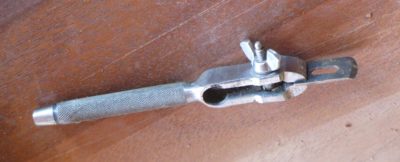
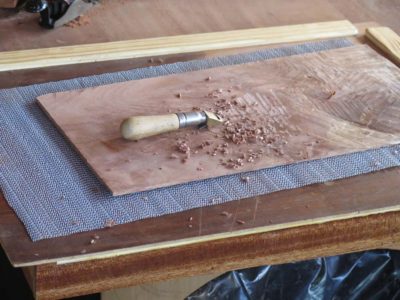
Working squirrely wood like this is less amusing than you might think. The grain was so wild I came down to only two real options; aggressive toothing plane work, which I did plenty of, or using a handled luthier’s palm plane. This latter step was immensely helpful once I got the tool tuned up. It reminded me of a lesson from the foundry pattern shop; to really hog off material in a hurry, use a small convex spokeshave that is sharper than sharp.
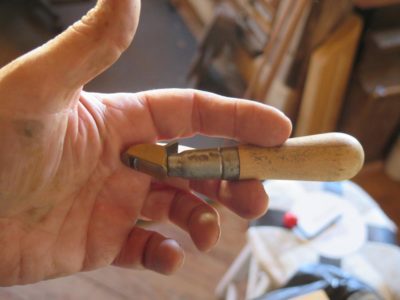
The tool in question was probably cobbled together but had real possibilities. The iron was adequate for nibbling at straight grain wood, but needed to be upgraded considerably in the sharp department. Given that the iron was barely larger than my pinkie fingernail I spent a couple minutes trolling in the shop for help.
Then I found the perfect tool, my jeweler’s hand held vise. With the tiny iron securely held in its jaws I could sharpen it effortlessly just like it was a narrow iron four inches long. Piece of cake.
It sharpened to a brilliant mirror and uber sharp cutting in literally three or four minutes.
Putting it to hard work was a pleasure. It hogged off stock like a pro, and all it took afterward was some time with one of my toothing planes to get it ready for application.
And all because I went shopping for just the right holding device in my own toolbox, allowing me to get the teeny iron sharper than sharp..
Starting top left and working clockwise: Model 296 ($42, sold privately and through Lie Nielsen only); 2″ Original ($42); 1″ Turner’s Model with 1/4″ bristles ($24); 1″ Carver’s Model ($24); 1″ Original Model with 1/8″ bristles ($24).
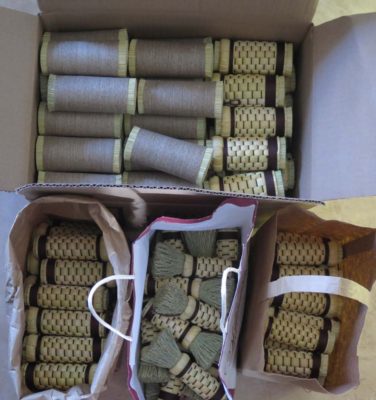
Yesterday I got my first polissoir inventory reload in the lead-up to the upcoming toolapalooza in Amana IA. I’ve asked the broom maker to just keep cranking them out until I say “Stop.” This is the first installment to make sure I have plenty for Handworks, and I intend to have sample boards to play with during demonstrations there. One of the things I want to emphasize there is how to prepare and tune up a polissoir for use.
May 23-27 Making a Ripple Molding Cutter – this is less of a workshop than a week long gathering of fellow galoots trying to design and build a machine to allow us to recreate ripple and wave moldings. Material and supplies costs divvied up, no tuition.
June 16-18 Make a Nested Set of Brass Roubo Squares – This is a weekend of metal working, as we fabricate a full set of nested brass squares with ogee tips, as illustrated in Plate 308 of l’art du Menuisier. The emphasis will be entirely on metal fabrication and finishing, including silver soldering with jeweler Lydia Fast, and creating a soldering station for the workbench. Tuition $375, materials cost $50.
July 24-28 Minimalist Woodworking with Vic Tesolin – This week long session with author and woodworking minimalist Vic Tesolin will begin with the fabrication, entirely by hand, of a Japanese tool box. Who knows where we will end up? I am looking forward to having my own work transformed. Tuition $625, materials cost $50.
August 11-13 Historic Finishing – My own long-time favorite, we will spend three days reflecting on, and enacting, my “Six Rules For Perfect Finishing” in the historic tradition of spirit and wax coatings. Each participant should bring a small finishing project with them, and will accompany that project with creating numerous sample boards to keep in your personal collections. Tuition $375.
September 4-8 Build An Heirloom Workbench – I’m repeating the popular and successful week-long event from last year, wherein the participants will fashion a Roubo-style workbench from laminated southern yellow pine. Every participant will leave at the end with a completed bench, ready to be put to work as soon as you get home and find three friends to help you move it into the shop. Tuition and Materials $825 total.
Since some recent research revealed the attention span of Americans to be eight seconds, I’ll re-run this periodically.
As I blogged last year I was fortunate to purchase at auction two lots of prints that had been sliced out of a First Edition of l’art du Menusier by Andre-Jacob Roubo in the 1760s and 1770s. These are remarkable artifacts, printed by hand on hand-made paper. Roubo was the artist for every image, was the engraver for a great many of the plates, and almost certainly was personally overseeing the production of the volumes.
As fate would have it all the prints I acquired are from the portions of Roubo that Michele, Philippe and I have completed after about 10-12,000 hours work thus far, and the hearty souls at Lost Art Press have already published.
Plate 296, the one which lit my fire for this project more than 30 years ago. This treasure will feature prominently on the wall of our home.
Among the prints I bought was the very one that inspired me to head off down the path to our ongoing project to bring to the Anglophone world our annotated Roubo translations. Plate 296 whetted my appetite more than three decades ago, and as soon as I get a frame made it will be occupy a place of honor in our home.
I have already gifted two of these prints to my LAP collaborator colleagues, chief-cook-and-bottle-washer Chris Schwarz, who received Plate 279 featuring “the German Workbench,” and book designer and artisan printer Wesley Tanner who seemed delighted to get Plate 327 featuring the printing press.
After culling the dozen-or-so prints of greatest meaning to me I have decided to sell the rest from my purchase because I do not have the appropriate wall space to display them (about three dozen); it is not a complete inventory by any means, but there are some pretty good ones.
Over the next several weeks I will be posting here all the individual prints I will have for sale in Amana. Terms will be cash, check, or Paypal. Prices will probably mostly fall between $150-$500 with a couple of outliers, but if you ever wanted a piece of genuine Rouboiana this is your chance. In addition to the Roubo prints I got a number of original, similarly excised plates from Diderot, all concerned with the manufacture of ship’s anchors. The Diderot plates will be considerably less.
There will be no advance reservations, this is a special first-come sale for Handworks attendees. If any do not sell there, I will offer them for sale through the blog afterward.
One of the great delights of attending the recent LNT event in Covington KY was to witness the overlapping of the generations of contemporary woodworking and woodworking tool makers. This atmosphere will be replicated to a logarithmic degree at the upcoming Handwork 2017 where there will be several dozen exhibitors in Amana rather than the half dozen in Covington. The ultimate irony is of course that the generations of modern craftsmanship, and the populations within them, have almost no relationship to the calendar.
There were of course the godfathers of the modern woodworking and toolmaking universe: Lie-Nielsen Toolworks (in truth Thomas Lie-Nielsen could be be considered one of the progenitors of this new world of high-quality tools at an approachable price), Chris Schwarz, Pop Wood, Matt Bickford. The middle generation was represented by Raney Nelson and Scott Meek, whose creative energies in the direction of tool making are probably now in their second decade.
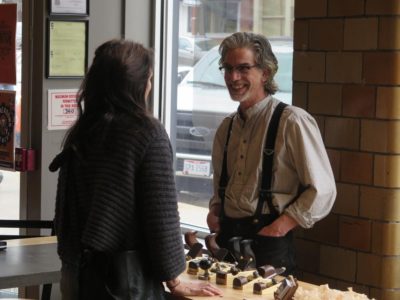
But what drew my attention was the presence of The New Generation in the persons of Mateo Panzico (top) and Steve Voigt, two brilliant toolmakers whose emergence in the marketplace over the past caouple of years has been noteworthy.
Both makers were at last year’s LNT Covington event (in fact my only picture of Mateo was from last year) and I was this close (thumb and forefinger a fraction apart) to coming home with some of their product but miraculously I resisted the temptation. The same could not be said for this year.
The two men are working in wildly different styles; Mateo is developing a creative vocabulary in infill planes, and his stylistic beginnings were a bit steampunk-ish but evolving into somewhat smoother, not-quite-organic forms.
Steve is tacking close to the winds of tradition with his double-iron beechwood body English designs. Notwithstanding my inventory of toothing planes, I am considering commissioning him to try his hand at the form.
Both makers are producing exquisite tools that are at the very highest levels of performance.
This year I came home with two smoothing planes, one from each fellow. In truth part of the reason I made the decision was my desire to get their tools before these makers become so well known and in such demand that I could no longer afford their tools. As a free-market absolutist myself, I will not object to their growing success in the least, in fact I will celebrate it, but I was simply making a rational decision to buy before they ascended to a point where I could no longer consider obtaining them.
The best part? Mateo and Steve are but the tip of the iceberg. There are literally dozens of new and nascent toolmakers seeking to fulfill your desires and demands in the marketplace.
Thanks to Lie-Nielsen Toolworks and Handworks 2017 for nurturing this new generation.







Recent Comments