I have long argued that we are living in two simultaneous Golden Ages, that of furniture making and that of tool making. Never before in human history has a culture produced more superb furniture than we are right now, it’s just that most of the furniture is being made avocationally rather than vocationally, which is not to disregard the exquisite furniture being made by people who do it for a living. It’s just that there are so many more “makers driven by passion” than those driven by income, a ratio I would conclude is far north of 100:1.
The Golden Age of Tool Making is a bit different in that the purveyors for those particular narcotics in the marketplace are simultaneously driven by both passion and income. Consider the upcoming Handworks event, where scores of professional woodworking tool makers will interact with thousands of woodworkers and tool aficionados, deep in the heart of the Iowa cornfields. I am honored to count many of these toolmakers among my friends and acquaintances.
I am sure there are cranky toolmakers working under the nostrum of secrecy, but thus far I have yet to run into any of them. My experience is that they are delighted that you are interested, and inevitably they will fill you with more information than you can digest at any one time. They must understand this, as most of them have web pages that are archives of definitive and dispositive documents telling you almost everything you ever wanted to know about whatever it is that they make or do. I keep several dozen of their sites bookmarked and visit them as often as I allow myself, knowing full well that the first click can result in an entire evening lost in pursuit of knowing more.
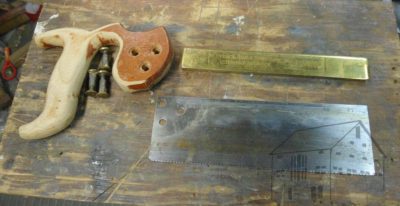
Occasionally one strikes my fancy or is so perfectly timed to a particular need that I find myself talking to myself in celebration. Recently I have been doing some things with saws, some of which may eventually leak out into this blog, but most of which has to do with tuning up the saws that I already have. With that in mind I was delighted to see a new (to me at least) offering over at Bad Axe on the care and feeding of vintage back saws. I am currently awaiting the fullness of time to get to a couple (four? five?) of them hanging on my wall, and this page will no doubt serve as a valued resource once I get to that point.
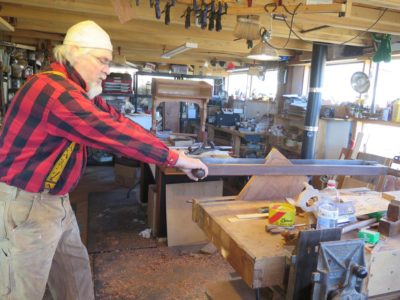
In the service of full disclosure I should say that I have two Bad Axe back saws that I purchased from them, and have communicated with Mark Harrell fairly extensively on my two 4-foot late-18th Century frame saws, tools I use surprisingly often. Someday I might show up on Mark’s doorstep with them in hand, and ask for a sharpening refresher tutorial.
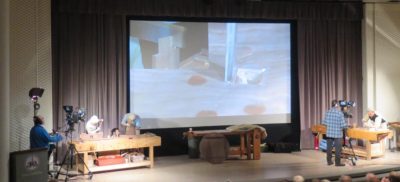
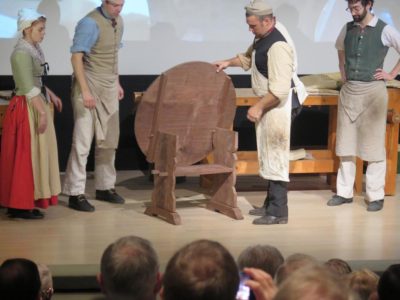
Ted Boscani’s crew from the CW Joiner’s Shop (I think at one time they were known as the housewrights) were the final in-house presenters as they had a Four Ring Circus in operation making a “table chair.” I think in some circles this piece is known as “a monk’s chair.”
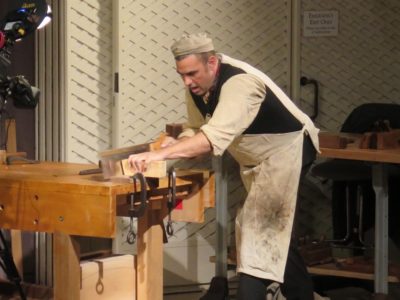
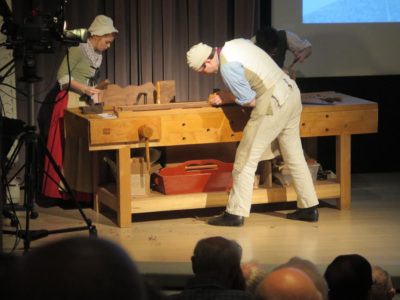
While Ted was demonstrating some of the joinery from the underside of the flip-top, most particularly the cutting of the sliding dovetail into which the hinging braces would be inserted, the apprentices were all working on the same bench on the opposite side of the stage fabricating the elements that were assembled into the chair’s base. Their congenial sharing of a bench tweaked my self-indulgence of working on, in a typical day, anywhere from 6-8 different work benches in my own space. I admit, I suffer under an embarrassment of riches.
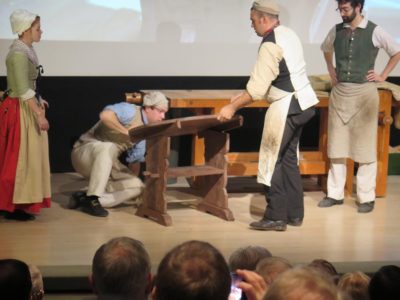
Finally, after 90 very engaging and entertaining minutes, the table was assembled. While I have my doubts about the interests and abilities of most of those in attendance to fabricate any of the chairs from earlier demonstrations, I can definitely see this fitting into the ken of just about everyone there.
If you have not already seen Konrad Sauer’s update on the restoration of the 1968 Volvo P1800 I disposed of in his direction, give it a look. The car, of which there were only about 125,000 produced over a 13 year period, was made famous in the early 60s British television series “The Saint” starring the utra-cool Roger Moore.
Here’s just one of the dozens of pics.

In addition to serving as the Master of Ceremonies for the Working Wood in the 18th Century event, Anthony Hay shop master Kaare Loftheim took to the stage to show us the developments of the corner chair made up the road in the Walker shop near Fredericksburg. This iconic chair form, perhaps most notable for the thunder mug contained underneath the upholstered slip seat, provided inspiration for many other chairmakers of the period. Maybe while they were sitting… oh, never mind.


Kaare was particularly struck by the stylistic variations of the form within the same shop. He spent considerable time pointing out the salient details from the version of the chair he was replicating in black walnut.

For the on-stage demonstration Kaare did the layout and carving in basswood so it would proceed more quickly and we could get his points in a hurry.

I am pretty sure that “working in a highly detailed artistic and technical exercise while an audience watches the results a 100x magnification” fits at least some definition of fearlessness.


Most of the structural creation had been accomplished prior to the event, but it still had to fit together properly. It did.
Prior to the last year or so I was only barely acquainted with Kaare personally, and it has been a true delight to get to know him better over that time and I look forward to the next time our paths cross.
Anthony Hay cabinet shop journeyman Bill Pavlak bit off the challenge of making a chair illustrated in Chippendale’s Director. Given the vagaries of historic images when compared to the structure of chairs, it was indeed something to wrestle with.

Bill engaged in one of the most innovative didactic exercises I’ve seen as he walked us through the evolution of the Chippendale chair by fabricating a display form on which he could attach full scale depictions for each of the major evolutionary steps in the design heritage. I found this to be a brilliant approach that should be employed everywhere for anyone interested in the subject.

Since much of the character of the chair is contained in the carvings, that is where Bill spent his time.

I must admit that I missed some of Bill’s presentation as I was 1) talking to someone out in the vestibule about some SAPFM bidnez, and 2) snuck out to go with my wife and some friends to an organ recital at the nearby Wren Chapel on the campus of the College of William and Mary. Sorry Bill, no disrespect intended.

In the next four postings I will be highlighting the contributions by the CW craftsmen to the Working Wood in the 18th Century gathering. They work under the burdensome (?) expectation of excellence on our part, as for years they have not only put on the show as the impresarios but are expected to be stellar in their on-stage performances. It’s a lot of weight on their shoulders, and they pull it off every time! You can tell they are comfortable with audiences, I don’t mind folks watching me work, but the contant interruptions they endure must be maddening. It disrupts any work flow and extends a project’s timeline by a logarithmic factor.

First up of the Colonialista soloists was Brian Weldy, demonstrating the steps to designing and building a late Baroque (aka “Queen Anne”) chair in walnut. As with all the presentations I found much to be learned from the project, although it is unlikely I will ever build one. Nevertheless Brian’s dealing with the sumptuously curvilinear form was instructive.


His layout of the serpentine center splat was particularly of interest to me as I have a pair of 16th Century Chinese horseshoe chairs on my bucket list.

He called on Kaare to provide a second pair of hands for the assembly of the chair seat rail and legs. I was fascinated by the wooden blocks left on the serpentine seat rail to provide striking anf clampning surfaces. These would be carved off once the assembly was completed. I thought it was an ingeniuos and efficient solution to a problem. Maybe everyone else already knew it, but it is a technique now residing firmly in the memory bank.

With the chair assembled Brian addressed the seat construction and lofting, and his time was done.
I’ll interrupt my jaunt through the CW confab to mention some new things in the mail.

First off is the catalog from the Marc Adams School of Woodworking which includes this page describing the two classes I will be teaching this fall, Parquetry and Historic Finishing.

Yesterday saw the arrival of the new Popular Woodworking with some intriguing contents.

In addition to an excellent article on bench chisels from The Schwarz Hisownself there is a wonderful piece by my pal Jameel Abraham on making and using plywood. Solid.

And immediately subsequent to Jameel is my latest article, which was about the most fun writing I have ever had.
To top it all off I received a sample of some shellac wax from the producer in India. It is excellent and I am going shortly to the bank to make the bank-to-bank transfer to order several hundred pounds. This steady supply will allow us to begin manufacturing Mel’s Wax shortly. Stay tuned.

Of all the thing I learned at the recent Working Wood in the 18th Century shindig, two come into clear focus: 1) Peter Galbert is a rock star, and 2) even though I am not a Windsor chair sorta guy I somehow have to figure out a way to budget the time and finances to attend a workshop he is teaching.
While I am not even a chair builder per se, Samuel Gragg chairs notwithstanding, I had been awaiting this presentation with great anticipation since I learned of it. Pete’s book on chair building was a thing of great beauty and erudition; the highest compliment I can give it is that I wish I had written a book this good. When reading it I found myself smacking my forehead with every new nugget of enlightenment, which meant every couple of minutes or so. In much the same way as Krenov’s original trilogy, Chairmaker’s Notebook is a snapshot of the craftsman’s soul.
And here he was on stage, unfolding his methods of work. As my friend MikeM remarked, Pete’s performance was perhaps the most amazing example of cogent non-stop talking and non-stop working either of us had witnessed. Next to both “peripatetic” and “loquacious” in the dictionary is a picture of Pete, and with great elan he walked us through the processes he uses to build his chairs, and his reasoning behind them. It was a beautiful thing to see.

Beginning with the splitting of the green stock needed for the fashioning of the steam bent pieces and finishing with the assembly of the chair’s elements, I found this to be as grand a learning experience as any I have encountered in furniture making.


Along the way he showed how he lays out the geometry of the chair spindles and legs, steam bent the continuous arm/crest rail (I was too engrossed in watching to remember to take pictures), and even turning the green wood legs on a treadle lathe, he did not miss a single note.


His assembled base with the arm attached was a great hit with the attendees as it was on display out in the vestibule of the auditorium.

Well done, and thanks Pete.
Recently I attended the annual Working Wood in the 18th Century shindig at Colonial Williamsburg. I’ve been to many of these gatherings over the years, but this was my first since moving to White Run, and also my first entree as a speaker. The theme this year was chairmaking, and the presenters were Kaare and Ted, along with Brian Weldy and Bill Pavlak, the journeymen from the Hay shop and Ted’s crew of interns from the Joiners shop, along with Windsor chair maker Peter Galbert and moi.
The general format for these has always been hands-on demonstrations by the CW craftsmen, usually from the Anthony Hay Cabinetmaker shop, currently mastered by Kaare Loftheim, and the Joiners shop, under the tutelage of Ted Boscani.

The setting for the conference is the Hennage Auditorium of CW, with each of the presenters engaging in actual hands-on work while engaging in soliloquies of discourse on their particular topic, on-camera with live microphones.
First up with the evening lecture on the opening night was Tara Gleason Chicirda, the long time Curator of Furniture for CW, presenting Craftsmanship of the American Chair. Tara possesses a breathtaking range and depth of knowledge about the things we care about, and I have never been disappointed by the many lectures I have heard from her.
The next morning was started by a “three-ring circus” as Kaare, Brian, and Bill took the stage for near simultaneous expositions on their projects with a session titled Chairmaking Fundamentals–Three Chairs which set the stage for the exhilarating ride to come.
More abut each of their projects in coming posts.
Here is the full slate of activities.
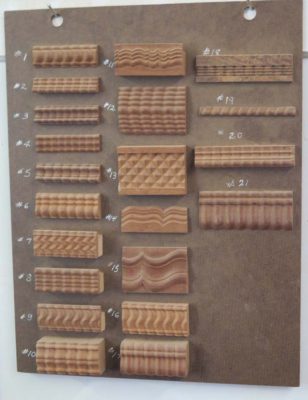
May 23-27 Making a Ripple Molding Cutter – this is less of a workshop than a week long gathering of fellow galoots trying to design and build a machine to allow us to recreate ripple and wave moldings. Material and supplies costs divvied up, no tuition.
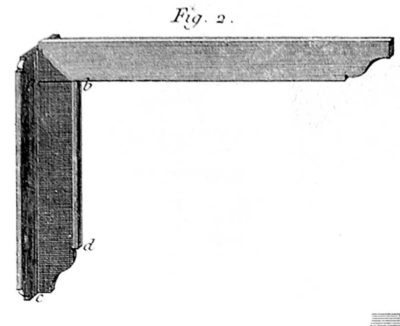
June 16-18 Make a Nested Set of Brass Roubo Squares – This is a weekend of metal working, as we fabricate a full set of nested brass squares with ogee tips, as illustrated in Plate 308 of l’art du Menuisier. The emphasis will be entirely on metal fabrication and finishing, including silver soldering with jeweler Lydia Fast, and creating a soldering station for the workbench. Tuition $375, materials cost $50.
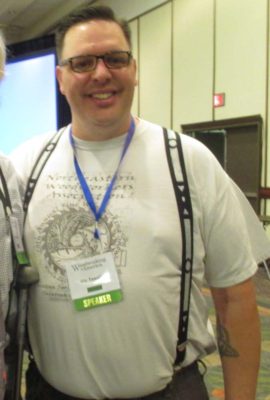
July 24-28 Minimalist Woodworking with Vic Tesolin – This week long session with author and woodworking minimalist Vic Tesolin will begin with the fabrication, entirely by hand, of a Japanese tool box. Who knows where we will end up? I am looking forward to having my own work transformed. Tuition $625, materials cost $50.
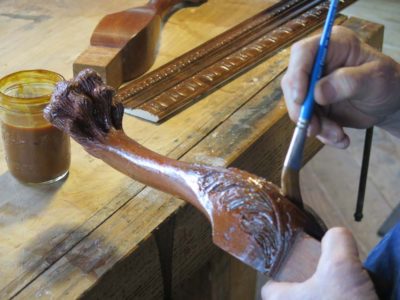
August 11-13 Historic Finishing – My own long-time favorite, we will spend three days reflecting on, and enacting, my “Six Rules For Perfect Finishing” in the historic tradition of spirit and wax coatings. Each participant should bring a small finishing project with them, and will accompany that project with creating numerous sample boards to keep in your personal collections. Tuition $375.
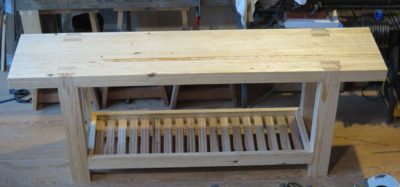
September 4-8 Build An Heirloom Workbench – I’m repeating the popular and successful week-long event from last year, wherein the participants will fashion a Roubo-style workbench from laminated southern yellow pine. Every participant will leave at the end with a completed bench, ready to be put to work as soon as you get home and find three friends to help you move it into the shop. Tuition and Materials $825 total.
Since some recent research revealed the attention span of Americans to be eight seconds, I’ll re-run this periodically.
If any of these interest you drop me a line here.


Recent Comments