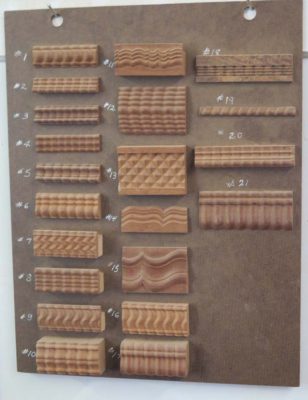
A couple weeks go I was in Elizabeth City NC at the invitation of the Tidewater Chapter of the SAPFM to speak about a current project involving a lot of moldings on the edges of curvilinear profiles.


I gave a quick review of the project then set about demonstrating the use of a set of scratch stock profilers I made for the task. Or to put it more correctly, Ben Hobbs demonstrated on my behalf as my hand was extremely tender, weak, and not flexible after six weeks in the cast. I gave it the old college try but was simply unable to complete the tasks. I did not notice making noises while trying, but TomS mentioned that I kept saying under my breath, “Ouch, that hurts.” Thanks for bailing me out Ben.


There was a lot of interest in the process, especially once folks saw how simply, relatively easy, and quick it could be.


A portion of this presentation will be included in my upcoming banquet lecture at the Williamsburg Working Wood in the 18th Century shindig.
PS It is good to be back in blogosphere circulation after travel when I was without internet access for an extended time.
I meant to post this last night but we had company and I was engrossed in our conversations.

I’ve been voting since 1974, and to the best of my recollection I have never been on the victorious side of voting for anyone or anything, a tradition I expect to continue this year. Except for that time I accidentally forgot which numbskull was the incumbent (are “numbskull” and “incumbent” redundant?) in a school board race and voted for the wrong guy.
Come on SMOD!

I am excited about the imminent announcement and opening of registration for the 2017 Working Wood Symposium at Colonial Williamsburg this coming February 2-5. Though I have been a frequent attendee, this will be my first stint as a speaker. For the “on stage” portion of the event Be Seated! Eighteenth Century Chair Making I will be demonstrating historic pre-industrial finishing. Then I will be the banquet speaker afterwards, addressing the topic of integrating traditional techniques into the modern workshop.
It is always a great time of fellowship and learning, and the conference coincides with the annual business meeting and banquet for the Society of American Period Furniture Makers, where we will recognize the winner of this year’s Cartouche Award Jeffrey Roberts.
I hope to see you there!

Martin Donnelly just announced the inclusion of a piano-maker’s work bench from the Poole Piano Company (HO Studley’s company) in his April 2017 auction. It’s in Newsletter #180 in case the link changes. I will post more. and a better picture, as I can.
Now all I have to do is figure out how to inherit new rich parents so that I can think about bidding on it.

On Saturday I will be demonstrating for the Tidewater Chapter of the SAPFM meeting in Elizabeth City NC. I’ll be presenting on the topic of fabricating and using scratch stocks to create complex moldings on undulating surfaces. Actually, even though my cast has been removed I do not yet have the hand and arm strength to do the hands-on, so my friend and SAPFM Cartouche Winner Ben Hobbs will serve as my hands in showing the approach I take.

You can get more information here.

Notwithstanding my adoption of the moniker “lefty” for the past six weeks I have cheerfully fulfilled my previous agreements to make some presentations.
The first was to the DC Chapter of the Piano Technician’s Guild, a national organization whose purpose is to preserve and foster the skills necessary to maintain these almost impossibly complex artifacts. A good piano is not only a thing of visual beauty, it is a thing of aural beauty for the listener and a thing of tactile beauty for the player.

This group wanted me to speak, not too surprisingly, about the HO Studley ensemble, a topic I never tire of. The talk must have been a success as I have been invited to give the keynote presentation at The Guild’s national conference next summer. It should be great fun.

photograph by Narayan Nayar
By the way, I did learn the function of these tools. Others remain a mystery, but I hope to get new insights at the conference. Stay tuned.

I also continued my longstanding practice of periodically speaking to the Washington Woodworker’s Guild. I think my first talk to them was in 1986. I recruited a volunteer from the audience to serve as my hands for the layout, cutting, and assembly of simple French parquetry. As always, the time was too short so we are discussing a field trip of Guild members to The Barn. Stay tuned about that, too.
‘
It was a great relief to get the cast sawn off of my arm yesterday, and the healing is proceeding apace; the bone has fused back together in the correct configuration as expected. That is not to say that the recuperation is anywhere near complete and I will need several more weeks to get back to normal.
Since my wrist and hand were locked in place for the past six weeks I’ve temporarily lost about 90-degrees worth of motion in my wrist and hand in every axis; rotation of the hand, flippering of the hand up and down, and moving the hand to the left or to the right. I can rotate my hand/forearm a little bit, but there is almost no motion in the flippering up-and down or side-to-side directions. None of this is unusual, as any of you who have worn an arm/wrist cast can attest.
So, my task over the next month is to regain this motion and by extension the dexterity of the hand and fingers. After that comes the recovery of strength necessary to resume with vigor projects in the studio.
My next doctor’s appointment is Dec 1, and until then I have a greatly restricted regimen of activities allowed, again focusing on regaining the full range of motion but forbidding any hard pushing or pulling, twisting, jerking, or hammering. In the next month I will be exercising as continuously as possible with flexing the hand in all directions, simply to regain the fine motor skills currently absent — the ability to use a fork with my right hand, brush my teeth with my right hand, and put in my contact lens, button my shirt with my right hand, hold tools, etc. But now I can shower without a trash bag on my arm.
Ironically working on the computer suits my hand posture just fine.
My hope is that on Dec. 1 I will get the green light to resume activities at the workbench “as you feel comfortable” and my strength regains quickly for my return to projects.
While sanding sticks are a routine part of my supplies I’m currently in the midst of a project requiring a varied inventory of them, and in large numbers.

When my usage is light I have no quarrel with buying the occasional package of emery sticks from the cosmetics section of the dollar store, but when I need a lot of them, and in different configurations, I set aside a few minutes to make some at the bench. All I need is some flat sticks (or not, see below) sandpaper, spray adhesive, and a utility knife


I take the spray adhesive and apply it the verso of a sheet of sandpaper, and press down as many flat sticks as I can. In this case I’m using tongue depressors. The identical process can also be used when making sanding sticks from stirring sticks that I make by the bucketful from scrap.


Using a utility knife I cut these up into individual units, then take a second sheet of sandpaper, almost always a different grit, and repeat the process resulting in a pile of double grit sanding sticks.

For the current project I needed larger scale flat and round sanding sticks, so I took a 1-1/4 dowel and ripped it on the bandsaw, then glued the flat surface down to the sandpaper. As soon as the glue tacked the paper down I rolled the whole sheet around the half-dowel. Whenever a face gets worn I just cut it off and keep on working.

Donkey dumb simple, but a valued asset in the shop.

My blog post of a few weeks ago on the mechanized wave/ripple molding cutter sparked an interest that surprised me. In response I’m scheduling a “Let’s make a molding cutter” week at The Barn May 23-27, 2017. It won’t be a regular workshop in that there will be no tuition since I’m not actually teaching anything, but the attendees will be working with me to make such a machine. There may be some expenses to be shared but they won’t be much. The main benefit all around will be the collaborative fellowship and, hopefully, a working molding cutting machine at the end. Of course, each of the participants will be stakeholders in the machine and can use it any time they need to.
If participating with us is your cup of tea, let me know.
Consider the humble zip-tie, the perfect tool for binding a handful of dowels for storage, latching together heat tape to a water pipe, fastening clusters of electronics cables on airplanes (its original function) and handcuffing together the wrists of miscreants at a riot.

But consider also its function in the world of forbidden acts, namely scratching the itch underneath a cast which the doctors tell you that you must NEVER do. Phooey.

Just stiff enough to travel its length underneath the shell, and when using the square end rather than the tongue it cannot cause any damage to the skin yet relieves the insanity inducing itch of dead skin otherwise unscratchable.

Ahhhhhhhhhhhhh.


Recent Comments