There are a variety of mechanisms for clamping a marking gauge’s iron(s) or beam into place but it generally comes down to one of two — a screw or a wedge. I toyed with both options and chose a screw as the simpler and quicker route. The only shortcoming of the system was that I did not have a “nice” screw to use when making it, an embarrassing inventory problem that can be resolved in the future.
In addition to the screw clamp I decided to add a pressure pad to the inside of the gauge block. I’ve always found this to be an elegant add-on as it looks nicer to my eye at least, and prevents the screw from disfiguring the iron/beam.
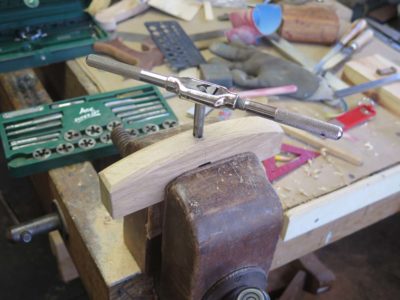
My first step was to drill and tap the access hole in concert with the screw I had on-hand. (As an aside, I once spoke to a woodworking group about tool making and asked how many had a tap-and-die set. Most hands in the room went up. When I asked how they used the set in their shops, there was a unanimous response of, “Never.” I use mine so much I hardly ever put it away.)
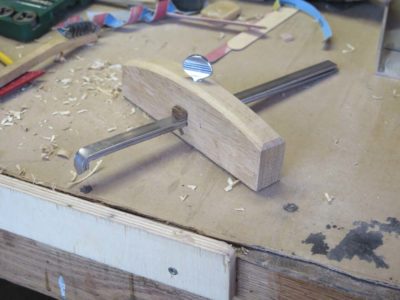
As I alluded all I had was a steel thumb screw, not even a brass one was to be found in the inventory, much less an ivory one. I’ll have to get or make a new one at some point to overcome my shame.


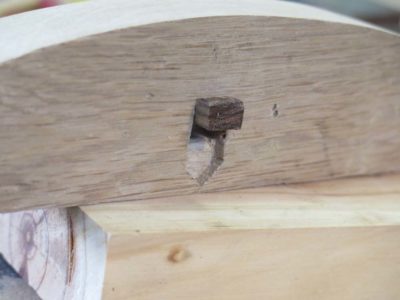
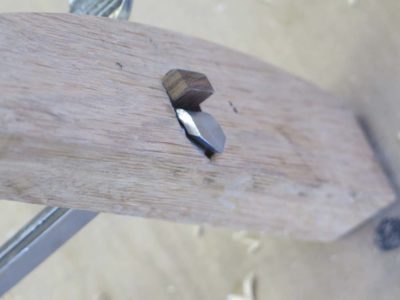
With the screw-hole drilled and tapped I went grazing in the scrap box and found a tiny piece of unidentified tropical hardwood (bocote?) from whence to fashion the pressure pad. This was a mostly filing exercise.
I honed the cutting bevels one last time with a fine diamond stone then cut the irons to length at about 6″, and before you knew it, the tool was finished.

A week ago I received my first emailed ransomware/blackmail/extortion threat, and immediately notified law enforcement and de-activated the compewder wi-fi as soon as I changed all the passwords to everything I could remember. Working remotely with webmeister Tim this evening he undertook a thorough genius-geek-worthy check of my machine, and fortunately nothing turned up. From what I gathered, it was like the vast majority of similar blackmail attempts where the criminal is simply hoping for the victim to pay the extortion demand to save themselves any trouble.
As a result of the earlier shut-down I was unable to do any email or blogging since last week, but I hope to start working on that backlog tomorrow evening unless something else (unrelated) pops up.
In the past several days I was definitely engaged in some imprecatory meditations, praying earnestly for the (probably Ukrainian) compewder from whence the threat emanated to explode in a ball of fire consuming the hacker and all their fellow hackers and all of their compewders to become a molten heap.
I have long believed that nefarious compewder hacking should be a capitol crime. I’m not kidding the least bit. It indicates a purely nihilistic and envious mindset that is beyond the scope of rehabilitation via civil law, it is in the realm of the transcendent and that realm is where the ultimate judgement needs to occur.
Preferably immediately.
For the past couple weeks our post office has been refusing overseas civilian packages due to changes in their operating procedures descending from above. I have tried to stay in contact with any overseas customers about their orders, but if not let this be a notification that I cannot ship overseas right now but will resume overseas shipments as soon as the USPO allows them.
I have not had any problems thus far with domestic shipping or packages to Canada. Overseas packages to military bases are going through for the moment.

At a recent gathering of the Potomac Antique Tools and Industries Association I picked up some goodies at the pre-event tailgating session. Among them was this gigantic pair of $5 scissors, a bit dirty and tarnished but still working excellently (shown in comparison to another recent pair of new-to-me scissors). To paraphrase Mick Dundee, “Now THAT’S a pair of scissors!”
I do not yet know all the ways I will put it to work in the shop, but already know they are perfect for card stock, machine-made veneers, leather, etc. I’ve owned metal snips that were less robust.
You may recall that a while ago I undertook the making of a bow saw prototype for Mark Harrell of Bad Axe using one of his saw plates as my starting point. I completed the initial prototype saw but in the end found it to be little more than an amusing undertaking, not really useful to Mark in planning out some possible inventory expansion.
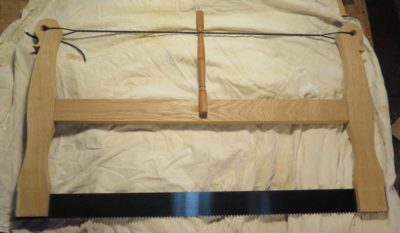
If the goal was to replicate exactly the saws of Roubo I failed pretty miserably. Now, had the task been to make a saw that Victor Horta would like, then I came closer.

I am returning to the project, and over several upcoming blog posts recount my journey to get something as close to Roubo as I could, to provide something for Mark to hold in his hands and use at the bench so he could more thoughtfully do some planning.
NB – I gladly collaborate with any tool makers who want my opinion, input, or experience brought to their specific problems.
With the mild winter behind us it was time to reconnect and rev up the hydroelectric turbine and reconnect the drinking water line to the barn.
Woo Hoo! We ended the winter with plenty of firewood, more than half-again as much as we used. I’m looking forward to increasing that reserve even more by next winter.
I walked the water line last week and checked it out, making repairs as needed to two places where trees had fallen on it. This was the least damage it’s had over winter. I also took some time to re-route some sections of the line to straighten it out a bit more. Even emptied of water a hundred feet of 2″ Schedule 40 PVC pipe is heavy and awkward. Especially when you have to move several of these. My shoulders are barking at me in several languages today. The process is exhausting mostly because the footing is so treacherous in and along side the creek I have to be at maximum attention to avoid slipping and falling. Which I did.
Late afternoon Saturday I connected all the penstock sections and opened the gate valve to the hyro-turbine and it went “whoosh!” The subsystem electronics booted themselves and the electrons were flowing. I guess it is time to set to work on designing the new downstream cross-flow turbine.
I had planned to take advantage of the next warm and sunny day to make one final attempt to troubleshoot the solar controller, the solar sub-system had been limping along for the past four months for no discernable reason. But much to my bewildered delight I noticed that the solar sub-system charge controller was working perfectly when I checked the powerhouse at the end of this afternoon. All by itself.
I’m not saying it was Divine Providence, but I’m not not saying it either.
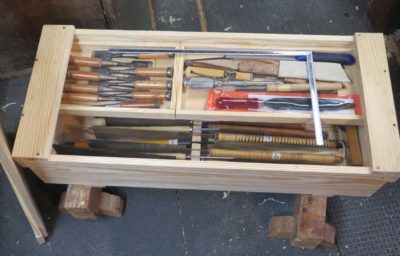
Among the tools I did not have in my set of Japanese woodworking tools were any marking gauges. Within the form are many different variations so ‘I was faced first with deciding what kind of marking gauges I wanted to make and keep in the tool box? In the set of hand tools in the shop I have several marking gauges ready to be put to work, but the Japanese tool box was already close to capacity so I needed to be very circumspect in the decision for this function.

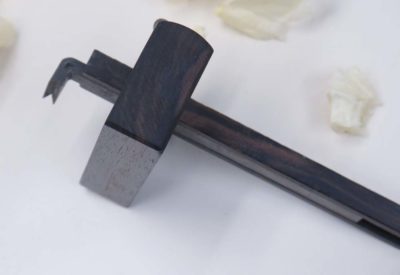
Fortunately at the recent Wilbur Pan Japanese tool demonstration, between Wilbur’s tools and the inventory brought by JayC to display and use by the woodworkers in attendance, there were several to view, handle, and use.
In the end I came up with my own version of the two-bladed gauge, with some slight modifications so that it could function well as a single blade or a double blade tool.
My starting point was a pair of mild steel bars, each 1/8″ x 1/2″ in cross section. Mild steel rather than tool steel because the mild steel would bend easily and the sharpened cutting edge would be marking wood, so the mild steel was plenty robust enough for that. I got the steel bars down from my overhead inventory; I probably bought it at the hardware store at some point in the past when I was just stocking up on raw tool-making materials.
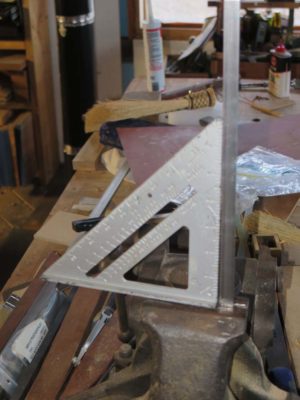
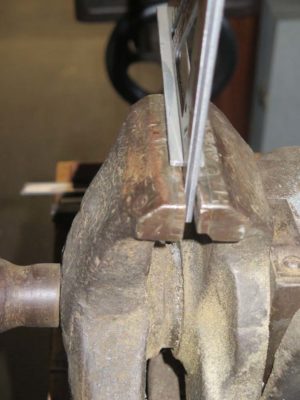
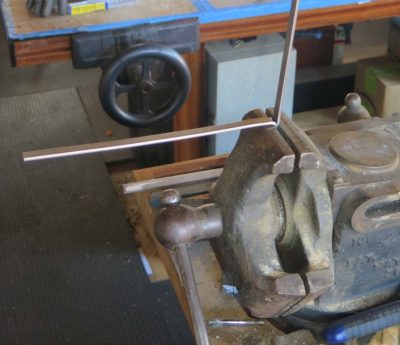
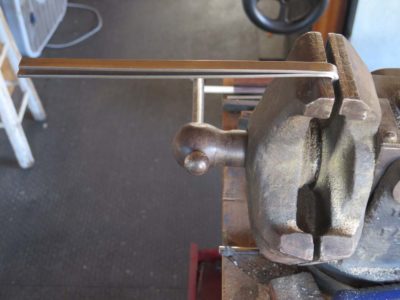
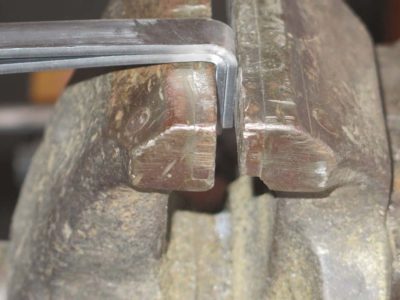
Placing the bars vertically in the Emmert tool-makers vice, making sure to square them to the jaws, I simply bent one and then the other of the bars so that they nestled against each other nicely. The hammer work was minimal to persuade them to conform.
Now, on to the block.
In addition to the earlier Rikon tune-up, consisting of a new lower tire, a new 1/4″ blade (although I am likely to supplant that with a 3/8″ blade) and tweaking the guides, I also recently re-installed the original rip fence augmented by a curved single-point resawing block. My own view of this setup is that a fixed rip fence is almost nonsensical on a bandsaw, given the almost inherent drift in the tool design. But, a band saw that is set up to rip and resaw well is a joy to behold.
Many, many articles and videos have been made about “truing” a bandsaw’s cut. Personally I find these a fool’s errand for the most part on a small-ish bandsaw if the end objective is to turn the bandsaw into a precision sawing machine. Sure, I stone both sides of the new blade when it is first running after being installed, to remove any distortion/excess at the weld joint. I also round the trailing edge of the blade with the stone while the blade is running. These two steps increase the performance considerably, but almost never result in a cut that is perfectly parallel to a fixed fence. One option in response to this, which I have used, demonstrated, and even included in a video, is to cant the fence to the degree of the run out.
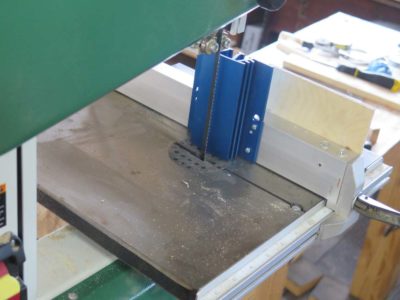
A single-point resawing block is a preferable solution, IMHO. Somewhere along the line I picked up a Kreg brand block and had it available to affix it to the original rip fence as illustrated.
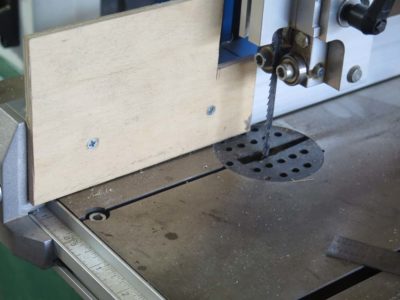
The beauty of the Rikon fence design is that I can have one side outfitted with a curved single point block and leave the other side with a half fence, which is also pretty usable (I have found that anything longer is useless on a band saw). I do not mind using both sides of the fence and thus cutting in two different orientations, one on the right side of the fence and one on the left side.
BTW, I notice that both Woodcraft and Highland have these little beauties on sale right now.
In the years since escaping Mordor for the idyllic solitude of Shangri-La (heck, “social isolation” is the normal practice for every day ending in “Y” out here) one of the valued local friendships is that of Tim, an all around cool dude and a primitive skills enthusiast. One of those “primitive skills” is Appalachian long rifle-making and connoisseurship and he has been an invaluable aid in my work on the David Cooley rifle.

In recent months Tim has been engaged in salvaging a couple of mid-18th century log buildings from south central Virginia, re-erecting them on his place a few miles from here to serve as his workshop for making rifles and other tasks relative to 18thC frontier living. Once I learned of this project I proposed building the tool to fulfill his need for a proper period-appropriate gunsmithing work bench. Tim’s rifle-smithing is in the later-18th century English style, so his bench will be a Nicholson.

We picked up the superb southern yellow pine from Virginia Frame and Lumber in Fishersville and over the next few Wednesdays I will be chronicling the project to outfit him in the manner he and his new shop deserve.
Stay tuned. I think you will find this an interesting trip.


Part of my process of refining the raw “slum gum” unfiltered beeswax from the honey factory delivered in a case of roughly 6-inch thick slabs from the bottom of a five gallon bucket, involves a step wherein the coarsely filtered molten beeswax/hot water slurry (removing the bee bodies and gross debris) is poured through fine pasta strainer into a cake pan and allowed to cool undisturbed.
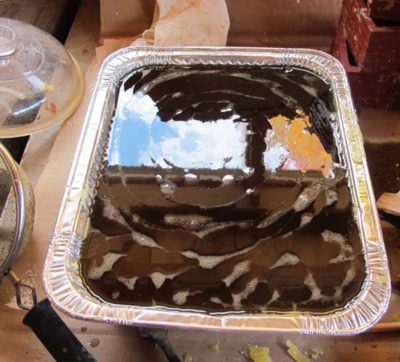

After cooling and decanting the water with any remaining water soluble adulterant, I am left with a big block of beeswax with a fairly uniform layer of sediment on the bottom face of the block. This needs to be removed before moving on to the next step of filtering.
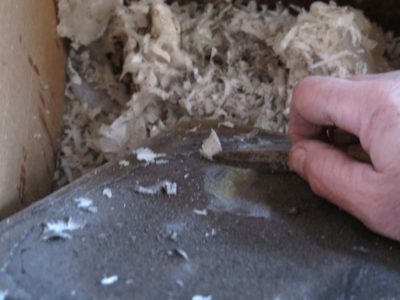
Normally I try to time the scraping off step for when the block of wax has cooled enough to be fairly solid, but still warm enough to be scraped easily with a large knife. There are times, however, when I do not get to this step soon enough and the block of wax with its accretions hardens fully. And with enough cold, it can get pretty hard. Scraping this is not impossible but it is some hard work when I am doing several of them at once.
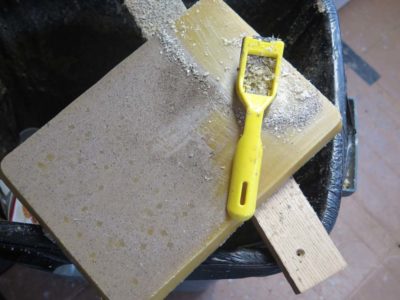
Recently I had a great idea while rummaging through my “Giant Files” drawer and pulled out this little curved Surform tool. I found that for a fully hardened block, even one that is chilled and rock hard, it removes the precipitant easily and quickly.
That smack is the sound of my pam striking my forehead. Usually in just a minute or less the block is ready to be put aside for the next melt during which time it will be getting its final filtering from me before moving into Mrs. Barn’s domain and one final filtering before casting into blocks.
I love it when caprice like this happens.


Recent Comments