In order to assist the students in saw sharpening I stumbled across another application of Clothespin Magic.
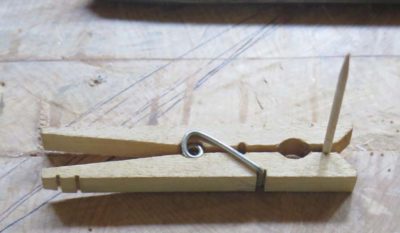
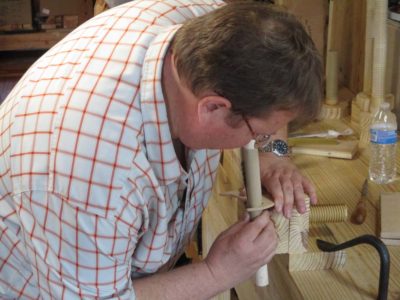
One of the key components of saw sharpening is to keep the orientation of the file consistent for each tooth. When you are using a comparatively tiny file, as we were on the dovetail saws, it can be a bit tricky to keep the rake angle the same for every tooth. A method that I find very helpful, short of using one of the specialized handles made for this purpose by Lee Valley or Blackburn, is to use a clothespin to hold a toothpick as a guide stick.
Sometimes I want a guide affixed to the tip of a file, and sometimes to the base. Making the accessory is the same either way, but setting them up is different.
For either version first file a groove across one of the clothespin jaws and on the second jaw file a groove running front-to-back, 90-degrees to the other one. For the tip guide this second groove is the one that is clipped to the end of the tiny file. You now have a set-up to hold a toothpick and the file tip in perfect conformation. Glue the toothpick to the cross groove. The tool is ready to put to work.
For the base version of the guide you simply revere the orientation of the toothpick; rather than gluing it perpendicular to the clothespin you glue it to continue the long axis.
This configuration is particularly helpful for new saw sharpeners, or those new to this scale of sharpening and teeth-cutting. By keeping the toothpick at the correct angle for each filing stroke, you end up with teeth that have an identical rake.
Doggone, is there nothing that clothespins cannot do?
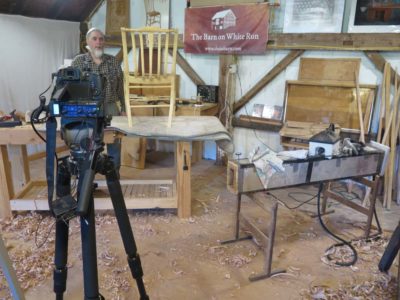
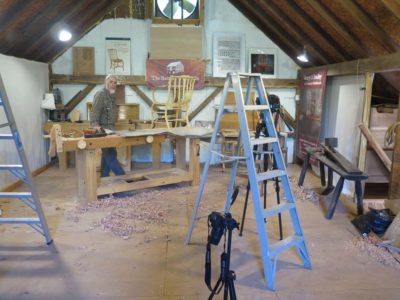
We recently had our second day of video work on the Make A Gragg Chair video.
We spent some time on the Special Feature portion of the production and the remainder fashioning the riven wood into thin slats for bending.
Then I steam bent some pieces.
The only dark cloud to the day, and it was a considerable one, was that the barn power system failed just as I was nearing the end of a long and complex steam bending process, causing us to lose an afternoon’s work. That system failure has turned into a headache of the first order as the solar system quit working for as yet undetermined causes despite many, many hours of trouble shooting. Then, two days ago the hydro turbine developed the familiar grumble of bearing failure requiring its shipment back to the manufacturer for repair as I do not own the requisite tools. If my hair had not already turned white…
Black swans, my friends, black swans. But more about that later. Sigh.
The next video session will actually be precedent in the final edited video as I walk through the process of creating the bending forms from the patterns I made. I have not yet decided whether to make the patterns available with the video, although it does sorta make sense to do so. I am also trying to keep my sense of the time required to build a chair in hope that I can create a week-long workshop for that project.
This post is presented annually on this date – DCW
As we consider the world around us it is worth reflecting seriously on the document encapsulating the ideas that founded the greatest nation ever known to man (the US Constitution WAS NOT the founding document for the nation, I believe it merely established the rules for its governance [admittedly now generally unknown and ignored] which is not the same thing). I pray you will read and reflect on the ideas expressed by men who pledged their lives, their fortunes, and their sacred honor to pursue the path of liberty. Reading it is much like reading the Minor Prophets of the Old Testament; more up-to-date regarding the human condition than tomorrow’s headlines.
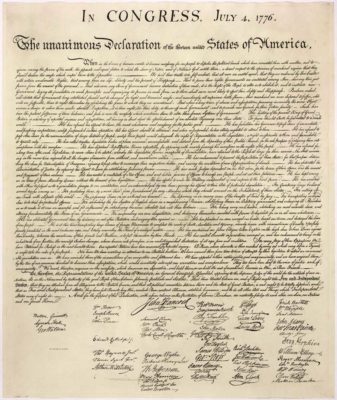
The unanimous Declaration of the thirteen united States of America,
When in the Course of human events, it becomes necessary for one people to dissolve the political bands which have connected them with another, and to assume among the powers of the earth, the separate and equal station to which the Laws of Nature and of Nature’s God entitle them, a decent respect to the opinions of mankind requires that they should declare the causes which impel them to the separation.
We hold these truths to be self-evident, that all men are created equal, that they are endowed by their Creator with certain unalienable Rights, that among these are Life, Liberty and the pursuit of Happiness.–That to secure these rights, Governments are instituted among Men, deriving their just powers from the consent of the governed, –That whenever any Form of Government becomes destructive of these ends, it is the Right of the People to alter or to abolish it, and to institute new Government, laying its foundation on such principles and organizing its powers in such form, as to them shall seem most likely to effect their Safety and Happiness. Prudence, indeed, will dictate that Governments long established should not be changed for light and transient causes; and accordingly all experience hath shewn, that mankind are more disposed to suffer, while evils are sufferable, than to right themselves by abolishing the forms to which they are accustomed. But when a long train of abuses and usurpations, pursuing invariably the same Object evinces a design to reduce them under absolute Despotism, it is their right, it is their duty, to throw off such Government, and to provide new Guards for their future security.–Such has been the patient sufferance of these Colonies; and such is now the necessity which constrains them to alter their former Systems of Government. The history of the present King of Great Britain is a history of repeated injuries and usurpations, all having in direct object the establishment of an absolute Tyranny over these States. To prove this, let Facts be submitted to a candid world.
He has refused his Assent to Laws, the most wholesome and necessary for the public good. He has forbidden his Governors to pass Laws of immediate and pressing importance, unless suspended in their operation till his Assent should be obtained; and when so suspended, he has utterly neglected to attend to them. He has refused to pass other Laws for the accommodation of large districts of people, unless those people would relinquish the right of Representation in the Legislature, a right inestimable to them and formidable to tyrants only. He has called together legislative bodies at places unusual, uncomfortable, and distant from the depository of their public Records, for the sole purpose of fatiguing them into compliance with his measures. He has dissolved Representative Houses repeatedly, for opposing with manly firmness his invasions on the rights of the people. He has refused for a long time, after such dissolutions, to cause others to be elected; whereby the Legislative powers, incapable of Annihilation, have returned to the People at large for their exercise; the State remaining in the mean time exposed to all the dangers of invasion from without, and convulsions within. He has endeavoured to prevent the population of these States; for that purpose obstructing the Laws for Naturalization of Foreigners; refusing to pass others to encourage their migrations hither, and raising the conditions of new Appropriations of Lands. He has obstructed the Administration of Justice, by refusing his Assent to Laws for establishing Judiciary powers. He has made Judges dependent on his Will alone, for the tenure of their offices, and the amount and payment of their salaries. He has erected a multitude of New Offices, and sent hither swarms of Officers to harrass our people, and eat out their substance. He has kept among us, in times of peace, Standing Armies without the Consent of our legislatures. He has affected to render the Military independent of and superior to the Civil power. He has combined with others to subject us to a jurisdiction foreign to our constitution, and unacknowledged by our laws; giving his Assent to their Acts of pretended Legislation: For Quartering large bodies of armed troops among us: For protecting them, by a mock Trial, from punishment for any Murders which they should commit on the Inhabitants of these States: For cutting off our Trade with all parts of the world: For imposing Taxes on us without our Consent: For depriving us in many cases, of the benefits of Trial by Jury: For transporting us beyond Seas to be tried for pretended offences For abolishing the free System of English Laws in a neighbouring Province, establishing therein an Arbitrary government, and enlarging its Boundaries so as to render it at once an example and fit instrument for introducing the same absolute rule into these Colonies: For taking away our Charters, abolishing our most valuable Laws, and altering fundamentally the Forms of our Governments: For suspending our own Legislatures, and declaring themselves invested with power to legislate for us in all cases whatsoever. He has abdicated Government here, by declaring us out of his Protection and waging War against us. He has plundered our seas, ravaged our Coasts, burnt our towns, and destroyed the lives of our people. He is at this time transporting large Armies of foreign Mercenaries to compleat the works of death, desolation and tyranny, already begun with circumstances of Cruelty & perfidy scarcely paralleled in the most barbarous ages, and totally unworthy the Head of a civilized nation. He has constrained our fellow Citizens taken Captive on the high Seas to bear Arms against their Country, to become the executioners of their friends and Brethren, or to fall themselves by their Hands. He has excited domestic insurrections amongst us, and has endeavoured to bring on the inhabitants of our frontiers, the merciless Indian Savages, whose known rule of warfare, is an undistinguished destruction of all ages, sexes and conditions.
In every stage of these Oppressions We have Petitioned for Redress in the most humble terms: Our repeated Petitions have been answered only by repeated injury. A Prince whose character is thus marked by every act which may define a Tyrant, is unfit to be the ruler of a free people.
Nor have We been wanting in attentions to our Brittish brethren. We have warned them from time to time of attempts by their legislature to extend an unwarrantable jurisdiction over us. We have reminded them of the circumstances of our emigration and settlement here. We have appealed to their native justice and magnanimity, and we have conjured them by the ties of our common kindred to disavow these usurpations, which, would inevitably interrupt our connections and correspondence. They too have been deaf to the voice of justice and of consanguinity. We must, therefore, acquiesce in the necessity, which denounces our Separation, and hold them, as we hold the rest of mankind, Enemies in War, in Peace Friends.
We, therefore, the Representatives of the united States of America, in General Congress, Assembled, appealing to the Supreme Judge of the world for the rectitude of our intentions, do, in the Name, and by Authority of the good People of these Colonies, solemnly publish and declare, That these United Colonies are, and of Right ought to be Free and Independent States; that they are Absolved from all Allegiance to the British Crown, and that all political connection between them and the State of Great Britain, is and ought to be totally dissolved; and that as Free and Independent States, they have full Power to levy War, conclude Peace, contract Alliances, establish Commerce, and to do all other Acts and Things which Independent States may of right do. And for the support of this Declaration, with a firm reliance on the protection of divine Providence, we mutually pledge to each other our Lives, our Fortunes and our sacred Honor.
The 56 signatures on the Declaration appear in the positions indicated:
Column 1 Georgia:
Button Gwinnett
Lyman Hall
George Walton
Column 2 North Carolina:
William Hooper
Joseph Hewes
John Penn South Carolina:
Edward Rutledge
Thomas Heyward, Jr.
Thomas Lynch, Jr.
Arthur Middleton
Column 3 Massachusetts:
John Hancock Maryland:
Samuel Chase
William Paca
Thomas Stone
Charles Carroll of Carrollton Virginia:
George Wythe
Richard Henry Lee
Thomas Jefferson
Benjamin Harrison
Thomas Nelson, Jr.
Francis Lightfoot Lee
Carter Braxton
Column 4 Pennsylvania:
Robert Morris
Benjamin Rush
Benjamin Franklin
John Morton
George Clymer
James Smith
George Taylor
James Wilson
George Ross Delaware:
Caesar Rodney
George Read
Thomas McKean
Column 5 New York:
William Floyd
Philip Livingston
Francis Lewis
Lewis Morris New Jersey:
Richard Stockton
John Witherspoon
Francis Hopkinson
John Hart
Abraham Clark
Column 6 New Hampshire:
Josiah Bartlett
William Whipple Massachusetts:
Samuel Adams
John Adams
Robert Treat Paine
Elbridge Gerry Rhode Island:
Stephen Hopkins
William Ellery Connecticut:
Roger Sherman
Samuel Huntington
William Williams
Oliver Wolcott New Hampshire:
Matthew Thornton
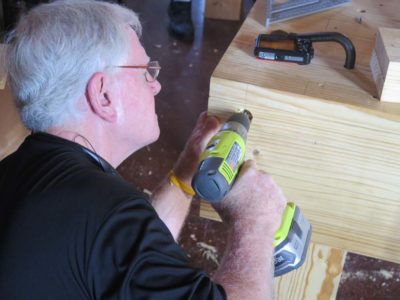
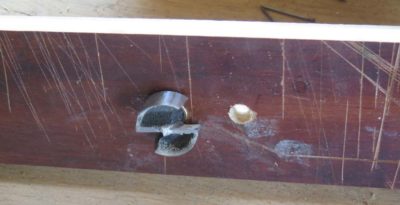
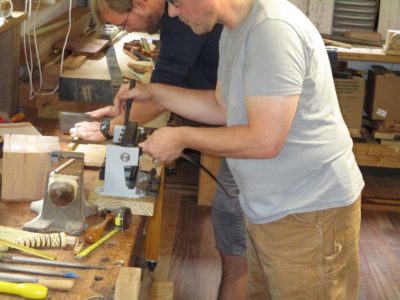
During the Hand Tool Woodworking workshop one of the things that gave some folks trouble was drilling the 1-3/8″ holes in the aprons for the twin 1-1/2″ screws that would be installed once the holes were tapped. At issue was getting the holes not only in the correct place, which was not much of a problem, but drilling them parallel to each other and exactly perpendicular to the apron. There is an art, or a least a practiced technique, to drilling clean holes with a large Forstner bit and a hand drill.
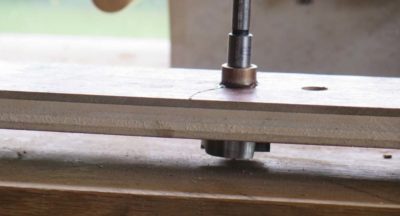
I decided to try building a jig that could suffice for the problem. The challenge was that the 1-3/8″ cutting head was affixed to a 5/8″ shaft. My jig design reflected that reality. I set a piece of scrap 3/4″ plywood on a pair of feet to make sure there was room for the drill bit cutting head to fit and also a place for any chips to go. The first thought was to drill a 5/8″ hole and just feed the bit shaft through it from beneath, but on second thought I drilled and 7/8″ hole to hold a 5/8″ I.D. bronze sleeve bushing. The bushing was roughed up on the outside and tapped into the hole slathered with Devcon epoxy.
The limitation of the system is that the hole can only be as deep as the shaft protrudes above the jig plate. Given that most of the time I’m hand drilling through two layers of 2x stock on the front apron the depth of the hole from using the drilling jig is deep enough (and straight) that completing it free-hand is adequate to accomplish parallel holes fully through the apron.
I have long incorporated Japanese knives into my work routine, beginning with my first one, a Christmas gift from my older daughter. When it comes to shaving and marking, cutting a line for precise sawing, nothing else comes close to them. I’ve purchased a few of these tools over the years, in various sizes and configurations.
One thing about them that I do not like is the feel of a new one with no handle. I am not sure these are even supposed to have handle cheeks, but I like them anyway. I generally wrap the handles with a double layer of leather boot strings, gluing them at the end with hide glue.
And, these critters are so sharp and pointy the need a sheath. I made three-layer sheaths for all of mine from a large scrap of heavyweight sharkskin. Starting with the first layer large enough to serve the function, I follow that with a second layer that is cut out to fit the knife tip perfectly. A third layer mimicking the first is the final part of the assembly, all of it glued up. The sheaths are snug so they stay put while the knife is awaiting use.
With my leather sewing kit I stitched a perimeter line around the edge of the sheath and it is finished.
Here is a captivating series of videos on using a Japanese knife to prepare a new lacquer brush for duty.
One of the tool groups whose importance has grown on me immensely over the years js that of the file family. Like most discriminating pursuits (addiction is way too strong of a word) it begins with the first strong hit of the good stuff, and before you know it there is an entire tool rack dedicated to them. A vintage mill file leads to a nice machine made rasp, and then a hand knitted rasp. Or six. And once you get your hands on a Vixen curved tooth the path to a selection of floats is pretty much inevitable. Then comes diemaker’s rifflers and sinkers, sculpting rasps, Swiss needle files, and barrettes. And eventually you seek out pushers like Slav in Chicago,, whose trench coat pockets are always full of files I suddenly discover a consuming need for. Every tool scrounging tailgating session becomes a new chase.
Which is where I got this new-old-stock premium Vixen file last year (a tool flea market, not Slav). I love the finish left by a perfect curved tooth file. I was using it recently and for the thousandth time I tapped it on the bench to knock out the shavings. Much to my literal astonishment this low mileage tool snapped! For many seconds my frame of mind was some combination of shock, anger, and dismay. Seriously, this was a premium tool that broke under very gentle stress within a very few hours of service. Exasperated I set it aside to compose myself in order to conduct the memorial service. Or not. In the meantime it would sit on the shelf of my file rack.
Then, suddenly the recipe for lemonade from a broken lemon leaped to the for. I was working on a saw handle during the Dovetail Saw class, using one of my Iwasaki floats to work the wood, At one point I needed something a bit larger but still with a fine, crisp cut, and no tang or handle. I walked over to the file rack and grabbed the broken Vixen to give it a try. The result was sublime. It still cut perfectly but without the obstruction of the handle end that had broken off. The fracture margin was a bit ragged so I touched that up with a coarse diamond sharpening stone.
It was the sweetest glass of lemonade ever.
Now I just have to ask Slav to find me some more handle-less curved teeth files.
I shaped the scrap ash handle of the froe with the usual tools (spokeshave and rasp) and mounted the blade with small carriage bolts. Since the holes in the planer blade were slotted the blade moved around more than I wanted so I drilled a third hole and added another small bolt. With everything fixed in place I ground a small back bevel on the splitter so that the tool would not “dive” to one side while in combat.
A quickly cobbled together sheath from scrap leather completed the activity, although I just glued the leather together. I will rivet it together tomorrow so it is a bit more permanent.
Taking the froe for a test drive was a delight as it split perfectly and was easy to both drive and maneuver, yielding very thin and narrow pieces exactly as I had desired. These two were about 3/8″ x 5/8″ x 30″.
This is a summer to try new things for workshops. Thus far one was less than successful (my annual traditional finishing weekend scheduled for the final weekend in April; the workshop itself was fine but the timing was just too early in the year), and two that were complete successes IMHO — the Traditional Handtool Woodworking confab in Arkansas and the recent Make A Petite Dovetail Saw weekend. As with the Arkansas shindig, I had taught folks to make a saw one-on-one over a relaxed and fluid timetable but never as a group with tight and fixed time budget.
From my perspective it was a rousing success.
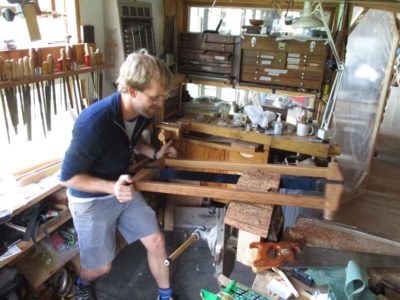
Making a dovetail saw involves integrating three major components: the handle, or tote (I never heard the word “tote” until a few years ago, and now it is everywhere although I still prefer to call a handle a handle), a spine or back, and a plate or blade in which teeth are cut with a file. My technique for small saws is to not set the teeth but rather taper the plate so that the thickest cross-section is at the teeth and tapers off towards the back. I find this method works best for me for making saws to cut very small joints in thin stock.
The first step in any custom-made saw is to fit the handle to the user’s hand. I had my own pattern for the students to examine, and each of them modified my template to their own preference.
A couple of students brought prized wood for the handles, and my sash saws came in handy.
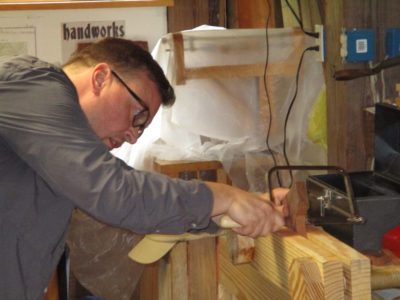
They transferred the pattern to their prepared wood for the handle and sawed it out with a coping saw, then trimmed the perimeter with files and rasps.
Next came shearing the saw plate from coil .020 x 1-1/2″ spring steel to an 8-1/4″ length, cleaning up the ends with a diamond stone and a bench hook. Everything in the fitting and sizing of the saw was determined by this piece from this point on.
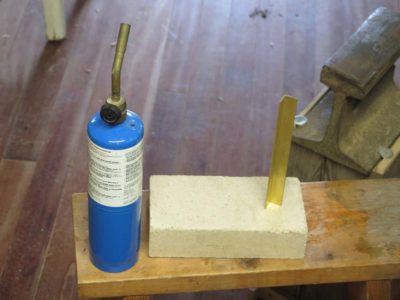
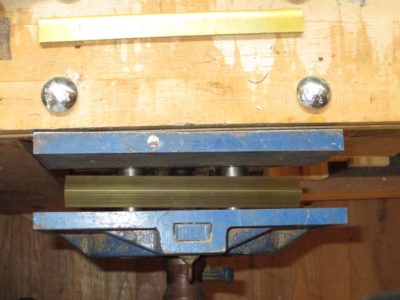
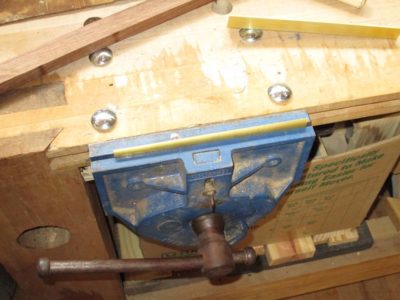
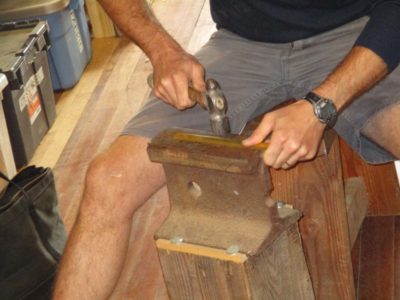
I used to bend the brass backs from flat stock but in recent saws I have switched to 90-degree 1-inch angle bar, 1/16″ thick. It cuts the time down to almost nothing. The angle bar stock is annealed with a torch, then allowed to air cool. Once cool the piece is set on the bottom of a large bench vise and the vise is closed, keeping a careful eye on it to make sure it bends evenly and nicely. After the initial bending it is moved to the top of the vise to crank it down as much as possible.
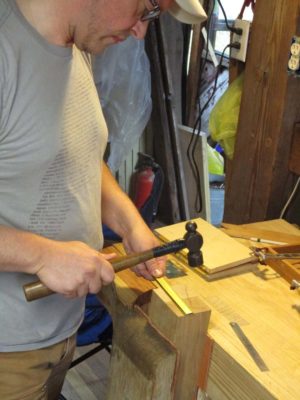
This is followed by a little hammering to close the fold tight to make sure the saw plate will be held/pinched snugly once everything is assembled.
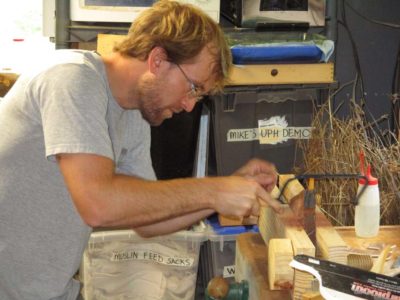
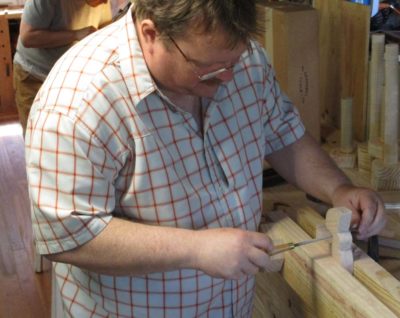
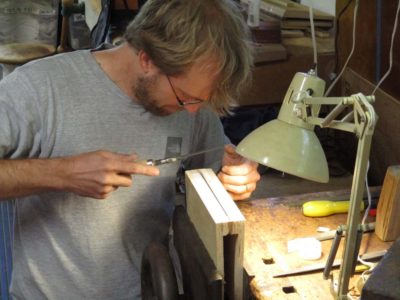
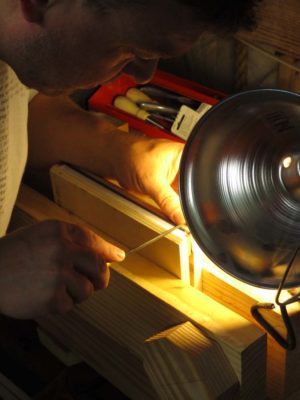
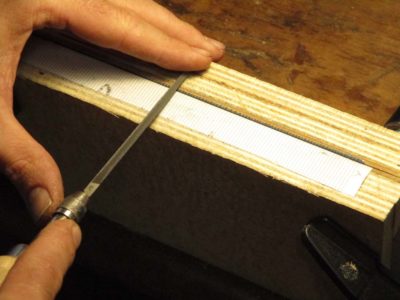
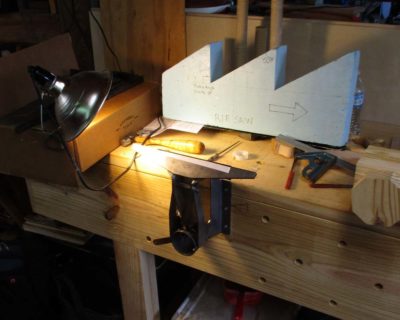
Then came the most intimidating part, cutting the teeth in the blank spring steel saw plate. We used 4″ XX slim taper NOS files (I am always looking for more) at a 16 t.p.i. spacing. I printed out the 16 t.p.i. pattern on my computer so they could tape it directly to the filing vise for easier spacing. One of the fellows brought his new Gramercy saw vise in his luggage, and we ogled it shamelessly.
I used to alternate filing each tooth from the opposite side, but then learned that Andrew Lunn filed his saws all from the same side. Given his results that was good enough for me, and I demonstrated and had the students work in this manner. Since we were not going to set the teeth there was no reason not to try this method.
They all took their time and established a good rhythm, their results were more than satisfactory.
Thus endeth Day 1, ahead of schedule and making me optimistic about a special project for them.
One of the options I wanted to make available in preparation for the “Make a Petite Dovetail Saw” workshop was the ability to use a slotted brass spine for the backsaw. To make the stock for this I ordered the brass bar stock and a 1/32″ slotting saw blade from McMaster Carr.
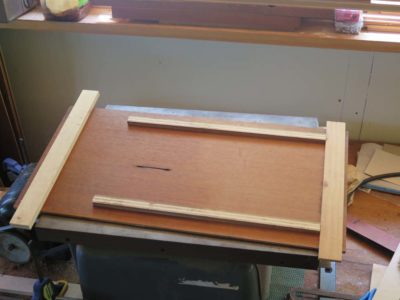
The issue I had to resolve was that the only slotting saw big enough to clear the table surface of one of my table saws from inventory had a 1″ arbor hole, while the shaft for the saw blade was only 1/2″ diameter. I made a fitted spacer from a standard large washer to allow the blade to be used on the shaft, adding a pair of oversized collars on either side to keep everything lined up.
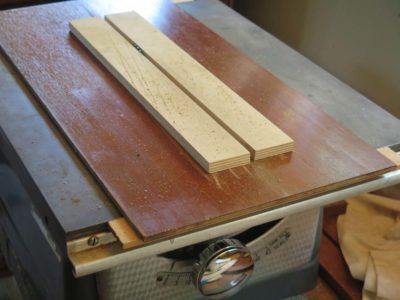
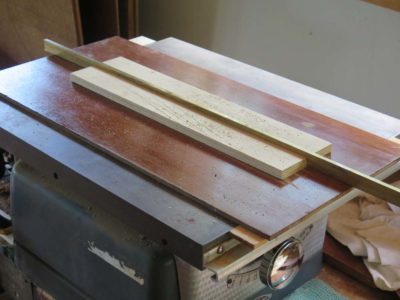
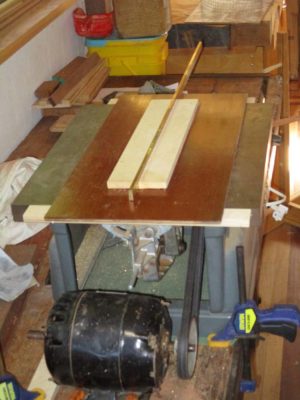
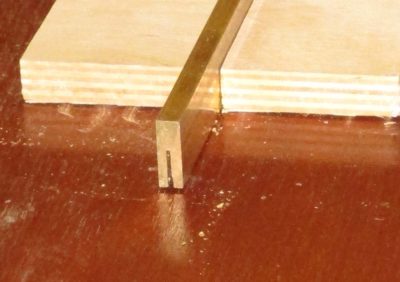
I then had to fabricate a jig to keep the bar stock in the correct relationship to the slotting saw blade in the table saw. Again some stuff from the scrap shelf came in handy. A piece of 1/4″ marine plywood served as the panel, with stops glued front and rear and another pair aligned with the miter-crosscut slots to keep the whole unit fixed in one place and one place only. You can see this panel flipped over here.
With that finished I glued fences on both sides of the slotting saw blade to bisect the bar stock. It worked like a charm provided I take three light and gentle passes through the saw.
I can now produce as much slotted spine stock as I want.
The aphorism that begins this post’s title was a familiar saying especially during the series of Great Depressions that lasted from 1929 to about 1950 and remains part of the undercurrent in most of the rural world. In its most extreme cases it can contribute to a psychopathology of “hoarding.” For most woodworkers or putterers of almost any kind this tendency becomes manifest in our loathing to throw out anything that might be useful. Some time. Some day. Even if that day is decades away.
But sure enough, with enough time that day will come.
Such a momentous day happened to me this week. I’m up to my eyeballs in Gragg chairs, and that requires transforming honking big pieces of oak trees into long thin pieces to be worked by edge and steam and bent into chair parts.
My long-time old-as-dirt hand made froe works fine on the honkin’ big pieces of trees, with its trailing edge thickness of almost a half inch. But for making long, thin pieces of about 5/8″ x 1-1/4″? Not so much success there.
I did a browse of the interwebz and found several acceptable options for a small froe, generally in the size range of something that would be called a basketmaker’s froe, and I was sorely tempted by this sweet little one from the Gramercy folks who have already parted me from much lucre over the years. But I pondered the froe iterations possible from my collection of repurposable raw materials in the barn.
Window shopping my way through the “hardware store” portion of the joint I found just the answer I had been searching for; a used planer knife from my 10″ lunch box portable planer. Darned. Near. Perfect. It was good quality tool steel, hard and very sharpen-able. Shoot, it already had a bunch of holes in it.
Quick as a bunny I pulled one out of the “metal scrap” drawer(s) and set to work. With my Dremel-ish Craftsman tool I cut the 10-inch knife in half. I was making a very petite froe so five inches was plenty. Grabbing a chunk of white ash from underneath one of the benches where that is stored I was set with all my raw materials.
I put the ash piece in the vise and ripped a kerf with a slotting saw (thanks reader Jack for clarifying the tool as being in the Starrett catalog in ages past) followed by a few seconds with the Iwasaki fine float.













Recent Comments