While visiting Mark Harrell recently our conversation returned to a topic we had engaged in previously, namely that of the repertoire of saws in an 18th century Parisian workshop. Whatever they had, Mark wants to try to make it.
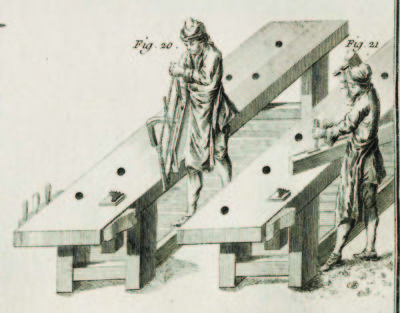
The literary evidence is pretty clear that the workhorse saws in these shops were frame saws for much of the heavy dimensioning (ripping) work and bow saws for the rest, including joinery. (Roubo makes no references to back saws) We might tend to see bow saws as a northern implement, coming from Scandinavian and Germanic traditions, but Roubo places inordinate emphasis on their use and utility in the Paris of his time.
The variations within this theme are many, but at present I am trying to brainstorm about adapting Roubo’s images and descriptions to the tasks of a workshop in 2018. I am starting from the premise that the saw plate Mark developed for the frame saw should serve equally well in a bow saw with the plate fixed parallel to the plane of the frame. With that in mind I have been noodling the designs and begun replicating at least one of a pair of Roubo bowsaws (the other being a compass or “turning” saw, so noted as having a shallow blade that can both follow a curved cut and be rotated in the bow handle for greater facility) in time for demonstrating at CW next week.
My recent trek around Flyover Country included an intersection between my path to my home town in southern Minnesota (the tropical part) and LaCrosse, Wisconsin, home to Mark Harrell and his ambitious enterprise Bad Axe Tool Works. I’ve been collaborating with Mark for some time on the development of a frame saw/sash saw with the promise that he would put one in my hands.
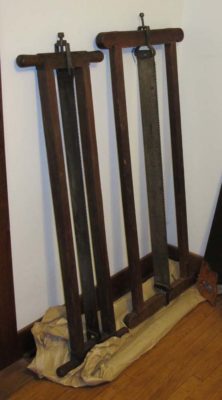
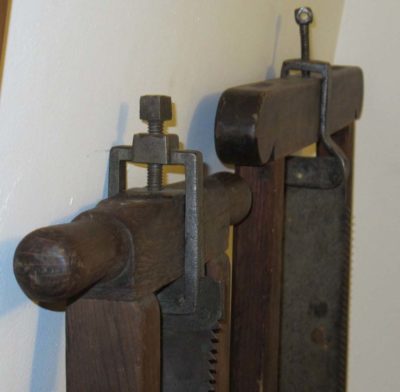
As the owner of two c. 1800 four-foot frame saws I was delighted to share the particulars about them with anyone who wanted to know. Their details are spectacular, from the hand forged hardware to the forged plates in near-perfect condition. (by that I mean there are no kinks or missing teeth, there was plenty of surface rust and the teeth needed touching up)
Like other saw makers, Mark contacted me some time ago and I took the time to talk with him at length about the vintage saws I have, in addition to the diminutive version I made for myself. Mark was particularly interested in a model halfway between my vintage big ones and my new smaller one, and we worked out the details over many emails and phone calls, an interchange I welcome from any tool maker who wants my two cents worth. To this point my only fee is that I get one of the tools in question if they ever go into production. I think Bad Axe might have had this model at Handworks 2017, but I was so busy I could never get to their station once they got set up, so this was my chance.
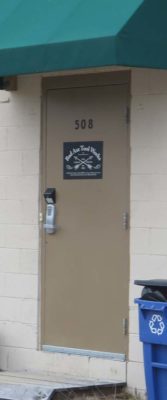
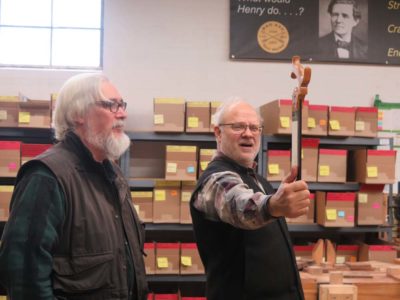
Accompanied by The Oldwolf, Derek Olsen, we arrived late-morning. And the saw geek-dom commenced. Behind this modest door and awning is a buzzing hive of saw making.
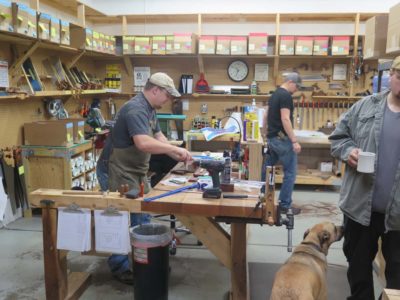
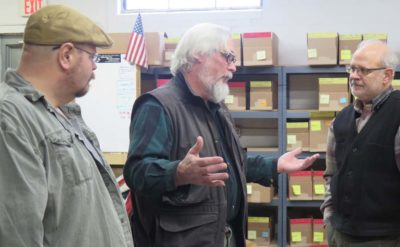
Mrs. Barn and I got a quick tour of the facility, getting the opportunity to meet and greet each of the the sawmaking elves there.
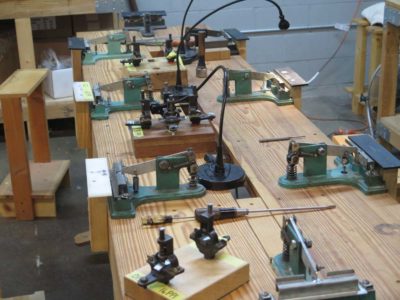
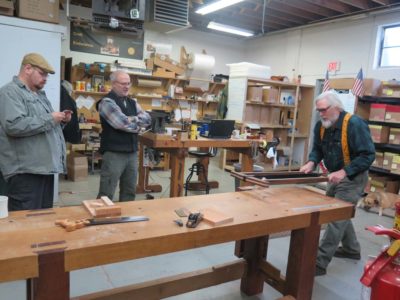
I was especially impressed with the classroom they have set up there for saw making and sharpening workshops. Mark definitely has the leads for mondo saw sharpening vises and setters.
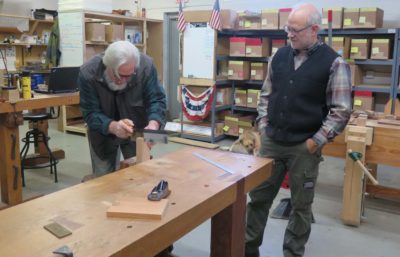
Then we got down to the real fun as Mark brought out several models of saws for me to play with. I already own two Bad Axe saws, including a custom made dovetail saw I commissioned and that has now become ensconced in their product line. Under Mark’s watchful eye the playing commenced, and it was glorious!
Our exploration of the topic continued almost non-stop and we were torn between talking about saws, and sawing.
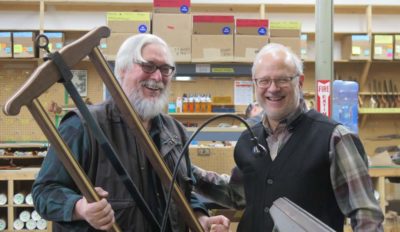
Then came the “official” purpose of the visit, taking delivery of my own Bad Axe frame saw based on Roubo, my old saws, and my new one, with a bit of Bad Axe special sauce tossed in for good measure.
It performed perfectly right out of the box and will be integrated into my shop work as soon as it gets home.
Notwithstanding the fact that I believe we are living in The Golden Age Of Woodworking Tools, the precipitous decline and apparent imminent demise of Sears/Craftsman is a cautionary tale, although I remain uncertain of its ultimate meaning. As a devotee of Joseph Schumpeter’s “creative destruction” premise, I do not mourn Sears/Craftsman’s passing as much as I celebrate the role going to the Sears tool department played in my early life. The tool department was large, the shelves fully stocked with high quality products, and the sales folks knew what they had and how to use it. Really. That is probably incomprehensible to anyone going to Sears now, but it was true in 1970.
The trips there with my Dad were too numerous to recall, and were equal parts utilitarian errands and incalculable treasure hunts. Our bond of toolism and tinkering was foundational, continuing until the day he took his final breath and we parted with no unfinished business. In fact that bond remains as after his funeral my brothers and I divvied up his tools, some of which get used in my shop now.
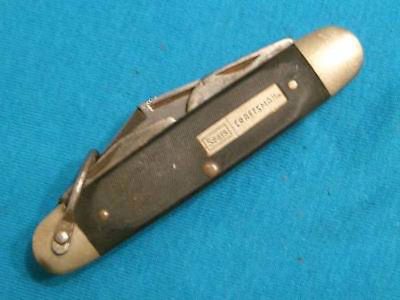
The first tool I ever bought with my own lawn-mowing money was this pocket knife, still in use 49 years after its purchase. (full disclosure — I could not lay my hands on mine at the moment, it is probably in a pair of pants or overalls that I have hanging on some hook in some closet. This is an identical one I saw on ebay.)
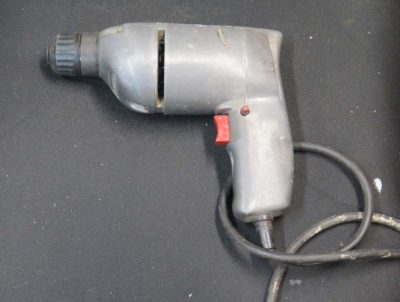
My first power tool was this 3/8″ Craftsman drill, still going strong after 47 years. It’s a low-speed, high torque unit that can just as easily spin you around if used carelessly. The only changes from the day I bought it are a new power cord and Jorgensen chuck.
I still have many other wrenches, sockets, and screwdrivers from the same store bought around the same time. None has ever given me a lick of trouble.
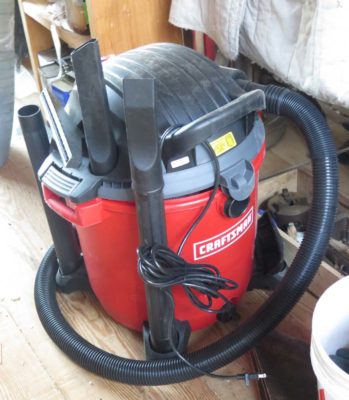
But recently my mondo Craftsman Shop Vac gave up the ghost, after only 44 years of faithful service. Or at least I inferred that it was dead based on the acrid smoke shooting out of the motor casing moments after it ceased operating with a snap, crackle, and pop. I did not even bother with an autopsy, merely cutting off the power cord and taking the canister lid to the dump (I never throw away a good power cord). I saved the rolling base, it still serves as a receptacle for scraps.
On the way home from the dump I stopped at our local farm coop and hardware store and bought a successor model. Given the current state of Craftsman products, I guess I will only get 30 years or so from it. I can only imagine how cranky I will be shopping for a new one at 92.
Some time last year I wrote an honorific on behalf of the clothespin, an integral tool in my workshop.
I’ve overlooked another vital function of this remarkable tool — if you get better-quality pins, as I do, they can be used as wonderful little shimming wedges for leveling something as heavy as a work bench or as a clamping wedge for something as delicate as carved tortoiseshell. I recently moved my workbench a foot or so and it wobbled just the slightest bit. I probably could have worked with it, but alas a wobbly workbench is one of my craziness-inducing hot buttons. So I just grabbed a maple clothespin, took one half as the quick and high-performing wedge shim, and tossed the other half back into the container with its mates for the next time I need another tapered shim.
My studio space in the barn is a work in progress. It has been so since the first day I put a single, raggedy workbench in there several years ago even before all the walls were up, and the process will continue as long as I work there.
I find that the fluid nature of shop organization is one of the threads binding craftsmen together, and a source of celebration when we gather together. Fortunately for me, I do not have the urgent requirement for maximized cash flow velocity generation from my work space, since my primary source of income these days is in the crafting of words while sitting on my recliner.
And, since I have been limited in the scope of my activities recently I have been reflecting on, and to some degree changing, the spatial flow for the studio. One of the advantages of this long lead time of several years of working there is to evolve a better sense of what the space should be to best serve my needs. And now I am making those changes, albeit slowly as there is only so much you can do on one leg.
I’ve already written about the reconfiguration of one corner to more optimally serve as my bench for doing the “fussy” work I encounter frequently in the conservation and restoration of decorative artifacts, and increasingly the repair of vintage gun stocks.
Other issues have nagged me, and are now in the process of being resolved. The first of these was my inadequate space in a single location for the residence of my hand planes. I liked the space I had chosen, directly over the planing beam, but I needed to consolidate all my inventory, which involved several steps.
First, I started undertaking a serious evaluation of many of the planes marginal to my work, deciding what to keep and then tossing aside planes that took up space but were not part of my working regimen. Down they came and out they will go.
That cleared some space, but not enough. So, I added more shelving without adding more shelves. How? By simply doubling the depth of the shelves in situ. Why I did not do this from the git go remains a mystery. Then I removed the silly brackets holding my Stanley/Bailey planes and hung them on the wall.
Presto! The result is twice as many planes in the same visual space.
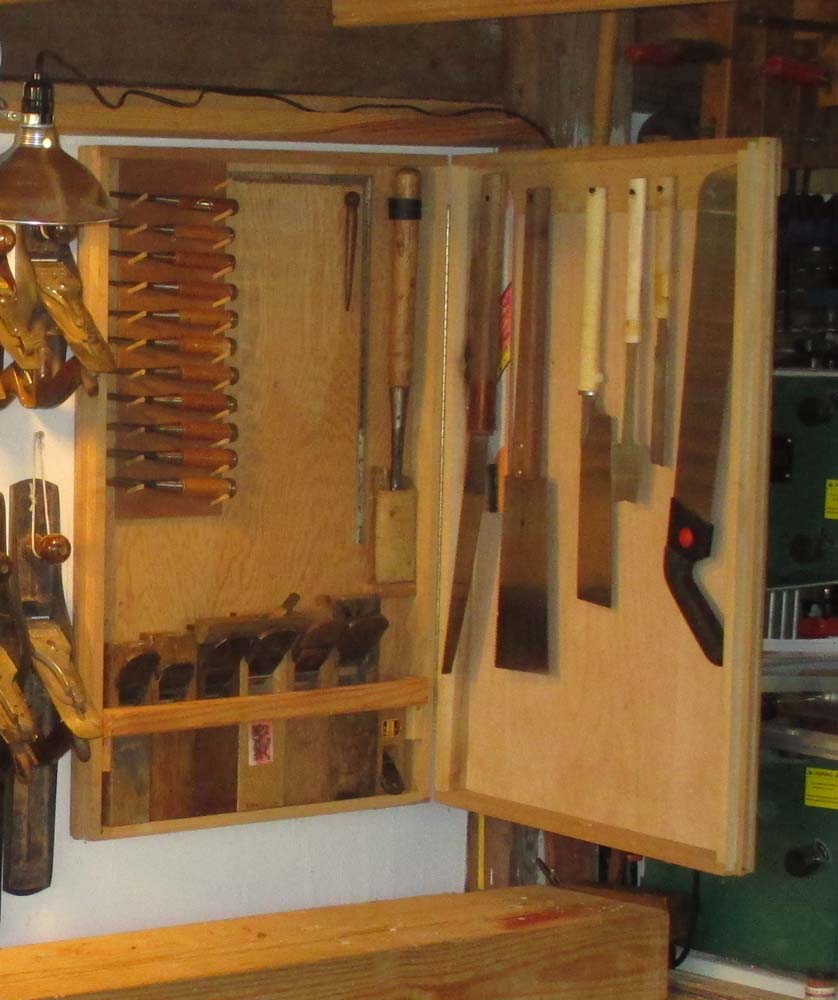
The next move was the consolidation and moving of my Japanese tools from a nearly inaccessible place on the east wall to a cabinet in the remaining niche over the planing beam. With saws on the outside and more saws, chisels, planes (and space for more on the inside) I am pleased with the result. (You needn’t scold me that I have the planes upside down in storage — I do not care)
Two final (?) issues to be resolved are the rat’s nest of a space halfway down the long north wall, which had become nothing more than a pile of stuff, some good, some less so, but all in the wrong place. This hodgepodge will be replaced in October when I build my Nicholson bench prototype for the rescheduled Refinisher’s Group bench-build (probably May 2016). This can serve as another work bench and my sharpening station.
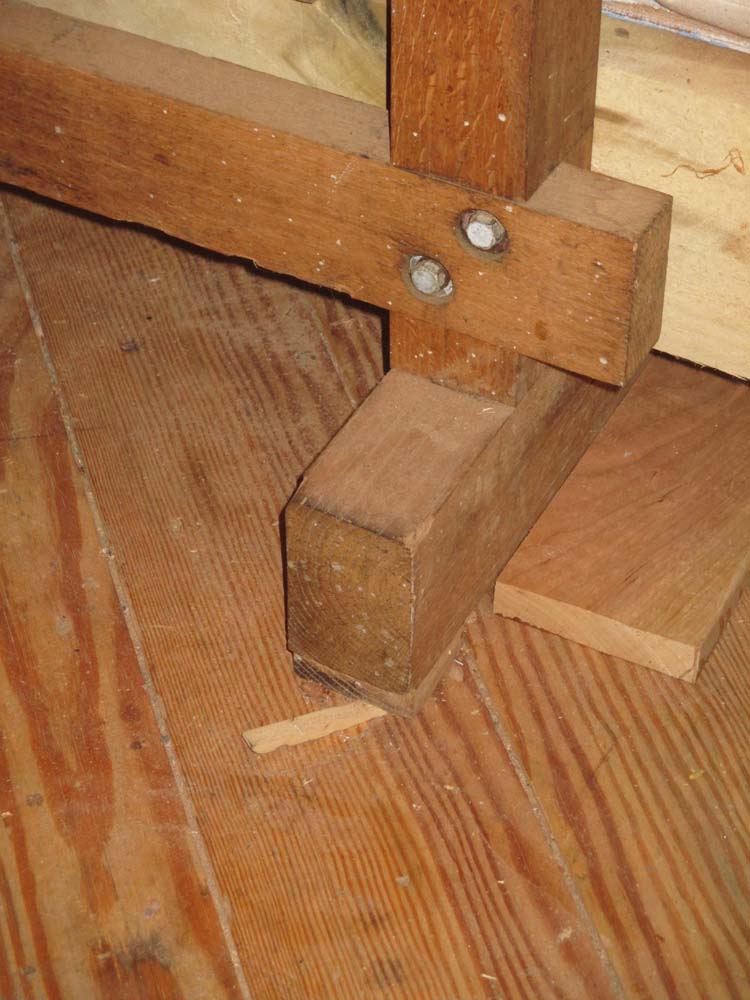
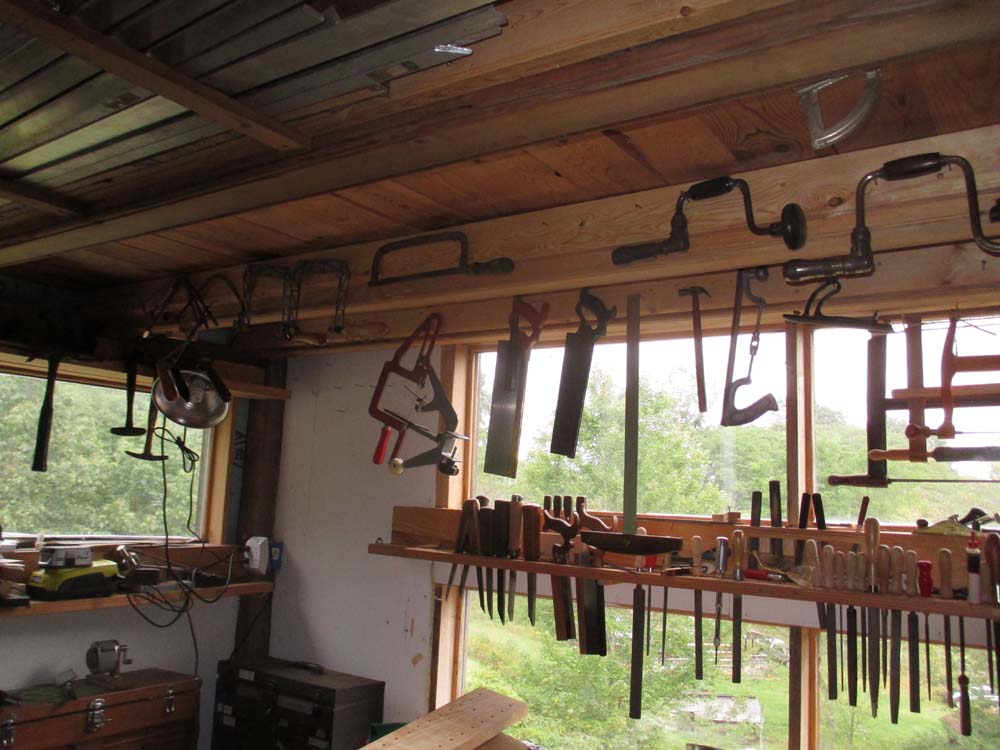
And I keep asking myself: with such a wealth of windows, why do I keep covering them up with stuff? Without a good answer other than, “Because you are an undisciplined slob,” I have begun to deliberately move many of the tools that were blocking the view to somewhere else, like alongside the overhead beams. That one will take a fair bit of trial and error to bring to fruition.
But I am determined to travel much less in the coming year or more, and pouring my time and creative energies into the barn and homestead. This will allow much in the way of improvements and I am anxious for them to unfold.
Like many woodworkers, over the years I have compiled more tools than I need (shhhh!; fortunately Mrs. Barn does not read this blog much so she does not need to be made aware of this confession). It was often from noble impulses as I would see a nice tool that was way underpriced, and say to myself, “Let me get that and find a good home for it.”
Regardless of the true motive, one undeniable fact remains; that “good home” was not to be my studio. There is no need for me to have several bushel baskets of tools that I do not and will not use. Some redundancy may be sensible, but do I really need six #6 Bailey planes? Or two dozen coffin planes? Two drawers full of bench chisels?
Over the past week I have been trying to impose, or at least, evolve some sort of order and organization to the barn studio. And time after time I would want to derive just the right spot for a tool or set of tools only to find that perfect spot was already full of boxes, bins, and tubs of tools.
So, beginning now and continuing through winter I vow to winnow my tool inventory, compiling a collection that I will sell, gift, or otherwise dispense. I will try to have a nice collection for sale at the Maple Festival in March, but otherwise will find places I can facilitate the parting of company., SAPFM Chapter meetings, etc., and if necessary get a table at MJD’s auction next summer. I am not going into the tool mongering biz– it is done far better by folks like Josh Clark,Martin Donnelly, and Patrick Leach, and others, and I will leave them to it — I am merely cleaning house.
Some tools will be, or can be made into, very nice “user tools.” For example, the #7 Bailey I bought recently for $15, with flaking varnish on the handles and a blade that has never been sharpened. Since I can sharpen fairly quickly it would be nice to get each edge tool presentable.
It will be quite nice to gain the space occupied by these tools, and hope they will do good work in the service of craftsmanship. In someone else’s shop.
And all I have to do is stop buying more tools I don’t need!
I can sit and review Roubo for only so long, and when my computer wanders the internet it finds amazing things. You might be familiar with this particular video — I am aware of the Japanese planing contests but had not seen this one before — but I certainly got a kick out of it.
God bless the Japanese, they take any manifestation of excellence and turn it into an all consuming monomaniacal pursuit.
Truth be told the only reason for me to stay for the third day was to bid on a pair of magnificent new-in-the-box Japanese planes from the estate of Jay Gaynor, friend and tool maven from Colonial Williamsburg (I thought I took a picture of these, but my camera says “no”). One of the planes in particular was simply magnificent, easily a plane well beyond my budget — perhaps as much as $4-5k new — but I hoped that perhaps in this crowd of vintage toolaholics this might slip between the cracks, bid-wise, and I could pick it up for a pittance which sometimes happens for tools that have little interest to the crowd. So I settled in to watch the entertainment that is a superb auction of things I like.
In the mean time we waited with anticipation and encouragement for Sharon to bid on a vintage printing press she had developed a crush on. When the time came we all cheered as she got it! The smile on her face was so big it enveloped her whole body. Truly, her delight was infectious.
In the aftermath of that she saw a small lot with something she wanted to get for her husband who was unable to come with her. Part of that lot was a very fine file-maker’s hammer, which we discussed when previewing the box. I have no real need for a file-maker’s hammer, but when she won that lot too we made a deal for it to go home with me. Perhaps I can figure out a good use for it, but for the immediate future it will just be something to show off.
Then came my Japanese plane lot. The bid started low, indicated little interest in the absentee-bid sector, which I took to be a very good sign. Unfortunately there was in the tent a fellow who came down from Canada for the simple and singular cause of going home with those planes, and he did. I ran into him as we were checking out, and he is committed to putting the plane to use in his studio, which I admire. I was going to do the same thing. Since I didn’t get this one I now have the inspiration to get all of my Japanese planes tuned to perfection.
Disappointed but not distraught I immediately sought out the flea market vendor who had the infill miter plane I had looked at frequently through the weekend, and we made the deal for it to come home with me. It was little-used, and with some sprucing up it will become a centerpiece of my working plane set. I will use it as a dedicated plane for my shooting boards, and may make some new ones in celebration.
Though unmarked, the vendor thought it might be from the renowned British maker Robert Towell, an attribution I find persuasive. My friend Raney Nelson used a Towell plane as the model for his full-sized infill planes, so when I see Raney next month I will ask him to look at it. You can see the old Towell next to one of Raney’s petite miter planes on my bench.
Thus endeth our time at Toolapalooza 2015. We bid farewell’s all around, and headed for home with thought of next year. Perhaps it is time to cull the inventory of surplus tools and set up our own table out in the flea market.
The second day of toolapalooza was slow for me as I bid on only a couple of lots and won one, a box full of infill planes that were by almost any definition, stragglers.
I’ve been wanting to play with infills in preparation for making one or more this coming winter, and getting a box full of them for a few bucks apiece was irresistible.
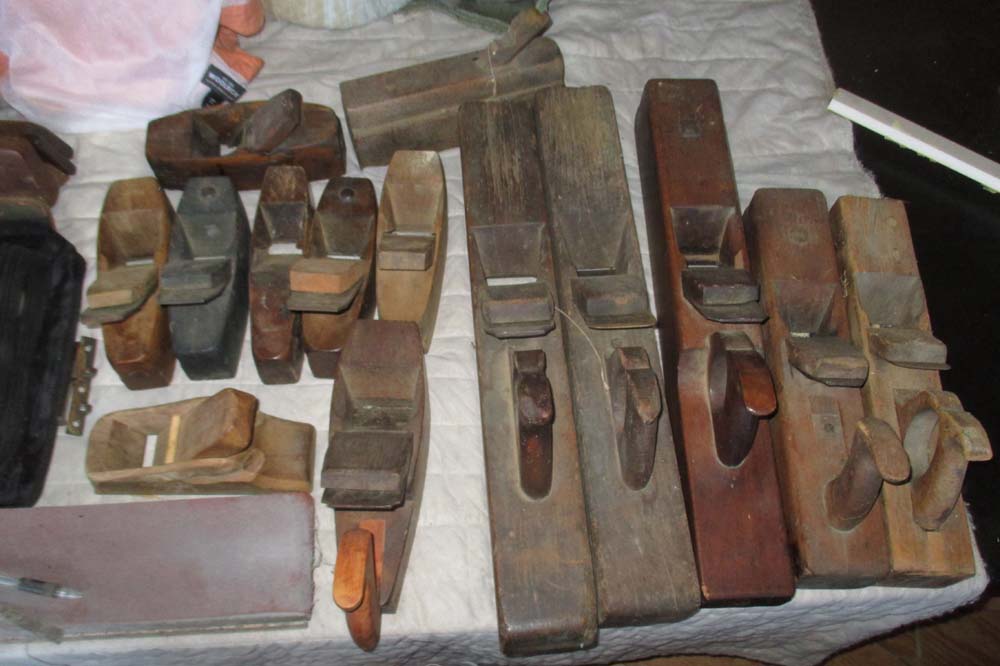
The three full-sized smoothers came with five smaller planes, including two dandy chariot style planes that should clean up very nicely.
The smoothers themselves were clunky at best, and for the purchase price and current non-functionality I have no qualms about wading into them with a heavy hand. The first one has a nicely spacious opening in the handle, well within the needs of me wrapping my fingers around it. I am pretty sure the Stanley lever cap is after market, ad it will go into my parts drawer immediately.
The second handled smoother is cursed with a far too small opening for my fingers. I have not yet decided whether to enlarge the current hole or replace the entire infill. Ditto the front knob infill.
The third pane, sans tote, is the most intriguing to me as it has the possibility of being transformed into something pretty special.
The day ended with Martin’s traditional Friday Night Pig Roast followed by the circle of bloviation and lie-swapping, er, fellowship, around the magnificent fire pit. After a few minutes we left to get a good night’s sleep.
Once again this year I was able to attend Martin Donnelly’s summer auction at his place in Avoca NY. I have been to many Donnelly Auctions over the years, but these summer ones are always my favorites because the warehouse is being emptied. The sheer quantity of tools is staggering (I think this year there were about 60,000 mostly woodworking tools in 3200 lots being sold in twenty hours of auctioneering!). This is the MJD auction with the highest number of “user” tools while his other auctions have a higher proportion of “collectible” tools.
As with other recent pilgrimages to Donnelly’s, I joined a good fellowship of friends. My old pal MikeM could not make it this year, but I was kept company by “Jersey” JonS, Josh Clark of Hyperkitten, TomD from the Chesapeake Chapter of SAPFM, MartinF from Toledo, and new-to-Donnelly JoshP, with whom I rode, and SharonQ. It was a gas watching Sharon and JoshP being totally overwhelmed by the multiple circus tents of tools.
TomD is already at Lot 200. Only 3,000 lots to go!
JoshP and I arrived late afternoon on Wednesday to begin working or way through the lots, which we resumed the next morning in preparation for the 2PM start.
We also worked in some quality time in the adjacent field with tailgaters offering many tools for sale in a flea market setting. Here is Josh gazing at the first booth we came to on our trek.
I bought a beautiful little Brazilian Rosewood torpedo level to fit into my evolving Studleyesque traveling tool kit (a couple of mother-of-pearl inlays and it will fit in nicely), and a little brass hammer that will be perfect for adjusting plane irons.
I kept finding my gaze returning to a British infill miter plane one of the dealers had. I made a mental note about that one.
One totally unnecessary temptation was this beautiful little Gerstner Tool traveling dentists’ box, complete with dental tools. It would have fit alongside my other Gerstner tool cabinets perfectly, but I am trying to not purchase things I do not “need.” (okay, quit snickering)
JoshP and I were both interested in getting an anvil, of which there were many offered, and sat to begin the bidding. I had a few other items I was going to bid on, and wound up getting a couple of them;
a pair of St. Johnsbury squares very similar to some in Studley’s tool cabinet (though not nearly as nice, yet — they were pretty rough and went really cheap),
and a near complete half-set of hollows-and-rounds. I bid hard on a very nice new Japanese plane but did not get it. No biggie, there were two even nicer new Japanese planes coming up on Saturday.
One of the most fun things about being at an auction with Josh Clark is that aside from being delightful company, he is buying a lot of stuff for his Hyperkitten Tool website inventory, and he is extremely amenable to wheeling and dealing with you on lots that he buys.
That is how I ended the first day with a pair of planes that will be perfect for hollowing out the seats of the Gragg chairs I will be making this coming winter. I had never before seen a compassed toothing plane, and the little hollowing plane is simply perfect for making chair seats. But they were in lots that Josh bought, and I acquired them before they got lost in his Hyperkitten inentory.
I think each of us in our posse made multiple deals with Josh over the course of the weekend.









Recent Comments