My heart aches and my rage consumes me. I find myself rereading Psalm 69, especially verses 22-28.
Remember the names and faces of these victims, killed a week ago by a psychopath who chose to murder them.
William Kinney, 9; Evelyn Dieckhaus, 9; Hallie Scruggs, 9
Cynthia Peak, 61; Katherine Koonce, 60; Mike Hill, 61
Remember her name or forget her name, whatever is your disposition.
She chose to murder innocents.
She is not a victim nor a mascot, she was a fiend.
She chose to murder innocents.
I offer two thoughts for the day.
A useful description for insanity is the inability to recognize or comply with reality. — Thomas Szasz
My spiritual gift is that I don’t care what you think about anything. — Mollie Hemingway.
If these sentiments offend you, sit down and shut up. Go somewhere else. You are part of the problem. I have no interest in what you have to say.
She is neither a victim nor a mascot.
She chose to murder innocents.
Remember them and pray for their families to find comfort. And pray that my burning anger towards evil remains a consuming fire, and that I never become complacent.
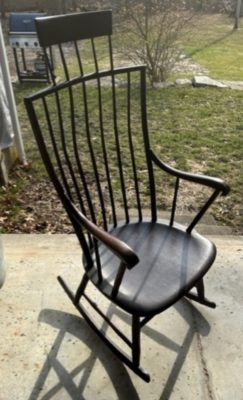
The Samuel Gragg Windsor rocking chair I bought several weeks ago has begun its winding road to Shangri-la. My friend JB, who clued me into the sale in the first place, was finally able to make the connection and pick up the chair this week. The logistics of getting an on-line auction trophy from northern Fascichussetts to the hinterlands of Virginia has been a challenge, but the plan is coming to fruition. I expect it to arrive as early as this coming week.
He assures me that the chair is very comfortable, not the least bit surprising because if Samuel Gragg knew anything it was how to make a comfortable chair.
I’m thinking it will live either on the front porch of the cabin or near my writing space in the barn. But one thing is for sure — it is getting enticingly nearer, and its arrival is much anticipated.
When not traveling for family/grandparenting activities I have settled into a not-very-interesting-for-blogging round robin routine in the barn. Depending on my mood as much as anything else I rotate between the tasks of cleaning and rearranging the barn spaces to reduce my footprint, tinkering with my formulation for Tordonshell, editing sections of the next Roubo volume (Michele is 2-1/2 manuscripts ahead of me, she can translate faster than I can edit and revise), working on the finishing book, editing Gragg video, and working at the bench, mostly on the parquetry and fittings for my tool cabinet. It is all in the “grind it out” category and is not particularly inspiring. There are many weeks I will get to the end and realize that nothing happened in the shop all week that anyone would be interested in.
I’ll work on one thing for an hour or two or three, then move on to a dissimilar activity to keep the juices flowing. If I am sitting down, I make sure the next activity involves standing up and/or moving. One recent adventure involved moving three 300-pound+ workbenches from the fourth floor down to the main floor for my upcoming Woodfinishing workshop (given the ongoing correspondence with my insurance agency this is almost certainly my final workshop hosting event; I will be transitioning the barn from being a business location to being a hobby shop. The in$urance premium implication$ are $taggering for having people here for workshop$. $taggering.)
Like I said, not particularly interesting for the blog but it certainly gobbles up my days.
After nine years of blogging and 1,700+ posts I cannot recall anything that surprised me more than the response to my recent post about mice in my truck(s). I got several Comments (I average about one comment per two or three posts, or about one-and-a-half per week). Plus, I got several direct emails with advice and commiseration.
Let it be said that the Mouse War has begun in earnest. There has to be a Peter Sellers joke in there somewhere.
The strategic approach includes three separate campaigns: discouraging mouse entrance, eradicating mouse presence, and expunging the olfactory aftermath.
As for the first point, that is discouraging mouse entry, two distinct tactics are involved. The first is to create an odor inside the cab that mice find repulsive. Problem is, the smells mice find repulsive, I do too. I am not hypersensate but there are precious few odors I want to be bombarded with continually. Good barbecue might be on that list, but I presume that would attract mice, not repel them. Yes, dryer swatches, room fresheners, and a host of other odors might work but I would soon tire of the fragrance.
The second tactic involves installing a strobe/sonic rebuff, which I ordered and will install when I get a free minute. My pal MikeM is a vintage car guy and stores a treasured vehicle in an out-building and swears by these devices. We will know soon enough whether it works for me, too.
The second phase of the war is the eradication of the interlopers. I’ve had mixed luck with traditional mouse traps, but find them to be too insensitive in general. All too often I do not find a dead mouse, but I do find the trigger has been licked clean of the peanut butter bait, even after I modify them to have a hair-trigger. At Mrs. Barn’s suggestion I put one of her RatZappers in each truck with resounding success. In short order I had six electrocuted mice, and in the week since there has been no activity. I am so pleased with them that despite the price I will order several for myself, one for each truck and one for each end of the studio. I work in a barn, after all.
The final hurdle is the de-stinkification of the cab once a mouse has crawled somewhere inaccessible and died. Based on the responses I am not the only one with this problem.
I will for the most part follow a line of passive resistance — when the weather is accommodating, I will leave the windows cracked a bit to air out, and until the stench of dead mouse is gone I will pack the cab with some of my homemade charcoal to soak up the smell.
This third and final installment of “Near Miss” planes is an eccentric one revolving around the fact that I am not a chair maker. I am a Gragg Chair maker, a definite distinction. It might be a distinction without a difference, but it is a distinction. My only rationale for including this/these tools here is that indeed they are integral to that work but are probably not true panes. They are plane-ish. Yes, they have sharpened irons held inside a body but they are different enough to call their type into question. This/these tools are the micro spokeshave and its cousin, the drawspoon, sometimes called an inshave or scorp.
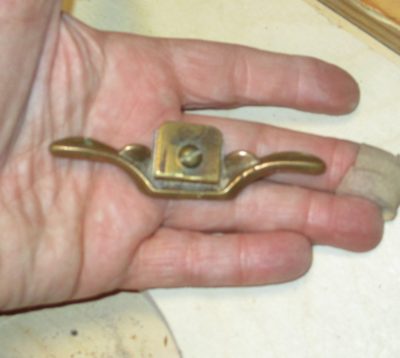
I was first introduce to the micro spokeshave in the foundry pattern shop when I started work there around 1978. At its core, when it came to the types of patterns we were often tasked with making, patternmaking was essentially no different than curvilinear sculpture. I was astounded the first time I watched the shop master John Kuzma lay waste to a glued-up stack-laminated helix that was to become the rib of a dredging cutterhead.
Almost hidden in his hand, this tiny tool soon had created a pile of shavings as the almost organic contour and surface took shape. While I had used “full sized” spokeshaves before, this little jewel was new to me and I have been a convert ever since. When I parted with the pattern shop in 1981 to marry Mrs. Barn and give college one final try — first college credits in 1972, tripe major degree finally in-hand in 1986 — John reluctantly bid me farewell (he could be an irascible sort but we got along famously; he came from the rough-and-tumble world of Cleveland factories and taught me obscenities and associated linguistic constructs that would make John McWhorter proud) he handed me as a farewell gift the micro spokeshave we had cast in the foundry. That tool remains one of my personal treasures.
The micro spokeshave we made in the foundry and John gave me as a farewell gift is the one in the upper right.
Flash forward to my first in-person encounter with a Gragg chair. Even underneath many coats of paint the processes and tools of Gragg were readily apparent, and a small spokeshave was integral to his work as well. Thus, when I started making replicas of his chair I was well equipped. Every curvilinear element of a Gragg chair is worked with this tool or one of its analogs (I own about two dozen micro spokeshaves and happily they are still being made)
The drawspoon on the left was made by AMT, and IIRC the one on the right by Ohio Tool. As far as I know neither is in production today. Perhaps the pinnacle of this form was made for a short while in Rhode Island by the Otner Bortner company. I am in the market for a set of those…
Another sorta cousin to the micro spokeshave to which I was introduced in the pattern shop was the drawspoon, used often in concert with the spokeshave. The spokeshave deals with the outer surface of a curvilinear shape, the drawspoon handled the inner curve. Unlike the shave, the spoon was restricted by its size and curvature so we had a set of them ranging from 1/4″ radius to 3″ radius. Try as I might I have never found another set like ours, perhaps not too surprising since we made them in the foundry ourselves. One of my great regrets ex poste is that I never copied the patterns for the shaves and spoons, and when I returned to visit the patternshop many years later all the tools and patterns of those tools were gone — rather than being a wood-based shop it was now a polymer-composite-based shop with body grinders replacing the woodworking tools.
Like the shave the spoon is plane-ish, but also like the micro shave it is integral to my working the seat deck of the Gragg chair. NB – I made a few modifications to Gragg’s original techniques and configuration, and introducing a modest swail to the seat deck with the spoon was one of them. That make the sitting ever more comfortable.
So, the micro-shave and the spoon are “near misses” in the Essential Planes menu only because they are plane-ish. If your work is different than mine these might not even appear on the radar, but in the context of my work they would be ranked #1A right behind the bench plane.
A second, most useful, “plane” that is adjacent to my Mount Rushmore of planes is the router. Hmm, is it really “a plane?”
Though primarily used for excavating, such as dados and rabbets (if I did more case-building it might be in that pantheon) but I find myself using it more than I would have thought when excavating areas for inlay or excavating joinery where my rabbet/dado plane will not work. I’ve even thought about getting one of the mini-routers now on the market, just for small inlay work.
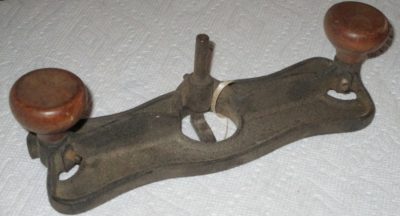
I have two vintage routers, one “D” style and one platform style, both with no adjustments other that tapping and tightening screws. Both are tool swap/flea market finds, and I found both to be terrific tools so much that I had no problem finding a new home for my NOS Stanley router.
Once again, the only reason they are not ranked higher on my list is that I don’t do enough of the kind of work that makes them reside there. It’s not their fault I don’t have them in my Essential Planes.
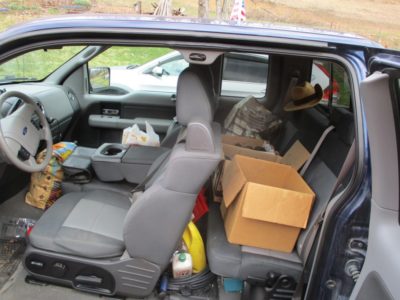
I can’t speak for or about any other place, but here in the hinterlands we have a big rodent problem. Not just the critters that burrow into Mrs. Barn’s garden (causing my sweet natured bride to pick up a pyrotechnic projectile tool and start blasting away at the bunnies and groundhogs), not just the critters that occasionally find their way into the house, but the real exasperation comes from mice and similar evil creatures infesting and damaging vehicles. These incursions are never ending and remain a constant source of work for local mechanics as mice chew through gas lines (yup), chew through brake lines (yup), chew up the insides of cars and trucks (yup), and especially get up behind the dashboard to either establish a colony (yup) or to eat the tasty wire insulation until they get electrocuted (yup, it’s why several of my dash gauges do not function right now). Up there. Behind the dashboard.
I think I’ve got such a case right now. A month ago I noticed the stench of death in my truck, and despite a thorough search I could not find the source. I have to assume that I’ve got a decaying mouse carcass somewhere hidden in the cab. I was advised to place a car air freshener inside the cab as mice hate the smell and it will act as a repellant, plus it will mask the stench of the decaying corpse.
I did, and all I accomplished was a whole new layer of stink to the truck interior. It didn’t even discourage the mice, as I noticed this morning that the peanut butter on all the mouse traps had been cleaned and none of the traps had any trophies. For the moment all I can do is keeping reloading the mouse traps, adjusting them to have the hair-est-trigger possible, and load as much charcoal as I can into the cab to eventually scrub the air passively. I put the charcoal in a few days ago and have convinced myself I can notice a difference, but still the peanut butter keeps disappearing off the traps. I expect that if I ever do excavate behind the dashboard I will find a complete mouse condominium there.
After three years of near-drought conditions (twice last year, once the previous year) I am suddenly deluged with opportunities to teach and present this year. In addition to those I have previously mentioned, there will be a third Historic Woodfinishing workshop, this one at the Barn(!), commissioned by the regional chapter of the Society of American Period Furniture Makers. They’ve had a month to get their members into the class and now I can open it up to the general audience for the last couple of slots. My neighbor is coming over this afternoon to help me rearrange the classroom and move some workbenches down from the fourth floor.
I’m also going to be the banquet presenter for this year’s Annual Meeting of the Early American Industries Association, speaking on the topic of the incomparable Henry O. Studley tool cabinet and workbench.
I even declined a gracious invitation to teach out on the West Coast and another out in the Heartland, but my days of that kind of travel for teaching are over.
When it rains, it pours.
So, here’s what my upcoming teaching/presenting schedule looks like:
April 12-14 Historic Woodfinishing 3-day workshop for the Howard County Woodworkers Guild, Columbia MD
May 20 The H.O. Studley Tool Cabinet and Workbench banquet presentation for the Annual Meeting of the Early American Industries Association, Staunton VA
June 19-21 Historic Woodfinishing 3-day workshop for the regional chapter of the Society of American Period Furniture Makers, at the Barn
July 17-19 Historic Woodfinishing 3-day workshop at Wood & Shop, Earlysville VA
August 21-23 Introduction to Parquetry 3-day workshop at Wood & Shop, Earlysville VA
September 1&2 Handworks 2023, Amana IA (yes, I know this involves long-distance travel but I’ve been committed to this for several years)
Among the multitude of planes that I own and use, the five previously mentioned are my Pantheon. Three more planes are “near misses” for one of three reasons. First, even though the tool might be called “a plane” it might not really be a plane in the most common sense of the word, that being a tool to make lumber flat, smooth, true, to a specific dimension. Second, it might not be as integral to my own work, in other words my projects might not require this or that tool. If your projects do require this tool, wonderful. Finally, I wanted to make sure the Essential Planes were not gargantuan or heavyweight; my Pantheon are things that would be found in a reasonably-sized traveling tool box. Admittedly, these restrictions are idiosyncratic and almost arbitrary, but so be it.
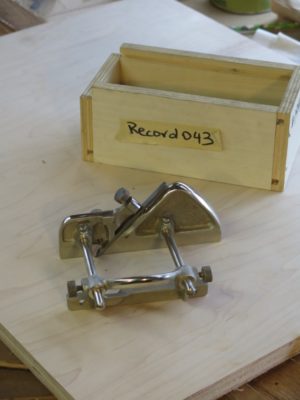
One of the tools in the “near miss” category is my sweet little #43 mini plow plane. Though technically a groove cutter rather than a stock prepping tool, it is called a plane in the lexicon so I will do so too. Were I more of a frame-and-panel sorta guy (I have recounted about how I am a premium plywood user for panel construction, even to the point of laying up my own custom veneer plywood) it would be right up there in the Mount Rushmore of planes. If you produce a lot of small boxes and furniture like RalphB over at The Accidental Woodworker it would be a perfect fit. The fact is I do not make much frame-and-panel work so this little beauty mostly sits on the shelf, patiently awaiting those few projects where it is an integral asset. If you do build a lot of frame-and-panel work, especially small to medium sized, this could easily be one of your two or three most important tools. I know that if I migrate in that direction, it will be for me too.
All that said, I do own two of these plow planes, one for the shelf in the shop and the other in my traveling tool kit; it breaks down to a very small package that fits into a #1 mailing envelope. You just never know when a frame-and-panel project will strike.
Up next – not a bird, not a plane, but for me a supertool!
From the golden age of America’s best ever rock band, sez me and Jimmy Page, the jazz/funk/polyrhythmic “Day at the Dog Races,” (I vaguely recall blogging about it eons ago) a song I can listen to repeatedly at the same sitting. Speaking of which, I remember one Thanksgiving Friday twenty years ago when Mel and I might have been the only people at work, so we decided to see how many times we could listen to Phil Collins’ “Something in the Air Tonight” on our best-in-the-building sound system. We put the CD player on “Repeat 1” until we were tired of it. As I recall, the answer was 43 times in a row.
Little Feat did a lot of backup for a variety of vocalists including Robert Palmer (Sneaking Sally Through the Alley) but as a bonus here is LF backing an engaging performance of Rhumba Baby by the infectiously charming Nicolette Larson. From back in the day when music was fun and didn’t make my ears bleed, like the junk kids listen to today.








Recent Comments