My longtime broadcaster friend Brian Wilson invited me back on his show Something Completely Different Tuesday to discuss the elections, or perhaps more precisely, the electorate. Find it and listen at your own risk. If pungent opinionating and analysis is too much for you, avoid it.
While this blog is not really about my family, there are times when it needs a good mention. Such posts may not interest you, but quoting Mollie Hemingway, “My spiritual gift is that I do not care what you think about anything.”
The cabin is hauntingly quiet now after a long weekend with both daughters, one son-in-law, and L’il T filling every cubic inch with love and joy. Even when he is fussy (teething) L’il T is a joy and truly a Godly blessing. He is completely captivated by this white fur on my face, stroking it every time I held him. Heart-melting moments.
One of the motivations behind the visit was a celebration of LtCdr’s birthday, but even more was it was deer hunting season. He spent several days sitting up in the woods for hours at dawn and dusk, bow-and-arrow at the ready. Of course, his only score was at dusk on their last night here. We spent until almost midnight dressing the carcass. My mouth is almost watering in the anticipation of the venison roasts yet to be cooked.
The skill set related to hunting is not one I possess, so it was a grand time of bonding with the father of my grandson. Given my age and visual limitations it is not likely I will ever be a good hunter, or even any kind of hunter, but I learned a lot about hunting in conversations with LtCdr over their visit. No doubt it could come in handy as the nation seems hell-bent on becoming Venezuela, where things got so bad they ate the zoo animals.
Our little community is down to one chimney sweep, a not inconsiderable logistical problem when there are probably around a thousand fireplaces and woodstoves in use here. Getting on Rick the Chimney Sweep’s calendar early is an important consideration, and this year we did not get on the calendar as early as we should. But just in time for chilly weather he worked us in to clean out our beautiful stone chimney. Fortunately, our exhaust flue is not prone to build-up and combining that with the choice of fuel — always well-seasoned hardwood — gives us a lot of latitude, chimney cleaning-wise.
The easy part for Rick is to climb a ladder to the top of the chimney and sweep it from the top down a la Bert the chimney sweep from Mary Poppins. I’m not afraid of heights but Mrs. Barn insists that my amygdala is not as sensitive as it should be so I take more risks than I should. Thus, she is delighted we can hire someone to work at the height required.
Rick is, among other things, an enthusiastic spelunker so crawling around in the fireplace behind the insert suits him just fine. He gave our fire exhaust system a clean bill of health and said that we may not even need an annual cleanout.
His ministrations were just in time as the temps will drop precipitously over the next few days with snow coming next Tuesday and Friday. I expect we will fire it up in the next 36 hours or so if for no other reason than Li’l T and his parents are visiting for several days and we want to keep him warm.
As for the barn, it is easy enough for me to disassemble and clean the stovepipe, which I did last spring.
All set.
PS I’m about halfway through the task of splitting and stacking firewood for next winter, and by the time I finish with the entire mountain of wood in the parking area next to the barn I’ll be ready through winter 2024/2025.
My original work on artificial tortoiseshell was presented in Amsterdam almost exactly twenty years ago. I think the conference publication was about eighteen months later.
Here is the link for the PDF on my “Writings” page:
One of the outcomes from my current developments will be an updated and more detailed monograph to be posted in that same directory. I’m also noodling a video on the whole process. My videographer Chris is now much harder to schedule, with a full-time job, a new/old house, and a wife and two tiny kids, so I will probably try to figure out how to do two-camera filming in the studio. My digital SLR has a microphone port so I think all I need to do is start figuring things out.
Stay tuned.
P.S. I will probably make some full blown tordonshell in the coming fortnight based on my latest results.
One of my regular podcast listens is The Darkhorse Podcast hosted by husband-and-wife Biology professors Drs. Heather Heying and Brett Weinstein. Though our general worldviews are definitely not overlapping too much I enjoy their conversations immensely as they are informative, gracious, and usually good-humored. Their quiet earnestness and quest for truth (with little tolerance for b.s.) keep me listening.
Recently they discussed the inter-relationship between science (I loved how it was described as a tool rather than a sacred totem) and the structured problem solving inherent in artistic creation. Part of the reason for my interest is fairly obvious, my career was spent occupying the space resulting from the intersection of materials science and artistic and cultural artifacts in the world’s largest museum complex. At one point of my career trajectory, I was a principal in a project to create a high school interdisciplinary curriculum merging the hard sciences with the world of artifacts and art. As I said in the funding proposal for the beta-test, “When the scientific analyst describes a material as having such and such properties and the artist says he wants art materials to accomplish this or that expression, they are talking about the exact same thing but from a different perspective.” My organization’s priorities changed with new management and the project was never brought to fruition.
I think you just might find Bret and Heather’s comments to be interesting. This specific topic begins around the 23-minute mark.
Many years ago, when I was Director of the Smithsonian’s Furniture Conservation Training Program, I was meeting individually with each student in preparation for their fourth-year fellowship, during which they were required to undertake a project that would result in their Master’s Thesis. The students had great latitude in their projects, some were purely historical aesthetics, some were about historical technology or craft, and some were analytical.
After our conversations I would arrange for each student to have a “mentor” to help them with guidance along the way. For those projects reliant on analytical data I brought in a highly respected statistician with a specialty in experimental design and data analysis to advise the students in designing their project, gathering data, analyzing that data and formulating the conclusions. One of the great beauties of DC is the abundance of research institutions and their scholarly communities. (The stories the statistician told me sotto voce about “research” shenanigans made me distrustful of any “science” ever since, even before the anti-“science” of the past three years. One tale literally revolved around a “researcher” bringing in a box of lab notebooks and dropping them on the statistician’s desk the with the instructions, “My conclusion for this project is XYZ so you need to review this data and arrive at this conclusion.” As the experimental designer told me then, “science” is not a thing, science is a process, and if the process is corrupt then the outcome [data and conclusions] is worthless. From that perspective I can barely withhold laughter when public luminaries now tell us to “follow the science.”)
Back to my student. The topic proposed for the thesis project was an evaluation of shellac properties, the particulars are lost to me at the moment. I only remember that the number of variables combined with the number of identical samples required for a statistically valid set of results would have require formulating and preparing approximately seven million samples. Needless to say, the student changed their project rather fundamentally.
Which brings me to work I am undertaking in the studio right now and probably for weeks or months to come. I am not the trained experimental scientist in this household — that would be Mrs. Barn — but I am fairly able to harness and focus my curiosities from time to time. My demonstration of making my artificial tortoiseshell several weeks ago has re-lit that fire for me and I have been working on refining the formulation and process ever since. Although my paper from two decades still stands up well, it only gets about >95% of the way to a really good imitation vis-a-vie the physical properties of genuine tortoiseshell. >95% is not the same thing as ~99%, which is where I want to go.
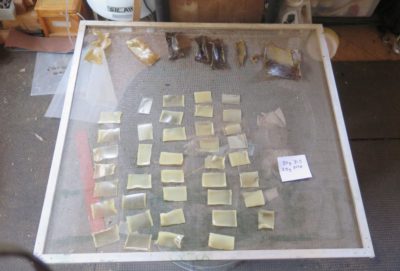
Like my student’s those years ago every variable change requires a group of samples to be formulated and made. Unlike the putative shellac researcher I am NOT weighing each variable as random and equal. I am not making the number of samples that might be required if the variables were purely random; I am testing one variable first, then applying the second variable once the first spec is established, then the third once the first two are established, etc. Even so I am creating hundreds of samples to assess for their properties based on a menu of options I must consider.
What grade of collagen should I use?
What concentration?
Which plasticizer (if any)?
At what concentration?
Which protein reaction catalyst to use?
In what proportion?
In solution or infused ex poste?
How long to cure?
At what temperature?
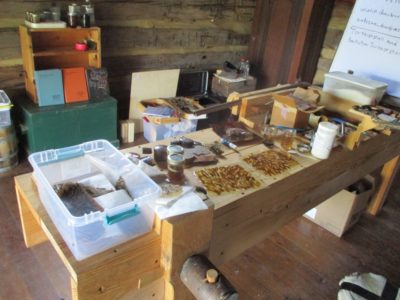
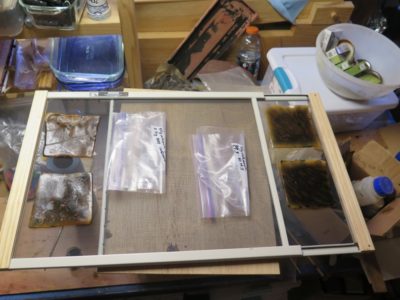
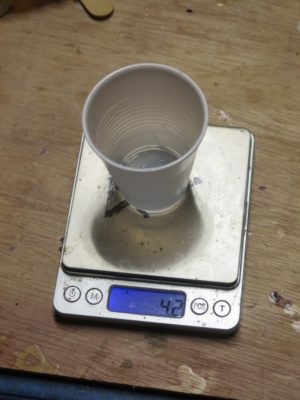
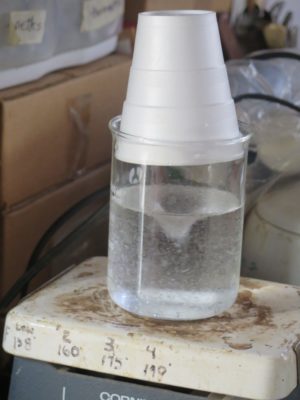
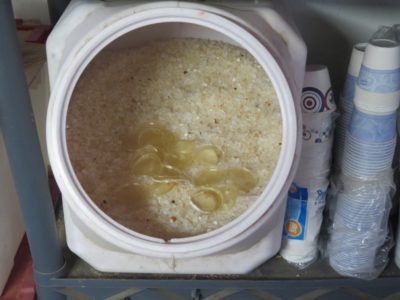
My tools for this undertaking are fairly simple and non-specialized; an analytical digital scale, disposable pipettes, disposable cups, a old microwave, an ancient ebay stirring hotplate, a rice steamer (most samples curl when they dry and need to be steamed flat), drying screens, and a desiccating chamber, a/k/a a Gammo pet food storage unit filled with conditioned silica gel. By far the most time for the sample involves drying them to the lowest moisture content possible, at which time the most extreme properties become manifest. Yes indeed, most of the time is watching samples dry.
There is simply no point in ongoing daily blogging about that, or in changing formulations by a hundredth of a unit proportion, but I will report back when I have results that I find encouraging in directing my final minute adjustments. In the meantime when there is radio silence on the blog, you can assume I am either splitting firewood for next winter and beyond, or tinkering with formula minutiae.
One of my real headaches at the moment has to do with a German chemical component that has a) become unavailable, or b) become unaffordable. My current dwindling inventory was a 100g jar given to me by the president of a chemical company almost twenty years ago, and in the intervening years I have seen the price go from a couple hundred dollars a kilo to several hundred dollars per kilo to a few thousand dollars a kilo to a quote yesterday of almost $100k per kilo. I’m really wishing I’d bought a big bucket of it fifteen years ago. Obviously, I am doing my best to work around that headache.
I am a complete sucker for a sublime artist’s brush and probably own ten times as many as I need (well, make that definitely, not probably; I’m getting ready to order a few more Kolinsky’s right now).
Recently my friend JoeA sent me the link to this video and I have watched it more than once already. Aspirations must have a focus target, and this is certainly one of those for me.
High quality tools both bring out the best work and require the most attentive care. Hence, the Special Feature on cleaning and caring for brushes in my woodfinishing video (currently out of stock but more copies are in the pipeline).
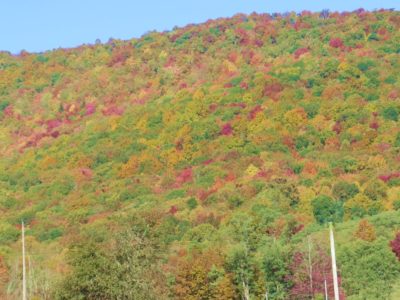
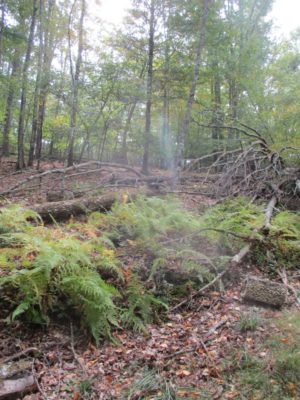
Even on a slightly hazy morning, the drive back from the hardware store featured a landscape of almost fluorescent colors on the mountain behind the cabin.
Autmn beauty is a fleeting thing here in the Virginia Highlands, a good year giving us at best three weeks of polychromy. This year we had about a fortnight plus a day or two.
Hard to not be distracted when this is the view from the window.
During that fat fortnight the drive up the road and the view outside the shop windows was glorious.
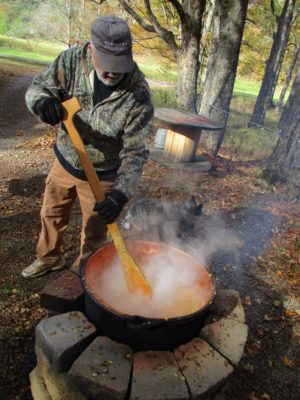
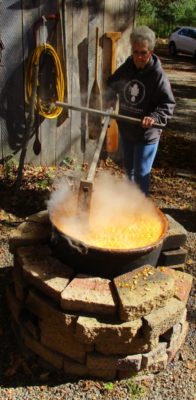
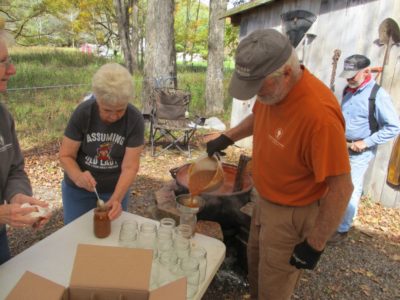
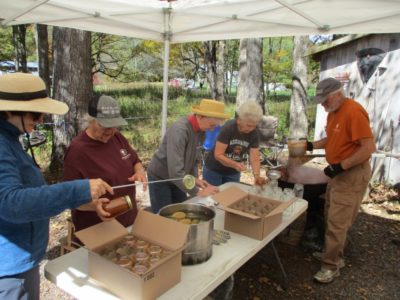
Another splendiferous happening during autumn in these parts is the annual making of apple butter the old-fashioned way. Twice we have been able to go to our friends Pat and Valerie to help cook, stir, and can apple butter in accordance with Pat’s mom’s recipe (I think), using a giant copper-lined cauldron resting above a wood fire. This year we had brilliant, crisp days for the event and garnered almost 150 pints each day.
The assembly line firing on all cylinders.
Perhaps the truest from of magnificence on these days is when we got to scrape caramelized apple butter off the bottom of the cauldron with fresh biscuits and popping the treat into our mouths.
In recent weeks I’ve been corresponding with a friend-I’ve-never-met about a wide range of topics, and the question came up (paraphrased), “How can I best help my teenager to pursue a life of skilled woodworking?” (The Dad is a brilliant woodworker but has a more-than-full-time profession). The young adult recently visited the North Bennett Street School and was much impressed.
But, what are the other options? It’s not a question I have given much consideration before now.
The family in question does not live in the US so moving to attend NBSS is only one option on the table. Any good fit for the youngster will be considered regardless of location. From conversing with the Dad I think anything from long-term apprenticing with an excellent mentor to finding a first-class skilled trade school is on the table. The only objective is to obtain a thorough grounding in the craft, so two-week workshops are not in the cards, nor is necessarily a BFA at a university as the goal is to impart the complete skills necessary to live a long and productive life as an artisan, not inflict malignant social/political indoctrination.
What are the other options for becoming a skilled furniture maker, boatbuilder, musical instrument maker, traditional timber framing, or anything similar? The things that come to my mind are Ecole Boulle in Paris, West Dean College and City and Guilds in the UK, some luthiery and violin-making programs, etc.
I will check more with the Dad to find out any particular proclivities of the prospective student, but if you have any good ideas please let me (and him) know about them.
Years ago when my sister’s family was visiting and we were giving the kids a walking tour of the property, one of my nephew’s exclaimed, “Uncle Don, it’s just like you live in a state park!” As you can probably deduce from some of the firewood-harvesting pics, the topography for much of the property is, shall we say with literary license, exuberant. One moment of inattention or one spot of poor footing can put you on the ground in a twinkle of the eye. Given my poor vision with almost zero binocular depth perception and my history of injury I am becoming increasingly attentive to keeping upright in the place I want to be moving or standing still.
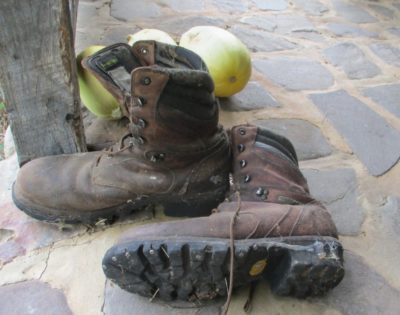
Traipsing around up and down and across the hills requires good footing and for all of these years I have relied on an old pair of lumberjack-ish boots. For standing, these are the most comfortable footwear I have ever worn, but as my excursions into the forest have become more purposeful, they were wanting. For starters, as the knobby soles became worn they were less able to grab the ground as needed, but even worse is the fact that they weigh about 8 lbs apiece making the traversing of rough terrain all the more problematic. Hiking around iffy ground with a brick lashed to each leg is not optimal.
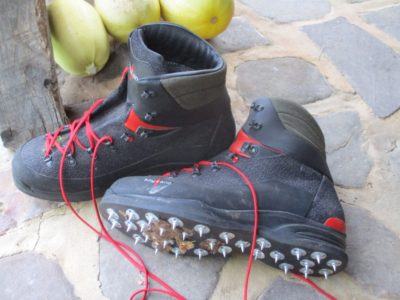
Since firewood-harvesting became integral to my routine here I started looking into spiked-sole lumberjack boots (the term for this type of boot or shoe is “calked;” I have no idea of this etymology) as a response to slippery footing.
After much browning of the interwebz I found this pair of “calked” boots built on a hiking boot platform, thus reducing their weight by around 50%. They are comfortable, lightweight, and grab the ground like they were, uh, spiked to the ground. They have transformed my time in the woods or when bush hogging the hillsides, or even just mowing the yard (although I must be attentive to where the water hoses are so as to avoid stepping on them). In these arenas, they are perhaps my most important tools.







Recent Comments