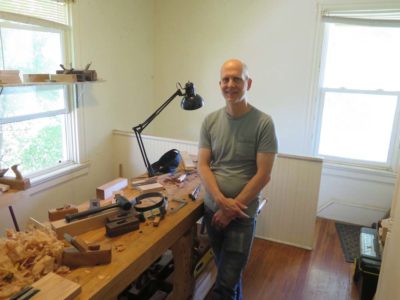
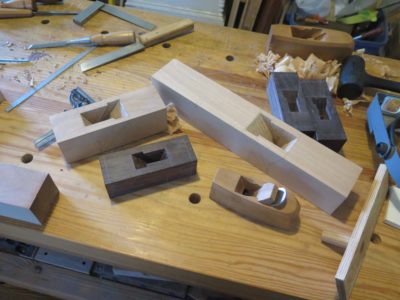
Last week en route home from Mordor on the Potomac I had the good fortune to visit Steve Voigt, music composition professor by day, planemaker by night. I became acquainted with Steve in the past couple of years and have come to enjoy immensely his company and his passion as a gifted craftsman fashioning wooden bodied planes in the style of 18th Century English hand planes. At one point in his life Steve was a skilled machinist and that attention to detail has carried over into this new chapter of life, in part teaching students how to construct music and also providing us with exquisite tools to construct furniture.
We spent a couple of delightful hours discussing woodworking in his charming, spare, beautifully bright garret studio above the kitchen of his (and the lovely and delightful Mrs. Steve’s) house. Tell me those windows and the light accompanying them does not instill some jealousy. Go ahead.
I continued my admiration of his products, and noted with anticipation some new items coming to his inventory soon. We also discussed the possibility of him making some custom tools for me soon. Cross your fingers.
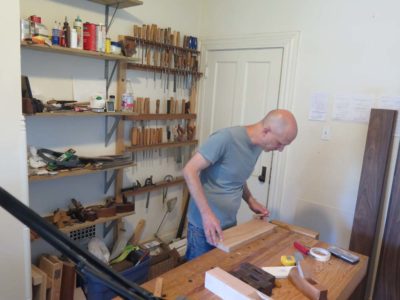
The money time was the hour or so spent with him demonstrating the method of setting up a double-iron plane to get the most superior results. I know how to sharpen tools pretty darned well, but his tutorial on setting the second iron was an eye-opener to me.
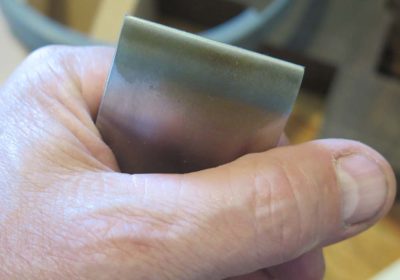
Steve’s first step confirmed his facility as a sharpener as he tuned up his iron in about 30 seconds.
Thus far I’d been setting my chip breaker around 1/25″ from the tip of the cutting iron but learned that my spacing was far too great, and the best setting is somewhere in the territory of .006″-.010″. Steve sets the cap iron distance by eye, but he showed me a foolproof starter method for learning the process. First, rest the tip of the cutting iron on the bench, then lower the chip breaker down onto a .010″ feeler gauge leaf.
Then bring it home with the resultant spacing between the chip breaker and the cutting iron being nearly invisible.
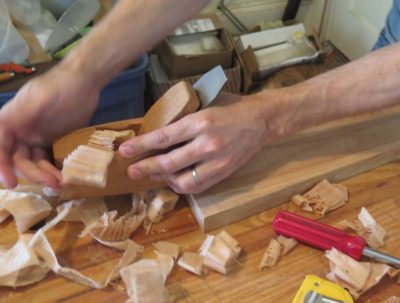
Setting up the plane itself with eyes way better than mine, Steve showed me the results.
He explained that a properly sharpened and set double iron plane almost literally shoots the shaving out of the throat. I was surprised that they did not curl, they were straight wisps of gossamer wood (this one was a bit heavy and rippled, but photographing him work is a challenge because his motions are so confident and rapid).
Who knew? Well, not me!
Steve definitely gave me something to think about and aim for, which makes our time together invaluable.
My never-dormant interest in and work on tortoiseshell and ivory recently led me to acquiring and playing with an amazing new imitation ivory. Brought to us by ivory artist David Warther, whose enterprise in dealing in certified vintage ivory was shut down by the previous batch of knuckleheads in Mordor-on-the-Potomac (given the revolving door of knuckleheadery in Morder, I have to specify). Like me David has been exploring alternatives to the use of an amazing natural material with engineered substitutes. My correspondence with him led me to Resin-Ivory (TM) as a raw material for use in the studio.
The creators of Resin-Ivory have managed to blend the polymer technology of crosslinked polyester with the artistic morphology of striated composites. Somehow these manufacturers have figured out how to mimic the working properties of the ivory (not perfectly but pretty close) with the grain patterns endemic to ivory, even to the point of inducing very faint Shreger Lines, those Spirograph-like patterns that are evident on the end grain of true elephant ivory.
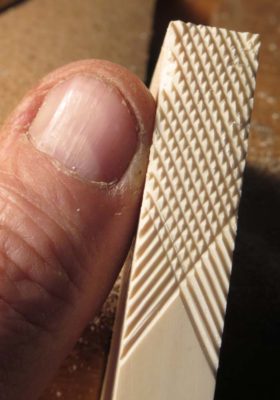
I’ve played with the material enough to know it is going to become a staple in my studio (and the prices are crazy modest). I was very impressed with its properties in cutting and carving, and spent about five minutes doing some checkering. The only thing I noticed was that occasionally the checkering cutters needed to be cleaned with a stiff brush, a step that is never needed when working genuine ivory.
I think my next big use for this material will be making a new wedge for the infill smoother I rescued earlier. Stay tuned.
While at the Piano Technicians Guild shindig I taught a couple of additional classes. First was a half-day on Veneer Repair (this must be the year for veneer repair, and in fact I am going to work on a full-length instructional video on the subject this Fall) and a lecture on the Principles of Conservation. The latter session essentially mirrored my recent article in Mortise and Tenon, so there isn’t too much to say about that.
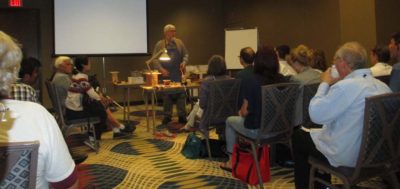
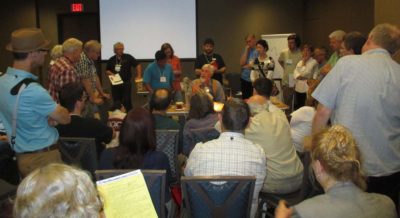
Both class sessions were well attended, in fact the veneer repair session was SRO much of the time. The attendees were highly enthusiastic, and I set the room up so they could be close enough to see me working.
At my invitation they gathered closer, and pretty soon it was a mosh pit. I’m not particularly claustrophobic, which is a good thing.
I managed to engage in a discussion of wide ranging topics related to the issues of veneer damage, and demonstrated the techniques that have served me so well over the past few decades.
With lots of Show-n-Tell to pass around, I think they all got a good exposure to the topic. If the evaluations are any indication, they enjoyed and learned much, which is about all you can ask.
My only regret was not bringing my own petite Roubo workbench, as the hotel folding tables were not really up to snuff. I guess that I will just have to make it practice when I go teach to bring my own workbench unless I know for a fact that another good one will be there.
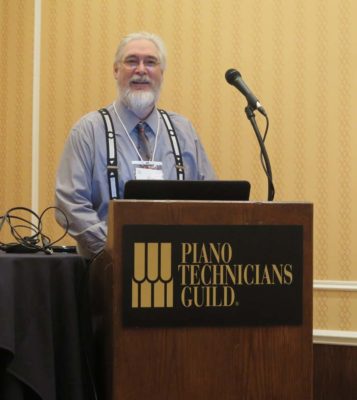
Last month I was invited to speak at the annual national confab of The Piano Technicians Guild, held in St. Louis. So Mrs. Barn and I hopped in the car and headed west, arriving on a day that was 99 degrees, quite a shock after leaving the mountains at about 70 degrees.
I made three presentations but the first one, on H.O. Studley and his tool box, was the one the audience awaited with greatest anticipation. Actually I was excited about it as this was the chance to resolve unanswered questions about some of the arcane tools in the collection.
The audience was very enthusiastic, all the more impressive when you consider it was an 8AM(!) gathering.
Immediately following the lecture I signed a basket of books for those who had them in hand. It was a great time of fellowship and exchanging, as many plausible (but often competing) versions of the esoteric tool functions were elucidated.
Alas, I cannot state with certainty that my understanding of Studley’s odd tools is fully cemented.
A couple months ago I blogged about building a pair of petite Roubo workbenches (18″ x 64″ tops) for my booth at Handworks in Amana IA, with one of them being ultimately destined for my colleagues in the Rare Book Conservation lab of the Library of Congress. I’d taught a two-day workshop on making book boards by hand, an event that was simultaneous delightful and frustrating. Delightful because the staff there was congenial, skilled, and highly motivated. Frustrating because they did not own a workbench worth lighting on fire. I vowed to rectify that situation, and now have.
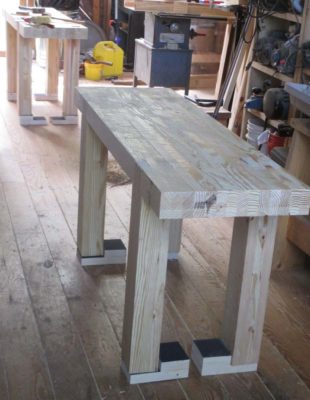
With the writing desk project completion drawing nigh I was able to take a few hours to get the LC bench assembled, trued, and tarted up. The former was straightforward, as I drove home the legs in their twin sockets with a sledge. They were so snug I did not bother with glue, I simply pinned them in place with 4″ screws and wedged any spaces. The top surface needed only a few minutes of flattening, first with a #5 set up as a fore plane, followed by a freshly sharpened #7, and concluding with cross-hatching with a toothing plane. The stretchers and shelf were equally simple, screwed or toe-nailed in place.
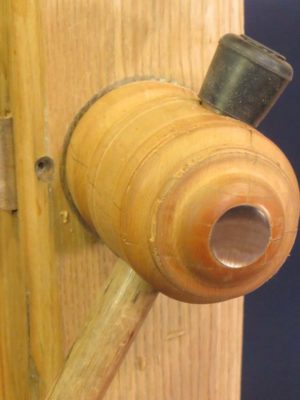
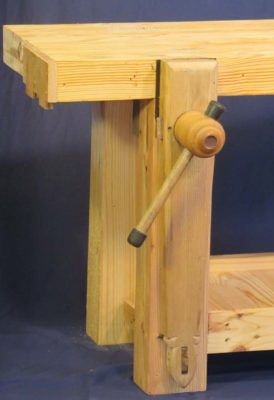
The “tartification” came in the guise of a modified vintage leg vise I had in my inventory. Given the mundane nature of the original, probably a late-19th Century unit I picked up who knows where, I felt some enhancing was in order. The barrel head of the original was entirely uninspiring, simply inappropriate for the new setting and the artifacts it was to be part of.
I gave it some new life in its contour, and inset a large mother-of-pearl button at its center. Just because I could.
Not to abandon the foot of the movable jaw, I spent a few minutes with a saw and a file to give it a bit of pizzazz also.
My final flourishes were a double planing stop attached to the end of the top and some sharkskin pads for the top of the vise.
It gets delivered in a few days, and I hope they enjoy using it as much as I did in making it.
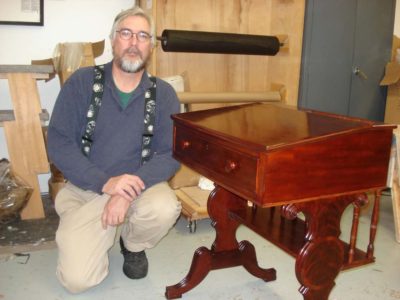
In December of 2014 I was contacted by a man who had somehow tracked me down based on one of my old blog posts describing several of my earlier projects, including this replica from a decade ago. He requested that I undertake a similar commission to build an iteration of an early 19th century writing desk, employing the furniture making technology of that period.
After much correspondence I agreed to give it a try, but let him know it would be a great many months before I could begin. At that time I had two book manuscripts to complete (Studley and Roubo on Furniture Making) in addition to the bajillion details inherent in creating the once-in-a-lifetime pinnacle-of-a-career exhibit of the H.O. Studley Tool Cabinet and Workbench. In short, I accepted the project with the caveat that I could not even begin to turn my attention in that direction for at least eight months.
He agreed.
Fast forward to now. Two books, one exhibit, a broken hip, and a broken arm later it’s done, and the delivery is on my calendar. Over the next few weeks I will post several blog entries describing the project in probably far more detail than you want, but that’s the way it is.
My friend Clint sent me this video (“This is what passes for entertainment among the blacksmith’s group”) and it made me smile. I’ll bet it will have the same effect on you.
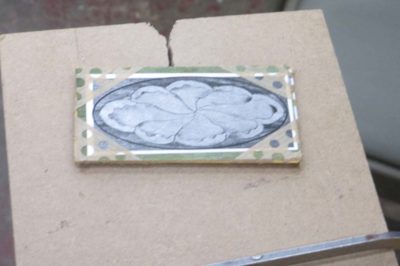
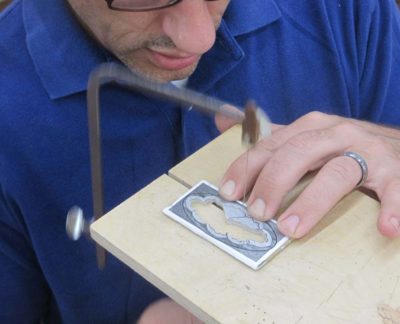
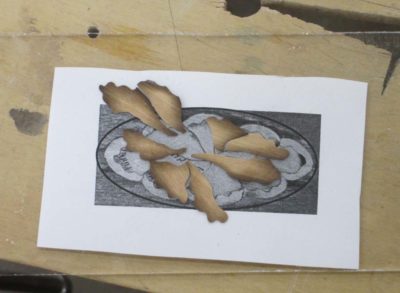
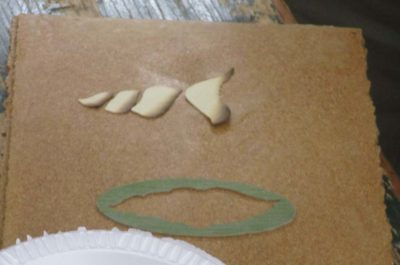
The day after Veneer Repair came a session to create a pair of oval Federal inlays. The morning was spent creating a simple conch shell pattern patera about 2 inches by four inches, in an oval surround with multi-stringing border. I provided all of the tools and supplies for the students.
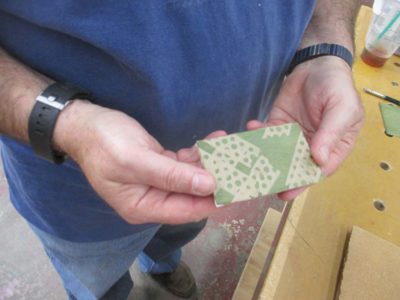
The first process is to make a packet of the veneers from which the patera will be cut. These are just stacked and wrapped with veneer tape.
Then the pattern is glued to one face of the packet, using stick glue.
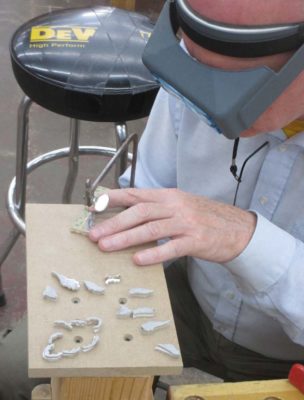
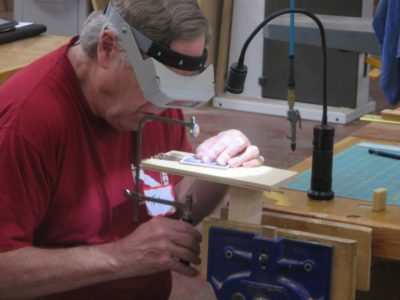
Using a small eggbeater drill and a tiny bit, a hole is punched in an unobtrusive spot and a jeweler’s saw blade (0000 in this case) is fed through, hooked up the the saw frame, and the sawing begins.
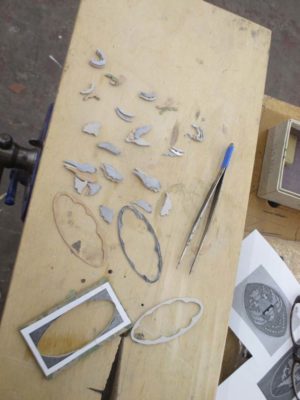
Once the pieces are all cut out they are immersed into a bath of hot sand to scorch in the shading pattern.
The end result is a compelling one.
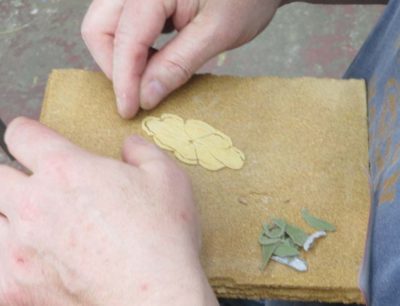
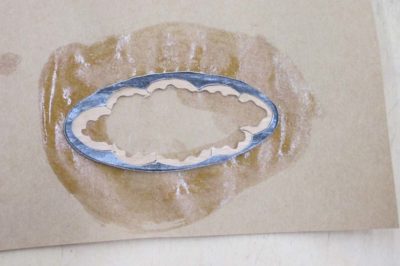
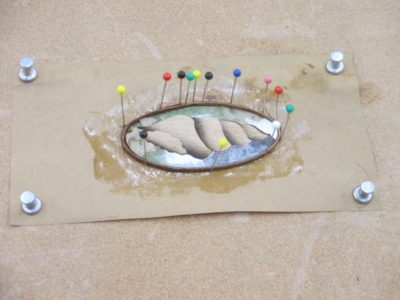
The pieces are all glued to a piece of kraft paper backing, and the stringing border also glued to the same paper with the help of a pile of straight pins. The proud wood would be trimmed with a sharp chisel and then it is ready to use.
Thus endeth the morning. Up next, the second patera.
Following the recent Groopshop gathering at the Connecticut Valley School of Woodworking I stuck around to teach a couple of one-day workshops. The first was “Veneer Repair” wherein I presented a group of techniques I’ve learned or created over the years. Having looked at an awful lot of historic furniture in my career, I think it is safe to say that the challenge of dealing with veneer damage and loss has been beyond the skill-set of a great many folks in the business. This is a topic of great interest to me, and since I’ve taught it many, many times, including last week, there seems to be interest in it. I am currently scripting out a video to shoot here in the coming winter with a young videographer living nearby.
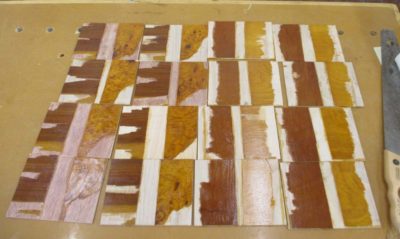
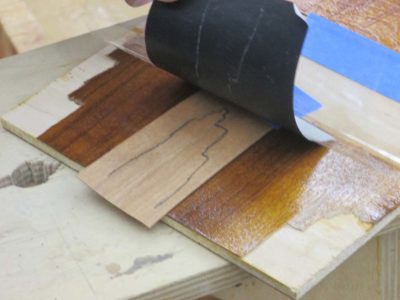
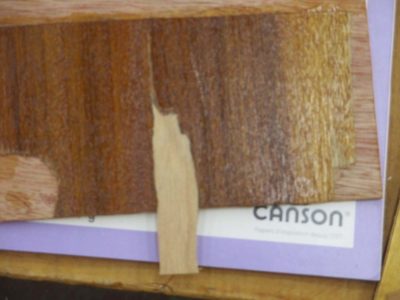
My first order of business, a month before the class, was to make a set of near-identical “problem” boards for the students to work on. These were fairly good representations of the types of problems they will encounter.
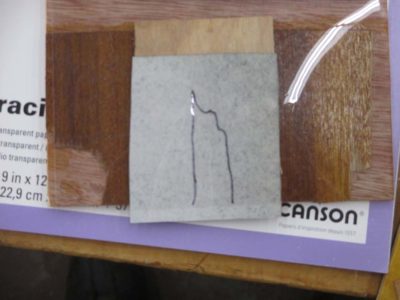
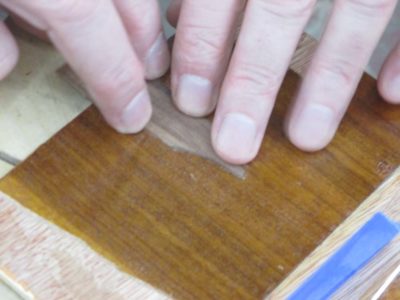
For most losses a technique I created involves tracing precisely the damaged area onto a small piece of mylar or acetate that is taped to the adjacent background. Then I select and locate a piece of veneer that matches the surrounding background as best as possible. (I apologize for many of these pictures, I discovered ex poste that the camera was having a bad day, or perhaps it was the camera operator…)
The outline is transferred to the veneer via a piece of carbon paper (these are obviously not the same problem piece, but I think you get the idea)
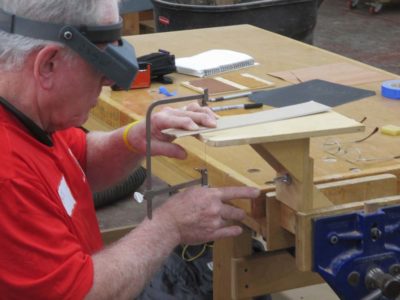
The marked veneer is then mounted on a backing board with stick glue, and cut out with a jeweler’s saw.
If all goes well you get a perfect fit from the git go.
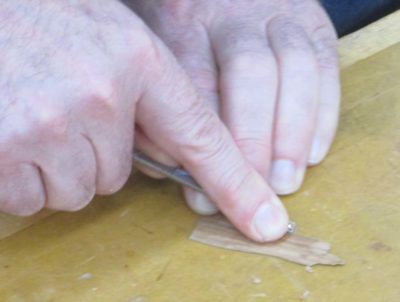
But sometimes the back side of the joint edge needs to be feathered with a small gouge to make it fit perfectly.
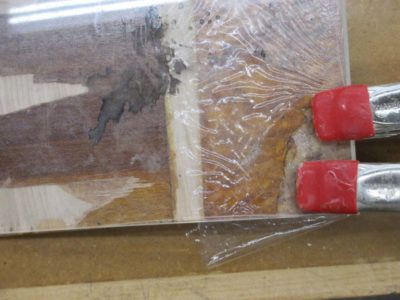
Once you have the grain and fit correct, you slather on some glue, overlay with a piece of cling wrap or mylar, and clamp with a plexi caul and the veneer repair is pretty much done. There is finish work yet to come, but that is another subject for another time.
A number of other techniques were taught, but I was so busy teaching that I forgot to take pictures of them. You’ll have to wait for the video, I guess.



















Recent Comments