The goal for the weekend, thus the goal for the day itself as the final one, was to allow each student to leave with a fairly complete Roubo parquetry panel. The pace of the day was then almost by definition a peripatetic of not frenzied one.
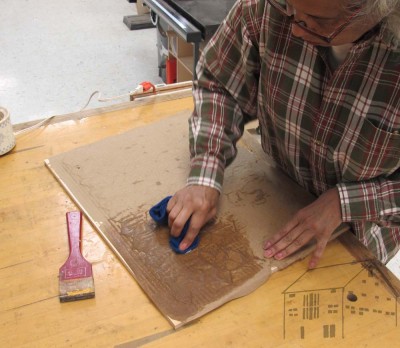
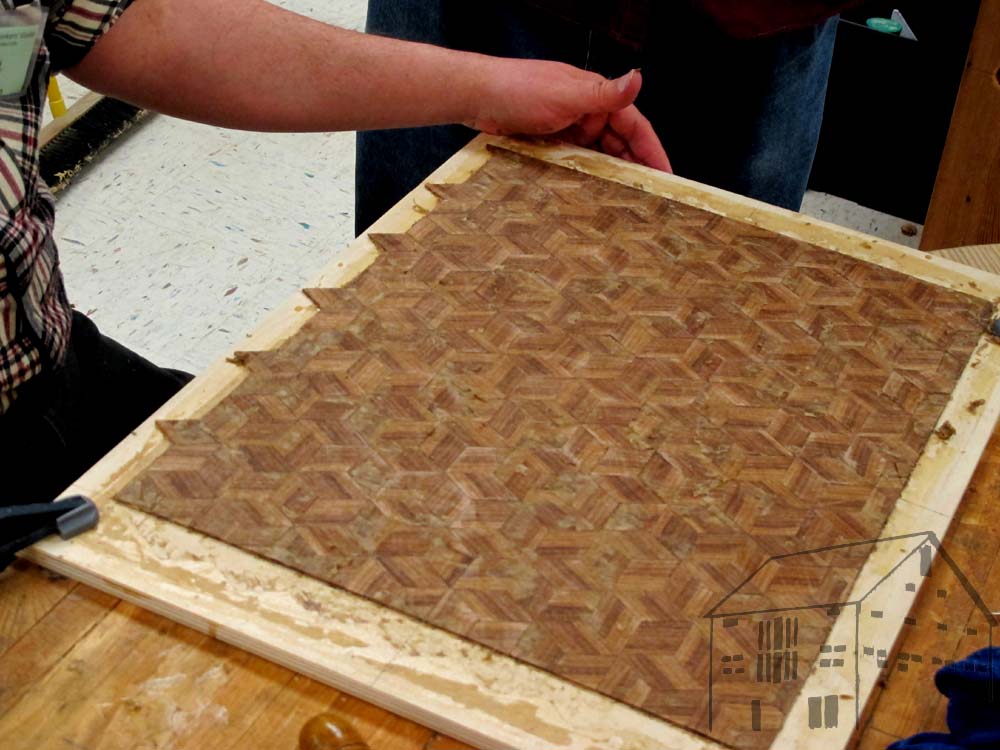
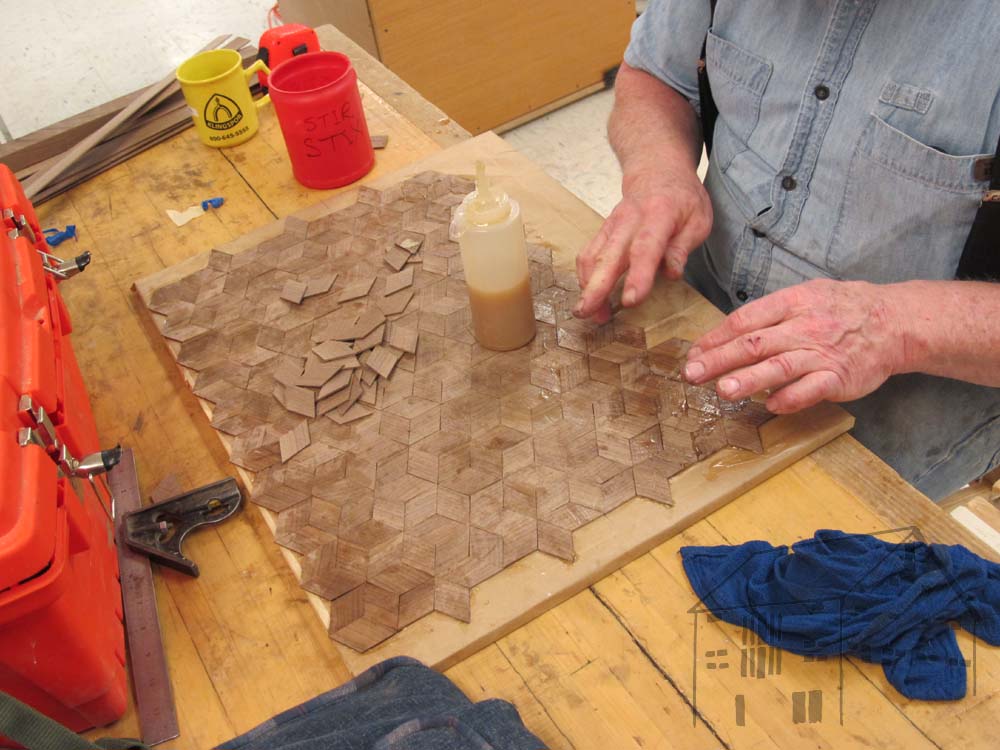
After opening the gluing set-ups each student was faced with a glued-down panel with a heavy layer of brown craft paper on the surface. Gentle work with a dampened sponge or rag combined with scraping with a scraper or knife resulted in a cleaned panel ready for trimming on the edges to allow for fitting of the banding. The trimming was accomplished with a straightedge and a utility knife or veneer saw.
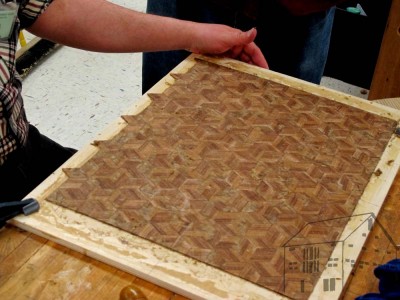
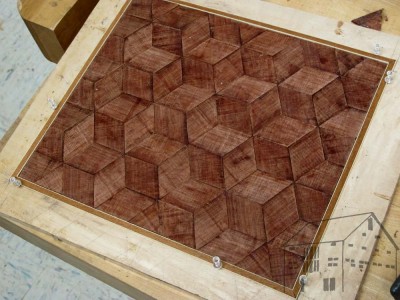
With strips of the banding glued up on day 2 each panel was fitted with the decorative detail.
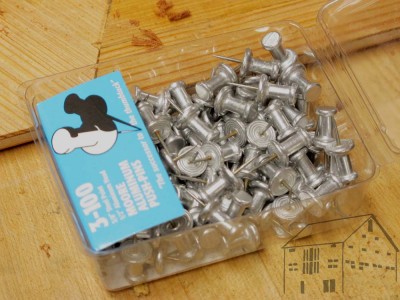
One of the delights of traveling and teaching is the opportunity to learn new things. In this instance, I learned that Utrecht art supplies carries an aluminum-head push pin, a necessary and useful tool for pinning the banding in place while the glue sets. I’ve been making-do with plastic headed pins, but until now had no success in finding the aluminum head ones. I left for home greatly pleased with the new information and source. My great thanks to Ms. S for finding them and bringing some to class, and for letting me buy her stash from her.
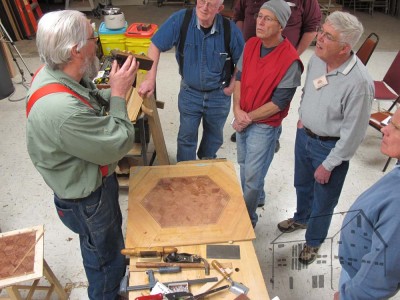
Once the students had their banding glued and pinned, while that was setting I took the opportunity to demonstrate flattening the surface of a parquetry panel with a toothing plane, smoothing it with a scraper, and finishing it with molten wax and water-wax. The students did not get to try all of these methods, but the techniques are simple and the students promised to finish them at home.
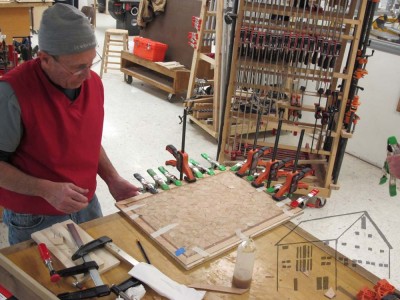
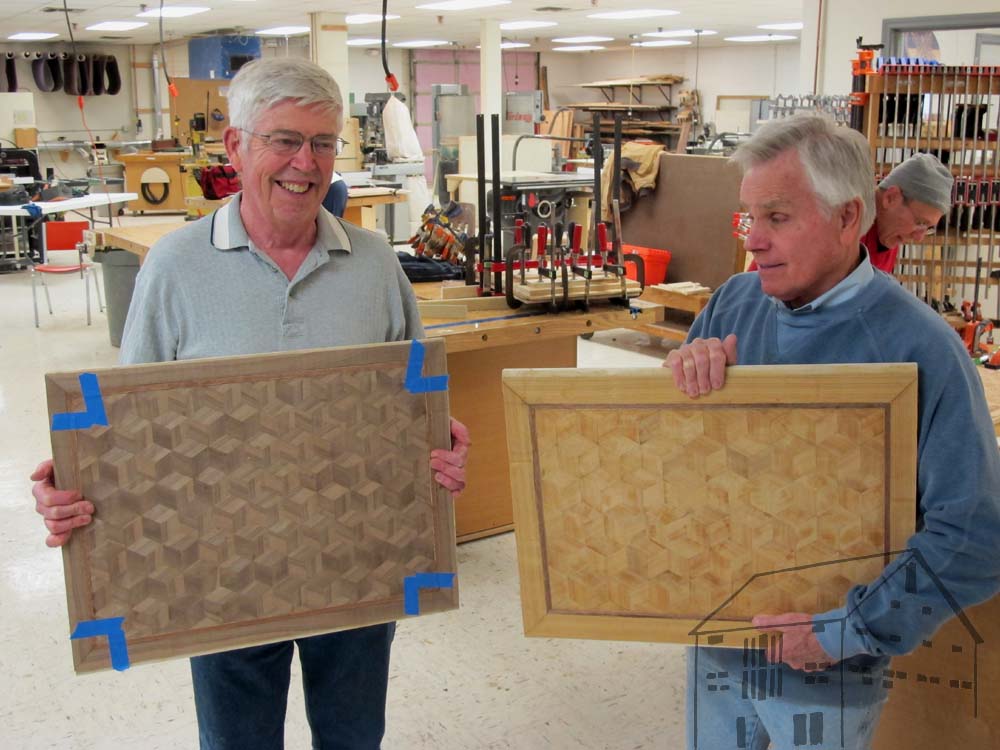
Once the banding was set, borders made from strips of the veneers used for making the original lozenges were fitted and glued as a longitudinal border around the perimeter of the panel.
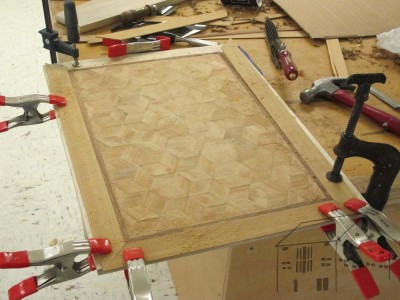
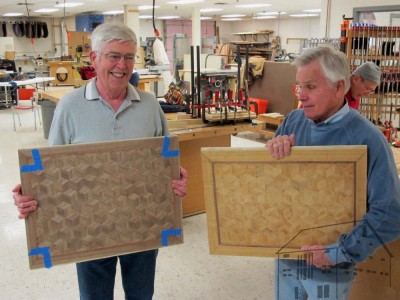
By the end of the day, everyone had their panel in “take home” condition, now equipped with a new technique to apply to new projects. Several of the students indicated that those new projects are either underway or in the planning stage.
If this workshop interests you, you can sign up for the July 18-20 rendition of the identical project at The Barn, by dropping me a line here. I look forward to seeing you soon.
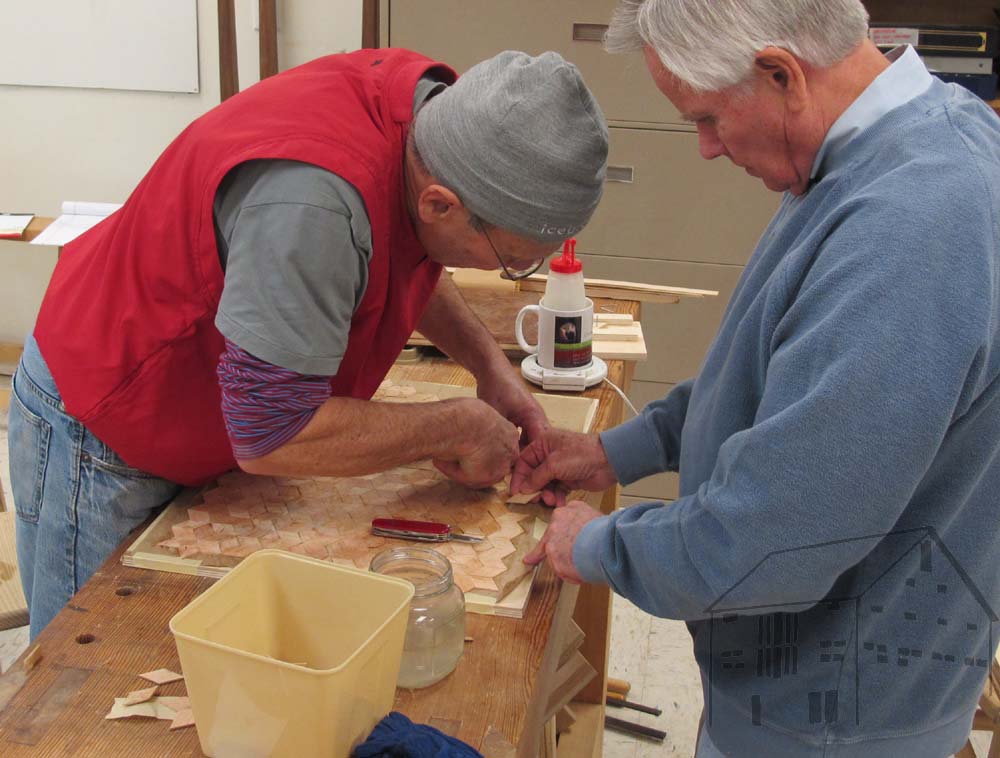
As is often the case for the second day of a three day workshop, the atmosphere was one of quiet work and little instruction or lecturing. Since the objective for the day was to get everyone’s parquetry assembled and ready to glue to the plywood base, there was lots,
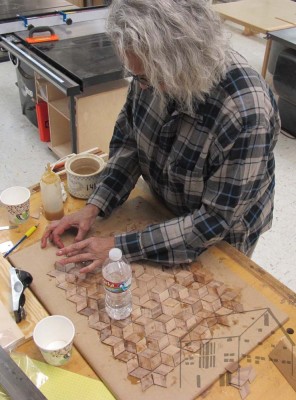
and lots,
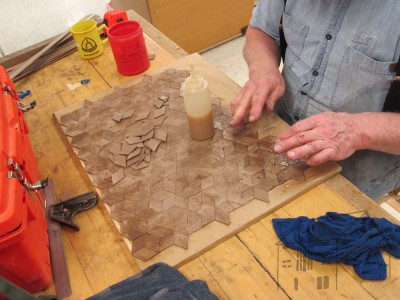
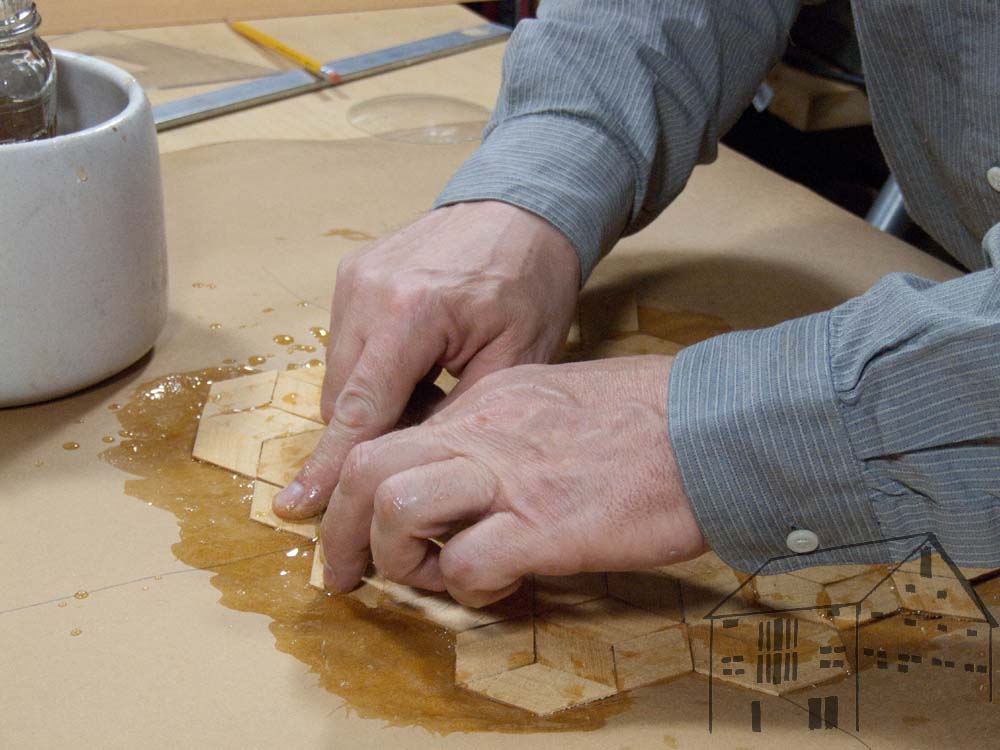
and lots of gluing parallelogram lozenges down to the kraft paper.
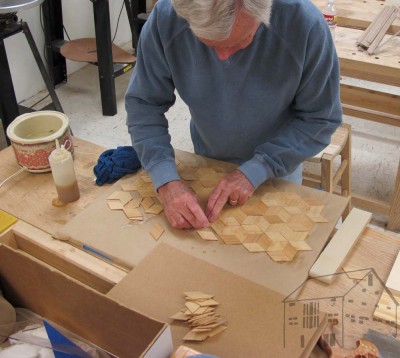
As usual, whenever somebody got theirs ready to go they jumped in to help the next person get theirs ready.
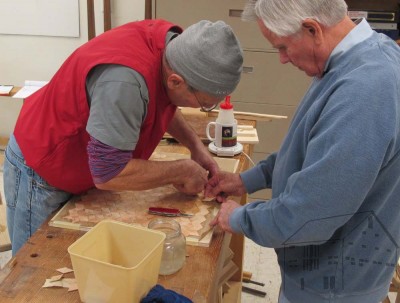
In addition, we needed to get the loaves of banding glued up to slice first thing in the morning of the third day.
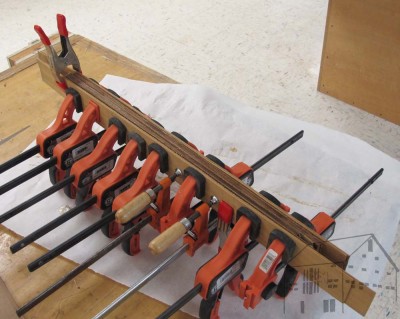
Finally everything was glued up and we called it a day.
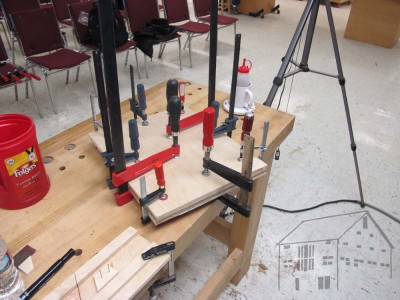
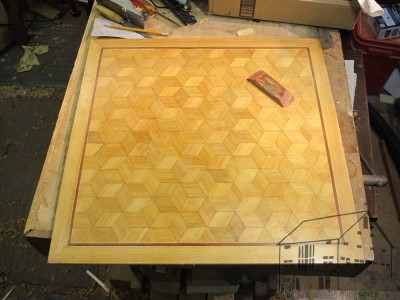
Last weekend I taught a three-day workshop on creating this parquetry panel a la Roubo for the Kansas City Wood Worker’s Guild, a delightful host if ever there was one.
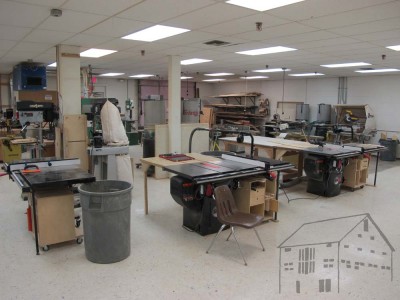
All you’ve heard about the Guild, its membership, and space is true and then some. they are positively at the top of the food chain studio-wise with a nice lecture space, and complete bench room, and a machine shop to die for.
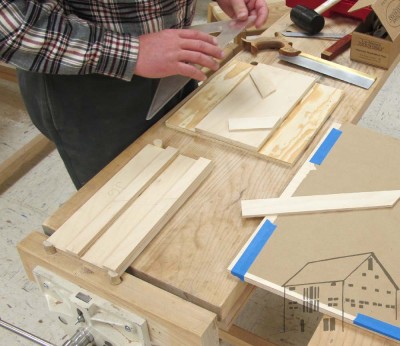
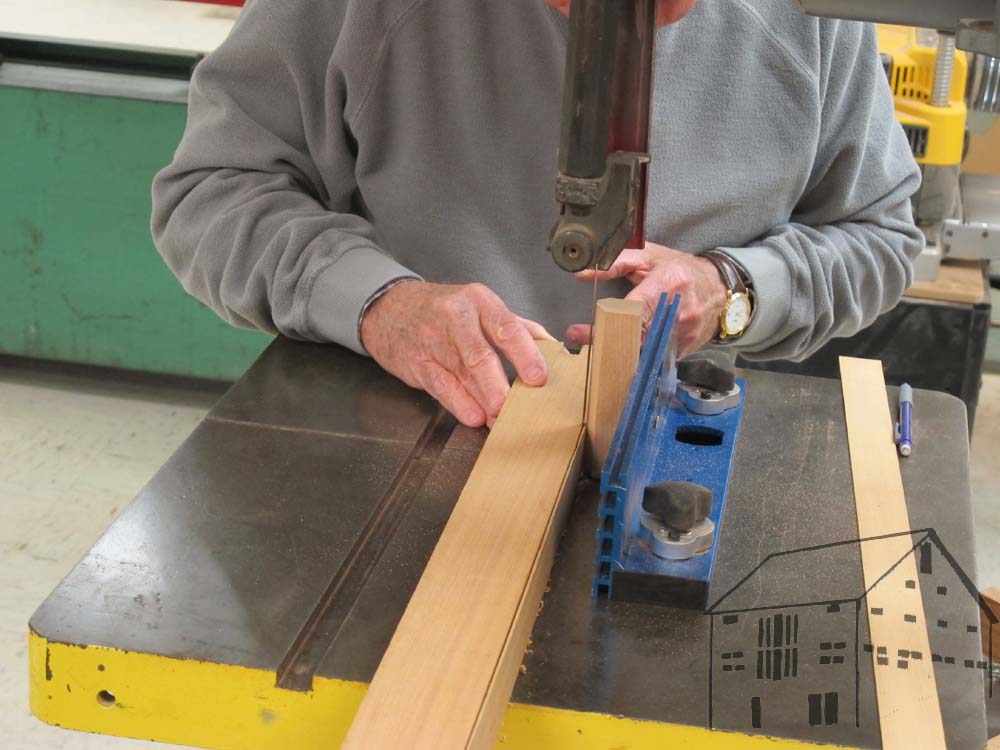
The first day began with a discussion of the project in general, but more importantly several specific tasks to get things started. First was the construction of two jigs necessary for the cutting of the 60-120-60-120 parallelogram lozenges that comprise the parquetry. One of the Guild members had prepared all the baltic birch plywood to make them, so all we had to do was cook some glue and assemble them.
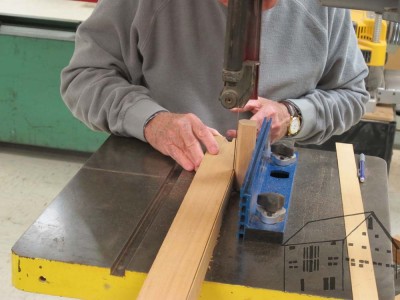
Next came the ripping of the lumber into the veneer strips from which the lozenges were cut.
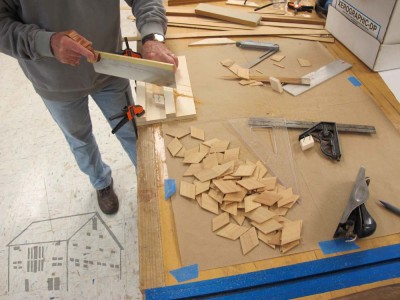
Following that was the cutting of lozenges. By the hundreds.
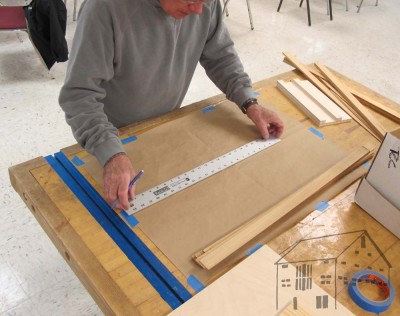
Since the pattern is first assembled and glued precisely onto heavy kraft paper, the needed to be divided exactly on both axes.
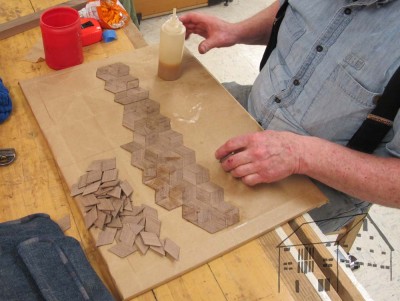
Finally came the assembling and gluing on the paper. this is actually more difficult than it seems and can be quite a challenge for newcomers until they get the knack of it, something I will be addressing in a blog in a week or so unless the spirit moves me to make it sooner.
More tomorrow.
The past couple weeks I have been assembling and packing the supplies I need to teach the Parquetry class at the Kansas City Woodworker’s Guild next weekend. I will be repeating this class at The Barn in July so you can get an idea of the syllabus for that too.
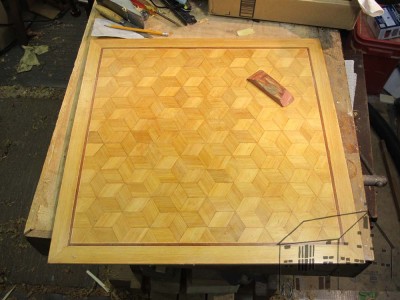
The preparation has been both frustrating and delightful, frustrating because so much of our material possessions are in chaos with the ongoing move, but delightful in that it allowed me to experience the parquetry process all over again, including the making of this panel.
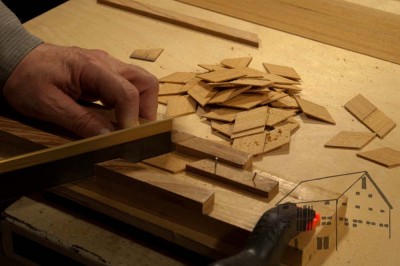
During the class we will be making all the jigs, cutting the veneer strips and lozenges,
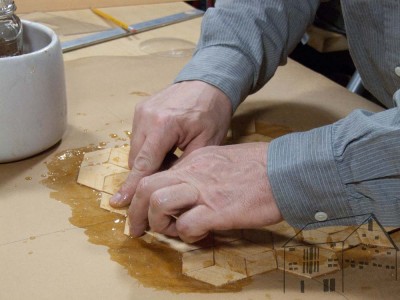
assembling the pattern,
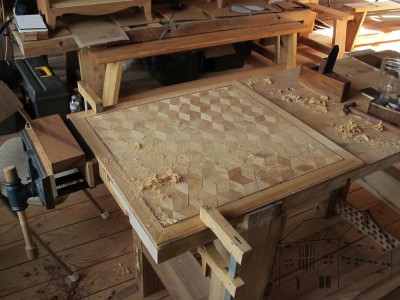
planing,
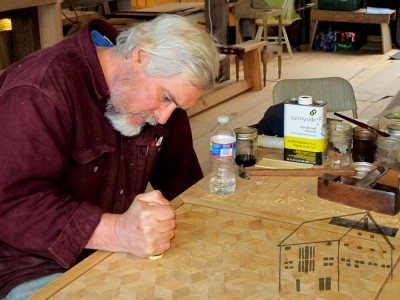
polishing, and completing the panel in this design, although the dimensions will be a bit different, and ending with a beeswax finish just like the originals back in the 1700s.
If you are interested in coming for the July class at The Barn drop me a line here.
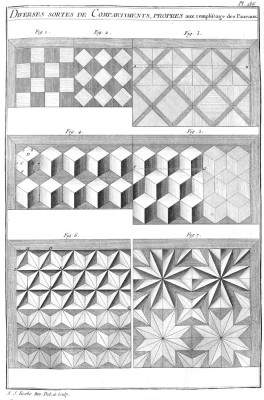
While prepping for my upcoming visit to the Kansas City Woodworking Guild to teach a class based on Roubo’s Plate 286 I was casting about for my inventory of toothing planes. I can find three of them, but the other half-dozen are MIA. If you happen to know where I put them, please let me know.
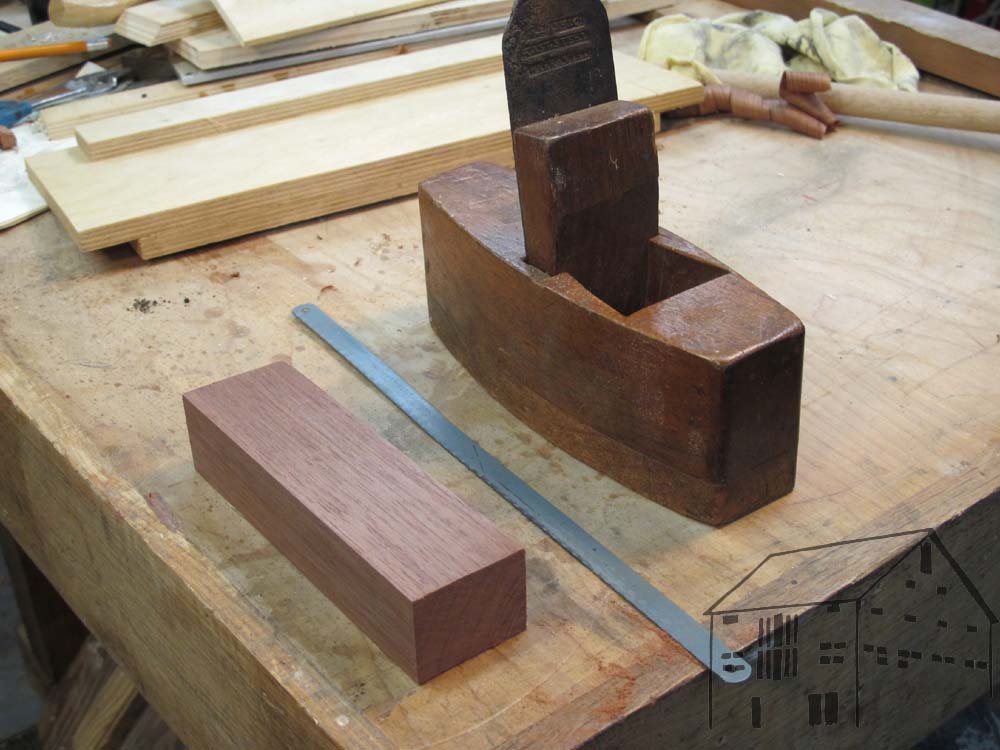
In lieu of finding my remaining stash of planes I revived an old homemade tool idea from the mists of the distant past. A word of caution: this will take almost five full minutes to make it with a cost of zero, so don’t say didn’t warn you. You will need 1) a block of scrap wood, 2) a hacksaw blade, and 3) a pair of metal shears.
Step 1 – Find a block of scrap wood. Cut it to about 6 inches long.
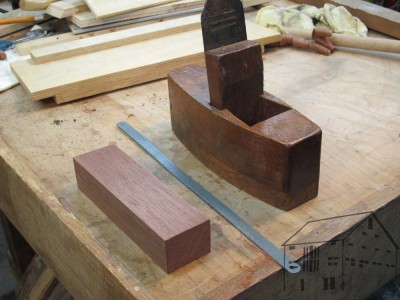
Step 2 – Find a hacksaw blade, and cut off a piece equal to the width of the block.
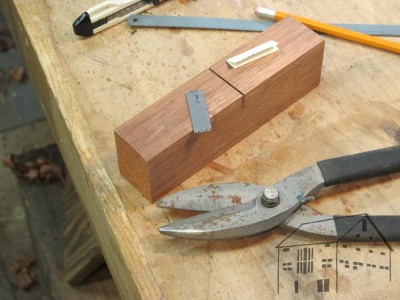
Step 3 – at abut the center of the block, on the side of the block mark the depth of the blade body to the base of the teeth.
Step 4 – Using a saw (in my case I used my band saw) cut a kerf to the depth you marked in Step 3.
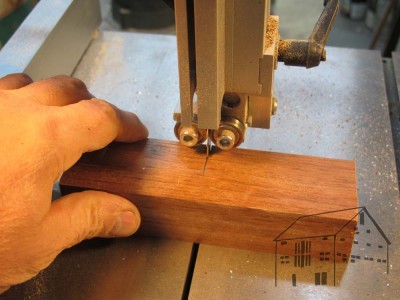
Step 5 – Ram it home. if necessary add a small shim of paper to the kerf to make sure the blade fits tightly. Adjust the blade so that the teeth tips are exposed about 1/16″.
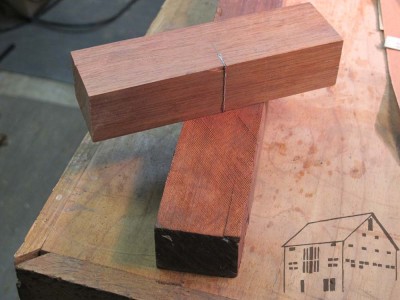
You now have an inelegant but functional toothing plane, a necessary tool for dealing with sawn veneer marquetry.
Step 6 – I will cover this in Part 2.
As far as I know these are my teaching/hosting commitments for this year.
March 8/9 and 15/16 – For the next two weekends I will be demonstrating at my pal David Blanchard’s shop on Main Street in Monterey VA during the Annual Maple Festival. If you are in the neighborhood stop in to say “Hi.”
March 21-23 I will be teaching a parquetry workshop at the Kansas City Woodworkers Guild.
May 30 – June 1 will be the Finisher’s Retreat, an annual event I host for the two chapters of the Society of American Furniture Makers in which I am active. This year it is the Virginia Chapter. For more information contact Bob Mustain at mustainrw@juno.com
June 24-26 The Eighth meeting of the Professional Refinisher’s Group, and the third time the event has been at The Barn. For more information, contact Ben Myre at bcmyre@hotmail.com.
July 18-20 will be a weekend parquetry workshop at The Barn.
August 11-17 will be a week with plane maker Tod Herrli at The Barn. the first three days will be a workshop on making a hollow-and-round pair, the next four days will be something a bit more advanced; topic not yet finalized.
September 12-14 Woodworking in America, Winston-Salem NC. I will be presenting two topics, the first being Traditional Finishing and the second being Gold Leaf.
October 3-5 will be a weekend workshop in Boullework Marquetry at The Barn.
October 21 I will give a presentation to my dear friends of the Washington Woodworker’s Guild. At the moment the topic is probably Inlaying Pewter.
When you combine this schedule with settling in out in the mountains, submitting the manuscript for To Make As
Perfectly As Possible: Roubo on Furniture Making sometime in April-ish, and the manuscript for Virtuoso: The Tool Cabinet and Workbench of Henry O. Studley some time around Thanksgiving, it seems like a pretty full year.
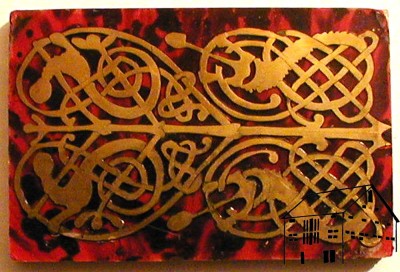
Boullework is the method of composing either pictorial or filigree marquetry employing metal sheet, usually brass, pewter or copper, with veneers of tortoiseshell. Tortoiseshell is now a proscribed material after the CITES Treaty of 1975. Instead we will make our own “tordonshell,” a convincing artificial material I invented for just this purpose, to make a pair of small marquetry panels, one the negative of the other. Some projects may instead use ivory planks for either the metal sheet or the tortoiseshell.
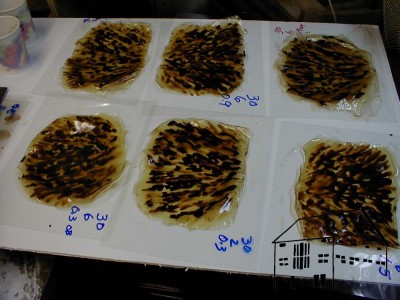
This three-day workshop will be limited to six participants, and will take place October 2-4, 2014, with a registration of $375.
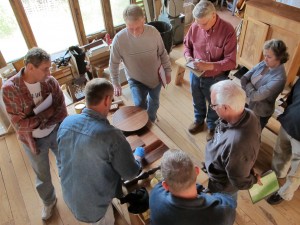
I am not sure if two events establish a tradition, but I am hoping that is the case. For the second year in a row I set aside a weekend in May to host one of the local Chapters of the SAPFM with whom I am involved to gather at The Barn for a weekend of fellowship and woodfinishing.
The first weekend of May 2013 The Barn hosted a “Finisher’s Retreat Weekend” for the Chesapeake Chapter of the Society of American Period Furniture Makers. I co-taught the event with old friend DaveR from Knoxville. The premise for the weekend was for each participant to bring a completed furniture making project and we would finish it together. Together Dave and I led them through the Six Steps for Perfect Finishing, beginning with preparing the surface of the workpiece and wrapping up with a glorious artifact portrait of their piece on top of Franklin Floor.
Since the task for each participant was to arrive with a recently constructed piece awaiting the final, transformative finishing processes, the range of projects was broad and the quality of workmanship exceedingly impressive. Between my ministrations on surface prepping, wax finishing and brushing shellac, and Dave’s instructions and demonstrations with spirit varnish pad polishing and traditional asphalt coloration, and the continuous cross pollination, great progress was made on each project.
I look forward to May 16-18, 2014, where we can perhaps cement the new tradition for SAPFM members to come finish the pieces they built over the winter.














Recent Comments