The day began with the excitement of seeing the glued-up panels. We had slightly oversized 1/2 baltic birch plywood for each of the panels so that they could be trimmed precisely to size one the project is complete.
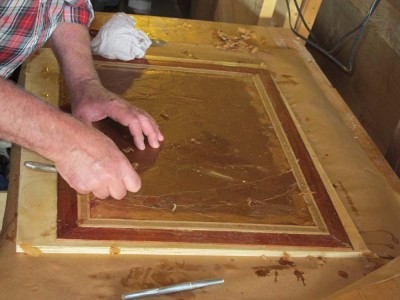
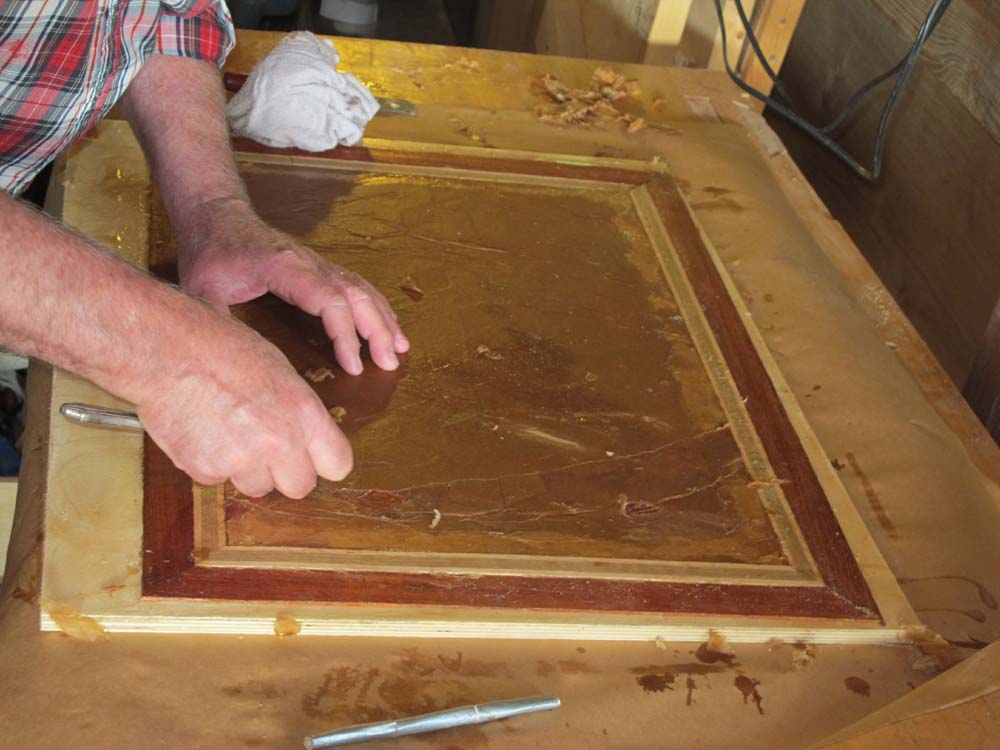
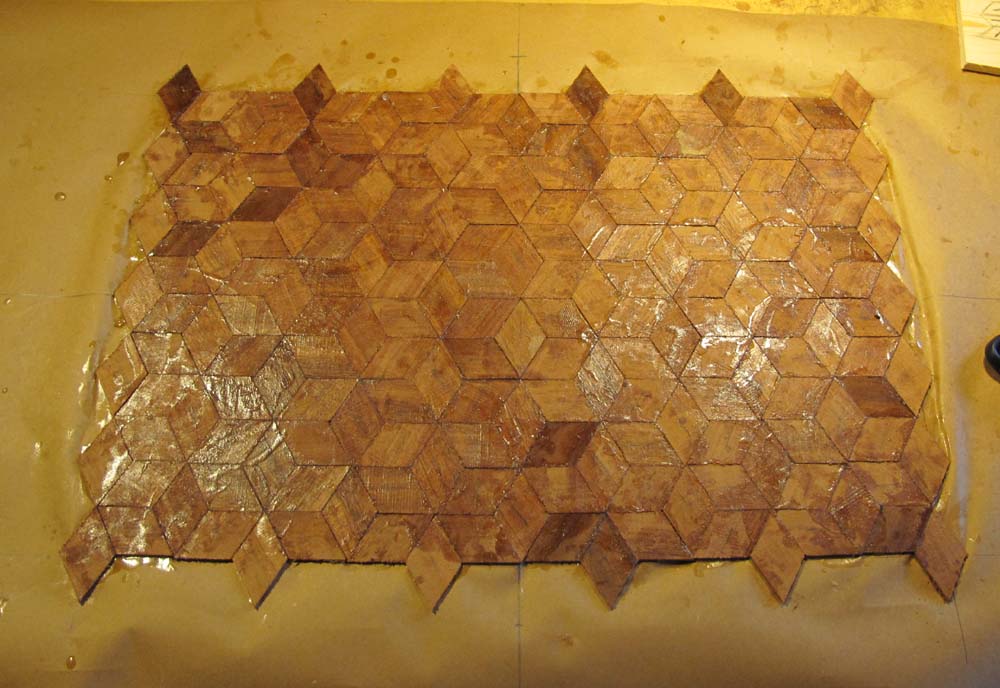
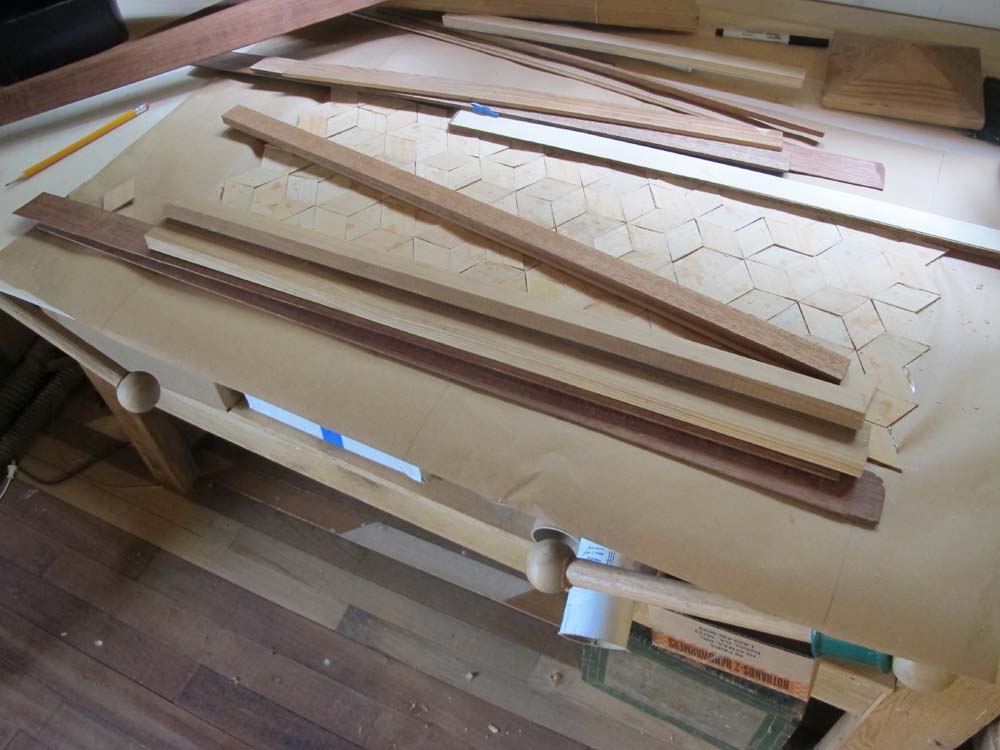
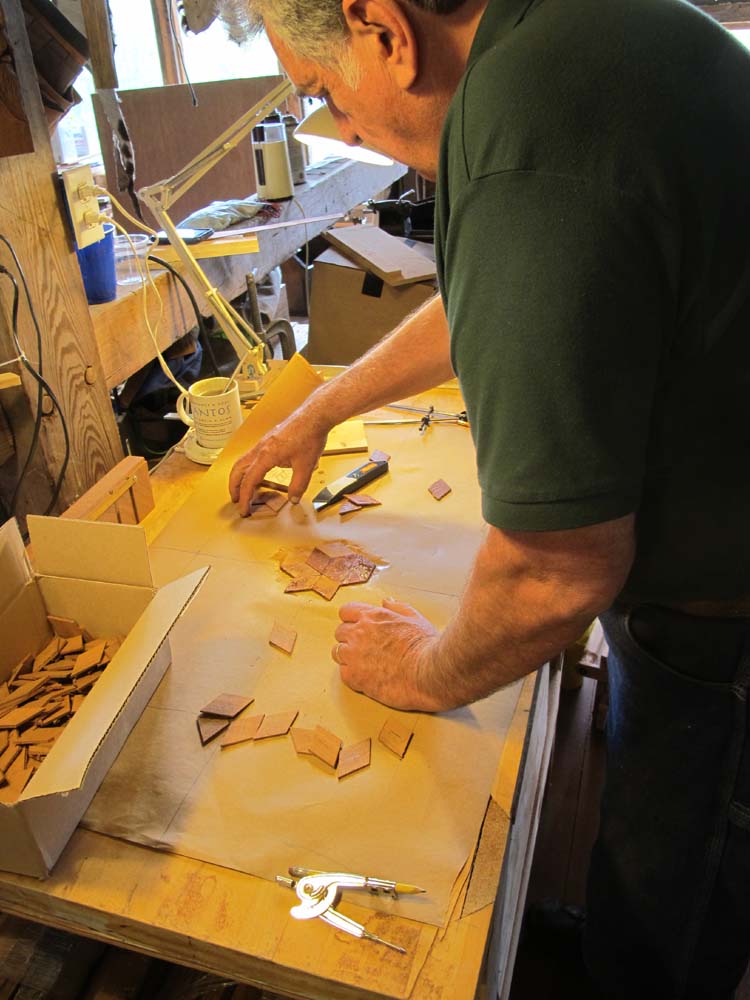
The first step to getting finished from this point was to moisten and peel off the kraft paper that served as the support for the assembling of the pattern, banding, and border.
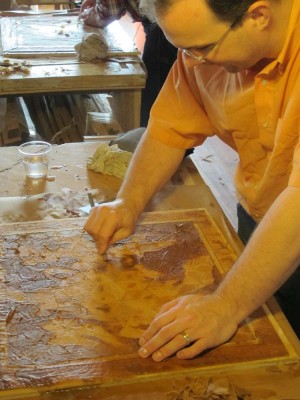
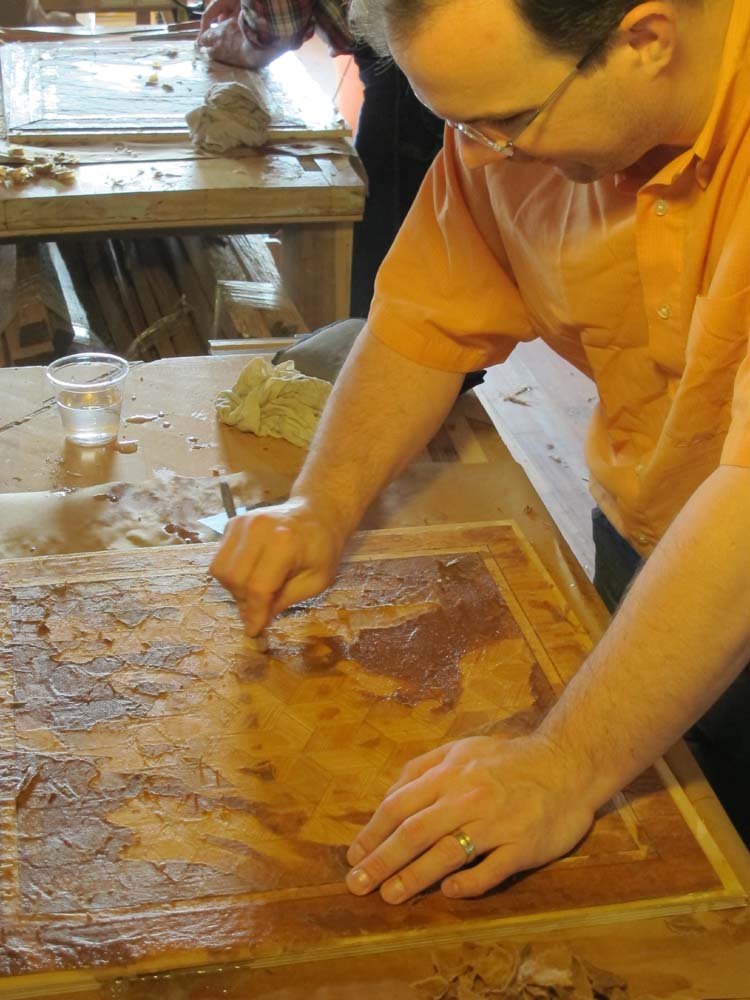
It was a delicate balancing act, moistening the surface enough to remove the glued-down paper, but not so wet as to lift the veneers. Once the paper is removed begins the tiresome task of dampening and scraping off all the glue left behind.
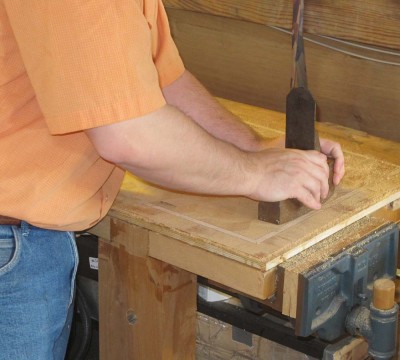
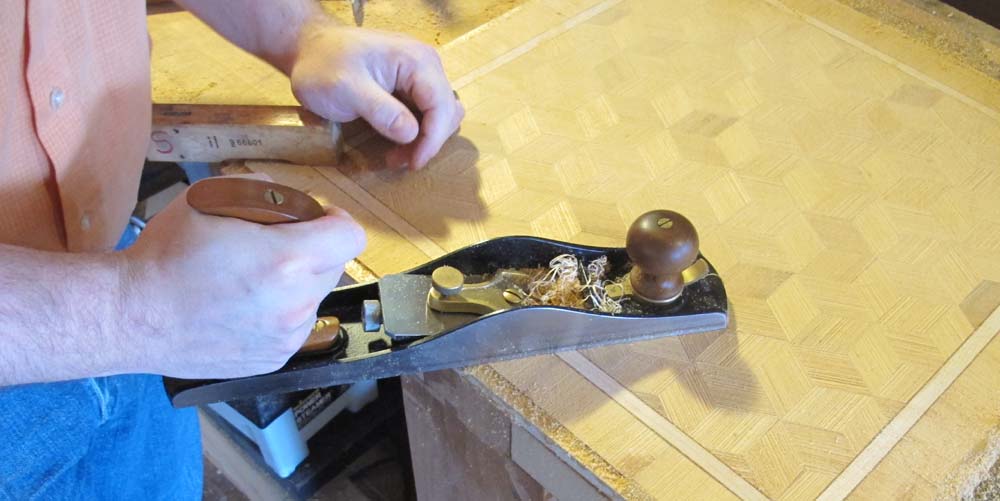
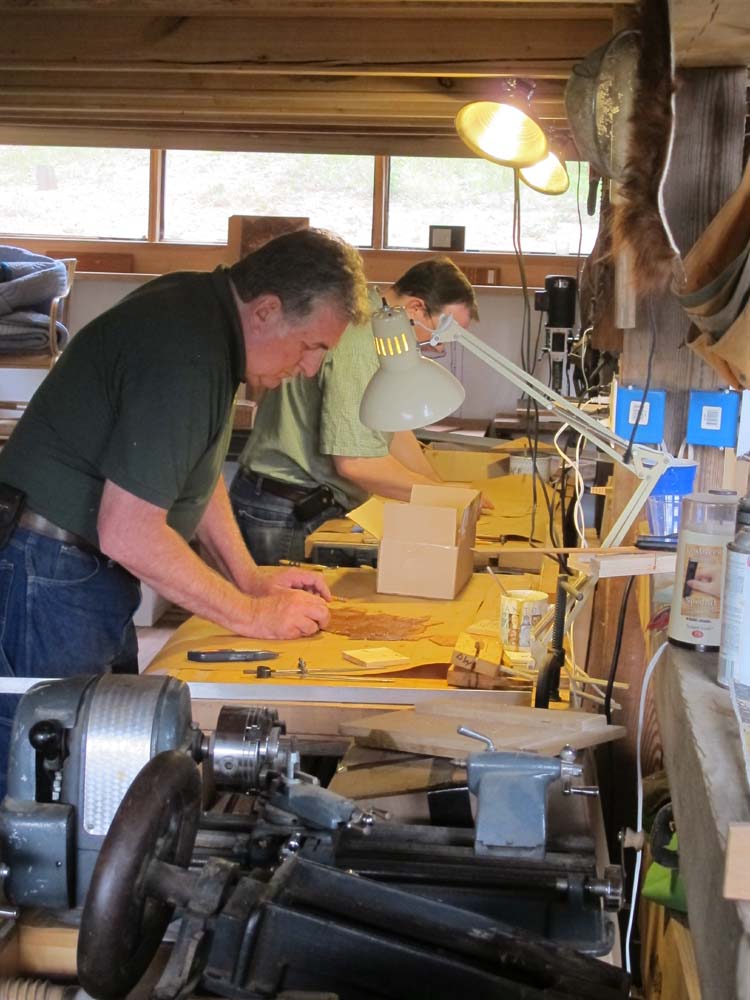
A quick stint on front of the fan to dry them, and then we brought out the toothing planes, scrapers, and small planes to get everything flat and smooth.
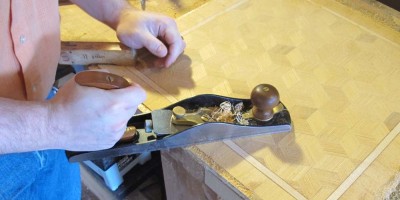
The conditions of the panels,
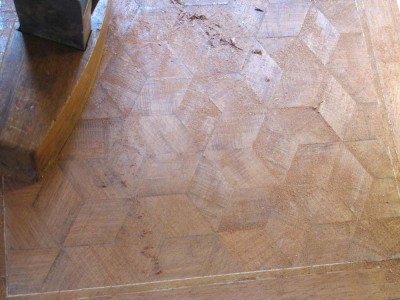

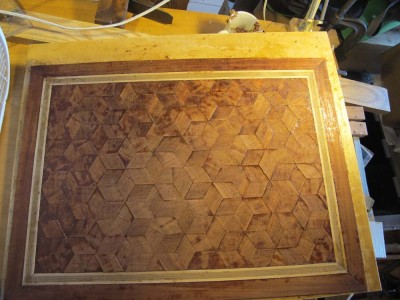
and the floor indicated we were making great progress.
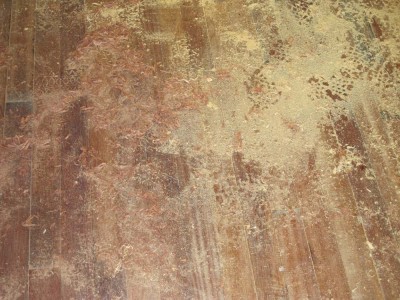
In a normal 3-day parquetry workshop this would have been the final process,
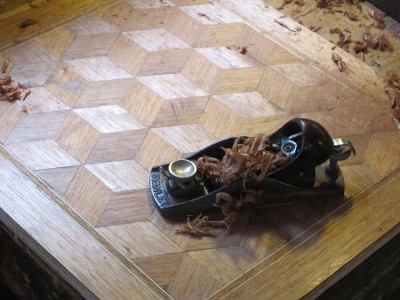
but these guys were working so efficiently we made it all the way through a finished project by the time they left.
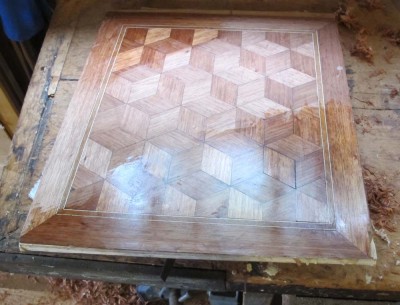
Using one of my panels, I demonstrated the simplest finishing approach to the parquetry, and they charged ahead.
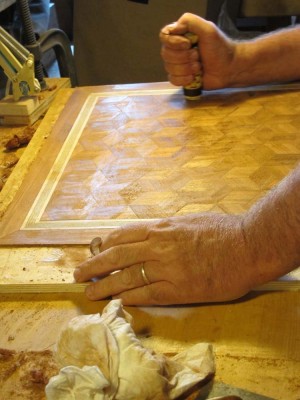
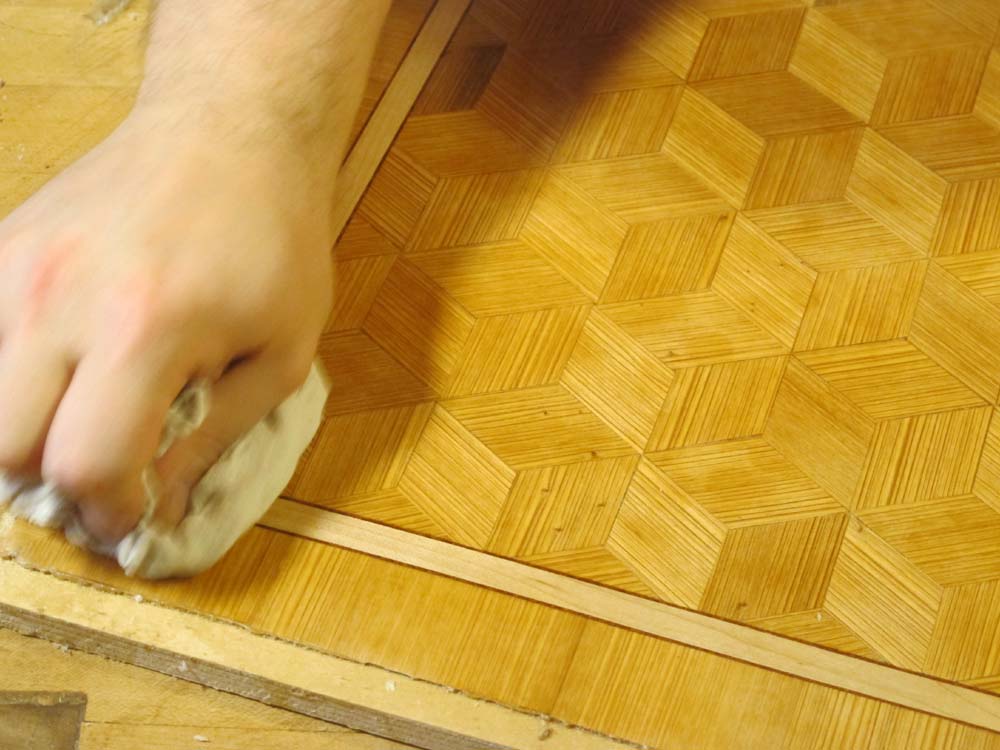
Burnishing with polissoirs came next,
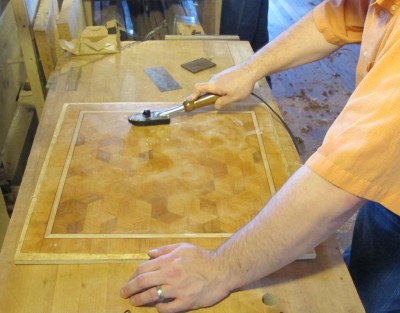
and then the molten wax treatment for the final finish. The wax was first dripped on the surface, then trowelled around with the tacking iron. Again it was important to use the iron delicately to melt the wax enough to impregnate the surface, but not to heat the surface enough to lift the veneer.
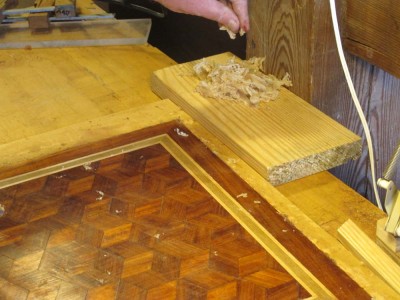
Once the surface was fully impregnated the panel was set aside to let cool and harden, then the excess was scraped off,
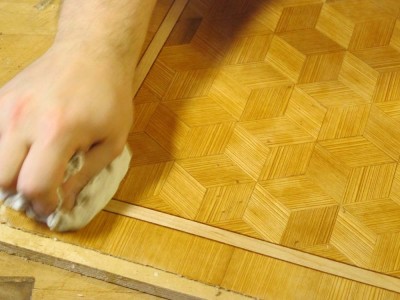
and the remaining surface was buffed with a linen rag.
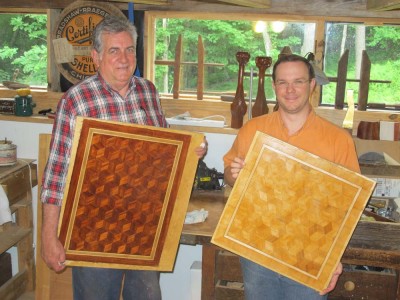
The results were eye popping, and demonstrated what can be done with very little wood in a short while. If you snoozed on this one, you loozed. Joe and Joshua now possess another important tool for their design and fabrication toolkit for the future, and when they get home they both plan to trim their panels and build a small table around them.
Great job, guys!
Our morning began with center sections completed and ready for trimming.
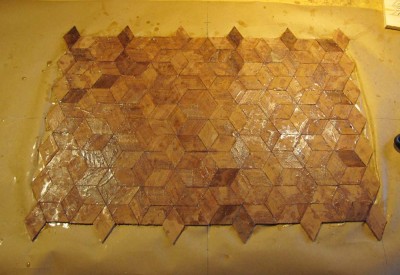

The weather was foreboding; the day was cool if not downright chilly (60-ish, in mid-July!), and the rain was threatening. This was a theme for the day, and did impact how things progressed.
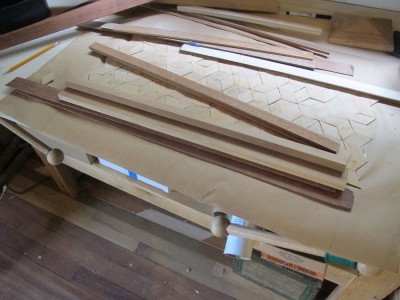
The first thing we did was select and prepare our materials for the edge banding around the center field, and glue them up into a “loaf.”
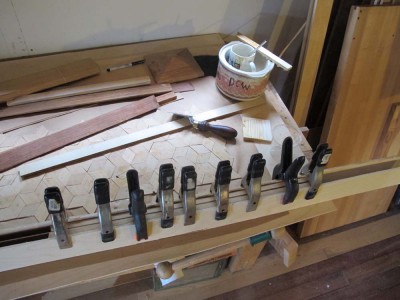
On a normal day these set fairly quickly, in an hour or so using hot hide glue, but the day being cold and damp we wrestled with this all day. Next time I offer this course we will glue up the bandings on the first day. Once they were set (mine hadn’t by the end of the day) we cut them into banding strips.
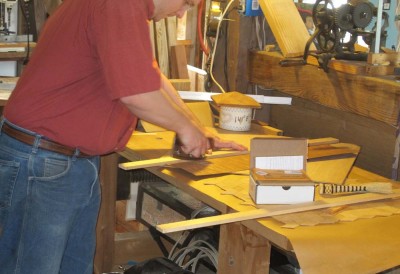
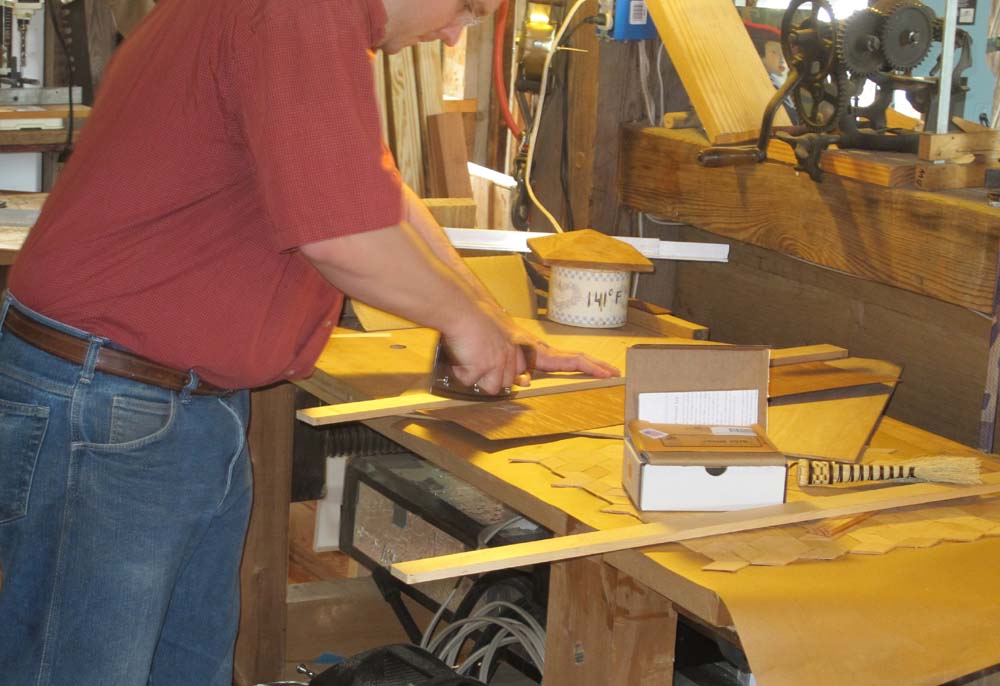
We trimmed the panels in order to cut and fit the banding.
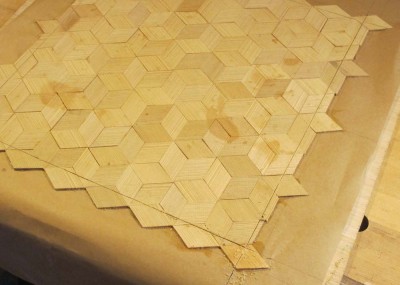
Trimming the panels gave Josh the chance to show off his new Gramercy veneer saw with the “King Kong” blade for use on sawn veneers. We were unanimous that it was a fabulous tool.

After trimming the center field, the parquetry was glued to another sheet of heavy brown paper an then fitted the banding,
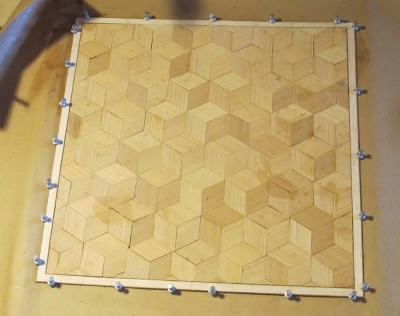
gluing it in place using the aluminum head push pins from Utrecht discovered by a workshop student in Kansas City.
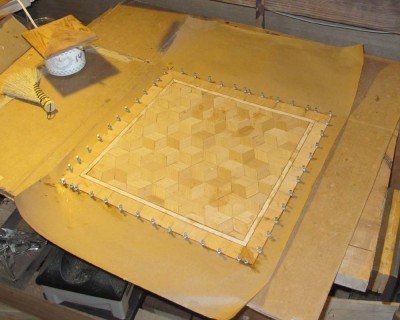
Then went on the outer edge, which could be either long grain or cross grain.
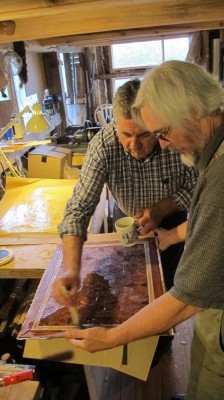
That done, out came the glue pots and the slathering began.
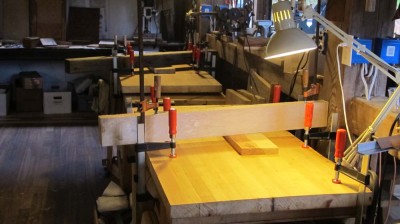
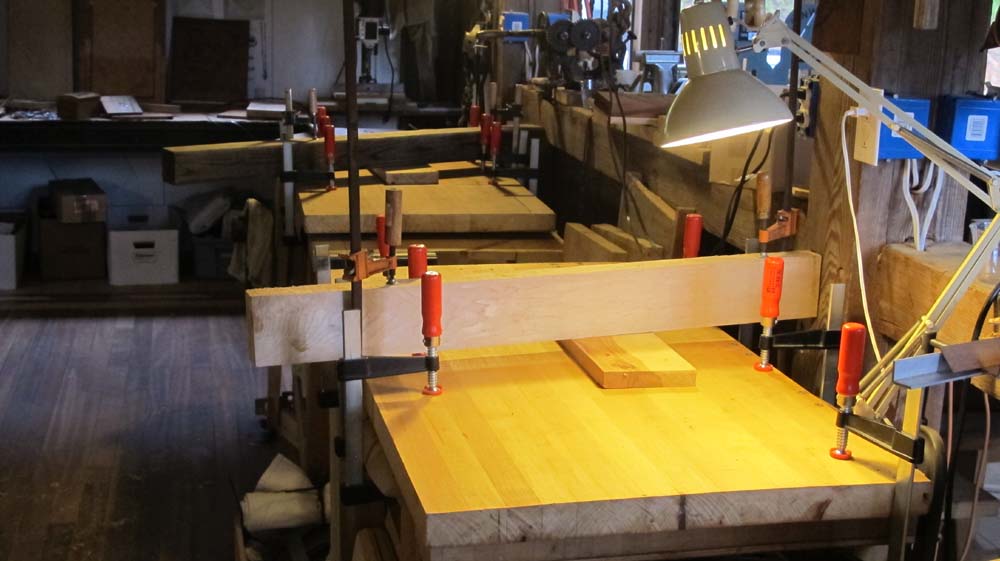
They are now all glued to their support panels and clamped up over night, awaiting planing, polishing, and finishing tomorrow.
=================================================
As a reminder, all of this information (and actually a lot more) will be covered in my ongoing blog series “Parquetry Tutorial” which will be a single downloadable PDF once complete.
We had a terrific day creating parquetry panels in The Barn today. Joe and Josh were on the spot at 9 AM sharp, and after introductions all around we got to work. I quickly reviewed all the materials, processes, and tools, and within minutes we were underway. 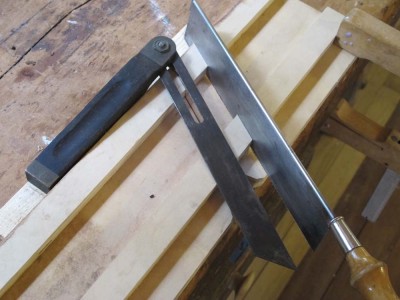 First, they glued up sawing jigs. A bit later we layed out and sawed the kerfs for these bench-hook style tools. I will blog about this process on Monday night.
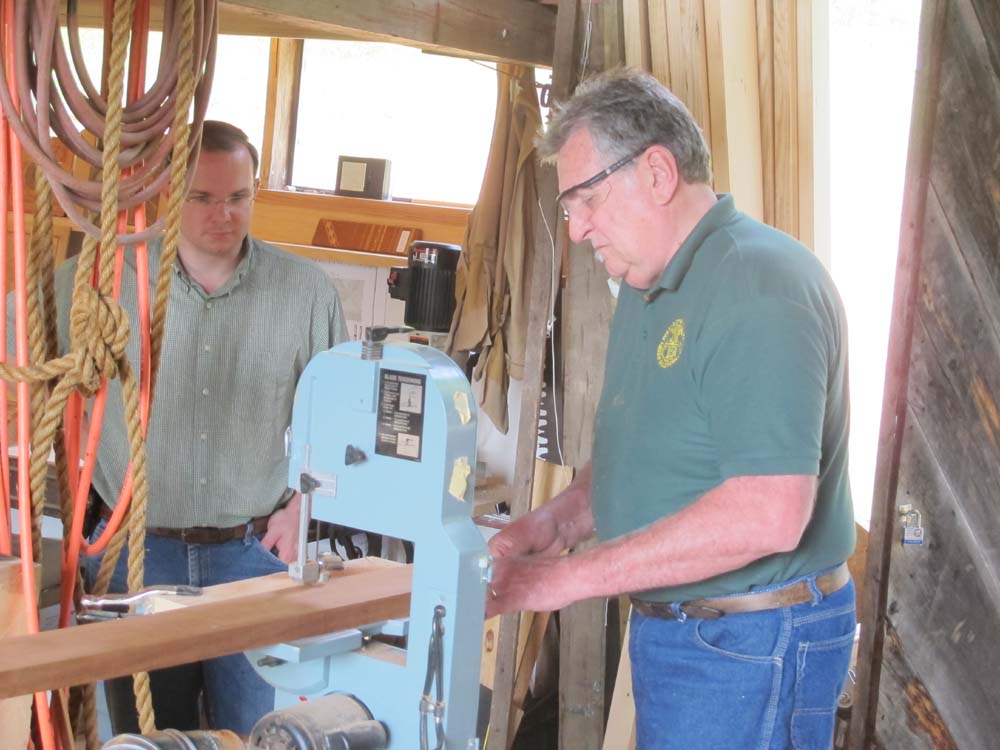
 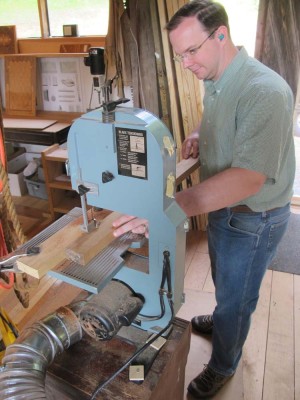 Then, we moved on to creating sawn veneer strips with my min-bandsaw, which is pretty much dedicated to sawing veneer for parquetry these days. Joshua opted for some of my vintage and tight grained Bald Cypress, and Joe brought a piece of superb true mahogany.
 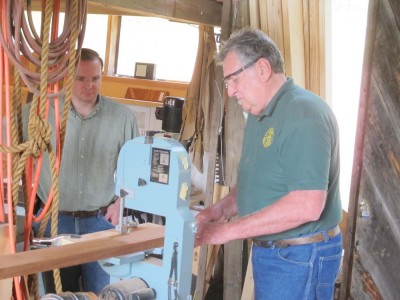 We ran it through the planer quickly to verify planarity, then sawed it up with the bandsaw.
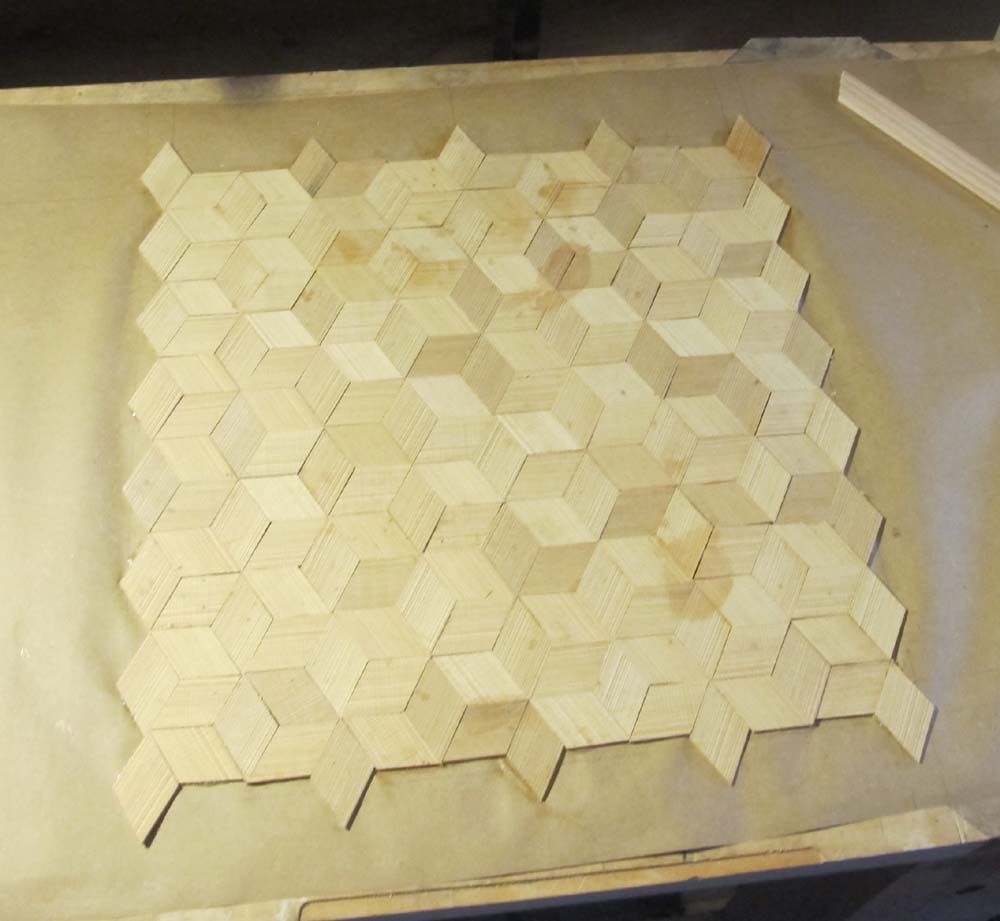
 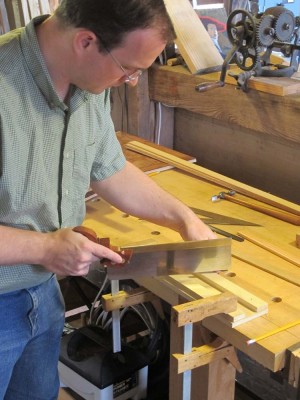 The we got to cutting parallelograms for the assembled pattern. And sawed. And sawed.
 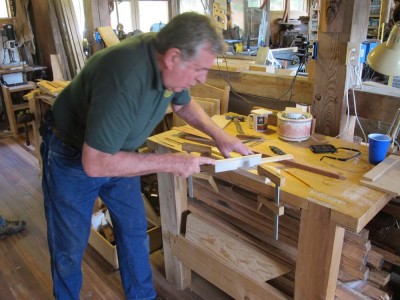 It takes a pile o’ lozenges to create a completed pattern.
 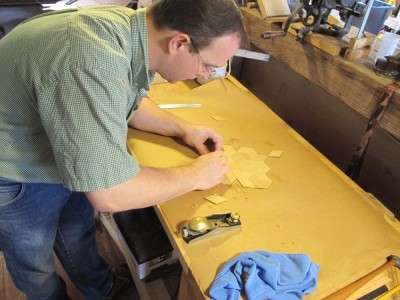 After lunch I reviewed the working system for assembling the pattern (about which I will be blogging later next week) then fired up the glue pots and we were off to the races. All three of us were creating parquetry panels; Joe and Josh were making small table tops, and I was working on one of four panels for an upcoming tool cabinet.
  By the end of the day each of us had completed the “field” of the panel we were creating.
 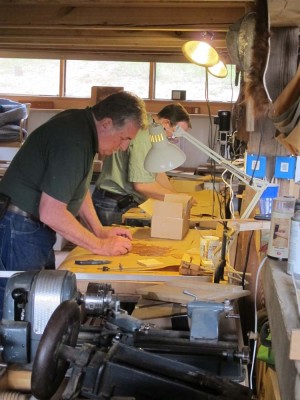 All in all, a very good day.
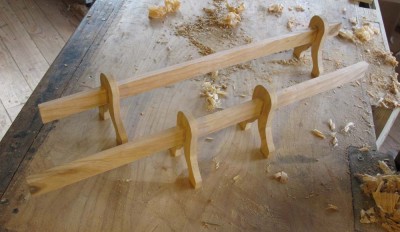
I’ve gotta say this about old Andre, he never stops larnin’ me. Over the weekend I built another set of his winding-sticks-on-stilts as I call them, so that I could photograph them for an essay in the book. I have been trying to incorporate them into my own work practices for the past several months, and doggone if I can’t already see how they will make my work so much more efficient than it was previously. His approach to flattening rough stock is insidiously ingenious.
You can read more about these gems and how they are used in the upcoming To Make As Perfectly as Possible: Roubo On Furniture Making (Lost art Press, 2014?)
Even my little niche of a “hardware store” the barn is beginning to look like there is a guiding organization involved. As a huge fan of Friederich Hayek and his mentor, Ludwig von Mises, it delights me any time order is emergent!
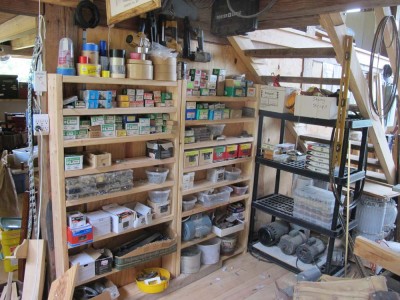
I have a few more parts cabinets to place there in the coming days, but I am not displeased at the progress thus far.
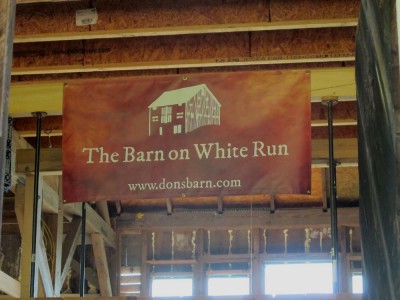
I recently hung a couple of banners in The Barn, just because they make me smile.
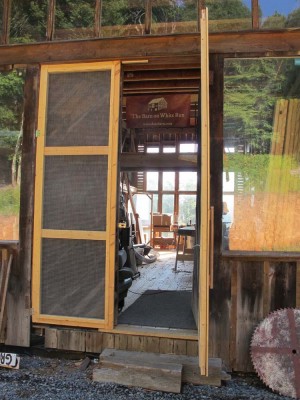
First was the original Barn On White Run banner we had last year at Handworks in Amana IA. I hung it off the bridge that connects the north and south balconies, and it is an immediate greeting once you enter the door.
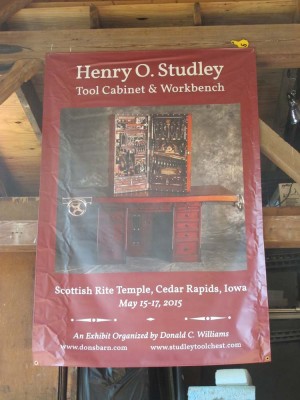
As a total whim I ordered a 4-foot by 6-foot version of an image I am using to promote the Studley Tool Cabinet exhibit (tickets are still available), and hung it just opposite the door to my workshop.
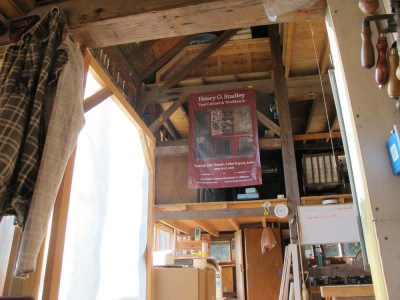
At that size it is an unavoidable reminder of 1) how cool the Studley cabinet and workbench are, 2) how great the exhibit is going to be, 3) how great the upcoming book is going to be, and 4) that I should be scared out of my mind with all the work (and expense) still awaiting me in order to make #s 2&3 a reality.
When back in the city last week I disassembled and loaded my first real workbench, a 5″ thick torsion-box mounted on an oak base unit, and brought it back to the mountains when I returned.
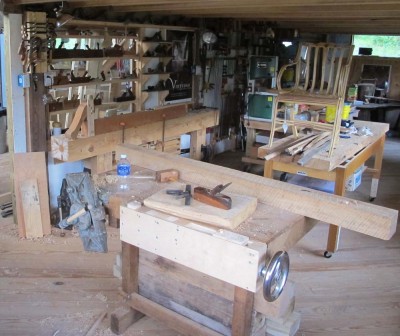
Reassembled and in its rightful place — it was designed and is intended for use in “the middle of the floor” rather than against the wall — its diminutive size makes it a near perfect fit almost anywhere, and the space between the Roubo bench in the window and the planing beam makes it an integral part of the shop activities. NOW The Barn feels like home. It was home-y before, now it is home.
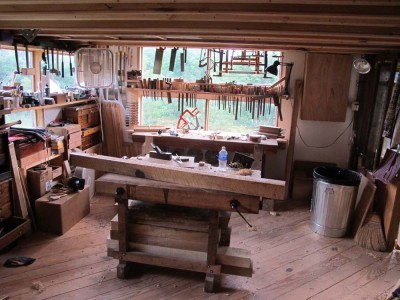
I built this bench in 1986 as I recall, using a pair of “Closeout table” vise screws from the local Woodcraft for the full length twin screw face vise, which is unbelievably handy. The Emmert was mounted a few years later, and I remember listening to the debates prior to the first Persian Gulf War on the radio as I was rasslin’ the beast into place.
The only real downsides to this bench are three. 1) it is really small, as was dictated by the space I had back then. At 24′ x 48″ for the core unit and 32″ x 54″ overall, it does limit the kinds of work you can do, but I have managed to do a lot with it over the years. 2) With the 90-pound Emmert vise hanging outside the trestle base, it does get kinda tippy especially when you put something heavy in it. I found that using the base as a lumber storage rack pretty much solves the problem. And 3) there was no end vise function, which I solved by designing and building the face-mounted end vise on it, a project that was featured in Popular Woodworking.
This bench has served me superbly for the better part of three decades and uncounted projects ranging from planing window trim to being a toy hospital to fabricating parts and even entire replicas) for priceless antiques and everything in between. If you have a severe space restriction for your working area, you might want to give something like this a thought. If so, I will be delighted to provide any insights and counsel I can to help you along.
But tread lightly when contemplating acquiring an Emmert. If you do try one out, be forewarned that a complete one in excellent shape often costs a fortune. In addition you will have to suffer the discomfort of kicking yourself non-stop for not having one before. There is also the continued annoying (to other woodworkers) habit of comparing everything to an Emmert from this point on. Frankly, nothing else measures up. Thanks to Benchcrafted and others we are living in a Golden Age for woodworker’s vises, but this standard is what keeps me looking for improvements all the time. Even when we get to fabricating Studley vises, this will probably remain my “go to” tool.
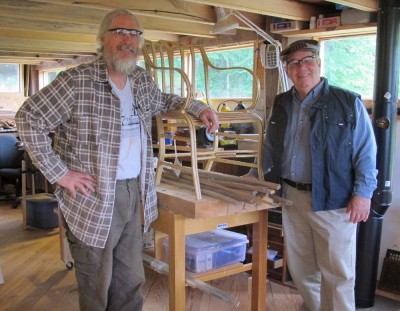
Yesterday I had the unmitigated delight of hosting Charles Brock (aka Mr. Highland Woodworker), Mrs. Brock, and Charles’ videographer colleague Stephen Price. They were up to film a segment for an upcoming HW episode, talking to me about my passion for finishing, which does make me a bit of an oddball in the woodworking world (which just confirms my oddball-ness in relation to just about every facet of the human endeavor) and my upcoming production of Gragg chairs. Being a chair maker himself, Chuck and I got into pretty deep weeds about the minutiae of curvilinear chair construction.
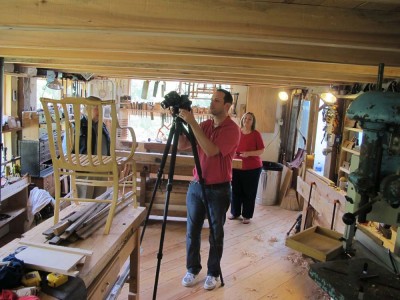
Thank you Chuck (and Mrs. Brock) and Steve for a day of invigorating conversation, and giving me the opportunity to show off The Barn to you.

This was my first Roubo bench, built from leftover timbers that were part of the original barn in Illinois. It’s been several years since I built it, and I never really did get the top finished all proper. Now it is. Using my scrub plane on opposite diagonals I got it pretty darned flat. At that point I slathered it with some of the Schwarz bench varnish of 1/3 polyurinate, 1/3 tung oil, and 1/3 turpentine. I did it at this point because two of the timbers turned out to be eastern white pine and were a bit soft compared to the southern yellow pine; I hoped the softer timbers would be firmed up by impregnating them with the varnish. They did, but only after a week or so, which was way longer than I was willing to wait.
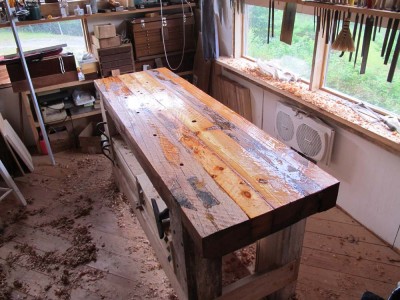
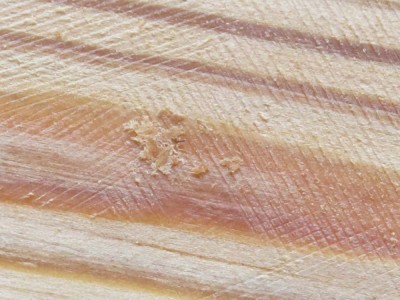
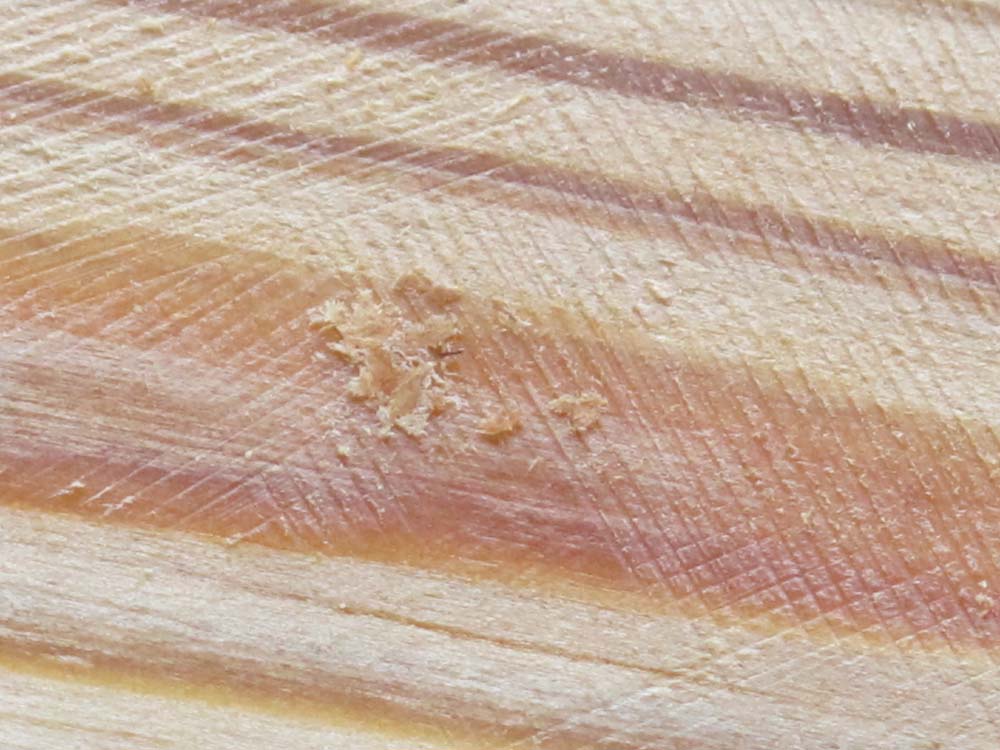
I followed the scrub plane on the varnished top with a toothing plane, on opposing diagonals again, checking to make sure everything remained flat. I prefer the tightly checkered surface of the toothed top as it grabs the work piece a little better than a smooth surface.
In the years since fabrication the entire unit has twisted a tiny bit, so I have a thin shim underneath one of the legs to keep it from rocking.
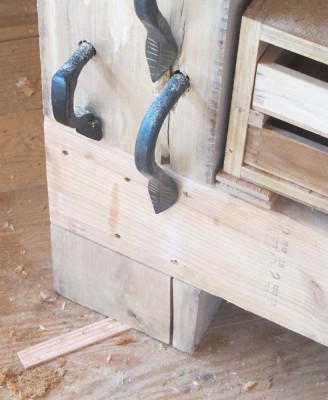
I have not installed a leg vise, even though I have a vintage one ready to use. I’m just trying to see how long I can keep on using the bench as is, with my workpiece-holding functions solely with holdfasts.
Above the bench I finally built racks to hold a multitude of tools, mostly files, and am hanging saws and the like off the joists with nails.
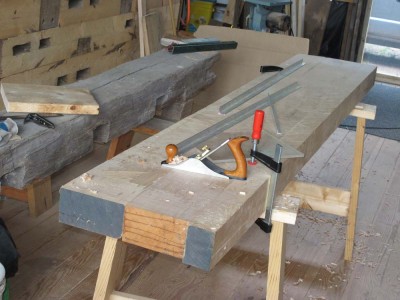
No doubt this may soon be supplanted by the group of in-process benches in line awaiting my ministrations, including a 5″ solid maple top with white oak legs bench; my French Oak Roubo Project bench, which is slowly being uncovered by the ongoing archaeology within the barn; a pair of Roubo benches also made from salvaged barn timbers (although I am almost certain to hang an Emmert K1 off one of them); a mahogany slab and black walnut legs Roubo bench (I was originally going to use this for a Studley bench, but have now decided to build a Studley bench the way Studley built it instead), and finally the true Studley bench.
I’m thinking I may need to install some of my existing or future benches up on the fourth floor. That’ll take a passel of stout guys even with a compound block-and-tackle.
In my workshop in the Barn I have a number of work stations — planing, main bench, secondary bench, Japanese tool corner, main tool cabinet, sharpening, metal smithing, etc. — awaiting my ministrations to make fully functional and dare I say it, DONE! I am going to attempt to address them one by one for a week or so to get the place ready for making and restoring furniture, as it was intended to be from the beginning.
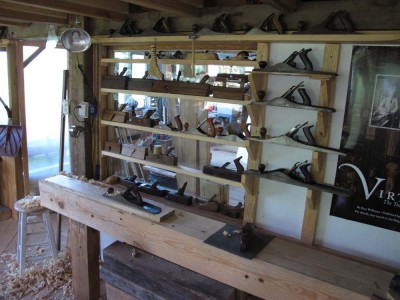
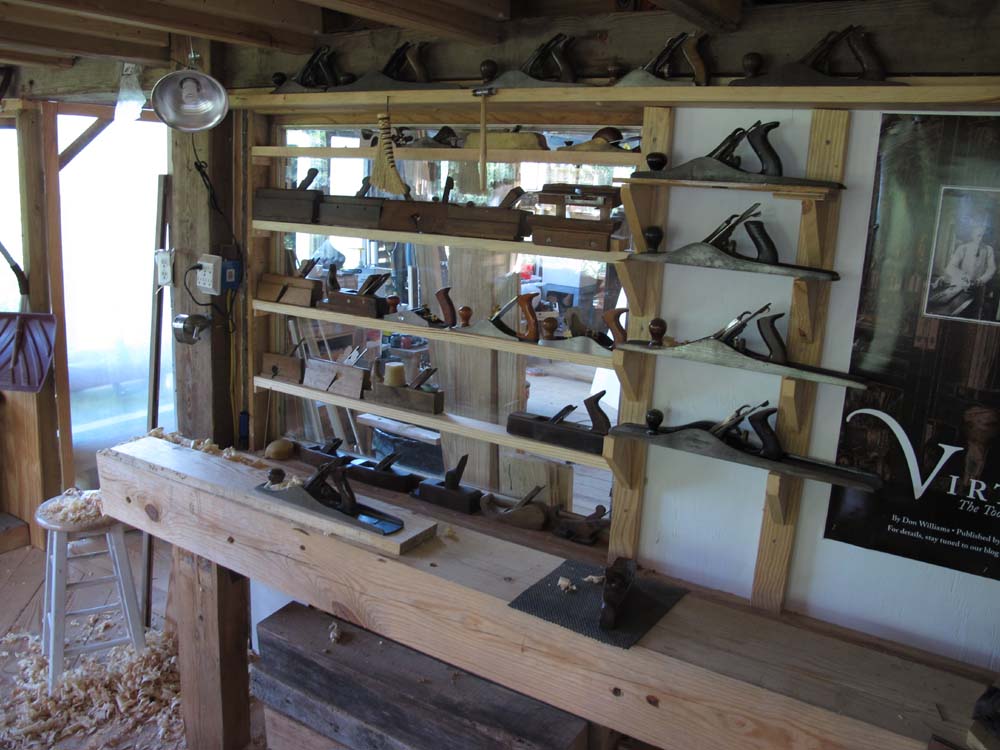
The lowest hanging fruit was the planing beam and surroundings, as it has been in place and vaguely functional for quite some time. Still, my planes were scattered about in a variety of boxes and bins, so I cut, planed, and installed several shelves into the window well behind the beam to hold the ones I wanted close at hand. It looks like I have space for a few more planes, but never fear, I have more and will pack the joint very shortly
One unexpected benefit was the realization that my shaving beam for making Gragg Chair parts fits right behind the beam on the trestles, nestled out of the way and immediately accessible.
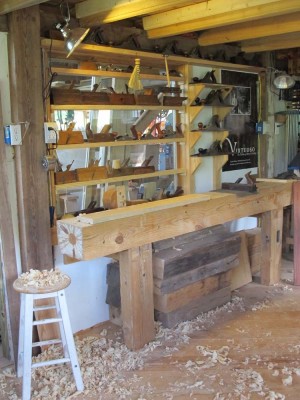
No doubt about it, this image makes me smile. You can just barely spot the head of the shaving beam behind the planing beam.


















Recent Comments