For unto us a child is born, unto us a son is given: and the government shall be upon his shoulder: and his name shall be called Wonderful, Counsellor, The mighty God, The everlasting Father, The Prince of Peace.
The angel went to her and said, “Greetings, you who are highly favored! The Lord is with you.”Mary was greatly troubled at his words and wondered what kind of greeting this might be.But the angel said to her, “Do not be afraid, Mary; you have found favor with God.You will conceive and give birth to a son, and you are to call him Jesus.He will be great and will be called the Son of the Most High. The Lord God will give him the throne of his father David,and he will reign over Jacob’s descendants forever; his kingdom will never end.”
And they said, “Isn’t this the carpenter’s son? Isn’t his mother’s name Mary?”
And I heard a great voice out of heaven saying, Behold, the tabernacle of God is with men, and he will dwell with them, and they shall be his people, and God himself shall be with them, and be their God. And God shall wipe away all tears from their eyes; and there shall be no more death, neither sorrow, nor crying, neither shall there be any more pain: for the former things are passed away.
I pray for you to have a blessed Christmas with loved ones and that you are celebrating the Incarnation, through whom we can be reconciled with The Creator.
This was certainly the fascinating terminus for an amusing rabbit trail. I was surfing for information on shop-made plywood-form-laminating and somehow this is where I ended up. Sometimes the interwebz is a vehicle for cultural destruction, other times it is a portal to enhancement.
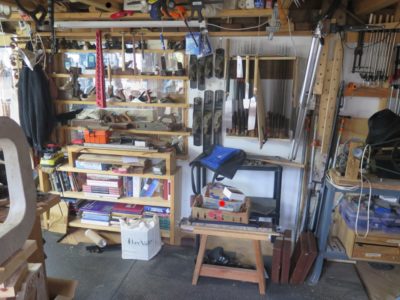
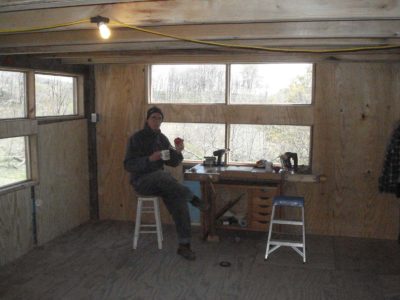
My friend Tom standing in front of Walt’s tool cabinet when we were visiting him in Staunton. I very much like this style of standing tool storage.
For a variety of reasons – desire to consolidate my core tools into a compact-ish volume in preparation for the “some day” time when I do not have a 7,000 s.f. barn, organizational order (my friends are laughing out loud right about now); work flow; parquetarian/channeling-Studley indulgence; antipathy for floor level tool chests — I plan to spend a good part of the next two (?) years constructing, decorating and outfitting a large standing tool cabinet in my studio. It will reside in the space currently dedicated to my saw rack and whatever is on the floor underneath it. I was really impressed by my acquaintance Walt’s cabinet and plan to use his as an inspiration for mine.
Rather than making it out of solid lumber with dovetailed corners my plan is to construct the box/doors entirely from 3/4″ & 1/2″ Baltic-birch plywood and sheathed in a yet-undetermined parquetry pattern (a la Roentgen?) using veneers sawn from leftover FORP workbench scraps. This project has been gestating long enough that I scrounged scrap 18th century French oak from the original Roubo bench-building workshop in Georgia.
The cabinet box will be roughly 48″ high x 42″ wide x 16″ deep with an open space between the base structure large enough to fit my Japanese tool chest.
Leave it to me to attempt a masterpiece project that almost nobody will ever see.
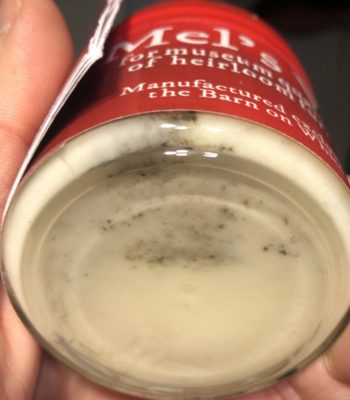
I got a note today from a customer whose jar of Mel’s Wax had some weird black schmutz in the sealed jar. If you have encountered anything like this PLEASE LET ME KNOW. I need to figure it out and resolve the problem poste haste.
I check every unit before it goes into the USPO and it wasn’t there last week, so I am scratching my head. I’ll investigate thoroughly once I replace it and get it back.
It has not only been a crazy year for the world at large but apparently the craziness is becoming manifest with this product as well.
One of the truly exasperating aspects of the Gragg chair workshop was that my 10″ benchtop bandsaw was continuously malfunctioning, requiring us to go up and down two flights of stairs to the main floor with its two larger bandsaws instead of using the little beauty up on the fourth floor. Chairmaking does not require fancy band sawing but it is an important contributor toward making it an efficient process.
After much sturm-und-drang I discovered ex poste that the new 1/4″ bandsaw blades I’d had in the drawer for the 10″ unit were mismarked; instead of being the 56-1/8″ needed they were 59″. I could get them on the wheels and run true when turning freely but they would not stay there once battle commenced. I ordered new blades and they were the right size, so with a complete cleanup and adjustments, combined with new guide blocks cut from a rod of 1/8″ carbon fiber rod from my stash, the new blade installed and ran perfectly and now once agin the saw cuts superbly.
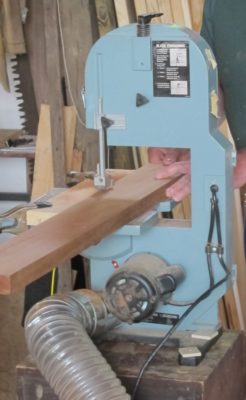
Meanwhile I decided to tune-up my 40+-year-old 14″ Delta bandsaw, a prize from a yard sale almost 20 years ago. I think it was $100 complete with rolling base. For a long time I had been contemplating adding a true rip fence to the saw, and finally made the plunge. Even though the Kreg fence is designed to be installed on the left side of the blade, with a little tweaking I installed it where I wanted it on the right side of the blade. Sweet. I also finally added a dust collection port in the lower wheel cover, which combined with a simple bent sheet metal cowl around the lower guide block unit, reduced the sawdust by roughly 95%.
I am contemplating but have not acted on purchasing a carbide tipped blade for the band saw; the ~$200 price tag is a bit stiff. If you have had any experience with carbide tipped blades for small bandsaws please let me know.
BTW here is an excellent short video on bandsaws that I discovered recently.
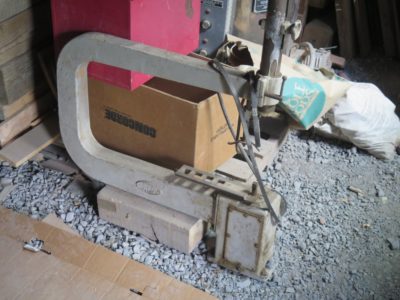
So, I’ve got this ancient 1930s era scroll/jigsaw, a Boice Crane Model 900. It is to my mind the tool form against which all others are measured. Acquiring it was my introduction to Tall Tom, my woodworking pal of lo these many years. He was at a community yard sale selling tools and carved walking sticks and had a small vintage Delta scroll saw at his booth. I checked it out and decided to pick it up on my return trip after browsing the yard.
It was, of course, gone when I did return. I engaged the seller (Tom) in conversation. He mentioned that he had another one back at the shop but it was too heavy to haul to a flea market, so we arranged for me to come see it at his shop. In the end we agreed to a trade; I would give him some turning lessons and he would give me the scroll saw. Little did I know that for many years I would be found in his shop on Wednesday evenings, and that he would make several trips with me to the barn (the picture is from 2011).
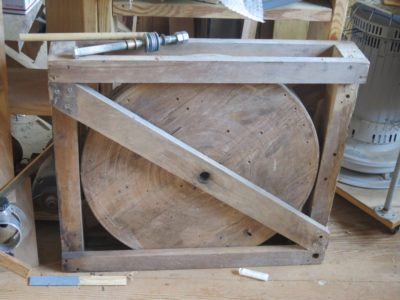
I am determined to get this saw rejuvenated and outfitted for marquetry work. Since I have a large wooden wheel I made for a treadle lathe, why not combine the two and make the Boice Crane something akin to a Barnes Velocipede Saw on steroids? If it works out it would be a superb marquetry saw.
I recently took a deep dive into the guts of my nearly non-take-apart-able Sony 300 CD changer to see why it was not working. I suspected that it was something like a broken drive belt, and sure enough found that the core of the mechanical system was (?)/were (?) a pair of utterly wimpy rubber drive belts. Interestingly when I did a web search for this device model the first thing that popped up was “replacement drive belts” so this problem is apparently endemic to the device. New belts are on order and will be installed as soon as the circumstances allow.
Since it has been a pretty long time since I was able to use the changer and listen to the music housed within, reviewing the contents was almost like Christmas all over again. There was a lotta great stuff in there, perhaps nothing more better (!) than a CD I burned combining two early albums from America’s greatest rock band ever, Little Feat. An offshoot of The Mothers of Invention, Feat had an amazing run in their early days cranking out masterpiece after masterpiece of southern funk/improvisational jazz/gritty folk/plain old rock; Little Feat (1971), Sailin’ Shoes (1972), Dixie Chicken (1973), Feats Don’t Fail Me Now (1974), Time Loves A Hero (1977), Waiting For Columbus (1978), Down on the Farm (1979), all of which I have on vinyl and most on CD. I cannot think of any American band having a better decade than that one.
“Day at the Dog Races” is premium stuff and perhaps my favorite Feat tune. The instrumental is muscular and intricate, with an interwoven rhythmic character wherein several seemingly unrelated rhythm strands eventually come to be unified just before the final crescendo. The complexity of the song is exactly what I would expect from music coming out of the Orbit of Zappa. Regardless of your musical tastes I think you can give it a listen and appreciate it.
My final trip to the Post Office before Christmas will be tomorrow morning, so if you wanted to send polissoirs, videos or wax as Christmas gifts, better get your order in tonight. I normally send out orders once a week, but this time of year I go to the PO every day, ending tomorrow until after the First.
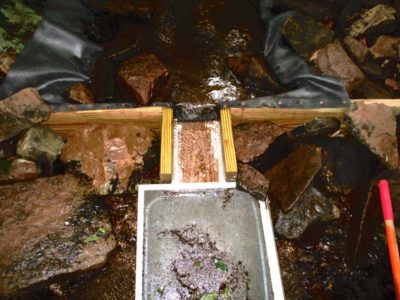
Though I have been exceedingly pleased with my latest iteration of the hydropower capturing basin, a/k/a “Rubbermaid tub with a window screen” and its attendant weir flow sluice eliminating 99% of any debris build-up, a recent trip up the hill has revealed a fundamental shortcoming to the system — it cannot withstand a bear (?) attack. The plastic tub-and-screen assembly was, to put it technically, knocked all whomperjawed. The problem was temporarily resolved but now that it is winter and the system is mothballed for the season, the time has come for a more robust response to the travails of life here where there are plenty of big critters.
I’m thinking of fabricating a more robust wooden basin from some of my exquisite c.1840 cypress, designed along the same lines as the plastic tub and its screening feature but with the addition of long horizontal cleats on the underside of the box. That way I can restrain the entire unit under a thousand pounds of rocks. And it the megafauna tears that one up? Hmmm.
I may also try to “straighten” the hydro line to allow year-round operation. since water will flow in a contained line well below zero degrees F, there is no conceptual reason I cannot operate it here all the time.
Gotta noodle that one.
Plus, it is time to get going on the second water turbine that absolutely positively can run year-round.
Recently I learned that Fred Schindler died. This picture is us from 2013. I recount my earlier faulty conclusion about his demise here.
I have always considered him not only a dear life-long friend but my greatest mentor in the finishing/restoration trade as he hired me when I was 18 (?) and I worked for him off-and-on for five years (the “off” of that was when I moved to attend college). He said he always appreciated the fact that when I asked him for a job and he asked me what I could do, I replied, “I know how to sand and sweep the floor.” (I learned over time that guys asking for work would promise the moon regarding their abilities, always falsely.) I could do a little more than that after two years as a “scratch and dent man” but did not want to over promise my abilities, which were nowhere up to the standards of his shop. I knew of Schindler & Son because one of the furniture stores I had worked for used them for special custom finishing projects.
As far as I know Fred was pretty much self-taught but he was the best finisher I ever saw when it came to matching a new surface to an old one. And the business had plenty of old surfaces to work on, as probably the premier antique restorers for old money Palm Beach clients including Charles and Jayne Wrightsman whose collection of classical French furnishings was unparalleled. The business was so successful that the shop phone number was unlisted. The velocity of projects there was mind-numbing in retrospect; I probably restored/refinished a couple hundred antiques a year while working there. Conversely, while at SI I generally conserved a piece or two, maybe three or four, every year. The wealth of that experience at Schindler & Son formed a foundation for all my work ever since.
While Fred was selfless in transferring his knowledge and skills, his father Fernand (“Pop”) was a bit pricklier and reticent but even he and I formed a close bond. Being the victim of good upbringing, I treated Pop with respect and admiration, and he reciprocated by teaching more about marquetry and furniture making (especially ancient French Furniture) than I can even fully comprehend. Pop was retired by the time I came on the scene, but he showed up for a couple hours almost every day, guiding me through scores of restoration projects.
My regard for this father-and-son team is such that one of the Roubo books is dedicated to them.
With Fred’s death I have been recalling three other great work-related mentors of mine — Frank Tautzenberger, a curmudgeonly Hungarian immigrant who seemed about 200 years old and operated the warehouse corner repair shop in the first furniture store I ever worked and shuffled around in bedroom slippers making damage disappear; John Kuzma, the master of the foundry pattern shop who taught me about the meaning of precision; and Bert van Zelst, my long-time unit director at SI who showed me what disciplined curiosity looked like. Each of them imparted an unspeakable wealth of knowledge and insight, and oh the stories I could tell… Perhaps another day.
When I contemplate my own role as a mentor to other craftsmen and measure it against what these men did to for me, alas I come up short.
Farewell for now Fred, I will see you soon enough in Paradise.









Recent Comments