Recently I was reviewing the manuscript for Joshua Klein’s great new book about polymath and furniture maker Jonathan Fisher for Lost Art Press as I had been asked to write the Forward. The book is an excellent reading and learning experience, and one of the descriptions of Fisher’s day-to-day life caught my particular attention. In addition to everything else he had to do was the onerous task of obtaining many tons of firewood requisite for each Maine winter.
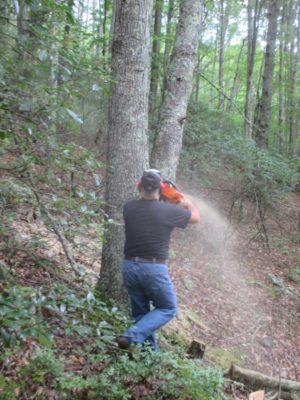
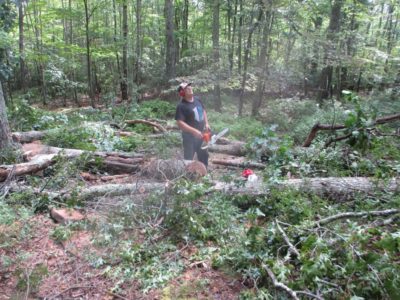
My friend Bob, who is a lifelong timberman, came for couple hours a few months ago and felled more than a dozen large ailing trees that had been damaged over the years. His help is incalculably important as I simply do not have the experience necessary to fell very large trees with confidence, while he has felled literally tens of thousands of trees and manages to drop them safely right where they need to go. Among this year’s prizes was a wonderful old oak with a long, straight trunk, that had been damaged in a storm last winter. I’ll be splitting and riving that one in a few weeks, I hope. More about that later.
Sometimes we just go where the trees are, but I am particularly interested in thinning the woods to the south and southwest of the barn to perhaps extend the daylight portion of winter days by an hour or more. Currently I lose direct light by about 3PM and I aim to push that to 4 or 4:30. That will be the best I can hope for unless we remove the crest of the hill occupying that space.

Once the trees are on the ground I can then return at my leisure to cut them into bolts and haul them down the hill. Inasmuch as I have the same objective as Jonathan Fisher, gathering tons of firewood each winter, I am more than delighted that almost a century ago the good folks at Stihl, Dolmar, and Festool worked independently to provide us with what we now have as the modern chainsaw. Ditto whoever combined a gasoline engine, hydraulic piston, and steel wedge to create log splitters.

With the side crib completely full with a double course of wood and the front porch filled with only a walking path to the front door we are ready for winter. I’m now working on my firewood pile for next winter with hopes of eventually getting a couple of years ahead. It’s the mountain way.
For unto us a child is born, unto us a son is given: and the government shall be upon his shoulder: and his name shall be called Wonderful, Counseller, The mighty God, The everlasting Father, The Prince of Peace.

The angel went to her and said, “Greetings, you who are highly favored! The Lord is with you.” Mary was greatly troubled at his words and wondered what kind of greeting this might be. But the angel said to her, “Do not be afraid, Mary; you have found favor with God. You will conceive and give birth to a son, and you are to call him Jesus. He will be great and will be called the Son of the Most High. The Lord God will give him the throne of his father David, and he will reign over Jacob’s descendants forever; his kingdom will never end.”

Isn’t this the carpenter’s son? Isn’t his mother’s name Mary?
And I heard a great voice out of heaven saying, Behold, the tabernacle of God is with men, and he will dwell with them, and they shall be his people, and God himself shall be with them, and be their God. And God shall wipe away all tears from their eyes; and there shall be no more death, neither sorrow, nor crying, neither shall there be any more pain: for the former things are passed away.
I pray for you to have a blessed time with loved ones, and that you are celebrating the Incarnation, through whom we can be reconciled with The Creator.
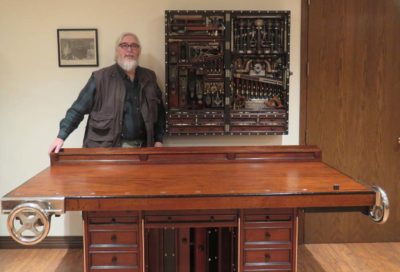

A while back I had the opportunity to visit some old friends, namely Mister Stewart and his remarkable collection of artifacts including the tool cabinet and workbench of HO Studley. My impetus for the visit, beyond the obvious, was to examine the newest element found and integrated into the workbench. The rear shelf completed the composition of the bench.

It was unusual for the form in that it was not pierced to hold tools, the typical arrangement for such shelves, such as this analogous bench and shelf.
Perhaps the function of this shelf on Studley’s bench was to simply look pretty?
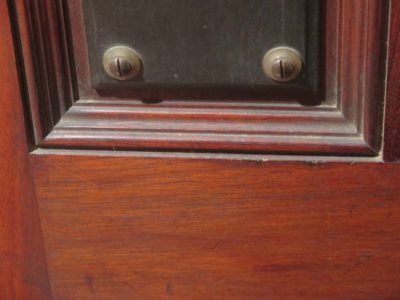
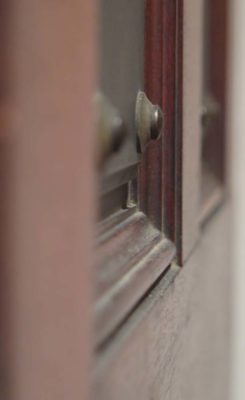
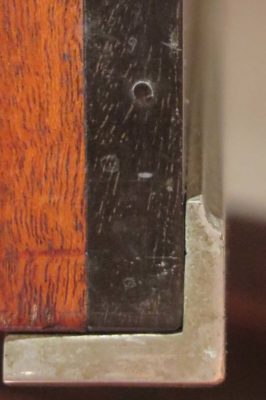
Another element of the visit was documenting more fully some of the molding profiles on the cabinet. Though I did not have a profile gauge with me, Mister Stewart gifted me with a piece of the molding he made when he fabricated the new workbench base. Once I get that photographed I’ll post that as well.

Now that we are on the verge of big time heating season I can reflect on the new hearth pad I made for the wood/coal stove in the basement of the barn. In the past, due mostly to the fact that the stove was installed in the dead of winter with near-zero temps, the pad for the stove was simply loose firebricks laid on top of the plywood sub-floor. It had remained that way for four years until I revisited the situation over the summer.

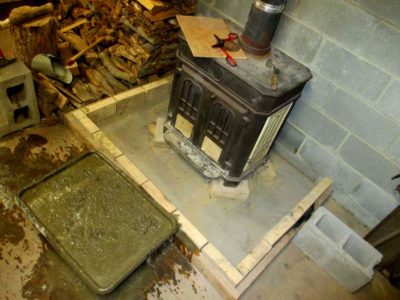
I removed all of the loose firebricks except for the four underneath the stove feet and a row around the perimeter and hand-poured a concrete pad (reinforced with hardware cloth) in its place. I don’d know if it will make any difference but it makes me happier to have it done.

It is pretty clear from the results that I am not a mason or concrete specialist. Regardless, it is ready to go and provides a permanent foundation for the 500-pound stove for as long as the barn is standing.

Once the Juncus dried enough for me to play with, I trimmed a large hank to length, about 4-inches.
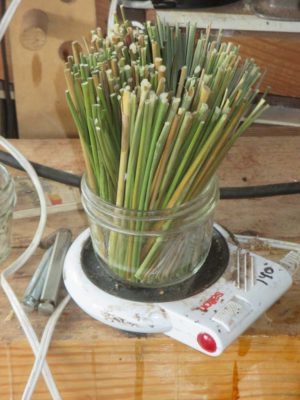
Just to make sure it was really dry I placed it in a glass canning jar on top of my coffee warmer glue pot for 24 hours. Then I started to make a polissoir as I have done many times before, albeit with sorghum broom straw.
One thing that is immediately apparent is that Juncus is much less dense and more fragile than broom straw. This is not a surprise give that Juncus is a hollow rush, essentially a tube structure. When assembling the fibers for constructing the polissoir I did something I had not done before, I flipped half of the fibers and then shuffled them for a fairly even distribution.
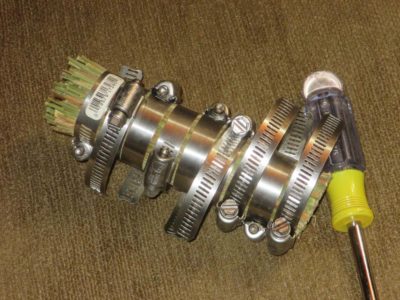
Grabbing a handful from the case of hose clamps I keep on the shelf for maintaining the hydroelectric penstock, I lined everything up and started tightening. And tightening. And tightening. The hollow feature of the Juncus meant that the collapse of the bundle was dramatically more than the broom straw. While the broom straw compresses about 10-20% under clamping, in my gross observation (I did not measure it in advance) the Juncus compresses 50-75% to achieve the same density as the corn straw. In other words, Juncus compresses somewhere between 2-1/2 and 7-1/2 times more than sorghum.
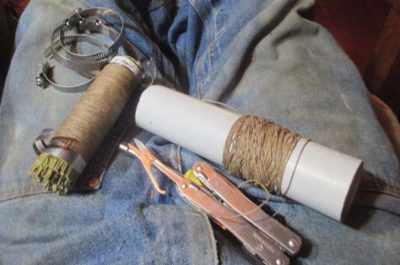

Once the bundle was tightly bound in the hose clamps I began to wrap it with heavy waxed linen cord until it was complete and tied off.
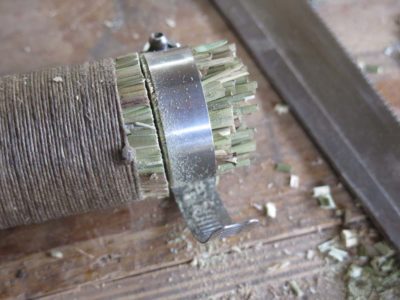
One one end of the polissoir I trimmed the tip with a Japanese knife; on the other I used a fine saw to cut off the excess.

Now it was ready to put to the test.
One day at lunch last spring I mentioned to Mrs. Barn my correspondence with Yannick Chastang and my subsequent interest in finding some Juncus rush to experiment with making a polissoir from this fiber. Where, oh where, could I find this exotic plant?
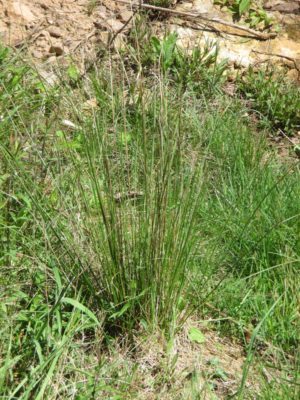
“Out back, it’s all over the place,” says she. “We have some here along the pond.”
Immediately after lunch we went together to walk around the pond and she pointed out the few immature clumps of this spikey plant. This was one of the hundreds of wetlands grasses, in our case Juncus effusis. After looking it up I concluded that its geographic growth range is limited to planet Earth. Apparently it is almost universal in its growing. Maybe even the river banks of Paris?
Cheered, I went back to work and after some more correspondence, knew I had to wait until autumn to harvest it.
Flash forward a few weeks to my chatting with stonemason extraordinaire Daniel as he was creating our new stone wall.
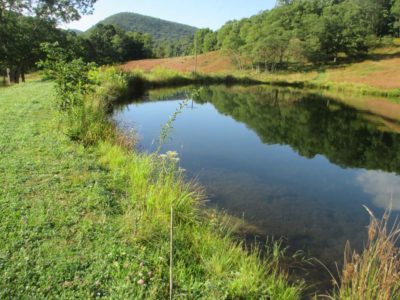
“Come over to my place, ” he said. “I’ve got a ton of it around the pond. Help yourself. It’s just a weed the cows won’t eat.”
Now I was getting really jazzed.
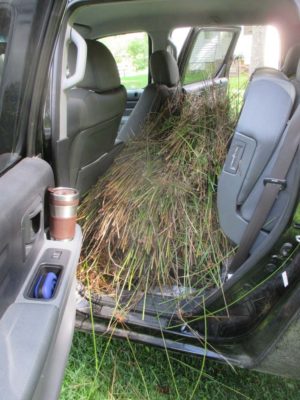
Flash forward again, this time to September when my friend JohnH came to help teach a workbench-building workshop. Since no one showed up to build a workbench we spent most of our week in great fellowship working on the ripple molding cutting machines, which he and I will be demonstrating at the upcoming Colonial Williamsburg Working Wood in the 18th Century shindig, we took time to go to Daniel’s and harvest a pile of the “weed.”
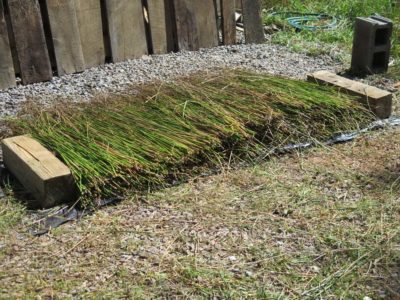
We spread it out to dry in the sun for three days, then I bundled it up and moved it inside to finish seasoning.
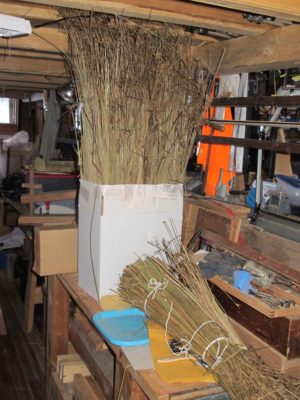
Before long it was ready to work with.
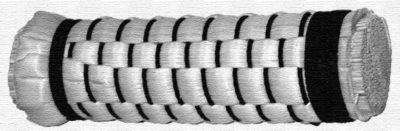
The polissoirs I commission from a local craft-broom-maker employ the materials with which he normally works, namely broom straw (sorghum) and nylon twine, with woven outer sheaths. It makes perfect sense given the scale that Polissoir, Inc. has become; he needs to use materials and techniques with which he is familiar and facile, and for which he has (for the moment) a sorta-reliable supply of raw materials.
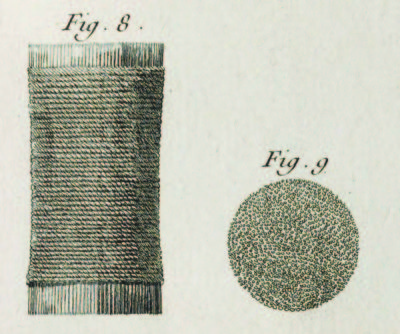
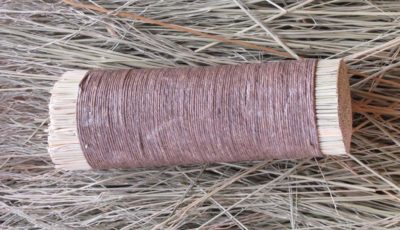
The only variance from this is the Model 296 polissoir first commissioned by Thomas Lie-Nielsen for sale through his enterprise. In this version, made as close to the original description in L’art du Menuisier as is practicable, the outer sheath is a wrapped linen cord rather than woven sorghum.
In reviewing the sorghum polissoirs (and To Make As Perfectly As Possible) marqueteur Yannick Chastang chided me for mis-identifying the fibers used in traditional polissoirs, asserting that the genuine article used a wetlands rush rather than sorghum, and that sorghum broom straw was an inferior material for polissoirs. The first point is certainly a fair one, the second is a judgement/preference call I will discuss in a subsequent post. It’s like saying a Ruger 10/22 rifle is superior to a Smith and Wesson .50 caliber revolver. It depends on what you are trying to accomplish with the tool.

In the original text, Roubo uses the term “de jonc ordinaire” (common rush; the connection of “de jonc” to “Juncus” is not a great leap) for the plant fiber used in polissoirs. Our dealing with that term highlights the difficulties of a translation project (and explains the reason this is a very slow writing process), especially when the primary meaning of words mutates over time. Although French was probably the first codified modern language, it has changed little in the past three or four centuries, the hierarchy of definitions for words has definitely shifted. Words for which the first definition might be XYZ in one time period might find definition WYZ to be the second, third, or even eighth-ranked definition in an earlier or later dictionary. This is a struggle Michele, Philippe, and I wrestle with continually as we work our way through the original treatise. Dictionaries roughly contemporaneous to Roubo declare that the word “de jonc” can mean reed, rush, straw, grass, hay and several other definitions I cannot recall at the moment. But Yannick’s assertion that I chose the wrong word in English based on my editorial discretion is certainly not unfair.
With that idea in mind, I set out to explore the topic more fully. One problem, though, resides in the question, “Which Juncus?” After all, this is a huge genus consisting of several hundred species.
And, where would I find it?
Stay tuned.
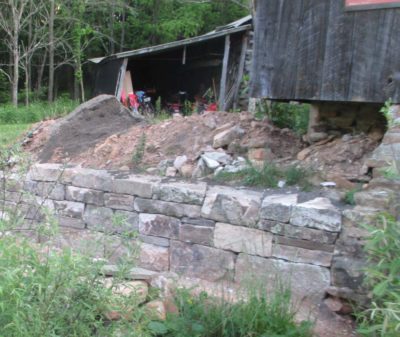
Back in the mezozoic era when I was in college, I hosted a late night jazz show on the college station. My theme song was a Dave Brubeck piece (as would be the case with any civilized person in that situation), in this case Unsquare Dance. For whatever reason this tune, or more precisely the title, leaped into my head when I first saw the juxtaposition of the new and magnificent stone wall with the whomperjawed lean-to attached to the ancient log barn behind the root cellar/granary. I’d always recognized it was a bit off-plumb, but goodness the comparison was sobering. My desire to get it straightened out needed to become action.

About that time my younger brother came for a week-long visit. We are pretty much two peas in a pod, although he is a better marksman than am I. He is an excellent carpenter and builder, so once I knew his schedule I ordered some 2x8x8′ pressure treated SYP to use in building the new wall structure.
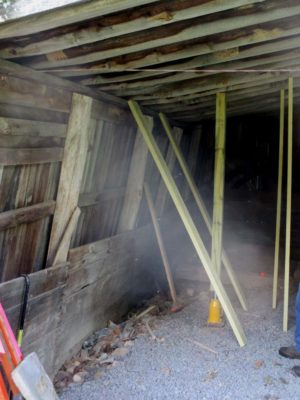
The strategy was to assemble stick-built laminated beam to serve as the top plate for a post-and-beam configuration, about a foot inside the original wall. But first we had to jack up the roof to some semblance of planarity, which we accomplished with hydraulic bottle jacks and extra 2x8s to wedge the roof to the height we wanted. It took a day of gradual lifting, but we finally had it ready to work on. The foot worth of swale was as gone as we could get it, and it was time for the hard work to begin.
The final day of bridge building involved cutting, painting, and installing the decking, which was made from the same 1×6 material used for the beams. Prior to installing the decking I mounted electrical wires to the underside of the structure. These are the wires that 1) carry electrons from the solar panels on the cabin to the power system, and 2) will eventually carry electrons back to the cabin from the system.
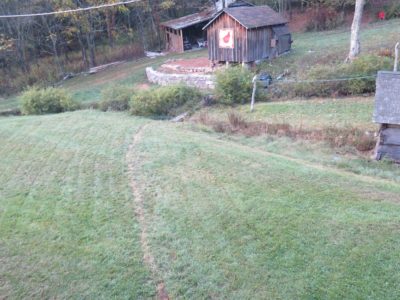
Before
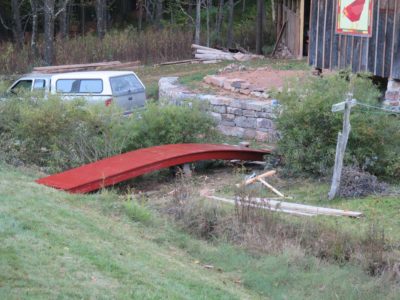
After
A little debris clearing, including the old plank walkways, and the job was done for now. I’ll let the paint weather a bit, then wait for a warmer sunny day to sand it and apply another coat of paint, sprinkling the sticky paint with play sand to give it better traction.
Between the new stone wall, arched bridge, and new wall on the lean-to on the old barn (more about that later), the vista from the side deck has been transformed.
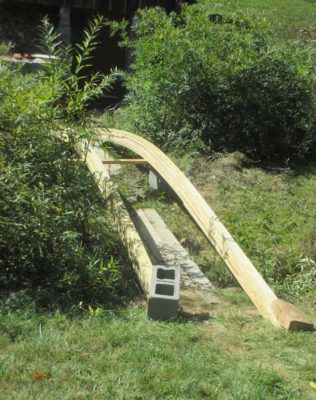
Our task for Day Two was to complete the two structural beams of the arched bridge, so we simply continued building up the glued-and-screwed laminations until each of the curved beams got to the full 10-inch depth I wanted.
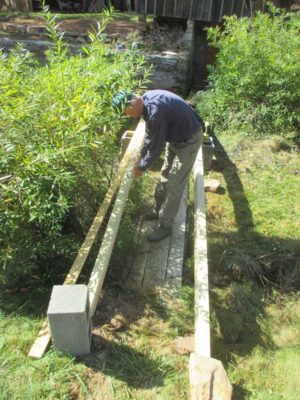
After that I affixed the cross-ribs to tie the two beams together. The end result was something with near-zero vertical deflection under load, but a little too much lateral wiggle for my taste. I solved that in the very end, but for now the structure was done.
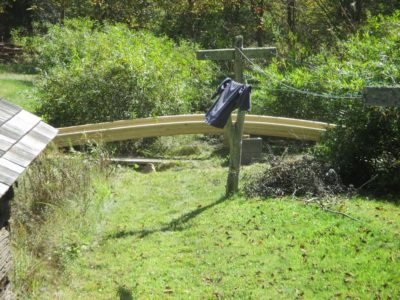
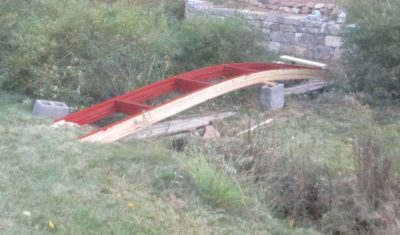
Before laying on the decking I painted everything I could reach with polyurinate paint, which is actually the appropriate application for this product.


Recent Comments