Many people equate “skill” and “talent.” They are sometimes related, but certainly not the same thing. It is like the modern conflation of “jealousy,” “covetousness, ” and “envy.” All are related as manifestations of the same base impulse, but they are not the same (envy being the most pernicious).
But back to “skill” and “talent.”
I possess precious little artistic talent, but have acquired fair-to-middling creative skills. I remember clearly a session in the studio of one of my art classes in college. I was succeeding in the class by sheer grit and inordinate time working in the studio; the art didn’t flow out of me simply because the talent was not there. But I was determined to succeed and spent untold hours at work there. One day I asked Mrs. Barn to come with me and keep me company as I worked, and as we walked there she picked up a branch of some flowering tree or something. So while I ground away at my “creating” she whipped out a lovely oil painting of the sprig even though she never trained as an artist. But she has sublime artistic talents while I am saddled with a noteworthy lack of them.
I’m not sure if curiosity is a talent, but I do have a fair bit of that. Perhaps my greatest creative gift was that I was an indifferent student in school prior to my third stint in college, when I worked and learned with a vengeance. But middle school and high school? Nah, I did not pay enough attention to enable them to beat the curiosity out of me and I was able to retain my native impulse to color outside the lines.
Talent is, I believe, a portion of that inventory of nascent gifts imparted at our conception as unique creatures, whereas skills are the abilities honed through repetitive exercises. That said, the vocabulary of skills we possess allows us to expand our creative and productive capacity to a nearly limitless vista, and to hone those natural talents.
As a craftsman and teacher that is where I try to invest my resources.
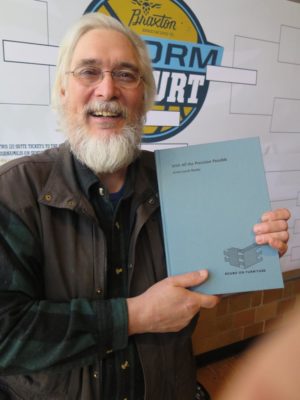
I am at a point in my life where my writing is an output that has value in the marketplace, all the more surprising to me in that I went to gubmint schools at a time when the rigors of language arts were, shall we say, not emphasized. Now I practice writing on a near-daily basis to sharpen my skills of wordsmithing. This occurs on this blog as often as I can even though many acquaintances urge me to de-emphasize my writing here in exchange for “more followers” via other vehicles that do not require anything more than a few pictures and words on a smart phone. I have resisted this for several reasons, not the least of which is I do not have a smart phone and have little interest in getting one given that I live in a place with almost no cell service. Second, if my goal is to increase my ability in crafting words, I’d better spend some time crafting words rather than avoiding it. An analogy would be encouraging someone to refine their joinery skills at the workbench by giving them a screw gun.
Instead, for the time being I prefer to write short articles for this blog a few times a week as a means of not only connecting with those who read it but also accomplishing the not-so-unintended-consequence of improving my own writing skill set. I know I will never become as facile as Chris Schwarz given both his natural talents and honed skills that enable him to have a daily output capacity of probably four thousand words. I hope for a tenth of that, and dream of a quarter, a pace I actually maintained while writing the 40,000 word first draft manuscript of Virtuoso in six weeks.
For the past few years I have endeavored to write something every day. A blog essay, even if only a short one, or at least a portion of one (some blogs take a few sessions of verbal noodling). Or another portion of my ongoing book manuscript, at present The Period Finisher’s Manual (I am targeting the end of the year for its completion). Some mystery/thriller fiction, currently about a derelict antiques restorer out in the mountains and how he eventually saves the world. Blowing off steam by recording pithy observations about the state of the world around me.
It is all enjoyable and ruthlessly demanding, but it is how I am building my muscles in formulating and organizing ideas and putting them into words.
Simply put, the regimen makes me more skilled at writing.
The same is true with my physical craft. As a furniture maker I will not and probably cannot become Jean-Henri Riesener, John Goddard, Alvar Aalto, or James Krenov. I am unlikely to ever become a truly skilled engraver, or metalsmith, or machinist, or chemical engineer. But I can become better than I am.
And so can you.
While I cannot endow you with creative genius, I can encourage and direct you in the genesis and more full formation of skills through practice and exercise. This has become cemented as the goal for my time in The Barn on White Run; that I explore and create, and share those adventures with you that you might be more encouraged to do the same.
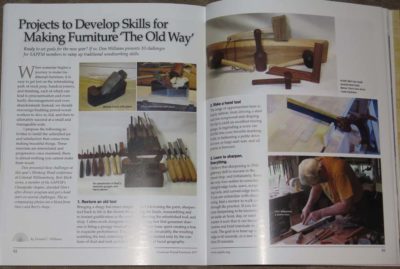
In the coming weeks and months I hope this will become manifest on this blog with my mercurial musings about craft and life on the homestead being augmented with more postings about the processes of doing and not just my noumena. One iteration of this starting next will be a series of bench exercises I presented at last year’s banquet address for the Colonial Williamsburg Working Wood in the 18th Century shindig.
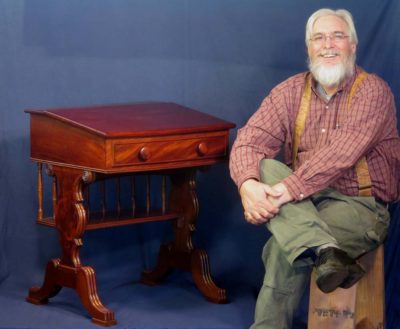
Another will be the multi-part walk-through of interpreting an early 19th century writing desk, of which I have already written a couple of blogs in the past.
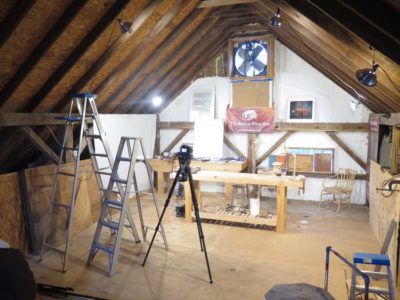
And making instructional videos for distribution with a talented young local film maker.
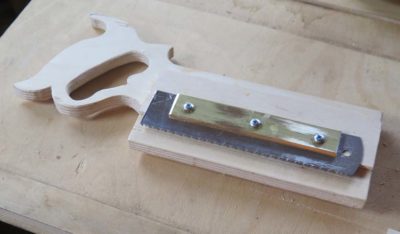
And making and modifying tools.
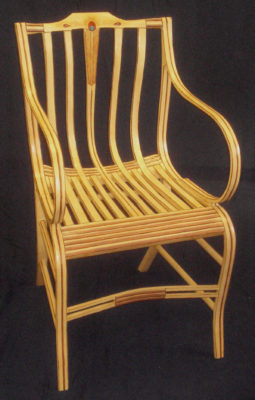
And Gragg chairs.
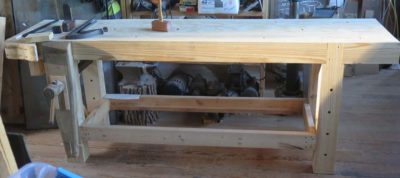
And workbenches.
And, and, and…
All in pursuit of skills, in service to my “talent.”
As the depths of winter set in out here in the mountains I decided to do something about the problem of early fading light, especially in the great room of the barn’s main floor. On a typical January day I lose direct sunlight by about 3:30, and the darkness creeps in from that point on.

I decided that a big hurdle to solving the problem lay in the fact that the two oversized doors to the barn were visually solid, and that a solution might be to pierce them with large panes of glass. Fortunately I happened to have just one such piece of glass leftover from the original construction a decade ago. It is a piece of salvaged thermal glass from an unremembered source but it was sized as though it was made for the task being contemplated and it seemed as though the project would be easy to undertake and complete.
So I did.
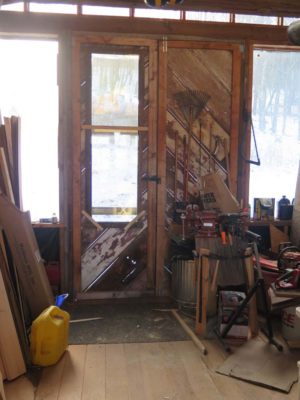
Since I was using the panel of glass essentially as a piece of sheathing the “framing” of the new window was a simple batten screwed to the door so that the panel would have someplace to seat. After the batten frame was in place I sawed out the opening for the window, lifted the new pane into its seat, and added some more temporary battens to the rear side to hold it in place until spring time when the warmer weather will allow me to caulk it in place permanently.

Until then I am enjoying both the doubling of the external light present in that work space, and celebrating the fact that this was one project that turned out to be as simple and quick as I had first imagined. I would like to find another panel the exact same size for the other door, and will keep scouring the salvage yards until I do.
For now, I simply enjoy being able to work in the great room until almost five o’clock.
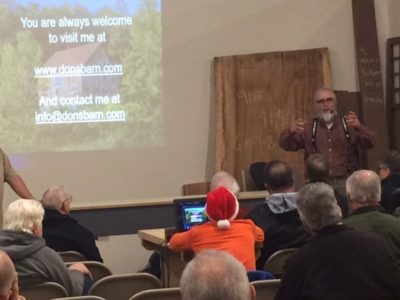
Recently I was invited to speak about the HO Studley project to the Frederickburg (VA) Woodworker’s Guild. My friend SteveD was my host and a grand time ensued.
While at Steve’s I got to see a bed frame he had been working on in recent weeks, and about which we had corresponded regarding the finish being used. This bed was commissioned by the organization that is recreating George Washington’s childhood home near Fredericksburg. Much of the recreation is based on rigorous and ongoing archaeology. The Washington family domicile being readied for the public is all new construction, but there is solid evidence that it is a very faithful interpretation of the original.
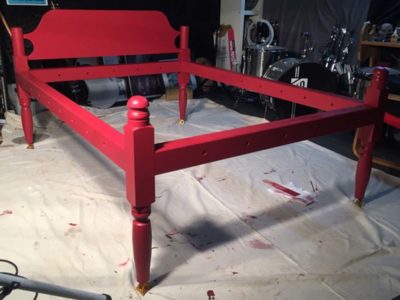
Steve has been commissioned to create a number of beds (and perhaps other pieces?) for the site, and this bed is a stunning one.

The audience at the Guild meeting was large and enthusiastic, Steve said it was about twice normal. And you gotta admit, the tale of Henry O. Studlew is a compelling one. The group meets in a semi-industrial space which suited me just fine.
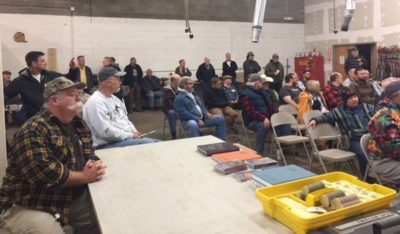
The audience was very attentive and engaged, asking excellent questions throughout the presentation and staying after to discuss all manner of Studley and Roubo topics. They promised to invite me back, and I look forward to that event.
En route back to Shangri-La following our excursion into deepest Flyover Country we stopped to see the progress of things at Lost Art Press. Mrs. Barn had never seen the new World Headquarters and since they were within a mile of our route, I checked to make sure we could stop.
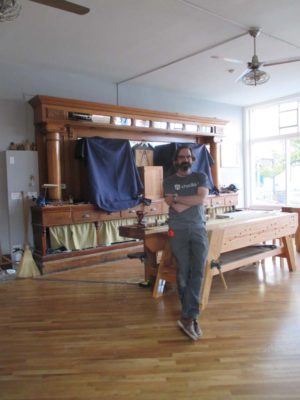
As usual Chris was hard at work in the shop and on the shop, but he took a few minutes to visit and relax.

During that brief visit I sat in the Mother of All Stump Chairs that Chris has been chronicling. I cannot say I could sit there for an entire evening but it was more comfortable than I expected and looked pretty cool too. All I needed was a bearskin vest and a grog of mead and I would have looked right at home.

We also toured the new machine room emerging from the renovation of the carriage house out back, and Chris had just hung and caulked his hand-made doors before we arrived. I definitely approve.
I join Chris in celebrating the establishment of the new headquarters, and even his dream of living in this vintage high density neighborhood. He likes having neighbors nearby, I like having neighbors on the other side of the mountain.
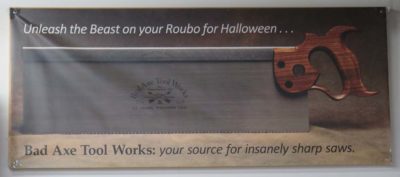
This giant banner at Bad Axe Toolworks made me laugh out loud. You know Roubo is catching on when the yardstick for a tool is its ability to cut the dovetailed leg tenons for a Plate 11 workbench.
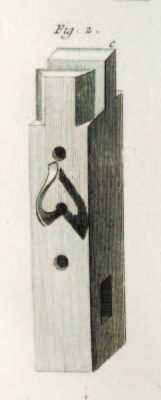
My recent trek around Flyover Country included an intersection between my path to my home town in southern Minnesota (the tropical part) and LaCrosse, Wisconsin, home to Mark Harrell and his ambitious enterprise Bad Axe Tool Works. I’ve been collaborating with Mark for some time on the development of a frame saw/sash saw with the promise that he would put one in my hands.
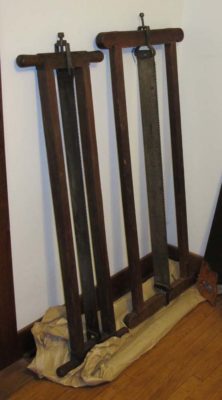
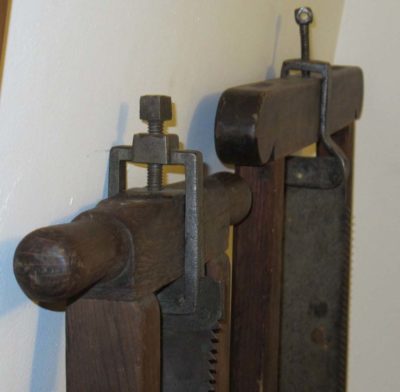
As the owner of two c. 1800 four-foot frame saws I was delighted to share the particulars about them with anyone who wanted to know. Their details are spectacular, from the hand forged hardware to the forged plates in near-perfect condition. (by that I mean there are no kinks or missing teeth, there was plenty of surface rust and the teeth needed touching up)
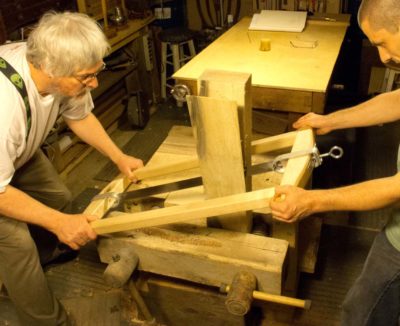
Like other saw makers, Mark contacted me some time ago and I took the time to talk with him at length about the vintage saws I have, in addition to the diminutive version I made for myself. Mark was particularly interested in a model halfway between my vintage big ones and my new smaller one, and we worked out the details over many emails and phone calls, an interchange I welcome from any tool maker who wants my two cents worth. To this point my only fee is that I get one of the tools in question if they ever go into production. I think Bad Axe might have had this model at Handworks 2017, but I was so busy I could never get to their station once they got set up, so this was my chance.
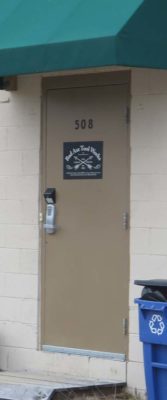
Accompanied by The Oldwolf, Derek Olsen, we arrived late-morning. And the saw geek-dom commenced. Behind this modest door and awning is a buzzing hive of saw making.
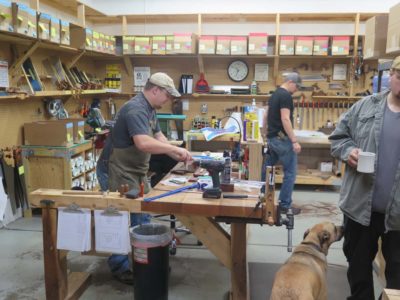
Mrs. Barn and I got a quick tour of the facility, getting the opportunity to meet and greet each of the the sawmaking elves there.
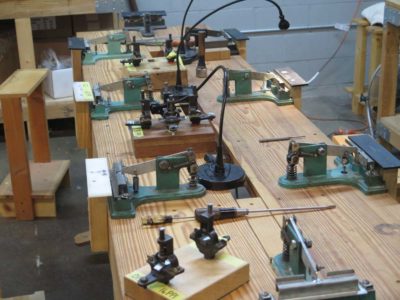
I was especially impressed with the classroom they have set up there for saw making and sharpening workshops. Mark definitely has the leads for mondo saw sharpening vises and setters.
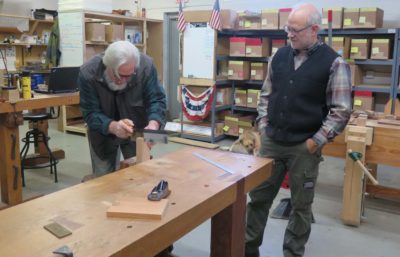
Then we got down to the real fun as Mark brought out several models of saws for me to play with. I already own two Bad Axe saws, including a custom made dovetail saw I commissioned and that has now become ensconced in their product line. Under Mark’s watchful eye the playing commenced, and it was glorious!
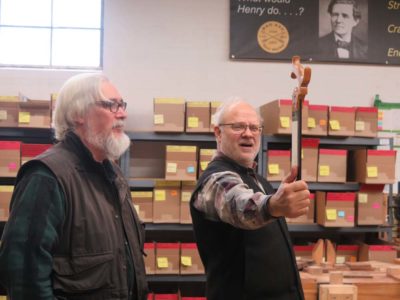
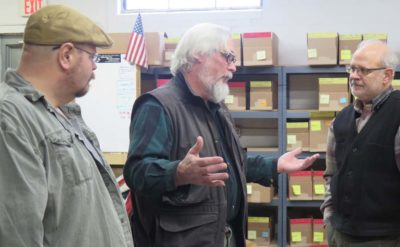
Our exploration of the topic continued almost non-stop and we were torn between talking about saws, and sawing.
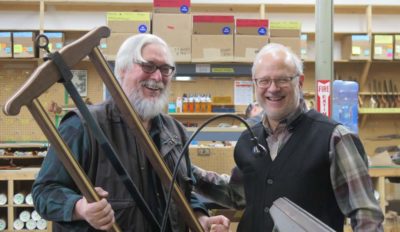
Then came the “official” purpose of the visit, taking delivery of my own Bad Axe frame saw based on Roubo, my old saws, and my new one, with a bit of Bad Axe special sauce tossed in for good measure.
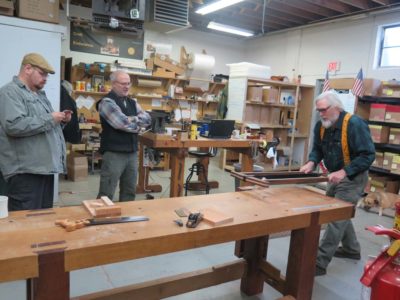
It performed perfectly right out of the box and will be integrated into my shop work as soon as it gets home.
More about the visit in the next post.
A recent trip to the Midwest for a variety of family gatherings provided a chance to drop in on Derek Olsen of Oldwolf Workshop fame. Derek’s is a fairly recent entrance into my orbit, but our friendship is fast and strong. He was first among the multitude of friends who volunteered to help with the 2015 HO Studley exhibit, and his account in The Bank of Don is brimming.
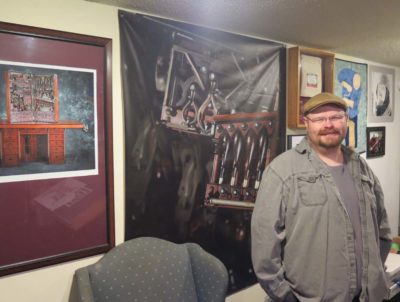
The stop for fellowship was a delightful one as you might expect.
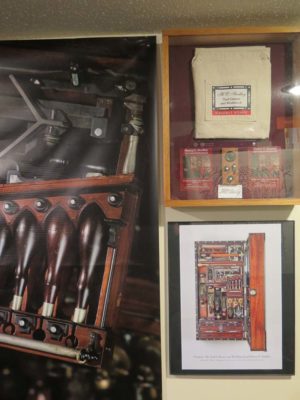
Derek proudly showed his impressive library of furniture history books, his shrine to Studley, and his still-in-development shop in the garage next to where he and Mrs. Oldwolf moved in recent years.
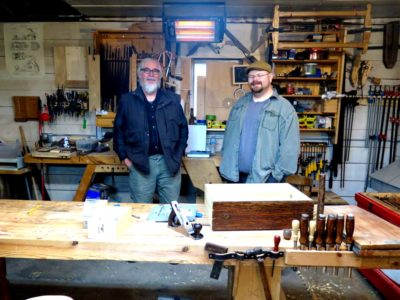
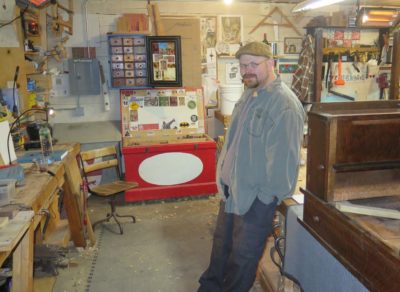
After our time there, we headed down the road (actually only a few blocks) to some time of saw geek-dom at Bad Axe.
But that’s for the next post.
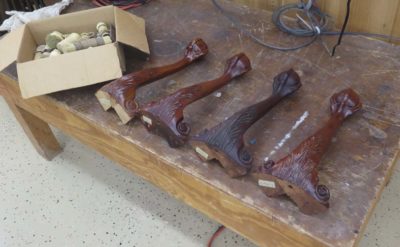
Right after the conclusion of the Parquetry workshop at the Marc Adams School of Woodworking I dove in again with three days of Historic Finishing (reminder to self — DO NOT do this again. The logistics of changing horses mid-week is a headache you can do without). This class had more than a dozen students, and the enthusiastic feedback had led Marc to ask me to develop an expanded week-long workshop on the same topic, which we will do in 2019.
I’ve pretty much got this workshop dialed in, as I do with Parquetry, so there is a fairly fixed syllabus here. The emphasis is on processes and work habits rather than having a “completed” project at the end, concentrating on shellac spirit varnishes and beeswax applications.

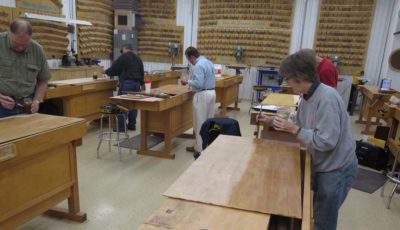
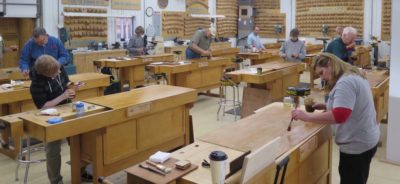
The starting point is this 24×48 panel building up multiple brushed applications of 1-1/2 pound cut shellac to about 18 layers over the first day and a half. Getting this to “done” allows us to explore the detailing and polishing of the surface.
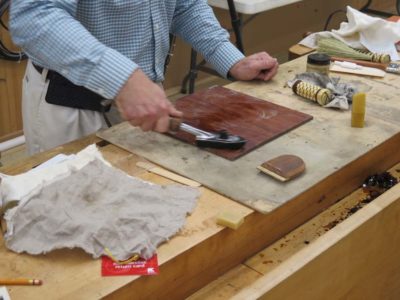


We used polissoirs for preparing surfaces and applying wax, and filled the grain with molten beeswax. Then we made and used polishing pads for applying spirit varnish.
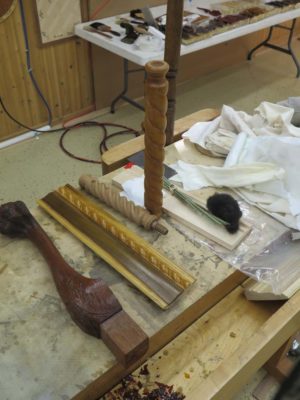
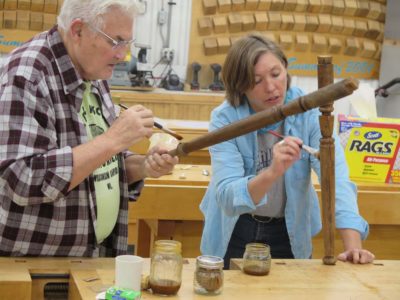
Each student got to address the problems of finishing undulating surfaces,
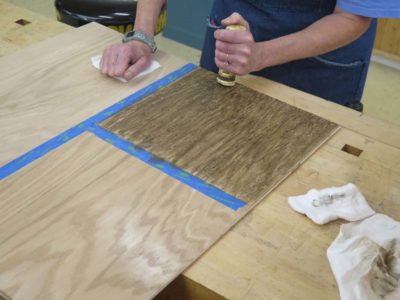
applying pigmented wax grain filler,
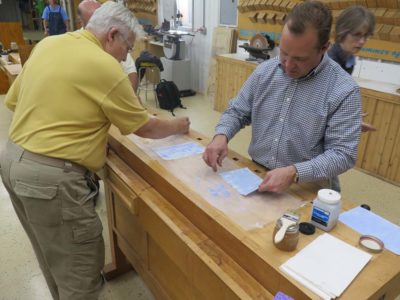
and even making historic sandpaper.
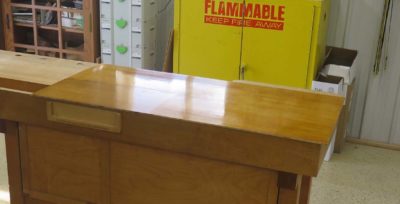
The giant panels were polished out with a variety of period-appropriate abrasives,
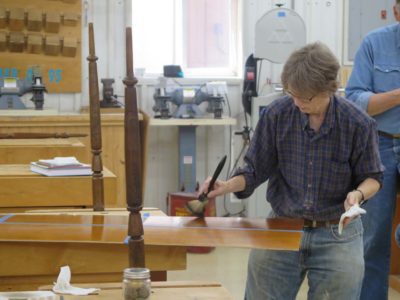
and one quadrant was glazed with asphaltum.
All in all, it was a great time of fellowship and learning. How could it not be, we were finishing!
I recently spent a week at the Marc Adams School of Woodworking, teaching two three-day courses. I believe this was an experiment on Marc’s part, road testing some new scheduling concepts such as a three-day workshop during the week as opposed to only on weekends.
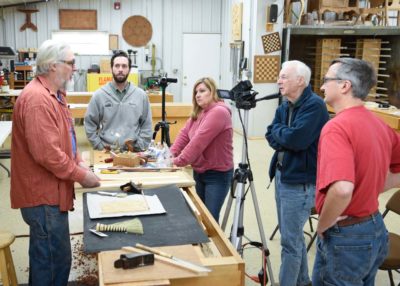
The Parquetry workshop had three enthusiastic attendees (plus a most excellent teaching assistant), a number the Marc told me precludes any repetition of the topic. This is an entirely fair conclusion on his part as he has a huge footprint to support. With several classrooms in simultaneous use I’m guessing he needs somewhere between 35-50 attendees every day for six months to make it work.
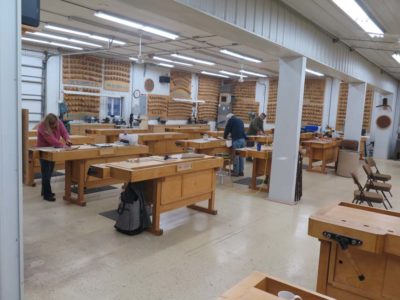
In fact our merry little band was in a huge, well equipped classroom with twenty (?) workbenches. The spaciousness was both unnerving and delightful as the students could spread their projects as widely as they wanted.
This workshop is somewhat unusual for me in that there was a finished project at the end, while I tend to prefer teaching a skill-set rather than a project.
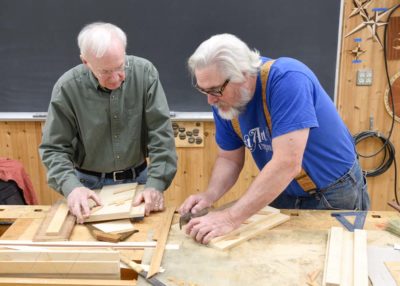
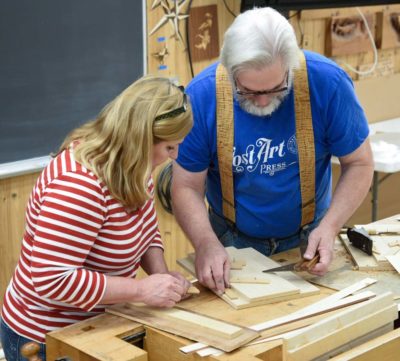
But skills and processes were taught and practiced, including the making of sawing and planing jigs,
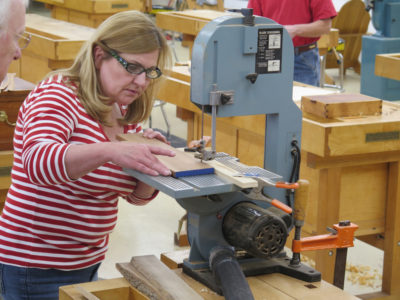
sawing veneer stock for making the patterns,

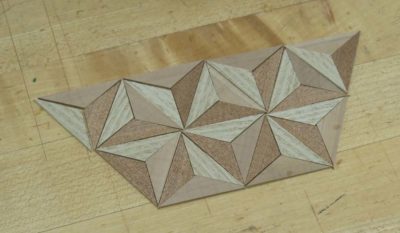
the assembly of the patterns,
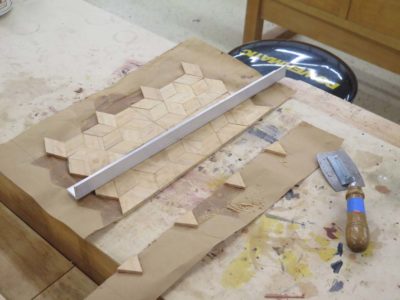
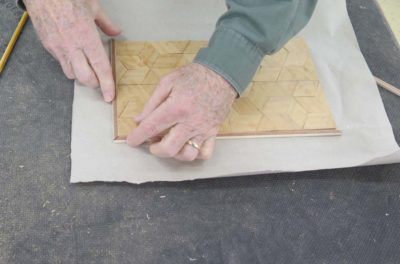
fabricating and integrating simple bandings,
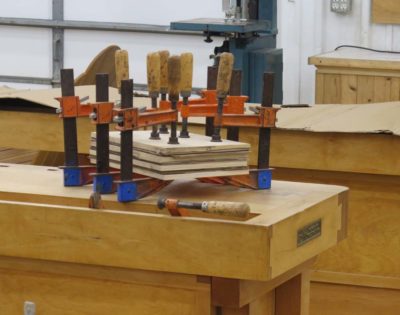
and gluing them down to a substrate.
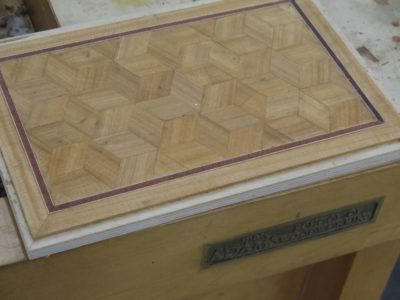

In the end they were cleaned up with toothing planes, files, and scrapers making them ready for the finishing process.
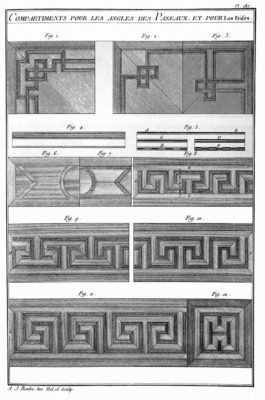
Though I will not be teaching this workshop again at MASW, I will not completely set the general topic aside. I am hoping to have a workshop on knot-work banding perimeters there in 2019.
My recent trip to Indiana to teach for a week at the Marc Adams School of Woodworking coincided with one of the monthly “open houses” at the World Headquarters of Lost Art Press in Ft. Mitchell, KY. I had a grand time there, visiting with many fellow woodworking enthusiasts.

I was especially delighted to cross paths with Dr. Mike, a specialist in hand and wrist injuries, who has been advising me on my rehabilitation following last year’s broken arm. The location and severity of the break made its manifestation a wrist and hand issue. The radius had snapped about an inch above the wrist and the broken-off tip had rotated considerably. Fortunately the setting went perfectly. (Note to self: don’t fall onto a stone walkway any more) The resulting cast was necessarily quite snug to keep everything in order, and the posture of the hand was not straight but rather considerably bent to keep everything in proper alignment during the healing. One result of this arrangement was that all the swelling was pushed down into my fingers, which for several weeks looked like kielbasa. As a result of all this, the directed swelling really aggravated the arthritis in my hand, which x-rays confirmed infest every single joint therein.
After getting the cast removed I undertook a rigorous regimen of physical therapy emphasizing flexibility and movement and downplaying the regaining of my hand strength. I attacked the problem, which seemed to be resistant to my best efforts at resolution.
Enter Dr. Mike.
At last March’s Lie-Nielsen event on Covington KY he examined my arm/wrist/and and declared that I was being too diligent in my exercises; I was working the region so hard I was essentially inflicting as much inflammation as I was alleviating. He proposed a new exercise routine for me, which I began the next day. The beneficial results were almost immediate, but still the road to full recovery had many miles to go. We corresponded regularly as I provided updates and he provided further counsel.
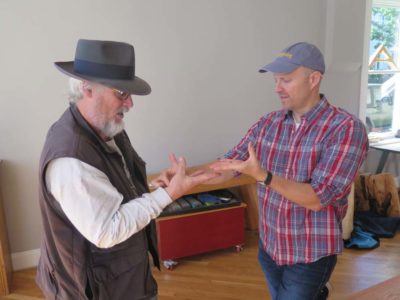
Flash forward to the LAP open house, when he gave an exceeding thorough evaluation of the damaged flipper. We were both every pleased at the progress, and changed the emphasis to the return of ultra-fine motor skills in the digits. With a new set of exercises to address this we parted and I have been engaged in additional finger flexibility routines ever since.
At this point the overall status of the ensemble varies on a day-to-day basis of somewhere in the 85%-95%+ range. My arm bone is fully healed and needs no more thought. My wrist flexibility as close to 100% of that which was expected. My finger micro-dexterity is somewhere north of 75% depending on how my arthritis is acting up. Some days it exceeds 90%. My hand strength is in the 80-90% range and slowly getting stronger with ordinary shop activities.
I recently wrote a note to Dr. Mike celebrating my use of chopsticks for the first time in over a year. Indeed I mark the progress by the little things I can do again; remove the gas cap from the car without discomfort, pull the starter cord for the log splitter, handle the chain saw, hand plane and hand saw with impunity.
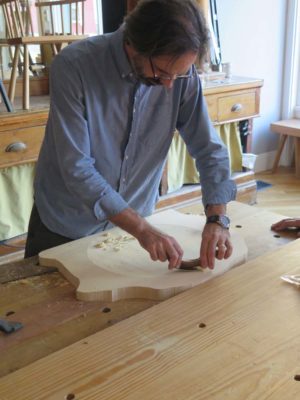
As the day in Ft. Mitchell wound down the stragglers mostly gathered to watch Chris work on a chair seat.

Finally it was just a handful of us, as we ate pizza and then I hit the road.


Recent Comments