Given my longstanding allergies to pollen and my fortnight in the hospital with pneumonia this past July I am increasingly attentive to what I breathe, especially when doing yard work.
For several years I wore a fitted industrial respirator when mowing and trimming, but even then I often had several days of wheezing and sneezing afterwards. While in the hospital in July I noticed that several of the caregivers wore powered air filtration helmets. They seemed like a near perfect solution to my problem. Their units were designed for medical/laboratory conditions and cost roughly $3k so that was not where I was going to go, but then I recalled the filter helmets often worn by wood turners and began my exploration there.
My first choice was the Axminster APF10 unit from England. It seemed to have the most streamlined configuration and the most comfortable fit. On inquiry I was informed that the company did not ship to the US so I had to remove them from consideration. (I am uncertain as to their current shipping regs; I might still like to get one, so if you are going to the UK and would be willing to pick one up for me there, let me know.)
In the end the only option left to me was the Trend Airshield Pro unit, which I did order. In some respects it is a fine unit, in other aspects not so much. There are other options, generally for the sandblasting and welding arena, but the prices for many of those units ($1500 and up) put them outside my immediate consideration.
When evaluating the Trend Airshield primary functionality, keeping the nasties out of my lungs, it does an excellent job. I have worn it several times mowing with nary a sneeze, wheeze, nor runny nose in the aftermath.
Alas, the unit is clearly designed for a static posture in use, in other words being used by someone standing in one place, not moving or bending very much. It is very top-heavy so the motions involved with mowing or trimming are problematic. It has fallen from its perch several times in use.
Getting the headband to fit properly remains a challenge, at least for my head, despite adjusting everything there is to adjust. On a comfortability scale from 1 to 10, I would rate the unit a minus 3. To get it snug enough to stay put while I am mowing or trimming or brush-hogging it is painful to wear as the front band imbeds into my forehead. I am working on devising a padding system to make it tolerable, but I am not there just yet. It seems that there is something just not right about the configuration.
As for the final consideration, namely price, at around $350 it seems expensive but a cost I am more than willing to bear given my respiratory allergies and desire for wheeze-free living.
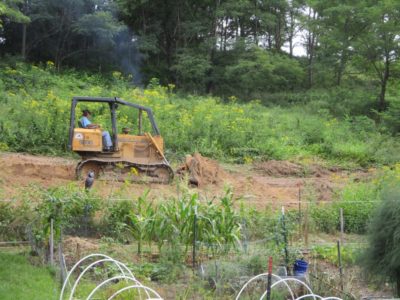
At long last Mrs. Barn has agreed that the time has come for me to build her a year-round playground. This required a new terrace to be cut into the hillside just above the garden plot, which in turn required a bulldozer to accomplish same. Since I do not own a bulldozer, rendering me as less of a man I know, I asked around and three friends independently gave me the name SteveB as the guy to do the job.
After several weeks of back-and-forth phoning he finally showed up a few weeks ago to do the deed. There is nothing quite so much fun as watching a good ol’ boy and his bulldozer at work.
I literally set up a lawn chair in the bed of my pickup and sat watching him all day.
It took him about six hours, back and forth in the space, to finish the job.
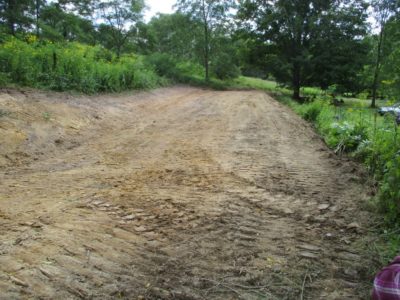
Working just by eye he created a long, wide, flat platform and when he surveyed the project afterward, he confirmed that it was not perfectly flat; it was a couple inches higher at one end than the other. For a 150-foot-long run that struck me as pretty good.
The greenhouse I will be using as my model, belonging to my friend F.
So, what will go there? For starters I will be copying my friend F’s greenhouse, hoping to get that built over the next few weeks, weather and family commitments allowing. Once that is up and running I expect Mrs. Barn to spend almost every day there through the winter since she loves puttering in the dirt and hates the gloom of short days and cold weather.
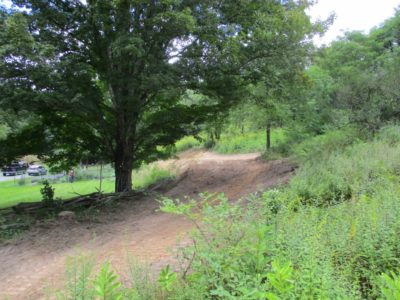
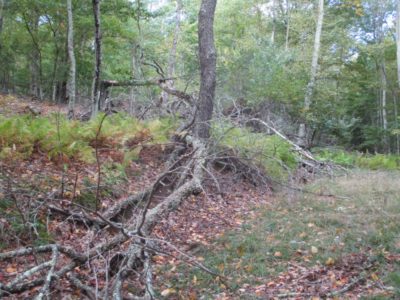
Once he was done with the new terrace SteveB he moved across the creek to smooth out the gnarly terrain in the space where we had felled a number of trees eighteen months ago to give better sunshine to the garden plot on that side of the creek.
That outcome was every bit as successful as the terrace, and we now have a wide range of options for using this plot of land. I’ll probably start with a parking spot and a small bed of gravel.
I seeded both patches of dirt and there are now flourishing stands of pasture grass there.
One of the curses(?) of occupying a space as large as the barn is that there is often little incentive to throw things away when their useful life is over. Even if some artifact is no longer functional, you see, its carcass may serve as the raw material for some new application. Such was the case with this simple project.
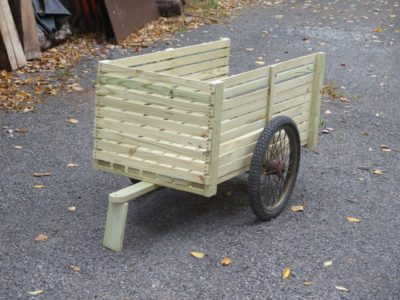
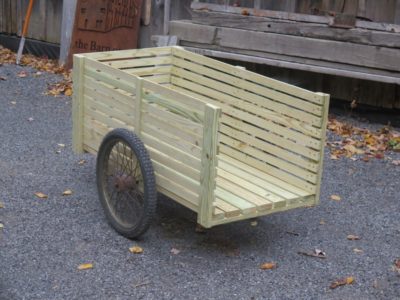
After many years of faithful service the old garden cart simply rotted away. The wood panels forming the box of the cart were friable to the point of needing no tools for the disassembly, gloved hands were all it took to take the detritus and toss it into the fire pit. The wheels and axel, however, remained robust albeit a bit rusty, and were kept in waiting in the basement of the barn for several years, just waiting for the new generation of use.
Once I got a new hefty riding lawnmower I realized that the homestead needed a tow-behind wagon for moving mulch, compost, etc., for Mrs. Barn’s gardening efforts. So I made one. Simple, sturdy and functional.
I ripped a pile of PT-SYP and assembled the unit with deck screws. I will make and affix the tail gate at some point soon, depending on weather and other projects. I’ll also fit it with a tarp liner so dirt and gravel can be hauled without falling through the cracks.
It was satisfying to get such a nice project in just a few hours of low-intensity work, requiring little precision and only a framing square and screw gun for assembly.
Generally, aside from my time with Mrs. Barn the overwhelming number of my conversations occur underneath my snow-white hair and between my years. That said, lately beginning with my three days of being on display at the 18thC Trades Show I’ve been talking out loud a lot. This week was a continuation of that theme.
On Tuesday I was at a local civic meeting and asked about my “newcomer’s” observations of our regional community and spoke at great length on the subject. Yup, even though we bought the cabin over 20 years ago, we are newcomers. That makes a certain sense in a community where dozens of families can directly trace their arrival here well over 200 years ago.
On Thursday my long-time friend and even longer-time broadcaster Brain Wilson interviewed me for his “Something Completely Different” podcast, discussing current events in the political economy. Say what you will, my perspectives are indeed “something different” than you are going to encounter in the corporate mega-media. You can track down the podcast fairly easily on your own, which saves me the aggravation of posting the link and then receiving gripes and moans about my mean, radical wrongthink ideas.
Friday morning was a long interview with Neal Bascomb from the Work/Craft/Life publication, discussing the H.O. Studley tool cabinet. Since I am always willing to discuss the collection and my relationship to it, the hour flew by. I will definitely post a link to that once it is published.
Friday afternoon brought a visit to the studio by my local friend, musician and luthier also named Neal, where we discussed at length the nature and manipulation of hide glue and the vagaries of guitar picks.
I feel all talked out, ready to resume my routine of silence listening to books, lectures, and interviews on my mp3 player while I make progress on projects in the studio and on the homestead.
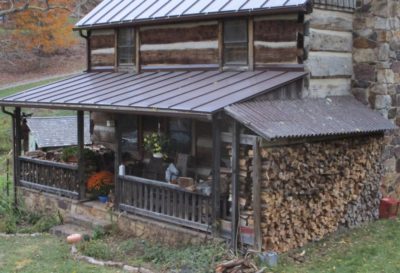
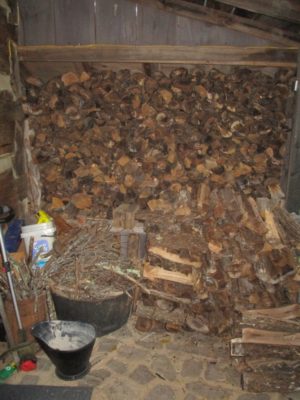
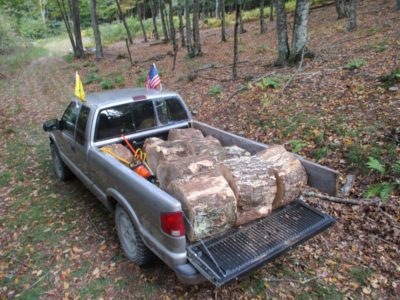
It’s time for the ceremonial portraits of this winter’s firewood. Even with the side crib already almost half-full after last winter, it took four days for me to load the pickup and move wood from the stacks of seasoned wood into the crib and on to the front porch. I’m working as hard as I always have but the output is diminished.
After the performance of the cabin envelope last winter following the complete re-chinking the previous year (that alone cost twice as much as my first house) and the crawl space sealing and insulating the year before, I am fully confident that even with a severe winter we are all set. In previous winters it took almost two full side cribs plus the porch-full to keep Mrs. Barn warm enough, this past winter it took the porch-full plus half a crib-full. I’m liking that trend line.
We’ve got new high performance windows on order to replace the 80s era windows now in place, windows with the particular feature of providing wonderful ventilation year round, open or closed. Depending on the performance of the supply chain we will be getting the new windows installed just before the dead of winter. Keeping fingers crossed. With new windows, the cabin should be cozier than ever.
Tomorrow I start splitting, stacking, and seasoning the firewood for the coming winters. There’s still at least two or three dozen heaping trucks full of timber on the ground. If I get done with everything already on the ground, I calculate 4-6 winters of firewood a-waitin’.
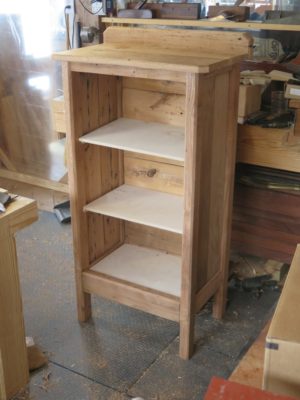
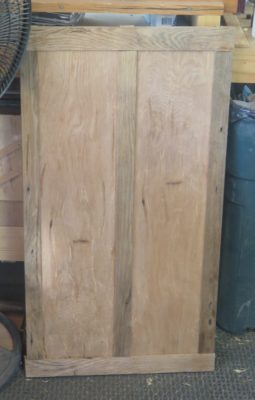
Last winter I started to finish the doors for Mrs. Barn’s clothes cabinet I built many moons ago using recycled chestnut lumber, warts and all, from an old, dismantled shack on the hill.
After preparing the doors (built as a single unit then sawn apart) with some scraping and burnishing with a polissoir, I laid down a seal coat of gloss Pratt & Lambert 38 varnish, a long-time favorite of mine, which I sanded lightly once it was hard (oil/resin coatings do not dry so much as they harden via chemical reaction).
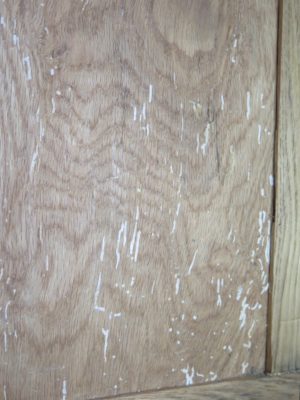
I applied what I thought would be the top coat of Pratt & Lambert 38 “Dull” varnish because that would leave the surface looking most like raw wood, and set the still-wet doors aside to resume work “some day.” Well, “some day” was a couple weeks ago. To say the least I was surprised at the outcome of my previous work.
The evidence of age and deterioration that I had purposely left on the surface as an aesthetic design element had turned completely white. What happened was that the wet varnish pooled in the recesses and the flatting agent, almost certainly a microscopically fine silica, was present to such a degree that it imparted total opacity to the finish film in those areas.
I’m pretty sure I know how to solve the problem, but I have never encountered something like this before.
In my frequent travels this past year to visit Li’l T and his parents and Barndottir the Elder I have almost always taken a traveling tool kit. Perhaps not enough for major home repairs or construction but certainly enough to get most woodworking tasks done. Fortunately, my SIL is an accomplished remodeler and the basement and shed at Barndottir the Elder’s home still has a pretty complete inventory of my tools, so I am almost fully set up regardless of which place I am.
My traveling tool kit is a very concise collection of woodworking tools with a couple of extra things useful for home repairs. Perhaps one day I will blog about the contents of the kit, which resides in a mahogany surveyor’s theodolite box with a couple drawers added on beneath.
Since space is always a premium in a kit like this I have become additionally enamored with Japanese saws, more particularly Z-brand saws with replaceable/interchangeable handles and blades. With one handle I can outfit it with any number of set-ups to accomplish everything from sawing timbers to fine dovetails and all points in between. I keep a cardboard “envelope” for the blades and pack them separately from the handle, so the spatial footprint is surprisingly small for such a large range of sawing utilities. In just the space of a handle I can carry a good set of saws.
Yet another reason to incorporate Japanese saws into your inventory of tools and skills.
This coming winter is already taken care of, so now I am working on winters 2023, 2024, 2025, etc. This week I have done nothing but retrieve a small portion of the windfall over the past year, yielding a heaping pickup every day. Thus far my mountain of firewood to be split and stacked is about 1-1/2 winters, maybe more if the new cabin windows make the same difference as did the two previous projects — insulating and sealing the crawl space under the cabin, and replacing all the chinking between the logs. These two ventures resulted in cutting our firwood needs by almost 50% last winter.
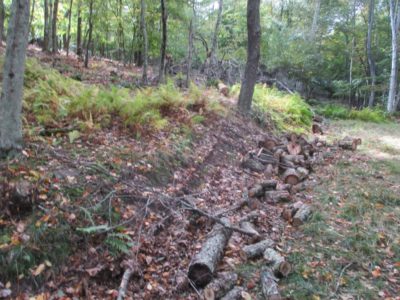
The road up to the previously felled timber is blocked by windfall trees which must be cut up and removed to even get to the upper inventory. Each of these trees renders almost a full pickup load of cut bolts.
I haven’t even made it to this tree yet, with its 40+-feet of clear trunk almost 24″ in diameter. If it were less logistically challenging, I would contemplate getting this one milled into slabs.
I’ve retrieved four truckloads, with at least another dozen still awaiting my ministrations.
This maple log was a particular challenge as I had to use some block-and-tackle to enable my little pickup to drag it uphill and on to the road so I could work it. This made me appreciate my little Stihl saw all the more. It is small and lightweight but can handle an 18-inch bar due to its narrow chain. I keep the chain sharpened several times a day and have to swap out the current chain because I’ve worn it to the nub.
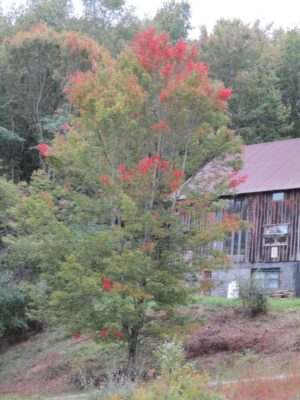
This week also brought the first swatches of color to the local flora.
This week by mail and email I got the announcements (several of them, actually) for the upcoming conference Working Wood in the 18th Century at Colonial Williamsburg, January 26-29, 2023. The topic is certainly of great interest to me and since they have rescinded all their previous Covid restrictions I am likely going.
Over the past dozen years I think the only times I have gone is when I was a presenter, so this will be a pleasant experience. I know most of the presenters and look forward to visiting with them, and hope to run into friends old and new. I promise to be mostly congenial but have to brush up on some social skills that may have become dormant in recent years.
If you’re going let me know.
Back to harvesting firewood for winter 2023/2024 and well beyond. There’s a lot of storm-fall out there.
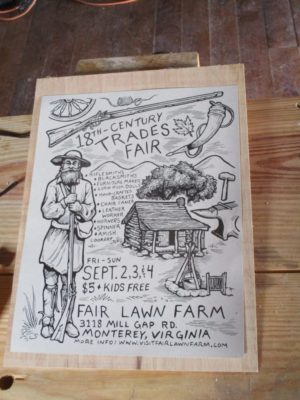
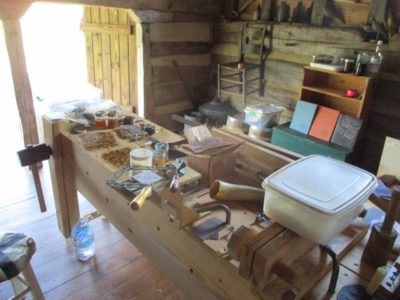
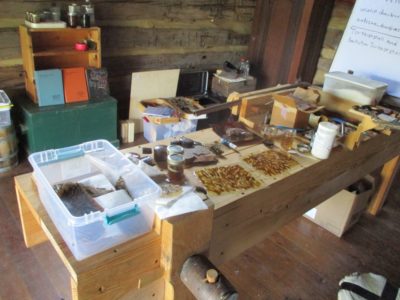
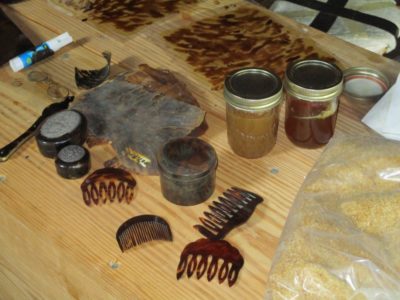
Some months ago I was approached by my friend TimD, who was organizing a “Historic trades” weekend at his place with fellow gunsmiths, horn workers, blacksmiths, weavers, etc. Tim is an accomplished craftsman, primarily making flintlock rifles and associated accessories like powder horns. So, he was gathering a number of friends and acquaintances for a weekend shindig open to the public and he asked me to demonstrate making my Tordonshell to the crowds. It was a peculiar technology to include but I was delighted to participate. I spent three days on display and explained Tordonshell to literally hundreds of attendees.
I was set up to occupy Tim’s gunsmith shop, a reconstructed late 18th/early19th log structure, using the partner’s workbench I built for him a few years ago.
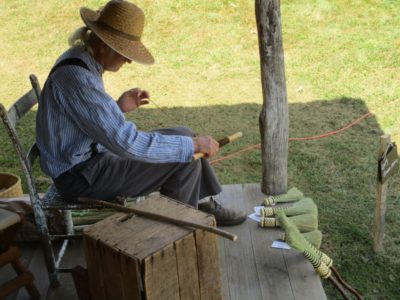
The front porch of the shop was occupied by other artisans including a wool spinner and my very own polissoir-maker Gary.
I was frankly surprised by both the number of visitors I had, and the intensity of their interest in both genuine tortoiseshell and my imitation of it.
Next year’s event is already on the books for Labor Day weekend and is expected to have around 30 demonstrators. I am already at work for my demonstrations, as I will be making things out of finished Tordonshell as opposed to making the Tordonshell itself.













Recent Comments