As I blogged earlier I will be selling many original First Edition 1772/1774 Roubo l’art du Menuisier prints at the upcoming Handworks 2017. I bought these prints at an auction featuring a huge inventory from an antiquarian bibliophile who had mutilated scores of exquisite ancient books by cutting out the print images from the bindings. As unfortunate as this act of barbarism was, it did bring these masterpieces to the marketplace.
The only other option for me to examine them closely would have been to purchase a complete set of First Edition l’art du Menuisier for perhaps $10-15k or travel to Ft. Mitchell KY to see Chris Schwarz’ excellent set. Since the latter remains an option to me for the foreseeable future, I’m jettisoning most of mine.
If you have ever wanted to own a genuine piece of Rouboiana, this is your chance. I will be selling my prints to Handworks attendees on a first-come basis, with terms being cash, check, or Paypal if you have a smart phone and can do that at the time of the transaction.
Roubo was the draftsman for all the prints, and the engraver for a large number of them. All these were hand-printed intaglio prints on hand made rag paper, almost certainly personally overseen by Roubo himself.
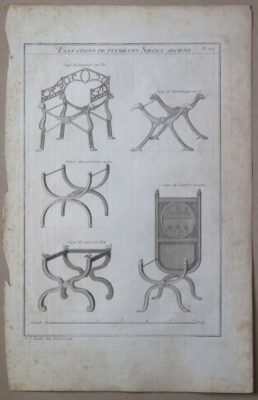
This is the first of the prints which I will be presenting in the order of their print numbers, Plate 222, “Illustrations of Many Ancient Chairs.” This image of chairs from the 7th Century through the 15th Century was both drawn and engraved by Roubo himself. The print is one of the rougher of those I purchase, with the left edge being pretty irregular as the removal from the binding was, shall we say, inelegant, and the page itself stained especially around the perimeter, reflected in the price of $100.
If you have any questions about this print you can contact me here.
I’m nearing the tail end of a long term project involving in part the sawing and preparing, and ultimately using, mahogany crotch veneers. Given my skill is not yet Roubo-esque I sawed the veneers to a fat 1/8″ because I had no room for error, in other word I would have to begin all over again with another piece of lumber if I could not get this to work out right.
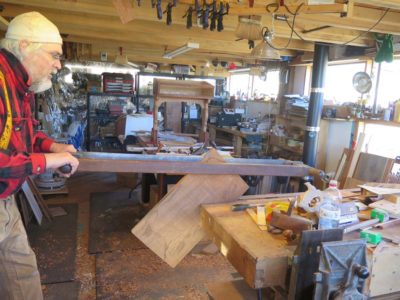
The weight of the veneer made it a delight to work with, that is until I had to thin it down to the final thickness.
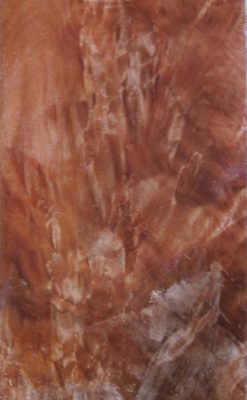
Working squirrely wood like this is less amusing than you might think. The grain was so wild I came down to only two real options; aggressive toothing plane work, which I did plenty of, or using a handled luthier’s palm plane. This latter step was immensely helpful once I got the tool tuned up. It reminded me of a lesson from the foundry pattern shop; to really hog off material in a hurry, use a small convex spokeshave that is sharper than sharp.
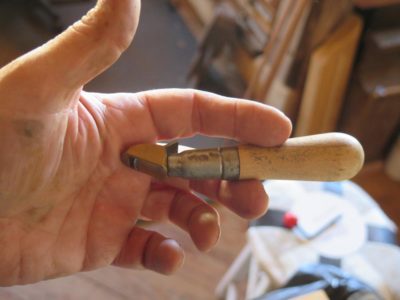
The tool in question was probably cobbled together but had real possibilities. The iron was adequate for nibbling at straight grain wood, but needed to be upgraded considerably in the sharp department. Given that the iron was barely larger than my pinkie fingernail I spent a couple minutes trolling in the shop for help.
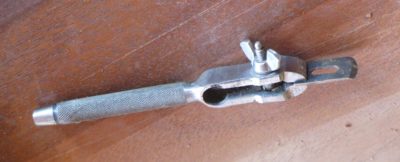
Then I found the perfect tool, my jeweler’s hand held vise. With the tiny iron securely held in its jaws I could sharpen it effortlessly just like it was a narrow iron four inches long. Piece of cake.

It sharpened to a brilliant mirror and uber sharp cutting in literally three or four minutes.
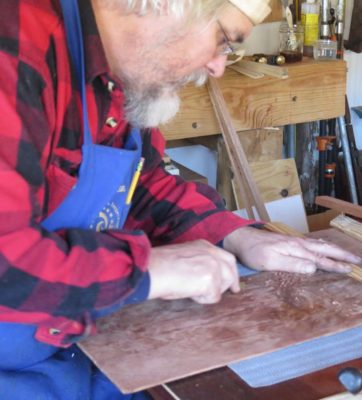
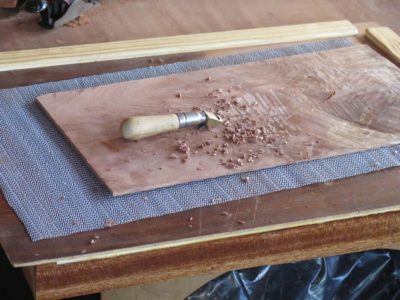
Putting it to hard work was a pleasure. It hogged off stock like a pro, and all it took afterward was some time with one of my toothing planes to get it ready for application.
And all because I went shopping for just the right holding device in my own toolbox, allowing me to get the teeny iron sharper than sharp..
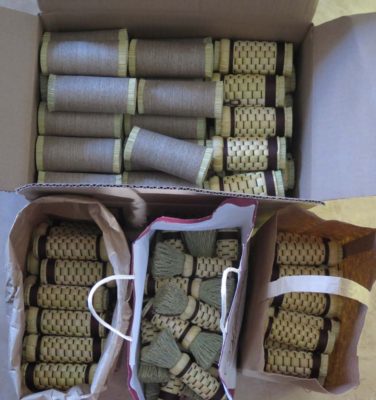
Starting top left and working clockwise: Model 296 ($42, sold privately and through Lie Nielsen only); 2″ Original ($42); 1″ Turner’s Model with 1/4″ bristles ($24); 1″ Carver’s Model ($24); 1″ Original Model with 1/8″ bristles ($24).
Yesterday I got my first polissoir inventory reload in the lead-up to the upcoming toolapalooza in Amana IA. I’ve asked the broom maker to just keep cranking them out until I say “Stop.” This is the first installment to make sure I have plenty for Handworks, and I intend to have sample boards to play with during demonstrations there. One of the things I want to emphasize there is how to prepare and tune up a polissoir for use.
You can also order them from me here.
Here is the full slate of activities upcoming.
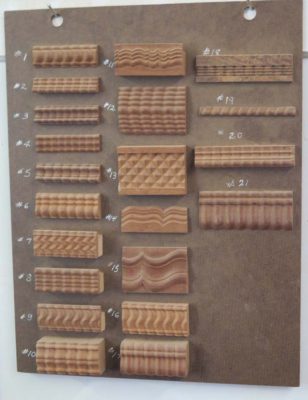
May 23-27 Making a Ripple Molding Cutter – this is less of a workshop than a week long gathering of fellow galoots trying to design and build a machine to allow us to recreate ripple and wave moldings. Material and supplies costs divvied up, no tuition.
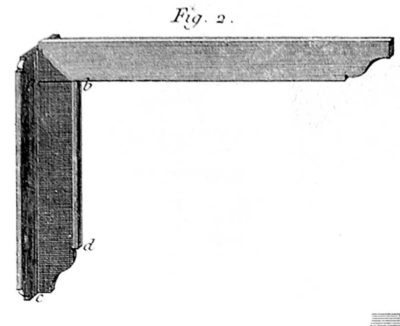
June 16-18 Make a Nested Set of Brass Roubo Squares – This is a weekend of metal working, as we fabricate a full set of nested brass squares with ogee tips, as illustrated in Plate 308 of l’art du Menuisier. The emphasis will be entirely on metal fabrication and finishing, including silver soldering with jeweler Lydia Fast, and creating a soldering station for the workbench. Tuition $375, materials cost $50.
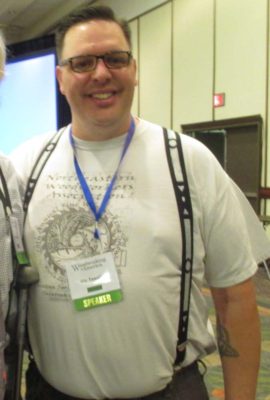
July 24-28 Minimalist Woodworking with Vic Tesolin – This week long session with author and woodworking minimalist Vic Tesolin will begin with the fabrication, entirely by hand, of a Japanese tool box. Who knows where we will end up? I am looking forward to having my own work transformed. Tuition $625, materials cost $50.
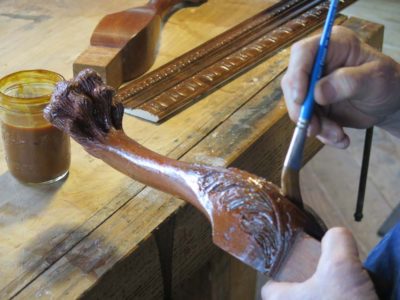
August 11-13 Historic Finishing – My own long-time favorite, we will spend three days reflecting on, and enacting, my “Six Rules For Perfect Finishing” in the historic tradition of spirit and wax coatings. Each participant should bring a small finishing project with them, and will accompany that project with creating numerous sample boards to keep in your personal collections. Tuition $375.
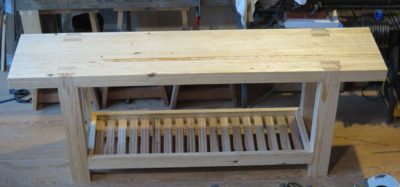
September 4-8 Build An Heirloom Workbench – I’m repeating the popular and successful week-long event from last year, wherein the participants will fashion a Roubo-style workbench from laminated southern yellow pine. Every participant will leave at the end with a completed bench, ready to be put to work as soon as you get home and find three friends to help you move it into the shop. Tuition and Materials $825 total.
Since some recent research revealed the attention span of Americans to be eight seconds, I’ll re-run this periodically.
If any of these interest you drop me a line here.
As I blogged last year I was fortunate to purchase at auction two lots of prints that had been sliced out of a First Edition of l’art du Menusier by Andre-Jacob Roubo in the 1760s and 1770s. These are remarkable artifacts, printed by hand on hand-made paper. Roubo was the artist for every image, was the engraver for a great many of the plates, and almost certainly was personally overseeing the production of the volumes.
As fate would have it all the prints I acquired are from the portions of Roubo that Michele, Philippe and I have completed after about 10-12,000 hours work thus far, and the hearty souls at Lost Art Press have already published.
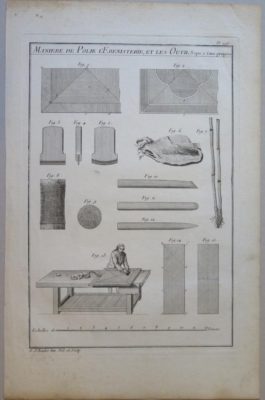
Plate 296, the one which lit my fire for this project more than 30 years ago. This treasure will feature prominently on the wall of our home.
Among the prints I bought was the very one that inspired me to head off down the path to our ongoing project to bring to the Anglophone world our annotated Roubo translations. Plate 296 whetted my appetite more than three decades ago, and as soon as I get a frame made it will be occupy a place of honor in our home.
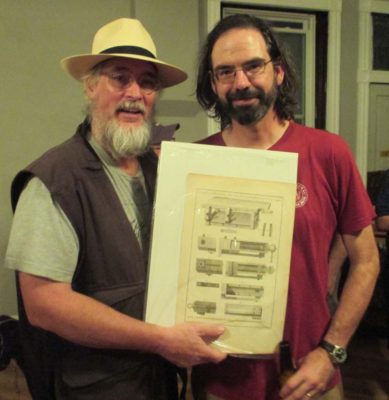
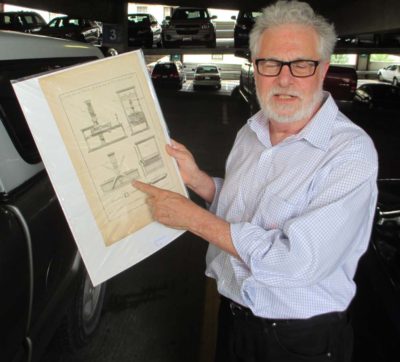
I have already gifted two of these prints to my LAP collaborator colleagues, chief-cook-and-bottle-washer Chris Schwarz, who received Plate 279 featuring “the German Workbench,” and book designer and artisan printer Wesley Tanner who seemed delighted to get Plate 327 featuring the printing press.
After culling the dozen-or-so prints of greatest meaning to me I have decided to sell the rest from my purchase because I do not have the appropriate wall space to display them (about three dozen); it is not a complete inventory by any means, but there are some pretty good ones.
Over the next several weeks I will be posting here all the individual prints I will have for sale in Amana. Terms will be cash, check, or Paypal. Prices will probably mostly fall between $150-$500 with a couple of outliers, but if you ever wanted a piece of genuine Rouboiana this is your chance. In addition to the Roubo prints I got a number of original, similarly excised plates from Diderot, all concerned with the manufacture of ship’s anchors. The Diderot plates will be considerably less.
There will be no advance reservations, this is a special first-come sale for Handworks attendees. If any do not sell there, I will offer them for sale through the blog afterward.
One of the great delights of attending the recent LNT event in Covington KY was to witness the overlapping of the generations of contemporary woodworking and woodworking tool makers. This atmosphere will be replicated to a logarithmic degree at the upcoming Handwork 2017 where there will be several dozen exhibitors in Amana rather than the half dozen in Covington. The ultimate irony is of course that the generations of modern craftsmanship, and the populations within them, have almost no relationship to the calendar.
There were of course the godfathers of the modern woodworking and toolmaking universe: Lie-Nielsen Toolworks (in truth Thomas Lie-Nielsen could be be considered one of the progenitors of this new world of high-quality tools at an approachable price), Chris Schwarz, Pop Wood, Matt Bickford. The middle generation was represented by Raney Nelson and Scott Meek, whose creative energies in the direction of tool making are probably now in their second decade.
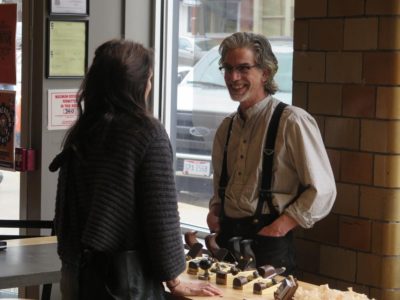

But what drew my attention was the presence of The New Generation in the persons of Mateo Panzico (top) and Steve Voigt, two brilliant toolmakers whose emergence in the marketplace over the past caouple of years has been noteworthy.
Both makers were at last year’s LNT Covington event (in fact my only picture of Mateo was from last year) and I was this close (thumb and forefinger a fraction apart) to coming home with some of their product but miraculously I resisted the temptation. The same could not be said for this year.

The two men are working in wildly different styles; Mateo is developing a creative vocabulary in infill planes, and his stylistic beginnings were a bit steampunk-ish but evolving into somewhat smoother, not-quite-organic forms.

Steve is tacking close to the winds of tradition with his double-iron beechwood body English designs. Notwithstanding my inventory of toothing planes, I am considering commissioning him to try his hand at the form.
Both makers are producing exquisite tools that are at the very highest levels of performance.
This year I came home with two smoothing planes, one from each fellow. In truth part of the reason I made the decision was my desire to get their tools before these makers become so well known and in such demand that I could no longer afford their tools. As a free-market absolutist myself, I will not object to their growing success in the least, in fact I will celebrate it, but I was simply making a rational decision to buy before they ascended to a point where I could no longer consider obtaining them.
The best part? Mateo and Steve are but the tip of the iceberg. There are literally dozens of new and nascent toolmakers seeking to fulfill your desires and demands in the marketplace.
Thanks to Lie-Nielsen Toolworks and Handworks 2017 for nurturing this new generation.
At almost the last minute I decided to attend the Lie-Nielsen event in Covington, in great part due to it being a sorta “release party” for With All the Precision Possible: Roubo on Furniture, (or simply “R2” for those of us living inside that particular bubble) which was arriving that very morning. Also in the equation was the fun I always have at these gatherings.
The exhibitors at the event confirmed my premise that we are living in a Golden Age of tool making and woodworking.
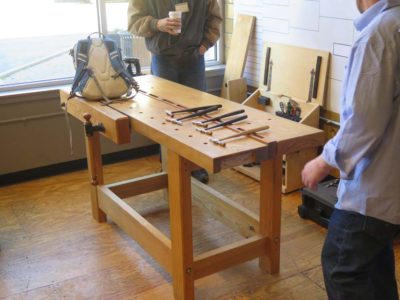
Beginning in the front corner window of the brew pub was Raney Nelson, plane maker extraordinaire and principal in Crucible Tools along with Chris Schwarz and John Hoffman.

Raney did have some of his planes in hand, but most interesting to me were these new plane-adjusting hammers he’s been noodling lately (I came home with one).
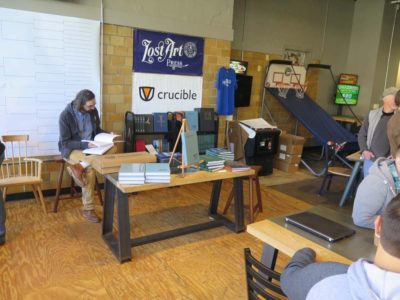
Next to Raney was the space for Lost Art Press. Since the second Roubo volume had arrived that very day, there was quite a bit of traffic. It was the first time any of us had seen the book in the flesh, and Chris (and I) spent a fair bit of time browsing through it. We are not displeased.

I used Chris’ staked table, I think this was the one with the soap finish, as my station for signing all three of my LAP books and promoting and demonstrating polissoirs and beeswax finishes.

I had a lot of traffic from friends old (Studley book collaborator Narayan Nayar on the left) and new dropping by for a signature and some chat about old ways of finishing.
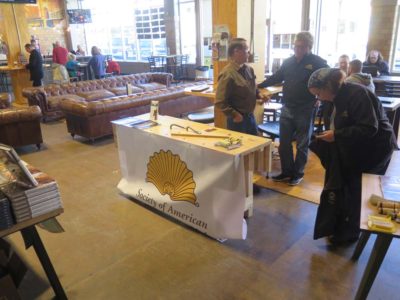
Directly opposite me was the work station for the Ohio River Valley chapter of the SAPFM as their workbench was humming with activity all weekend, extolling membership in SAPFM, an organization that is near and dear to my heart.
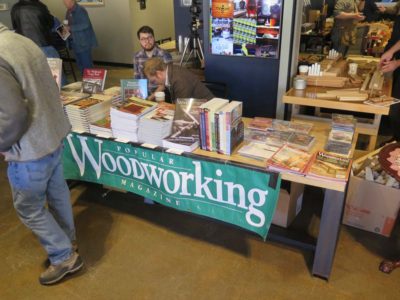
Rounding the corner was the large offering from Popular Woodworking with lots of books and videos, and opportunity to interact with Editor Megan Fitzpatrick and other PW/F&W staff, including video producer Jake Motz (in the beard and glasses) with whom I worked on two videos last year.
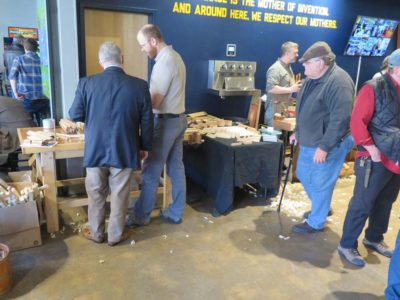
Turning into the bullpen at the center rear of the brew pub was Matt Bickford with a great selection of his molding planes and dozens of lumber blanks into which contours could be made. Immediately adjoining Matt was Scott Meek, whose magnificent planes are both high performance tools and sculptural artworks. Unfortunately I failed to get a decent picture of Mateo Panzica of Lazarus Tools who took his station between Scott and Steve.
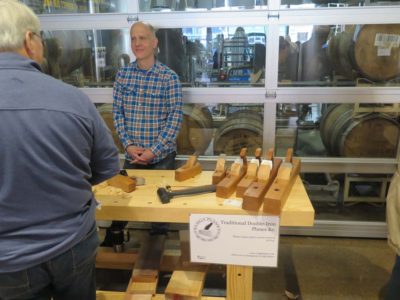
Along the back wall was my almost neighbor Steve Voight (he is a music professor in nearby Harrisonburg VA), whose traditional style beech bodied planes are a fairly new, and most welcomed, entry into this world.

Finally we come to the sainted patron for this and many more events of this type, Lie-Nielsen Tools. Daneb Puchalski and the LNT crew are remarkable in their teamwork — imagine if you had to both coordinate the entire event and set up AND take down your display every day — and their welcoming of fellow craftsmen and toolmakers is a model of evangelism at its best.

Now that the last bluster of winter is in the rearview mirror, it was a pleasingly and comparatively mild winter, and spring is in the headlights (we hope) it’s time to reflect on the utility of my cast iron bi-fuel stove for the barn. Finally, after three winters of trial-and-error I think I have it down to the point where it is the reliable workhorse heat source I had always hoped for.

To recap, the unit is a smallish British wood-and-coal stove probably of the 1970s vintage. Though smaller than the cast iron fireplace insert for the cabin, it is considerably heavier (the barn stove weighs in at about 525 pounds) due to the need for a firebox that can handle both wood and coal. I went on line to retrieve both the owner’s manual and to view youtube videos on the operations of such stoves. That was not the least bit helpful. In fact, I believe the owner’s manual was written by people who eventually became computer software instruction manual writers; neither had any usefulness for the end user, being written only by and for someone who already possessed full mastery of the “information” contained therein. Of course, it is possible that there is a contextual implication and perhaps those inculcated with the cultural norms of Britain are predisposed to operate such a device.
The stove is not located in the studio, it is in the basement directly underneath it. Thus it requires a long, steady heat in order to get the warmth up to my work space. Following the instructions on youtube served only to frustrate me, and I had to re-invent using this stove myself. Once that was done the use of this heater became a pleasure.

Here is the routine I have devised after scores of attempts, and is one I find to provide steady and constant warmth to my work space. A typical cycle for heating with the stove is 48 hours, by which I mean I can keep it running steadily but must clean out the ashes and clinkers every other morning. It usually requires 1-1/2 buckets’ worth of cleanout.

With the firebox emptied, the building of an effective heating fire can begin.

I begin this process by laying down about a roughly 2″ layer of nut coal as the bed for the fire and the foundation for the roaring heat to come.

On top of the bed of coal I place a single firestarter. If you are sharp-eyed with a good memory, you will recognize the firestarter as a piece of paper towel I used for the final filtering of our beeswax upstairs. I use one new filter for each platter of molten wax, so I’ve got a good (if not excess) inventory of this aid.
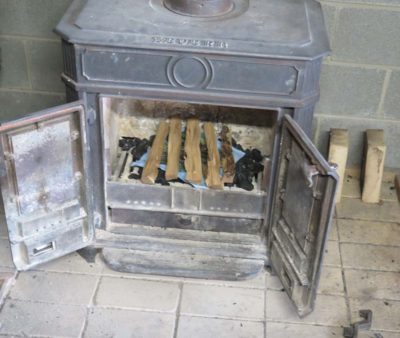
Next comes the whole reclusive woodsman skill set in constructing the kindling/firewood conflagration.

Each layer of fuel gets more massive.

Finally the firebox is completely full of dried maple, locust, and oak awaiting a flame.

Then, the flame.

Once the flame is going, I close the left door completely and close the right door to about 1″ opening to maximize the air flow.

10-15 minutes later I check back on the fire to make sure it is doing what I want it to be doing.

If going well, and a this point of my experience it always is, I place the iron fences at the front of the firebox to allow “banking” of the coal throughout the day.

Within a half hour the stove pipe is plenty hot, and upstairs it radiates heat into the shop.
From this point on I add fuel to the fire every hour or so until early afternoon. At the 1-hour point I add about three pieces of firewood along with three scoops of coal, at the 2-hour mark two pieces and four scoops, at 3 hours one piece and five or six scoops, and just after lunch another half dozen scoops of coal with no new firewood. I close the doors both firmly and make sure the flues are wide open (the gates are right behind the ceramic panels in the doors) and can usually hear whistling sound of the combustion air being drawn through.
As I wrap up the day at 6PM I pack the firebox as full as I can with coal, close the doors and tighten the latch, and close the gates halfway. Next morning when I arrive in the shop at about 8.30, the pace is still toasty warm and the fire is glowing red. I do a partial clean-out of the firebox by agitating the movable grates and emptying the ash drawer underneath, and spend the second day just shoveling in coal every few hours.
On even the coldest day of the winter — temps in the teens and nearly gale force winds — the workshop space was a cozy 64 degrees all day long (cozy because I am dressed for winter, after all). On such a day I will use 1-1/2 50-pound bags of nut coal, on a milder day 3/4-1 bag will suffice.
While I am not anxiously awaiting the next winter, I now know I can keep my own workspace cozy and amenable, and I still get to look out at the mountains any time I want.
Over the next six weeks I will be blogging about Handworks 2017 a lot, or at least my preparations for it to be sure. I think we are at T-minus 52 Days before departure.
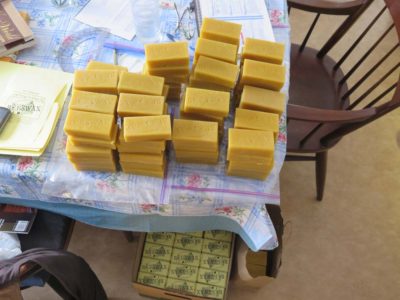
Over the winter Mrs. Barn prepared two full cases of packaged beeswax in anticipation of the event. If all goes well I will not bring any back home. One thing down, a bazillion to go.
I intend to demonstrate wax and shellac finishing during the event, so come by and say “Hi.” I’ll be in one of the center aisle booths at the Festhall.
The task for the second day of training at the Library of Congress rare book conservation lab was for each of the specialists to emerge at the end of the day with a perfectly prepared matched set of oak bookboards in order to create their own model of the art form. Considering that this was an assembly of gifted folks with near-zero woodworking experience, that is no small feat.
Re-sawing in the vise, crosscutting, and trimming on the bench hooks was what consumed the entire day.
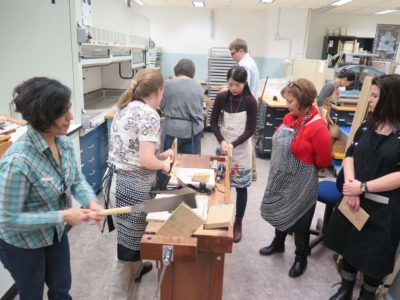

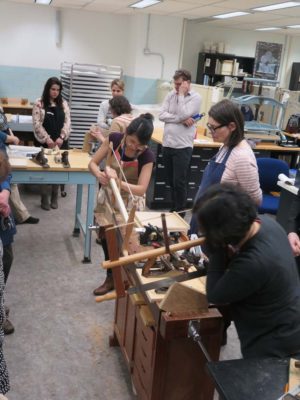
I let them try any number of re-sawing methods, ranging from my vintage 4tpi carpenter’s rip saw, my own bow saw or their bow saw, a range of Japanese saws they had in-house, my French style frame saws, etc. I have to say that by nearly unanimous confirmation the Japanese saws came out the favorites.
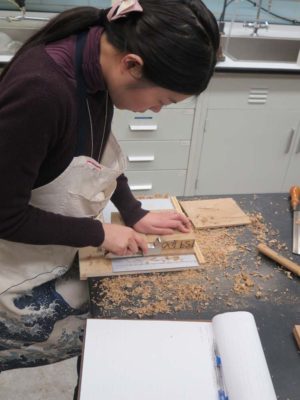
Following the re-sawing, and the flattening of one face of each of the two bookboards, I asked them to mark the desired 1/4″ thickness with a gauge and shoot a rabbet around the perimeter for the final thicknessing by hand plane.

Off they were to the races. After the boards were to the proper thickness they were sawn to width and length on the bench hook with back saws or Japanese saws, and all four edges shot also on the bench hook, mostly with either block planes of small bench planes (most of the book boards were in the 5″ x 7″ range). The final step was slightly beveling the edges.
As I packed up at the end of the second day I think everyone was well on the way to having their own pair of boards ready for making their model book.
It was an unmitigated delight to introduce them to the tools and processes of making their own bookboards and I look forward to getting reports of them applying their new skills to projects in the future. The virus of hand toolism was planted, and some of them even went to the recent PATINA tool sale two weekends later.
Now I just gotta see to fixing their orkbench problem.


Recent Comments