Recently I came across the pile of prints I have from a First Edition of Roubo’s L’Art du Menuisier. These were a lot I purchased at auction some time ago, primarily because it contained the core prints that started me down the Roubophile path decades ago. Though not a complete set of the volumes’ prints, they were and are spectacular even though we have access to them only because some barbarian cut up the original volumes just to have the individual prints.
These are hand-printed on hand-made linen paper, and Roubo almost certainly provided some level of direct supervision in their making (beyond doing all of the illustrations and engraving most of the plates himself). There is an almost tangible connection with him as you see the impressions from the engraved plate on the not-flawless paper from more than 250 years ago.
As soon as we can get the formatting complete they will go onto the Store page of this web site and be available for you to acquire for your own workshop wall or wherever you want them to hang.
Here is the inventory I will have for sale. Up through Plate 297 these are images of the actual prints I have, after that they are an image from Chris’ First Edition. I’ll make sure I have the genyoowine pics on the Store page.
224, Many Types of Folding Stools and Their Development
234, The Manner of Determining the Desired Centers for All Kinds of Seats
238, How to Draw a Full-scale Pattern of the Curve of a Seat
245, The Way to Draw Extended Curves Used on Bed Canopies
248, Illustrations of a Turkish-style Bed and its Developments
249, Plan and Elevations of a Campaign Bed with Its Developments
251, Diagrams of a table and a camp bed with their Developments
256, A Continuation of Description of a billiard table and the Instruments that are Necessary to this Game
259, Other Sorts of Game Tables with Their Illustrations
260, Diagrams and Elevations of a Desk With Its Developments
263, Further Developments of Roll-Top Desks and Other Writing Tables
271, Various Sorts of Shelves and the Profiles Appropriate for Armoires
273, Developments of the Buffet Represented in the Previous Plate
274, Plans and Elevations of a Common Commode
282, The Way of Preparing Frames To Receive Veneerwork
283, The Ways to Cut Veneers
297, Elements of Perspective Necessary for Cabinetmakers
298, Method of Creating Perspective Images With Wood Veneers
321, How to Add (Hardware) Fittings for Cabinetry
322, Portable Embroidery Frame with Its Developments
323, Continuing with the Movable Frame and Another Small Frame
Last autumn our Maryland friends Karl and Nina had a large holly tree cut down next to their house. (The area is rich with large holly trees; the yard of my daughter’s house has several gigantic trees with trunk girths up to nearly six feet with many more with a girth of three feet!) The tree had become a hazard to the house and had to go. I knew the tree and asked if they could keep the trunk and stump for me. They agreed, and several weeks ago I was back in Mordor and spent some quality time with a chainsaw in their yard. The harvest was almost three truck loads of wood.
Even though much of the wood was unsuitable for woodworking, the good stuff was a considerable pile. I now have enough holly to build many dozens of veneered Federal pieces with holly stringing. This is a the portion of the haul I brought back to my storage barn, the longest piece is about 5-1/2 feet.
Next trip back I will harvest the crotch, and somehow cut that into veneer or turn it into some spectacular bowls.
With great pleasure I spent the end of 2017 and beginning of 2018 preparing for my upcoming presentations at Colonial Williamsburg’s Working Wood in the 18th Century conference, and annual soiree of the highest caliber. It was a tremendous honor to have been invited to take the stage to give two presentations, one about historic wood finishing and one about the workings and accoutrements of an 18th Century Parisian atelier.
Things were progressing swimmingly until just before Christmas 2017, when I corresponded with Anthony Hay Cabinet Shop master Kaare Loftheim about the logistics of moving Colonial Williamsburg’s Roubo bench to the stage of the auditorium. His reply, which I should have expected, was that they did not possess a Roubo bench. I smacked my head. Of course they would not have an 18th Century French workbench since Williamsburg was essentially a 17th century English town!
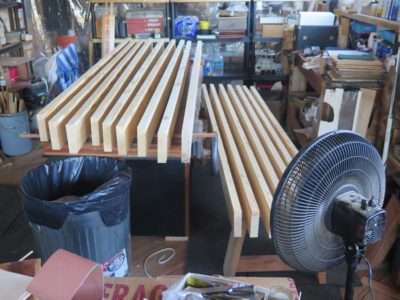
It was time to rethink my strategy as I would need to arrive with my own c.1760 Parisian workbench. I already had three that would serve the purpose nicely but they were so ensconced in their places that it was easier to build a new one for this demonstration.
I began with a selection of SYP 2×12 framing lumber stacked underneath the lathe. I ripped in half as much material as I needed to make the bench and legs and loaded the ripped lumber into the truck to cart downstairs to the planer.
After running it through the 10″ Ryobi planer to get clean surfaces on both sides and then carting back up to the main floor I set them out spaced in my barely heated shop for a few days to equilibrate.
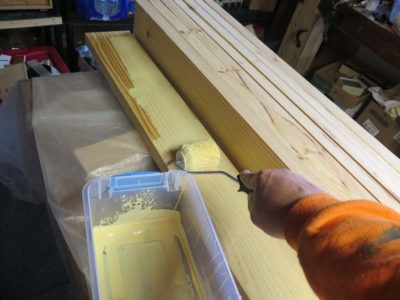
After spreading some plastic on the bench I glued up the core laminae using yellow glue to skirt any temperature issues. Previously with 3-3/4″ stock I assembled the bench tops in two pieces so I could run them through the planer once assembled, but since this was 5-1/2″ stock I was going to have to plane everything entirely by hand. No, I was not going to be slinging these slabs around to feed them through a planer.
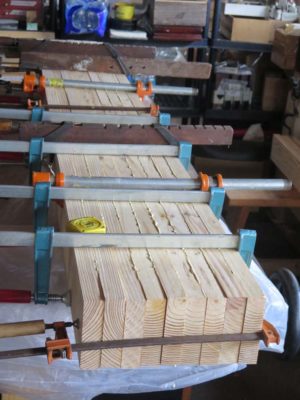
I had not yet finished fabricating Roubo’s panel clamps, which could be scaled-up to work perfectly for this process, so I wound up using practically every clamp I had of this size to get things glued.
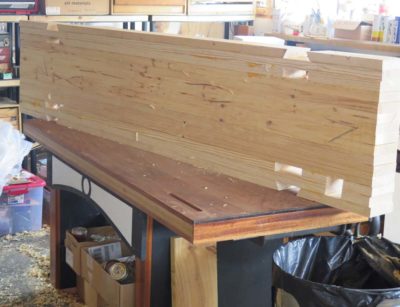
The next day I came back to glued up the outer laminae with the mortises, using 5″ decking screws as the clamps. The resulting slab was right at the weight limit I could handle by myself.
For many, many moons I have been restoring tortoiseshell boxes for one particular client, with whom I have become a good friend over the many years. Lately I have been on the home stretch for a group of boxes on which I have been working for a very long time. One complex tea caddy in particular has kicked by behind in every way a project can fight you. I cannot recall ever having such a troublesome project in my nearly fifty years in the trade. I took on that project thinking it was a straightforward one, bidding it at 20 hours of work. By the time I finished I was well up over 300 hours (I just quit counting a long time ago).
As Bob Ueker might say, “Just a bit outside.”
Still it has been a fascinating learning experience as literally everything that could go wrong has gone wrong, and by the time I finished it I had removed and re-adhered literally every single piece of tortoiseshell veneer on the box, and fabricated numerous pieces of “tordonshell” for the places where the tortoiseshell was missing. I developed several new techniques for tortoiseshell conservation during the time spent with this project, and look forward to the next one.
I will surely blog about these projects at length once I get past them a fair distance.
Between this and some travel, the teasing days of spring drawing us to work outside yet interspersed with the tenacious winter weather, really knuckling down to wrap up the manuscript for A Period Finisher’s Manual, and an article for American Period Furniture I have been up to my eyes in alligators for many weeks and I’ve been slacking on my blogging lately. I’m hoping that gets back to normal very soon.
PS – I still have not figured out how to use this !@#$*&^#$ new and “improved” WordPress template to include videos. I’ve got the next five in the Veneer Repair video series ready to go, but thus far the new stinking template remains obscured to me. I truly detest platform designers improving something that was working perfectly before, all because the idiocracy wants some new look. I get new clothes every other decade, and want my compewder programs to be updated as frequently.
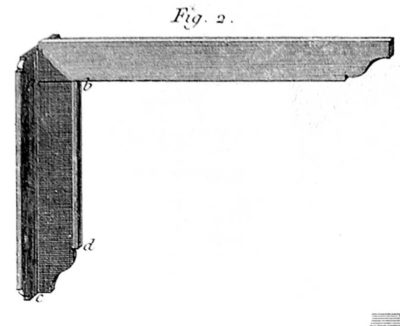
One new workshop for this summer is the project to make a set of nested cabinetmaker’s squares a la Roubo. When first encountering them I was immediately intrigued and made myself several versions of the form in wood, metal, and ivory. For the upcoming workshop we will make our sets with plate brass. Since the process and form might be unfamiliar let me recount it for you in several steps over the next couple of weeks.
Roubo does not describe the “making” of his tools, merely their utility. In our modern times we have the advantage of having tables saws at our disposal, and most of us have crosscut sleds. And, we have easy and (comparatively) inexpensive access to plate brass. I started with a piece of 1/8″ brass plate measuring 12″ x 24″ and cut it in half on the sled.
Since the fragments of the brass coming off the saw can be quite stinging, when I find that I cannot arrange to be out of the way I often cover the kerf line with a piece of scrap lumber to keep all of that shrapnel going down into the saw box rather than up into me.
The first thing I did was take the 12″ x 12″ plate and rip off four 1-inch strips to get to a final dimension of 8″x 12,” which would be the size of the largest square for this nested set. The 1-inch strips will become the “shoes” for the squares later on.
One of the trickiest parts of this step is judging how close to the corner you can get with your cuts as you want to make sure not to cut past it as that ruins the corner intersection. I get to about 3/16″ of the corner with the saw blade, then turn off the saw and rotate the plate to cut it at 90-degrees,
To complete this particular cut I took the workpiece to the vise and finished the cut with a large jeweler’s saw frame and some #4 blades.
The “outer” corner of the remaining piece was cleaned up gently with a file and I returned to the table saw to repeat the step. Lather, rinse, repeat.
In the end I was left with all the parts I needed to make a nested set.
Since I had very little invested in my set of kerfing planes I felt no hesitancy in attempting to modify them into greater usefulness, even if the result was their destruction. Fortunately it did not.
Clearly the solution to the knuckle scraping problem illustrated last time was to elevate the position of the trailing hand.
Since the bodies of the planes were made from Baltic birch plywood, my favorite material for prototyping (although probably far too often the prototypes remain the final in-use version for a lot of things) I just cut the handles off and remounted them to a more satisfactory position.
The only real challenge was to make sure that the glue line between the plane body and the newly re-located handle fit closely so that the new glue line was robust enough to withstand the use.
It was. I glued the handle in its new location then went back in and rounded out the front of the hand hole and it was ready to get back to work.
As you can see and I can testify the new posture was perfect for continued use without having to be attentive to the blood flowing out of my pinky knuckle. For someone who re-saws by hand a fair bit, this is a big deal.
===============================================
PS I am still trying to post the next video. I must have forgotten some trifling step in the process, but a soon as I remember it the video will go up.
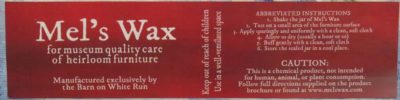
The introductory price of $43 for Mel’s Wax (domestic shipping included) will expire in a week as the price will assume the standard level of $49 (domestic shipping included) on or bout April 1. This is not an April Fool’s joke, it is just a convenient transition from the two months of previous pricing. At the moment I have no plans for another price increase.
A while ago I made myself a dedicated kerfing plane, adapting the designs by Tom Fidgen which in turn were probably originally documented by Roubo in the 1760s. Tom re-invented the idea unaware of Roubo’s tools, and in turn I adapted them for my own use. My first foray into this arena was re-purposing a derelict plow plane, and idea that worked okay, but then I moved on to a dedicated tool made with Baltic birch plywood build more along the lines of a backsaw profile.
For the workshop I taught last summer in Arkansas I made a few more kerfing planes, and their shortcomings, which I had dealt with unthinkingly, were a serious issue as almost every person who used them got their pinky finger knicked simply due to their configuration.
I noticed that the students modified their handhold to grab the tool differently, as I had done at home almost unconsciously after ripping open my pinky knuckle a time or two. It was time to address this nuisance and I did.
A few months before the benches were built for and debuted at Handworks, I had been invited to teach woodworking to my colleagues in the Rare Book Conservation lab of the Library of Congress. The emphasis for this two-day workshop was on fabricating oak book boards by hand. In antiquity the covers of a book were almost always leather covered this wood boards, usually quarter-sawn white oak.
The workshop was simultaneous delightful and frustrating. Delightful because the staff there was congenial, skilled, and highly motivated. Frustrating because they did not own a workbench worth lighting on fire. At the time I vowed to rectify that situation, and by repurposing one of the petite Roubos I did.
Several months later, as other projects were winding down in the studio, I was able to find the hours to transform one of the Handworks knock-down display Roubos into a workbench worthy of daily use by my friends at LC.
The initial steps were straightforward, as I simply reassembled the basic bench as I drove home the legs in their twin sockets with a sledge. They were so snug I did not bother with glue, I simply pinned them in place with 4″ screws and wedged any spaces. This construct was so stout that it would hold up to vigorous use even without integral stretchers.
The top surface needed only a few minutes of flattening, first with a #5 set up as a fore plane, followed by a freshly sharpened #7, and concluding with cross-hatching with a toothing plane. The stretchers and shelf were equally simple, just screwed in place.
In the end the “transformation” might be better expressed as “tartification” that came in the guise of a modified vintage leg vise I had in my inventory. Given the mundane nature of the original, probably a late-19th Century unit I picked up who knows where, I felt some enhancing was in order. The barrel head of the original was entirely uninspiring, simply inappropriate for the new setting and the artifacts it was to be part of.
I gave it some new life in its contour, and inset a large mother-of-pearl button at its center. Just because I could.
Not to abandon the foot of the movable jaw, I spent a few minutes with a saw and a file to give it a bit of pizzazz also.
My final flourishes were a double planing stop attached to the end of the top and some sharkskin pads for the top of the vise.
The true beauty of the bench was that with the addition of the risers underneath the legs it was suited for every person in the Rare Book Conservation group, and the petite size was absolutely perfect for the very limited space they had for it. It was the example of something turning out perfectly almost accidentally.
The second of the petite Roubos remains in the classroom of the Barn, awaiting re-fitting for my nephew’s wife who want to learn woodworking and will need a bench in their Philly apartment.
I have distant memories from more than a half-century past regarding my sister and a French pen-pal with whom she corresponded throughout high school and perhaps beyond. Evidently Pen Pal Clubs were a thing back then, I do not know if these were school activities or what, but I remember her reading tales from Monique(?) about every day life in 1960s France. These memories are charming artifacts from a time when people actually wrote letters by hand, on paper, using pens and stamps and such. For a time I was a letter writer, mostly to parents and siblings. My father would often shout out to my mother, “Mary get out the dictionary. Here’s another letter from Don.” (Actually my parents were both lovers of words and their skillful use, a trait that has redounded through the generations of their descendants; my 102 y.o. mother has more than a half-dozen great-grandchildren).
My sister is still an enthusiastic letter writer and I correspond widely myself, albeit by electronic means. My mindset might be 17th Century, but I am at least superficially conversant with modern technology. Via the magic of the interwebz I correspond with folks, mostly fellow woodworkers, from around the globe.
It was by these means that I made the virtual acquaintance of Jonas Jensen, a marine engineer and woodworking/homesteading blogger from Denmark. I have been following his Mulesaw blog for years, and corresponding with him nearly as long. I remember once chatting with Chris Schwarz about Jonas when the latter attended Chris’ tool chest class in Germany, and Chris remarked, “Yeah, Jonas is your kinda guy.”
Our correspondence is voluminous and while it concentrates on woodworking it also contains forays into family, homesteading, world-views, and a host of other rabbit trails.
Until recently Jonas’ work travels were concentrated in the northern Atlantic Ocean as he was an engineer on supply ships providing support for North Sea oil rigs. We who follow him were never short of amusement as he would chronicle amazing woodworking projects using crate wood and similar materials and a sparse tool-kit working in the machine shop of the ship. Though I encouraged him to visit or even move to the Virginia Highlands he was bound to family and job in Scandanavia and the surrounding region. Any trek to North America was simply out of the question.
Recently all of that changed. About three months ago Jonas excitedly informed me of a job change, moving from utilitarian North Atlantic supply ships to become the Chief Engineer on a heritage Norwegian sailing vessel.
And, that ship makes an Atlantic circumnavigation every year, stopping in Norfolk, Virginia. With great anticipation we marked the calendar and planned to meet in person on his ship. We finally did so last week.
As I was approaching the berth where the ship was docked I wondered if I would recognize it. Of that there turned out to be no doubt. The ship is striking in appearance, and the giant Norwegian flag allowed me to find it effortlessly. I strode up the aluminum gangplank and a minute later the beaming face I recognized from his blog approached me and we greeted each other warmly.
What followed was a memorable time of fellowship and learning about the ship that was his new work-home. I was struck by the elegance of the ship even as I was at its entry. This fitting for a section of folding rail was truly impressive, only the first of many times I was agog in the coming hours.
I had the same overwhelming impression of the yards of well-fashioned mahogany throughout the ship, from the precisely fitted decking to the vintage steering wheels (two sets) to the exquisite pilot house.
Though retaining its century-old heritage and configuration, the ship is necessarily a thoroughly modern sea-going vessel as you might expect for a ship traversing the full Atlantic Ocean. To the greatest extent possible the modernization of the ship is disguised, as in these rescue runabouts suspended over the deck. There is no practical way to make these speedboats look old, but at least the booms used to hold and lower them are fashioned to look like they were part of the original construction more than a century ago.
The attention to historic presentation and modern practicality continues below decks as well, some times the modern looking not much different than the vintage. For example, the carpenter’s shop looks like any carpenter shop might look in such a setting. Still, the absence of “flat, square, and true” almost anywhere on the ship is disconcerting to us landlubbers. I think a week in this shop would probably make the OCD/anal-retentive type woodworkers mad.
Just down the way from this shop is one I think Jonas might be eyeing for re-fitting as another woodworking shop. The set-up is well underway with this bequeathed set of hand planes already ensconced there; the space only needs Jonas’ magic ministrations to turn it into a fine woodworking shop.
In between these two spaces was a store room filled with ropes. Lots and lots and lots of ropes of every size and configuration, along with a number of examples of the sailor’s knotwork arts.
One of the primary functions of the ship is as a training vessel for naval cadets from the Navies of Norway, Sweden, Denmark, and The Netherlands. When hosting groups of these naval cadets, usually about 60 at a time if I recall correctly, these younger folks sleep in hammocks hung from hooks in one of these large bays. You can spot the hooks on the beams overhead. Each cadet has 1/3 of the floor chests, and the dining (and studying?) takes place at the benches and tables situated along the hull.
Fortunately further back in the ship are the cabins for the crew and officers of the ship, including Jonas. This cabinet in Jonas’ cabin re-emphasizes the reality that on a ship like this, almost nothing is flat or square. The cabinet and cabin doors often look like they came from a crazy house in an amusement park.
The accouterments and detailing of these spaces are quite elegant. Carved stair railings, furnishings, and skylights are all magnificent.
After the tour of the ship we went out for some barbecue and the conversation lasted for hours, covering woodworking of course, but also rural living, faith and world view, families, and the state of Western civilization. Jonas made arrangements for me to sleep on board, and before dawn the next morning we parted and I headed for home looking forward to our next reunion.







Recent Comments