You might recall my recent post about Ray Larsen’s piano maker’s workbench, probably with one degree of separation from Studley himself. Ray recently contacted me to let me know he was considering selling the bench to someone who would restore and use it. If you are interested in connecting with Ray about this bench, drop me a note via the “contact” button on this page and I will forward it to him.
I am an entirely disinterested party in this affair, seeking only to match a grand work bench with an enthusiastic new owner.
I am not a morning person, and thanks to the WIA home page hotel reservations we found ourselves staying more than 20 miles away from the conference hotel. Check: lesson learned. Make your own reservations.
This all comes together in that the first session on Day 1 of WIA was one I very much wanted to attend, and in fact I made it only a few minutes late. Mostly that might be due to the facts that 1) it was Friday morning rush hour, that 2) the road signage in greater KC is among the worst I have ever encountered and Google and Mapquest merely compound the problem with incomprehensible directions, and 3) my ambulatory speed was set to 0.1. I think it took more than fifteen minutes for me to get from the parking garage into the exhibit hall, then up a flight of stairs and across the long balcony to the conference room.
Nevertheless I get to the presentation of James “Stumpy Nubs” Hamilton probably five minutes after he started. The title for the session was something like “Make Your Own Woodworking Machines” and based on the riches of information from his web site I figured it would be a lot of fun. And it was! Two hours of jigs and home made devices was a total gas. Yes, I have been steadily moving towards hand-tool primacy in my own work, but I do have a pretty complete machine capability in The Barn, and to quote hand tool star Vic Tesolin, “Of course I love machines, I’m a guy!”
The Stumpy Nubs session was indeed a trove of motivational treasures. In particular I am prompted to finally build the horizontal drum sander I can use when preparing the yards and yards of veneer strips I produce for executing Roubo-style parquetry. I’ve already thought of a couple of ways I can tweak their design to better suit my own needs. This will please ol’Stump to no end as he probably views his role as evangelist and innovation encourager, taking delight in seeing his ideas taken to new heights. I’ve already got the basic ingredients in-hand: hyper-curiosity, a stash of electric motors and machine parts, and lots of Baltic Birch plywood.
Mrs. Barn and I also had a wonderful time later chatting with Jim and his dad Mike in their booth over in the Exhibit Hall.
The lead-up to WIA, in fact my very attending it, was predicated on the Monday morning appointment with the orthopedist. Much to my (expected) delighted, he noted that my recuperation was progressing excellently, and that at the six-weeks-and-four-day mark he released me to resume normal activities. I was now free to progress through the stages of bipedal locomotion, casting the walker aside and moving through the crutches and then a cane and then nothing.
We hit the road the next day, winding up in Kansas City on Thursday. Mrs. Barn was not sanguine with the idea of me driving, so she spent every mile of the trip behind the wheel.
Along the way we even took the time to do something we almost never do, we actually stopped and engaged in tourism. Since it was only 25 miles off the interstate we took the detour and spent a half-day at Pleasant Hill Shaker Village just outside Lexington KY. I was walking for four hours with the assistance to my pair of crutches. It was exhausting.
Worse than that, the almost nonexistent on-site programming and tepid presentation at Pleasant Hill was disappointing. We learned from the one fellow we saw working there that the plan to eradicate craft practices from the site will be complete in the hear future. To me that removes a return visit from the list of things to do.
Still there were some noteworthy encounters, beginning with the remarkable circular staircase at the building now serving as a restaurant and hotel.
My steadiness on crutches was iffy, so I did not get the perfect picture from the bottom.
While walking around, probably my favorite thing of the whole place was this amazing stone wall.
Among the pieces of furniture these two caught my eye. The first one has a one-piece side board, eight feet tall by about twenty inches deep,
with this one being my all time favorite. I might have to build something like this some day.
Even though I was mobile, it was not sprite-like and my motion was super slow motion. This rendered much of the place inaccessible to me, but still it was terrific to spend the day upright and moving..
That night as I drifted off to sleep I had the delightful experience of aching from a day of “walking.”
Knowing my interest in all things Studley, Patrick Leach recently sent me an email with the following:
It has a book-matched mahogany top with vivid grain, the mahogany is 1/2″ thick veneer.
It has a long slot for a sliding dog, but I don’t see any sign of that on the vise, nor do I see that it ever had one. All the other dog holes have their original dogs.
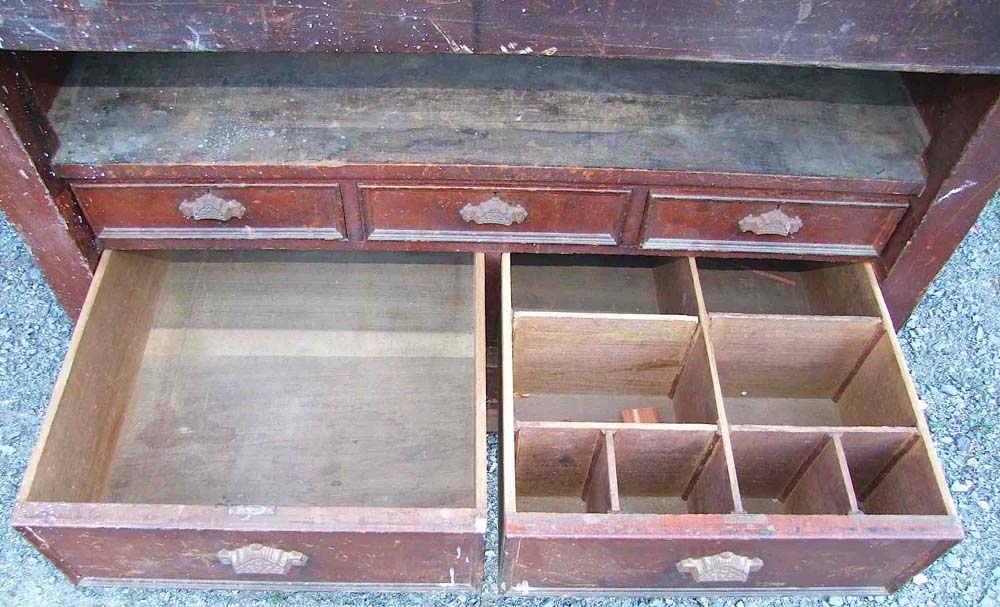
The open area under the bench top is odd. I don’t see that any front/drawer was there.
The vises are both original, and off the bench. Each is a different width and with differing length of travel. The fixed jaw is mounted on the top. The metal is japanned, though there is little left.
The top needs to be scraped, if you want to make the mahogany pop.
It was found near Lawrence, MA, another area for piano making. It’s older than mine. I’d guess it to be ca.1890.
And, it’s for sale! If you are interested, contact Patrick directly. His email can be found on this page.
It’s been 6-1/2 weeks since my little argument with Ace “Bonecruncher” Wheelbarrow, resulting in his, well, crunching the biggest bone in my body. I have assiduously followed the medicos directions ever since, including ZERO weight on that leg, to keep from loosening the mondo lag bolts pinning the hip ball together while the bone fuses, and undertaken twice daily exercises to retain muscle mass and improve the range of motion. I have been pleasantly surprised at the progress, frankly I expected it to hurt a lot more and for a lot longer. Still I cannot recommend breaking your hip just for the fun of it.
Over the past three weeks I have been spending the majority of most days up in the studio. Admittedly, the accomplishments have been modest and slow, as you might expect when the allowable motive force is restricted to one leg while holding on to a geezer-style walker with two hands. To tell you the truth, mostly what I was doing was just cleaning up and being somewhere other than the recliner in the living room, and if nothing else the constant slow movement was good for both my hip and my psyche.
Today was the long anticipated return to the orthopedist’s, and the result was as I had hoped. After x-rays I went to the examining room where he first manipulated my good leg to get a point of reference regarding the hip function, then he grabbed my bad leg and did the same, instructing me to stop him when it hurt.
I had no reason to stop him. Its healing and flexibility are excellent, and I told him I didn’t actually feel anything as he was yanking my leg around. He smiled and said that was the answer he loves to hear. He said the pictures looked perfect, and that I was to return for a final exam in two months.
In short, he has released me to “resume normal activities as tolerable,” including moving with the use of a pair of crutches ($1.99 at Goodwill) and a single cane to ease myself into bipedal perambulation over the next few weeks. I will be rotating amongst the three walking aids for the near future before becoming entirely comfortable with freestanding, um, free standing.
As I took my first gentle steps this afternoon I noted the oddity of the sensation. For starters, since I have placed no weight on the skeletal structure of my right leg it has all loosened up in the past six weeks, so there is a weird “loose” feeling when I put any weight there, with the hip, knee, and foot all wobbly. Not painful nor uncomfortable, just weird. And second, it is amazing how weak the leg feels. A few gentle steps and it feels worn out. It will take at least a couple of months at least to get my full strength and stamina back, but the road has been mapped out.
He noted with some humor at the change in the comparative muscularity of the two thighs; my left thigh is probably 5% more robust while my right thigh is 10% less. This is with a rigorous exercise regimen! And don’t even talk about gluteus maximus. My right glute has almost disappeared, making sitting a challenge sometimes, especially on the hard chairs at Sunday Night Bible Study if I forget my pillow. Thanks to the loan of a primo pillow, riding in the car is no more uncomfortable than it was before the accident.
The only long-term downside of the adventure, more from the orthopedist’s point of view than from mine, was that no one managed to film the original incident. The Doc said it must have been hilarious in super slo-mo. I’m guessing he was right.
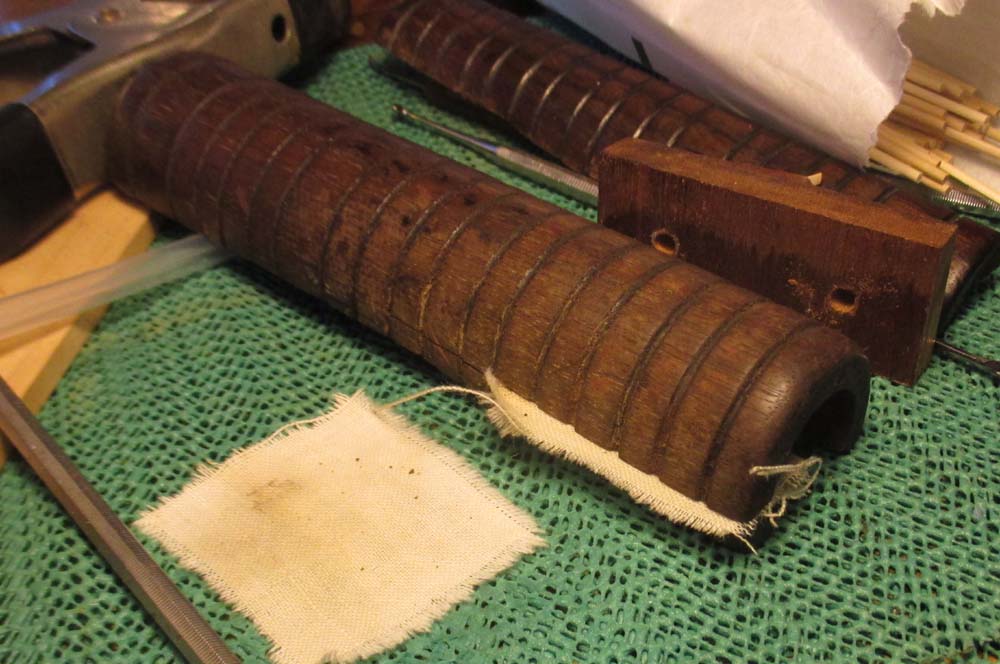
By buddy Bob is a gunsmith,and lately we have been collaborating on some of his projects. The first one was a split and broken forestock on a client’s ancient shotgun that might have been on the Mayflower. The stock had obviously been damaged and repaired many times, and the evidence of those campaigns was abundant. I could identify at least four different adhesives employed, including polyurinate foam, yellow glue, liquid latex construction adhesive, and something like an acrylic resin gel.
The strategy for the repair was complicate by the fact that these repeated incidents of damage and repair had resulted in the loss of some of the original material at the fracture line. No matter what, this would make the re-gluing an adventure.
On top of all of this the broken piece, being from a functioning firearm, was pretty fully contaminated with lubricant oil. Thus the cleaning regimen required was multi-faceted, including solvent soaking (acetone and naphtha) and many hours with a magnifier and dental tools to scrape and chip off the accretions that would not dissolve.
For the solvent cleaning I swabbed the surfaces repeatedly with my cleaning solvent mixture on cotton swabs, cosmetic sponges, and sometimes just cut pieces of blue paper towels. The amount of oil that can be in a wooden gun part is pretty astounding. Because of the repair strategy I was going to follow I needed to get the entire interior of the stock squeaky clean.
An additional issue was a split in the stock that had not become detached.
I gently pried it open and slipped some cotton fabric into the split, then wicked in acetone to remove as much of the oil as possible.
Once that was done I introduced West epoxy into the crack, closed it and swabbed off the excess with acetone, then clamped it up to harden overnight.
The next morning I went over the inner surfaces one last time with acetone. Once that cleaning was concluded, I was ready to reassemble to broken pieces. That comes next time.
After much consideration I decided to upgrade the heating in the barn studio. While my existing system of a premium wood/coal stove in the basement combined with a kerosene heater in the studio provided plenty of heat, two problems needed addressing.
For starters, the kerosene heater consumed about 1-1/4 gallons of kerosene for a full day’s heat, at a cost (last winter) of about $5/day. Not a killer, but not irrelevant.
Second, and more significant, was that I have never perfected the knack of keeping the wood/coal stove in the basement burning all night. Thus even though the shop space is super-insulated, every morning when I arrived in the shop, given the usual howling winds here its temperature would be close to the outside ambient temperature. This meant that a great many mornings the shop was in the single digits, and it took a very long time for the stove and heater to get the space and its mass of contents up to an acceptable temperature. My late afternoons were cozy and comfortable, toasty even, but the mornings were mighty brisk.
With that in mind I selected a heavy duty Empire three-panel radiant heater, fueled by propane. It was installed last week, and on its test run made the space uncomfortably hot in short order. The propane service fellow (actually a good friend of mine named Brad) thinks that given the volume of the space and the super insulated walls and ceiling, I should be able to make through the entire winter on a single 80-gallon fuel tank, or about $175 worth of fuel. This works out to about $1.25 a day. My strategy is to keep the propane heater set at about 40 degrees, just enough to keep the space warmer than freezing and much easier to heat up with the wood/coal stove in the morning.
I’ve also purchased a bunch of transparent shower liner curtains to close off one end of my shop, a space where I do not need immediate access most days. Reducing the volume of air being heated by 25% should have a beneficial impact on the micro climate.
Since the heating season in the mountains will begin in about a month, I should be able to report back on the efficacy of the new arrangement soon.
My studio space in the barn is a work in progress. It has been so since the first day I put a single, raggedy workbench in there several years ago even before all the walls were up, and the process will continue as long as I work there.
I find that the fluid nature of shop organization is one of the threads binding craftsmen together, and a source of celebration when we gather together. Fortunately for me, I do not have the urgent requirement for maximized cash flow velocity generation from my work space, since my primary source of income these days is in the crafting of words while sitting on my recliner.
And, since I have been limited in the scope of my activities recently I have been reflecting on, and to some degree changing, the spatial flow for the studio. One of the advantages of this long lead time of several years of working there is to evolve a better sense of what the space should be to best serve my needs. And now I am making those changes, albeit slowly as there is only so much you can do on one leg.
I’ve already written about the reconfiguration of one corner to more optimally serve as my bench for doing the “fussy” work I encounter frequently in the conservation and restoration of decorative artifacts, and increasingly the repair of vintage gun stocks.
Other issues have nagged me, and are now in the process of being resolved. The first of these was my inadequate space in a single location for the residence of my hand planes. I liked the space I had chosen, directly over the planing beam, but I needed to consolidate all my inventory, which involved several steps.
First, I started undertaking a serious evaluation of many of the planes marginal to my work, deciding what to keep and then tossing aside planes that took up space but were not part of my working regimen. Down they came and out they will go.
That cleared some space, but not enough. So, I added more shelving without adding more shelves. How? By simply doubling the depth of the shelves in situ. Why I did not do this from the git go remains a mystery. Then I removed the silly brackets holding my Stanley/Bailey planes and hung them on the wall.
Presto! The result is twice as many planes in the same visual space.
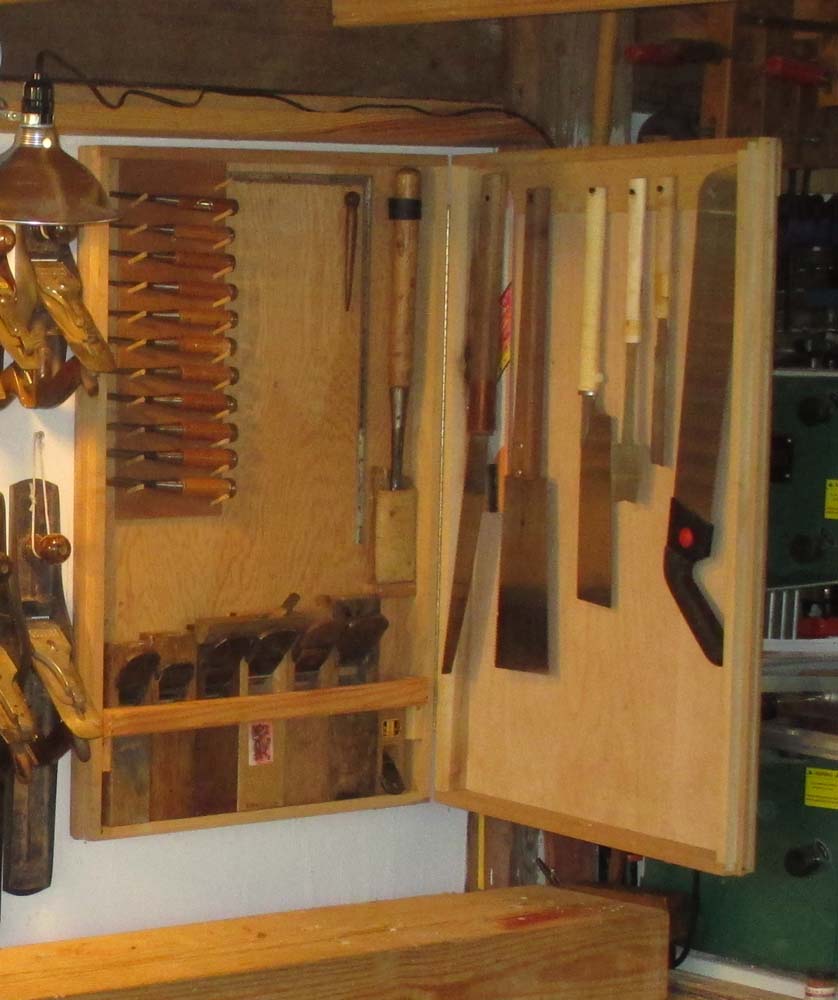
The next move was the consolidation and moving of my Japanese tools from a nearly inaccessible place on the east wall to a cabinet in the remaining niche over the planing beam. With saws on the outside and more saws, chisels, planes (and space for more on the inside) I am pleased with the result. (You needn’t scold me that I have the planes upside down in storage — I do not care)
Two final (?) issues to be resolved are the rat’s nest of a space halfway down the long north wall, which had become nothing more than a pile of stuff, some good, some less so, but all in the wrong place. This hodgepodge will be replaced in October when I build my Nicholson bench prototype for the rescheduled Refinisher’s Group bench-build (probably May 2016). This can serve as another work bench and my sharpening station.
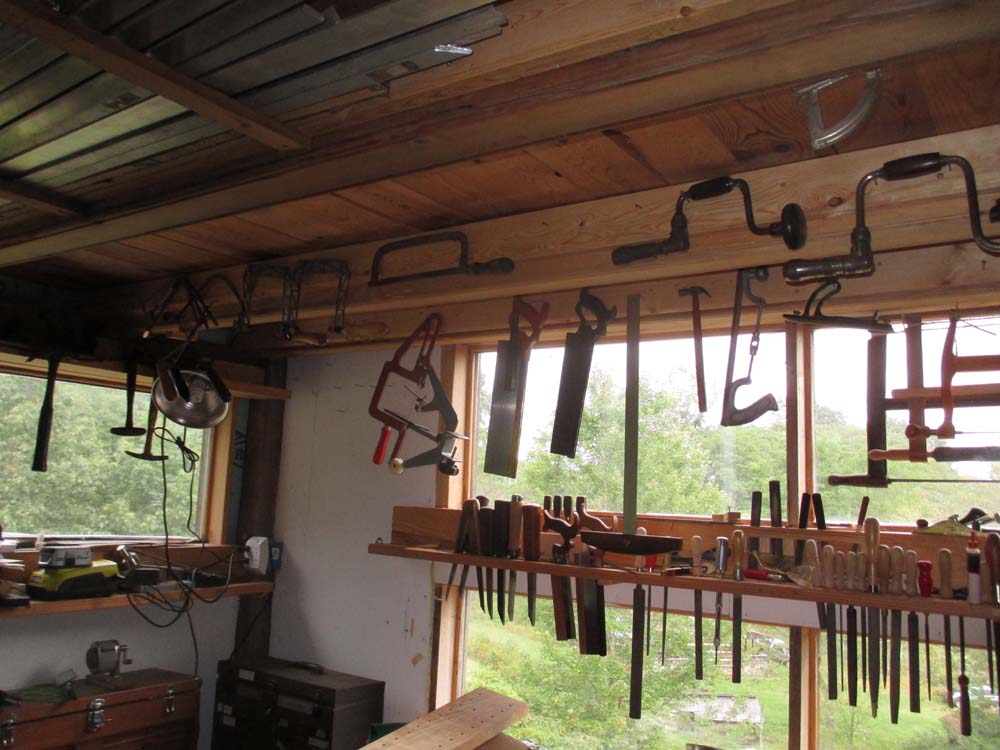
And I keep asking myself: with such a wealth of windows, why do I keep covering them up with stuff? Without a good answer other than, “Because you are an undisciplined slob,” I have begun to deliberately move many of the tools that were blocking the view to somewhere else, like alongside the overhead beams. That one will take a fair bit of trial and error to bring to fruition.
But I am determined to travel much less in the coming year or more, and pouring my time and creative energies into the barn and homestead. This will allow much in the way of improvements and I am anxious for them to unfold.
One of my favorite woodworking web sites is Stumpy Nubs, which I browse regularly. The other morning I was startled to see my face featured prominently, and followed the video link.
It did not take too many seconds before I was laughing out loud. Rose petals and dandelion fuzz indeed. Finally a news report that veers dangerously near the truth. Given the state of modern “reportage” (blogger and law professor Glenn Reynolds has characterized most “journalists” as activists with credentials) it is a relief to find an account bearing any resemblance to reality.








Recent Comments