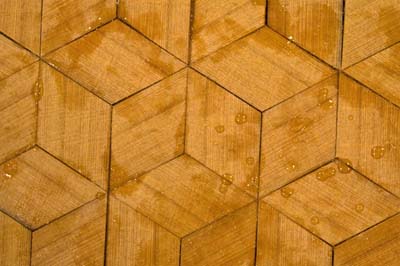
Once you select your wood, prepare it such that the edge of the lumber is the radial orientation, and make the board flat and true. Using a power jointer and power planer or drum sander is perfectly fine. It’s how I do it. My favorite little Makita combination 4″ jointer/4″ planer is darned near perfect for the task
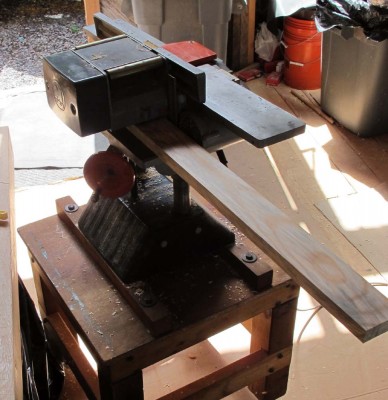
The thicker the board, the larger the eventual veneer lozenges (and pattern) will be, and the converse is equally true. For first timers. unless you have a specific design aesthetic in mind I recommend lumber stock finished to about 1-1/4″ thick.
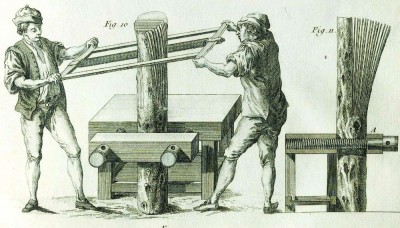
The final step in acquiring the raw material for the parquetry is to saw the edge of the prepared lumber into slices about 1/12″ thick. You need not follow historical precedent precisely.
Whatever tool or machine you use for such processes is fine. I set up my band saw with a fence and simply run off slices until the board is gone.

And, you do not need a big, expensive band saw. My favorite tool for the job is an old Delta 10-inch benchtop model with a 1/4″ narrow kerf blade. A single point or half-fence guide is perfectly fine, and as you can tell, I do not invest much money or time on this. This arrangement has cut hundreds, probably thousands of linear feet of veneer stock for parquetry.

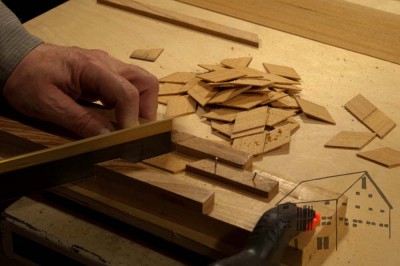
To figure out how many strips you need for your project, simply lay them down next to each other as you are cutting them, and compare that area to the area you are trying to cover. Make about 10% more than your panel’s end size and you should be fine. This image shows a piece of stock laying flat — the strips are cut off the edge on its radial orientation — with the pile of perfectly equal and parallel veneer strips ready for sawing into simple parquetry.
Next, a review of the hand tool inventory you need for the project.
Whenever I teach I request honest and constructive feedback, especially from my hosts. (I often even request video if it is available, and I do study it not because I am a narcissist but because I want to be better at what I am doing)
My recent “off campus” weekend at the Kansas City Woodworkers Guild was just one such event. Many fine swaths of parquetry were created, but the weekend was not without its hitches. There were definite instances of frustration and communication failures, many revolving around the problem endemic to teaching something to new audiences. Since I have done this parquetry exercise so many times I have internalized much of the process such that it is not even fully articulated in my head any more. After the fact I realized that I was reminded that I had not given enough detailed step-by-step instruction, something I am determined to rectify.
One excellent suggestion from the KG gang was that I create a detailed illustrated tutorial for the class, especially since I am going to repeat the workshop probably several times in the coming years beginning with the weekend of July 18-20 at The Barn. Beginning with the selection and preparation of the stock material, through the inventory and use of the tools, constructing of templates, to the much-more-difficult-than-it-looks process of compiling the pattern, and finally the finishing process.
I have finally finished writing the tutorial and will plug in the pictures and post it in installments beginning Thursday or Friday. Once I have posted all the installments, I will move it to the “Writings” page as a free, complete, and downloadable .pdf.
======================================================
My workshop schedule for The Barn this year is decidedly and purposefully brief with the Roubo manuscripts, the Studley manuscript, and the Studley tool cabinet exhibit hanging over me.
July 18-20 Parquetry and Banding
August 11-13 (H&R pair) and 14-17 (complex) Plane Making with Tod Herrli
October 3-5 Boullework Marquetry
If any of these interest you, contact me here.
It’s been a while since I added to the Shellac Archive with Juliane Derry’s very important recent Thesis, so I thought I would dust off another, much older piece of valued research.
Henry Payne and William Howlett Garner, two monumental figures in the workd of coatings technology, co-authored the 1937 paper “The Relative Effect of Structure and Other Factors on the Permeability of Varnish Film” for the Shellac Research Bureau of the Polytechnic Institute of Brooklyn. The BPI phase of the SRB research was the most fertile period of shellac research ever, in my opinion.
I would abstract the contents, but I think the title is pretty self-explanatory. It does make for an interesting conceptual bookend with Bill Feist’s “Moisture Excluding Effectiveness of Finishes on Wood Surfaces” from the Forest Products Laboratory in 1985.
One of the wondrous (?) things about moving after almost thirty years in the same house and with the same job is to “rediscover” treasures you squirreled away for some future day. Well, that day has come.

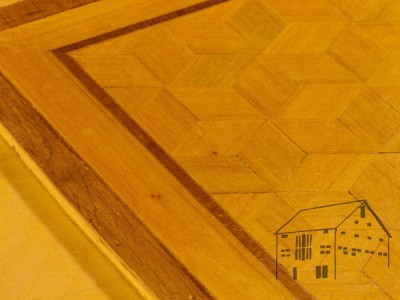
One of the treasures I acquired in the distant past was this Anglo-Indian lap desk, with ivory and sadeli parquetry on a yellow sandalwood base.


I bought it for a song because the antique dealer had absolutely no idea how to restore it, and fortunately I do. The “secret sauce” adhesive technology revolves around road tar. Yup, asphalt was the original adhesive laying down all these tens of thousands of bits, and I expect I will use it again. I can practically sense the wide smiles on the faces of two dear friends, “Czar of Tar” AlanN and finisher extraordinaire DaveR, two earnest evangelists for asphaltum.

This detail is of a medallion about the size of a nickel.
Now to somehow figure out how to work its restoration into the schedule…
Last Monday while en route to the Virginia Highlands, my friend Tom and I had the opportunity to visit an old colleague of mine and make the new acquaintance of a remarkable artisan, thriving in the smallish Shenandoah Valley city of Staunton, Virginia.
I first met architectural conservator Richard O. Byrne almost thirty years ago at museum conferences in Canada where he was then working and living and I was early in my career at the Smithsonian. We corresponded for a while, but about 20 years ago the connection faded. About a month ago I got an email from Richard — thanks in great part to Roubo. Richard has always been an enthusiastic reader of ancient French encyclopedias and craft treatises if I recall correctly. He indicated he was now living fairly near me in the beautiful little city of Staunton. His invitation to visit was accepted and fulfilled the next time I passed through town.
Who knew that one of the hemisphere’s most accomplished architectural preservation practitioners now lived only an hour away? Ironically it turns out he was the project leader for the restoration of the famed mansion house in McDowell, VA, which now serves as the headquarters for the Highland Historical Society and museum.
Richard promised to introduce me to a friend of his, whom he touted as a first-class woodworker. It was perhaps one of the few times I have known Richard to engage in understatement.
Walter Wittmann was immersed fully in the artistic and technical aspects of woodworking designs as an artisan and student in his native Switzerland, a context that immediately resonated with me. You see, my oldest and dearest mentors, Fred and Pop Schindler, were Swiss, Pop an immigrant to the USA in the 1920s. My admiration, appreciation, and affection for them was such that To Make As Perfectly As Possible is dedicated to them.
I intended to spend a few minutes with Richard, a few minutes with his friend Walter, then be on my way to the Highlands. Instead the captivating experience consumed almost the entire afternoon.
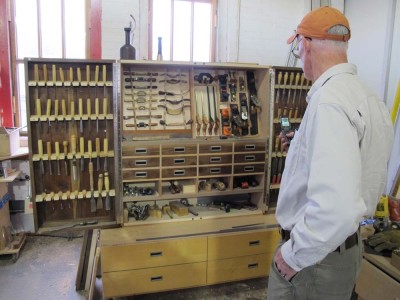
Here is Tom admiring Walter’s almost-completed handtool cabinet.
It turns out that Walter is much more than “a woodworker,” he is a consummately skilled artisan in a wide range of enterprises. A product of the peerless European tradition of the skilled crafts, he is part machinist, part joiner, part furniture designer, part inventor, part musical instrument craftsman (bass viols and cellos), and furniture maker par excellence. He has a cavernous work space carved out inside a rehabilitated former auto dealership, which includes a fully equipped millwork shop for large runs of architectural and related work, a brilliantly illuminated (with huge banks of windows) handwork room, and a fully equipped machinists lair. A brief visit with him unveils the making and modifying of tools, restoring early automobiles, and much, much more.
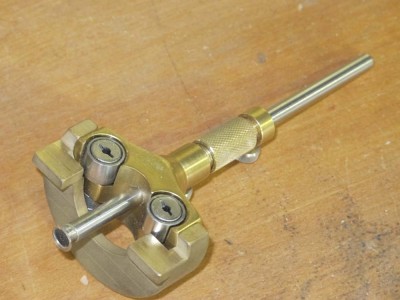
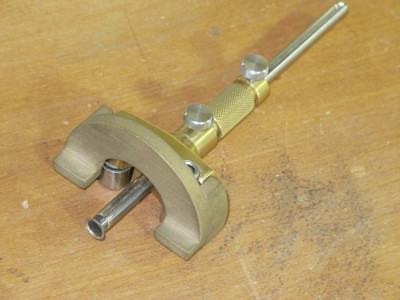
Two views of a heavily modified marking gauge for bombe surfaces.
Staunton, Virginia, an unexpected (?) place to find such excellence. I suspect that my excuses to visit Walter will become increasingly flimsy, but the visits will become equally frequent.
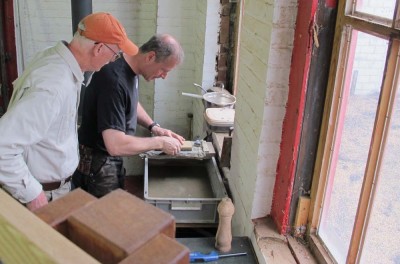
Side note: I know a lot of folks who are good at sharpening their tools. I am myself fairly confident in my own skills there. But I have never seen anyone who can put an edge on a tool like Walter can, as he demonstrated his techniques for doing so. I have much to learn from him and practice, something Tom and I have already begun to implement in our own work based on the demonstration, with great results!

I know exactly what I will be doing precisely one year from now. I will be heading west from Virginia Highlands to begin the packing, shipping, and installation of the exhibit “The Tool Cabinet and Workbench of Henry O. Studley,” in Cedar Rapids, Iowa, May 15-17, 2015. The exhibit will be twenty-five minutes away from the concurrent Handworks toolapalooza in the nearby Amana Colonies in eastern central Iowa.
We are now setting up the ticket sales site for the exhibit, which goes live at 12:01 AM, June 1, 2014.
As of five minutes ago I now have no more pending orders to ship for polissoirs! I packed the last pair of my standard 1″ models to go to Sweden, which coincidentally finished off the inventory of that model. Fortunately I will be receiving more of them next week, and I still have a pretty nice inventory of the other three models in-hand.
Given the beauty of summer in the Virginia Highlands, it is probable that product flow will be a bit slow over the next dozen weeks, as the broom maker will concentrate on doing those things in his life that require pleasant weather (he is building a new house by himself).
Thanks again everybody for your continued interest is the old ways of doing things.

Last Saturday was the Spring meeting of the Chesapeake Chapter of the Society of American Period Furniture Makers. During the Show-and-Tell I provided an update on the HO Studley Tool Cabinet Exhibit, which is now only 53 weeks away. There seemed to be pretty keen interest, and many of those in attendance were already crunching their calendars and check books to figure out how to make it to the toolapalooza weekend in eastern Iowa.

I included three or four images of the host venue, the very classy Scottish Rite Temple in Cedar Rapids, Iowa. Believe me, when you see and experience the exhibit yourself, you will agree with me that it is the perfect venue.

If I can pull together an opening event on Thursday night, it will be in the auditorium with the ensemble in attendance on-stage.

The exhibit itself will be in this elegant room in the facility — complete with dramatic staging and lighting — and over the past two Saturdays I have received much encouragement and feedback and will now pursue some augmented components for the exhibit. Stay tuned.
After that I was able to introduce my Roubo compatriot Michel Pagan to the audience, and lotsa well-deserved love was heaped on her. Chris Schwarz blogged about that here.
Bert Bleckwenn offered an impassioned tribute to the project, about how it was part of the fabric of knowledge that was simply unavailable when he and I started woodworking 45 years ago. Michele and I were very much moved by your remarks, Bert, and our only regret is that Rouboista #3 Philippe Lafargue was unable to hear them in person. Believe me, the heartfelt appreciation on your side of the equation is matched by the passionate commitment on this side.
After a few weeks of being completely sold out I now have enough polissoirs in-stock to fulfill all the orders I had up to about five days ago. I will get them packaged up tomorrow evening and shipped out the following lunch time. Thank you for your patience.
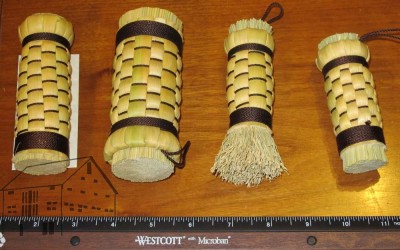
If your order is newer than a week ago, it will probably be a couple weeks before I get additional refill inventory.
PS Thanks Caleb James for your very nice words about your experience with the polissors.
One of the great things about woodworking is the people you get to befriend, and I say this as someone who is not by natural inclination a “people person.” As the son of a pastor I became reasonably adept at social interaction, but I am entirely comfortable being alone, perhaps too much so. So many of our cohort are truly gifted thinkers, seers, and solvers. Many are even pretty good company!

One terrific fellow and gifted designer and maker who fits this description is Jonathan Szczepanski, who lives and works in the Maryland suburbs of DC. Jonathan is one of the moving forces behind the SAPFM Chesapeake Chapter, and at yesterday’s meeting he presented Michele and me with these t-shirts of his design.

If you find them as amusing as I do and want to “Roll with Roubo”, Jonathan has them posted for availability at CafePress. It has become one of the treasures of my wardrobe, I tell you. Fortunately, like Jonathan’s Roubo I am a total hipster.


Recent Comments