The second day of GroopShop was just as engaging and instructive as the first, and one again I was paying so much attention to the speakers that my photo record was not as good as it should have been.

The opening session was a demo by one of the reps from Apollo Spray Systems, the HVLP units used widely in our circles. The blow-by-blow of the history of product development was fascinating to me.

My friends Mark and Valeri from Besway/Benco, manufacturers of chemicals and products for the finishing room, provided a chilling account of the regulatory war against our trade. Do Gooders are relentless, that is why they win unless they are opposed in a smash-mouth fashion by someone with the means to do so. Since sanctimonious moral certitude is the regulator’s fuel, I do not expect us to prevail for the most part.

Freddy Roman gave an impassioned and enlightening talk about using social media for marketing his business. In that realm he really is the Energizer bunny. Were I less curmudgeonly I might go this route.

I gave my 120-minute spiel on “Decoding Hide Glue,” covering everything from manufacture to modification to application. We got almost all of it recorded and it will soon be posted, or at least as soon as I can knit it all together.

Bill Ryan is an on-site-work warrior doing mostly architectural punch-list work in new construction, and he brought his complete traveling workshop with him to show its contents and applications. Very inspiring. I am still kicking myself for not taking a picture of his traveling kit.
Tom Delvecchio presented his recent fascination and exploration of 3D printing and its applications to his work in the restoration shop. I’ve long been considering this technology, and since there is a manufacturer her in this county I will delve more deeply.


The after-dinner talk was one of the most intriguing I’ve seen as a young fellow demonstrated 3D imaging and its link to robotic 3D manufacturing. The implication for replicating metal furniture parts especially was astounding. We used to work on 3D imaging at SI and the progress made in this area is staggering.

The final presenter for the gathering was the next morning with the rep from Mohawk covering his line of products, and how that offering has changed over time. Like many practitioners of the furniture restoration arts Mohawk is what I cut my teeth on; I attended a Touch-Up workshop back in 1974 and still have drawers full of the materials I got then, using them as needed to this day.
And thus endeth GroopShop 2018. As always I came away inspired and informed. If you have any interest in the finishing and restoration arts, you should belong to the Professional Refinishers Group.


Mrs. Barn and I spent the afternoon at the Atlanta Botanical Garden. It was delightful. Then we drove home. Less delightful.

After many moons of hibernation the Shellac Archive is back among the living! If I can get/keep my act together there will be a new posting every week or so until I have exhausted my 8,000 page archive (the page number is estimated, I have not literally counted every page; it might be more, it might be less). I think I already have about 200 more articles scanned, needing to be formatted and readied for posting.
This offering is the chapter “Natural Spirit Varnish Resins” from the most excellent H.W. Chatfield book Varnish Constituents (1953). As you might expect the chapter places great emphasis on shellac.
Enjoy.
With a number of data points in my hand it was time to give this gelatin mold thing a trial run. For the master pattern I selected one from my inventory of such things, an epoxy replica of a carved element.


I first affixed the pattern to a flat board using sulfur-free modeling clay as my gasket and adhesive. I have used this method as a rock-solid tried-and-true technique for decades, the sulfur-free aspect is critical whenever the mold-making material is silicon rubber (sulfur inhibits the silicon rubber from setting), and I just use this as my default for every similar application. I cleaned off the excess and brushed the thinnest possible coating of petroleum jelly onto the pattern to assure perfect separation, then dammed the pattern with a rectangle of Lego blocks.

For the gelatin mold material I used 192gws Standard glue, soaked overnight with the water level equal to the height of the glue in the glass jar. I wanted the gelatin to be on the viscous side, remembering that all the water going in has to come out and there are shrinkage issues to consider with that.
Once the glue was cooked and ready, I added 3% of glycerin to it to serve as a plasticizer followed by 2% protein hardener to crosslink the glue (both additions were by weight in proportion to the dry glue granules). I had already learned to allow the glue to cool a bit before adding the hardener as higher temps make the crosslinking go too fast, turning the glue into an heterogeneous lumpy mixture.


Once everything was ready I simply poured the glue over the pattern until it stood proud of the surface by about 3/8″ and set it aside overnight.

The next day I dismantled the Lego dam and the rubbery block was just what I wanted, it peeled away from the pattern easily. Clearly the hardener was imparting toughness from the git-go and the glycerin enhanced the flexibility of the still-swollen block.


I whipped up a batch of plaster and poured it into the gelatin mold with outstanding results. Well, as outstanding as I could have expected given my impatience, which caused me to de-mold the casting too soon. I should have waited 36 hours instead of 12; the high moisture content remaining in the gelatin mold retarded the setting of the plaster.

I immediately double bagged the gelatin mold to keep it from drying out, thinking the crosslinker would inhibit mold growth.
Not so much. Two weeks later when I opened it to use it again it was something akin to a slimy special effect for a space alien movie.
Still more territory for improvement on the next try.
By the third year of the Pilgrim settlement, the experiment with communalism having previously resulted in widespread deprivation and death, a theme that continues to this very day for the malignancy known as collectivism, Governor Bradford of Massachusetts perhaps unwittingly acknowledging that property rights always redound in bounteous blessings, made this first Thanksgiving Proclamation, 1623:
Inasmuch as the great Father has given us this year an abundant harvest of Indian corn, wheat, peas, beans, squashes, and garden vegetables, and has made the forests to abound with game and the sea with fish and clams, and inasmuch as He has protected us from the ravages of the savages, has spared us from pestilence and disease, has granted us freedom to worship God according to the dictates of our own conscience.
Now I, your magistrate, do proclaim that all ye Pilgrims, with your wives and ye little ones, do gather at ye meeting house, on ye hill, between the hours of 9 and 12 in the daytime, on Thursday, November 29th, of the year of our Lord one thousand six hundred and twenty three and the third year since ye Pilgrims landed on ye Pilgrim Rock, there to listen to ye pastor and render thanksgiving to ye Almighty God for all His blessings.
William Bradford
Ye Governor of Ye Colony
Amen.
Back at home after GroopShop 2014 Bill continued to assemble, finish, and augment the folding portable workbench we had built as a demo for GroopShop.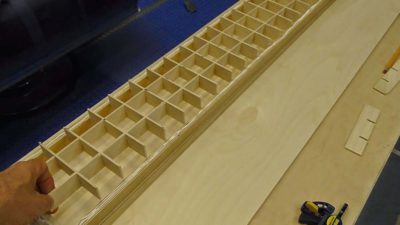
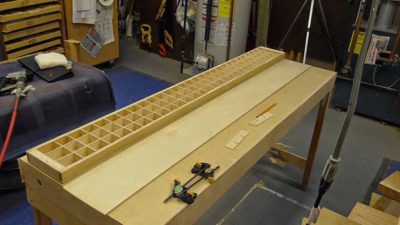
After installing the folding diagonal leg braces he gave it a trial run and found it to be too light for his tastes. Plenty sturdy enough but too light to work with comfortably. So, he made a shelf to fit between the lower cross braces of the legs and serve as a storage space, clearing the space around the bench and adding mass to the overall unit. The shelf was made using the exact same technology as the top. Like the top it was amazingly light in relationship to its strength and utility.
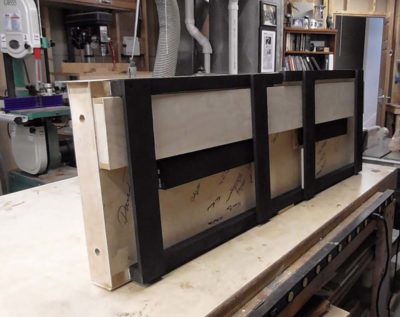
One of the really cool features is that the shelf fits neatly in between the folded legs underneath the top. As you can see he even has room for a second shelf if ever one is needed.

After painting the leg units black, it was going to be used in a museum gallery after all, he set it up and found it to fulfill his needs precisely. I don’t think he ever found the need to install the vises, but the set-up for them remains in place and ready to go any time he needs it.
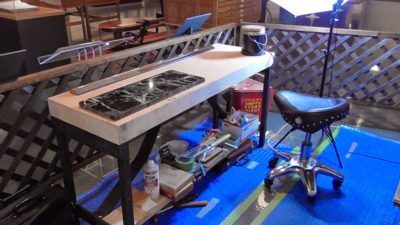
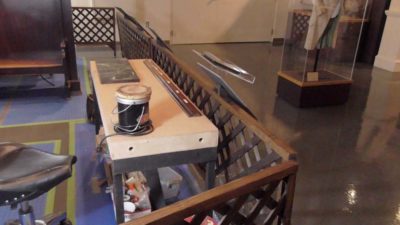

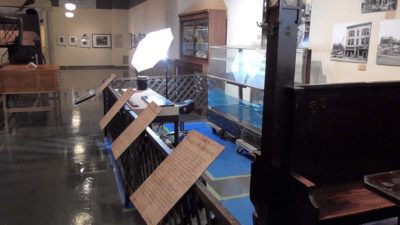
I believe he uses it regularly as a wonderful assembly table in his own shop, ready to be folded up and easily transported to a new on-site project where it is needed.
Sometimes improvement occurs as a flash of inspiration, sometimes through an incremental grind. This bench concept was a bit of both, and the improvements I made in this version carried over into the next folding workbench model, which I believe is workbench #20 or 21 in the series. I will be recounting the changes in great detail.
I do not have a workbench problem. I have a lot of workbenches. Big difference.
I do not normally post about current activities, but I was so excited about my vertigo beginning to subside and my getting back up the hill to the Barn yesterday I just wanted to do so this morning. Under the watchful eye of my visiting brother I spent much of yesterday puttering in the shop, tidying and setting up for some work in The Waxery, that dedicated “clean space” reserved for my mad scientist-y stuff.
Another couple days of improvement like the last two and I will be well on the road to normalcy, or at least what passes for a facsimile of normalcy in my life. I’m still a tad fuzzy around the edges and must be very careful not to turn my head quickly (dizzeryness ensues) or use power equipment, but otherwise it was a most productive day.
I even got all caught up on shipping orders that had accumulated over the previous fortnight.
Just in time for Thanksgiving.
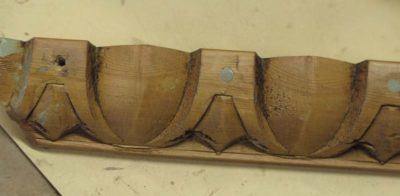
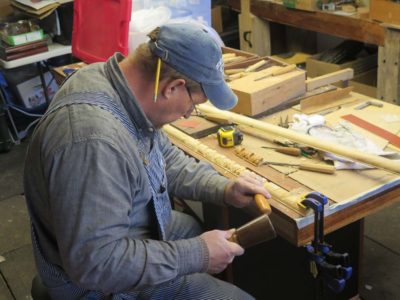
Recently I was called by a nearby acquaintance asking me for a lesson on carving egg-and-dart molding. Sam is a talented restoration carpenter who is a whiz at saving houses old and new, but this project required him to flex a bit and branch out into carving some moldings needed for a fireplace mantle. I said sure and we scheduled a couple of times for him to work in the studio.
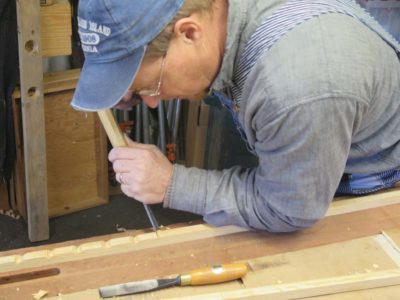
Most egg-and-dart molding involves a very limited number of carving gouges, and the sample he needed to match fit that description. Fortunately for him I had exactly the sweep and size he needed. I sat down and showed him the steps of the procedure then turned the sample piece over to him to, well, practice. I used to carve quite a bit, and there was a period 45 years ago I though about becoming a carver. Not becoming someone who could carve, but someone who was a carver. Big difference. But the lure of the finishing room soon won out, and ever since I’ve only really undertaken carving to replicate missing pieces from my projects.

After a couple of sessions in the Barn, Sam was ready to execute the moldings for real. The initial struggles he had with the fairly coarse-grained workpiece was alleviated the second time around, and the results were gratifying.
With him, I expected no less.
After struggling with my previous attempt to harvest oak from my own mountain, disappointed by the fact that even those large trees, or at least sections of their trunks, yielded so little usable material, I had for the moment hope for two long, straight sections that I had not yet processed. The tree from whence these bolts came had grown tall and straight in a very dense cluster of trees. Those facts led me to my optimism. So recently I headed up the hill with my implements of destruction in-hand.
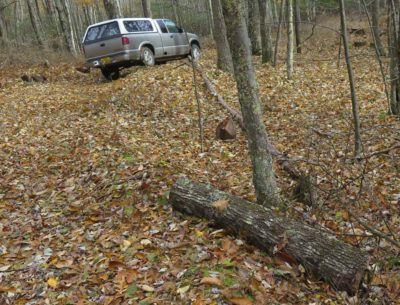

Cutting up the long straight trunk produced the first two segments to be split.
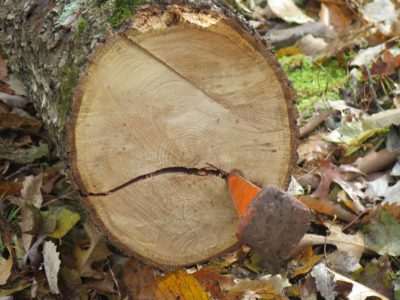
I studied the first of them to decide where to place the first wedge. I drove it in and immediately my heart sank when the split wandered off toward California.

With a deep breath and some impolite utterings under my breath I tried to salvage the situation by putting the second wedge in a place to continue or re-establish the split line I wanted in the first place.
It worked.

Carefully working down that line with more wedges, a nice split was established.
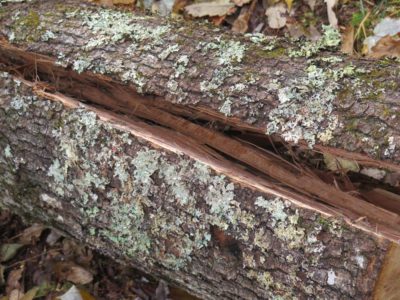
My only concern at this point was the interlocking that emerged but since it was restricted almost completely to only the pith it was no cause for hysteria. A few whacks with the roofer’s hatchet, my “go to” tool for this task, and the problem was resolved as I hoped. It was only a little loss to a region of the trunk I didn’t want in the first place.
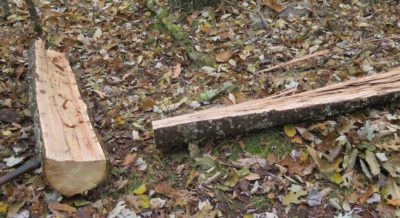
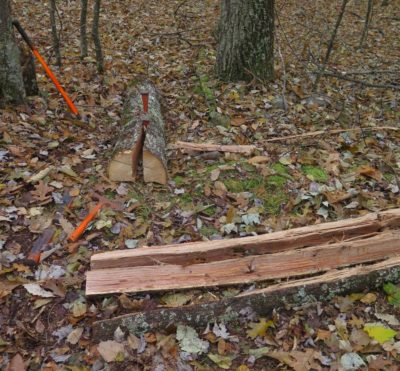
Soon enough I had two halves of a trunk, then four quarters, and in the end, eight wedges.
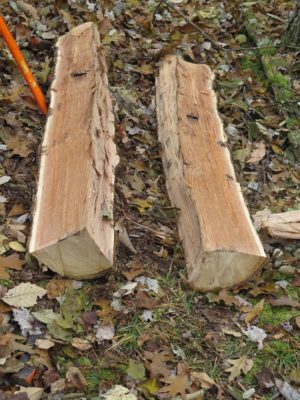
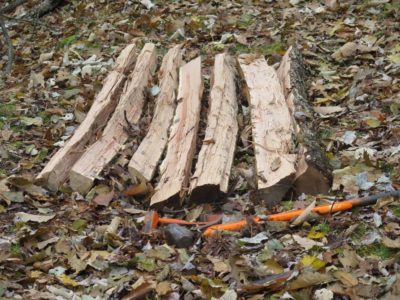
I was pleased with the minimal amount of overall interlocking and wind.
My friends, there be some chairs.
Recently we traveled to Greater Atlanta to attend this year’s gathering of the Professional Refinisher’s Group, a/k/a “Groop,” and online forum to which I have belonged for almost twenty years. Though initially a “virtual” community, we started assembling almost annually for the past 16 years.

Our hosts this year were the cooperative known as Southern Restorations whose large enterprise is steered by Brian Webster.
Note: If you have even a passing interest in furniture finishing or restoration, you SHOULD be a member of Groop. For further information on joining click here. If you attended the HO Studley exhibit in Cedar Rapids IA you undoubtedly met some of our members, as most of the docents were volunteers from Groop.

Once again GroopShop was an invigorating time of fellowship and sometimes idiosyncratic conversations ranging from surviving running a small business in an esoteric marketplace to arcane discussions of technical subjects and all points in between (virtually all the members of Groop are some version of small businesses). I know my interest was piqued on a regular basis throughout the three days, sometimes so much I forgot to take pictures..


After opening introductions and such the first demonstration of the event was for a low-impact abrasive cleaning system that was especially appealing to our members who undertake architectural work. Were I a younger man living near the city trying to build a business, this is a device I would certainly consider obtaining. The results were impressive, and I brought home a cleaned table leg to see how it finishes up.

Next came an excellent presentation on recent advances in waterborne coatings systems. While I do not use much in the way of these products, if I had a commercial refinishing shop in this age of envirohysteria, I would.


Next came Dan and Tredway demonstrating the process by which they mold and cast replicas. I especially enjoyed this not only because I have done so much of this, but because they use a very different product line/technology than I do. (They are Smooth-On guys and I am a Polytek guy) Somehow I wound up with the fancy eagle, and will probably paint and gild it and perhaps put it in next year’s Groop fundraising auction. In the mean time I will experiment with making a gelatin mold plaster cast from it.

RandyB gave another inspiring talk about life in the antiques preservation trade. His creativity knows no bounds. His many years of caring for collectors’ and dealers has left him with a wealth of experience and knowledge. I first met Randy while teaching at DCTC decades ago.

BobC gave his paean to oil finishes. Intriguing. I think there could be an intersection between them and polissoirs.

After dinner we held our annual Refinishing Jeopardy tournament, with host MikeM invoking Sicilian rules more than once. Like most things Sicilian it is best not to ask too much about them. I served as the adjudicating judge for any disputed answers. Thanks to some curious scorekeeping the hilarity was sustained to the very end.
And thus endeth Day 1.
Recently while working to impose order to the library of the Barn I came across a pile of articles needing scanning and formatting for posting to the web. “Tortoiseshell and Imitation Tortoiseshell” was my contribution to a 2002 conference that required travel to Amsterdam for the presentation itself, in complete disregard to one of my personal mottoes, “If I ain’t at home, I’m in the wrong place.”
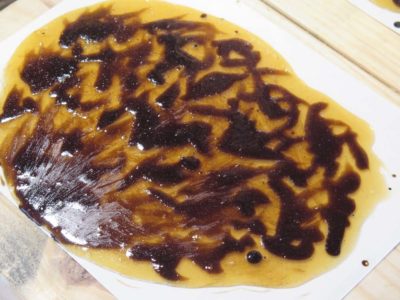
The scanned article is now in the “Conservation” section of the Writings section of the web site. There are two versions, one about 4.5 megs and another about 1.5 megs. I’m still working through the idiosyncrasies of my scanner and compewder, figuring out what settings work best. If I can get this better I will upload that version later.


Recent Comments