After first establishing the clean bevel angle, whatever the angle is (I do like Chris Schwarz’ practice of standardizing his angle with a setting jig for the honing guide, although I do not employ the practice yet myself) I like to move quickly through my DMT dual surface diamond stone then on to my dual surface Norton ceramic stone.
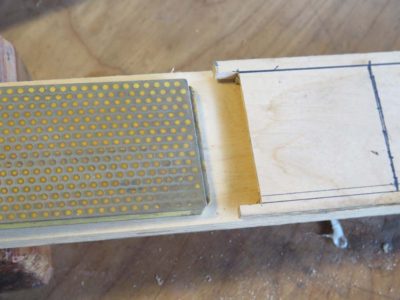
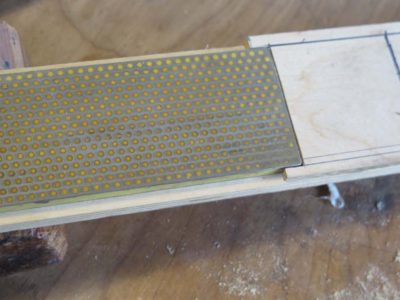
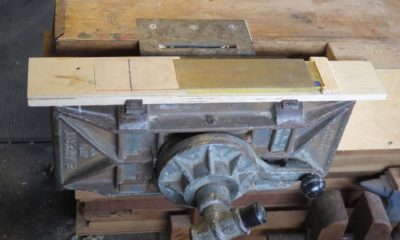
One of my gripes about honing guides, and which the LNT does not alleviate, is that the guide and its fixed angle eliminate a big chink of the stone for each stroke. I addressed this problem myself by making this jig to allow the diamond stone to nestle into a plywood jig, which in turn allows me to use every bit of the sharpening surface with each stroke.
If I do everything right, from this point on I usually need only a dozen or so strokes on each successive stone in order to get to “finished” in about 90 seconds. Then back to making shavings.
After the diamond stone I take a few quick strokes on the 1000 grit side of the Norton with the honing guide still holding the blade, regardless of whether it is a plane blade or a chisel.
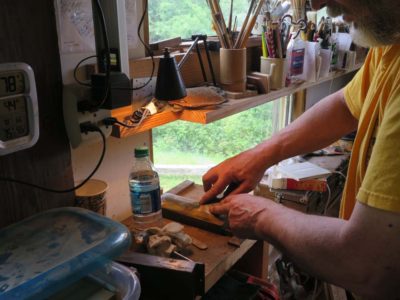
For the final few strokes on the finest stone I use the 8000 grit flip side of the Norton water stone. I do this freehand and sidewinder style. I can easily ascertain the correct honing angle by gently raising the blade bevel down until I see a sudden “pooch” of water being pushed out as the bevel angle becomes the same as the stone surface. I usually take four or five strokes on the left side of the stone, then four or five strokes on the right side, and I am done with that step.
I flip the blade over and put about three or four strokes of micro-bevel on the back side, usually with a tongue depressor as my spacer.
A new addition to my sharpening regimen was one I learned from Walter Wittman, perhaps the finest craftsman with whom I am acquainted (although Jameel Abraham and Michael Podmaniczky would surely give him a run for his money). Walter recommends a final stropping of the bevel edge on a piece of hardwood that has been impregnated with micro-abrasives. I believe he uses 0.5 micron diamond lapping paste, while I use 0.3 micron agglomerated microalumina powder. Neither he nor I like the idea of stropping on leather as the flexibility of the leather under compression compromises the clean edge of the tool by wrapping around the edge as the stropping occurs.
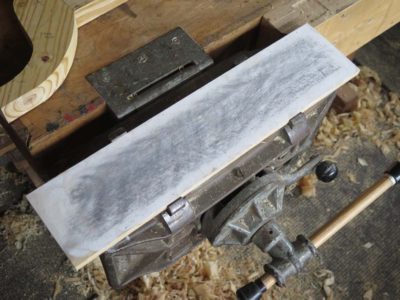
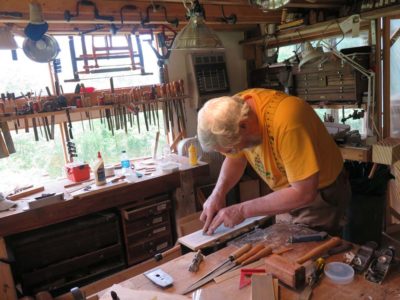
I made my stropping board from a clean scrap of baltic birch plywood which I sanded smooth with 320 sandpaper. Then I wetted the surface thoroughly and sprinkled the micro abrasive powder on the surface, and worked it into the raised grain with my fingertips. I let it dry and it was ready to go to work.
Holding the bevel edge against the board surface, and raising it the tiniest smidge I firmly draw to tool towards me by rocking back on my heels to maintain a steady and consistent contact angle. Five or six pulling strokes is all I take, and the result is simply transformative to my sharpening.
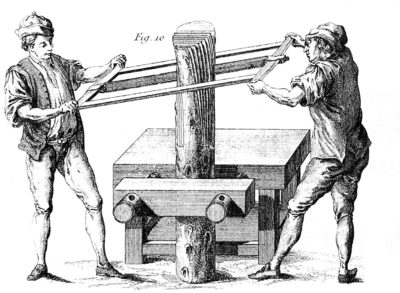
There seems to be a growing interest in frame saws of the kind that Roubo illustrates in Plate 278. I made a smaller scale version of the tool being wielded here, and purchased two full-sized four-foot versions of c.1800 vintage.
And now there is the continuing tale of The Accidental Woodworker creating his own frame saw based on the kit supplied by Isaac Smith of Blackburn Tools, and I had recent lengthy conversations about the Roubo frame saw with Mark Harrell of Bad Axe Tools. There are of course many other iterations of the tool at work in the shops of Mike Siemsen and Shannon Rogers, and probably many others.
Recently while preparing some stock for my current project I employed my best frame saw, the one with about an eight-inch frame width and a four-foot-long hand forged blade. The piece being prepped presented a fascinating quandary in that it was 1-1/4″ thick (it is vintage piece of tulip polar that was probably once used as a kitchen table top) and what I needed was a finished thickness of 3/4″. I do not possess a bandsaw nor planer of adequate size to re-saw or thin the 20″-wide board, so the choices available to me were 1) try to connect up with the two guys in the county who own 24″ planers, 2) attack it with scrub and fore planes myself and make the extra half-inch thickness into literally bushels of shavings, or 3) try to re-saw it with either my 3-1/2 t.p.i. hand saw or my four-foot 4 t.p.i. frame saw. I chose Door #3.
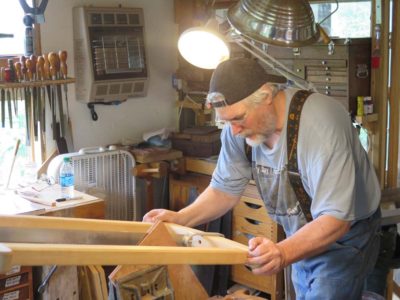
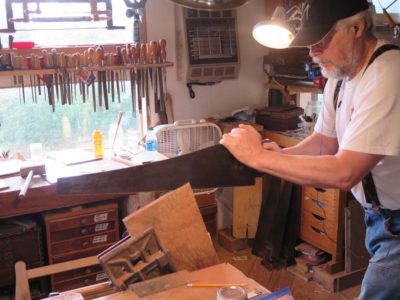
Both the frame saw I fabricated and the hand saw (here seen sawing some mahogany crotch veneer) cut the 150-year-old tulip poplar like butter, but they were not long enough to work the full width of the board easily.
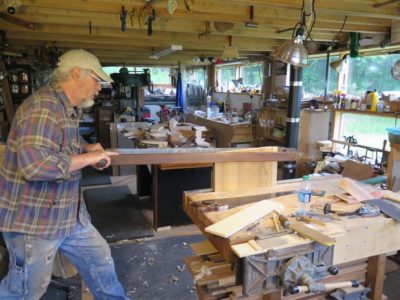
So I wound up using the long frame saw, which handled the task without trouble. First I spent a little time tuning up the blade, which I had not done since buying the saw at Martin Donnelly’s annual July toolapalooza a couple summers ago. Then I got to work. I would first use the saw in the pushing direction from one side, then after a few minutes move to the other end and pull it for a while. The actual sawing is not too difficult, but controlling such a long frame saw is tiring. It took me about two hours (with frequent rest breaks) to cut the nearly 3 feet of board, which would have gone much more quickly had Roubo or someone else shown up to grab the other end of the saw.
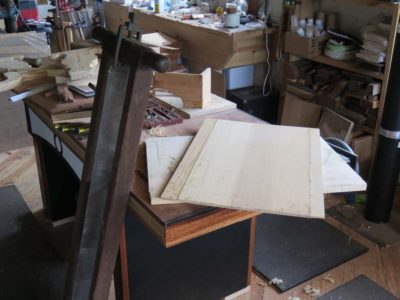
In the end the result was remarkably acceptable, especially given my lack of time in service behind the controls of this machine.
I was wrong. Or at least not as right as I thought.
As a self-taught free-hand sidewinder sharpener for four decades I eschewed the use of sharpening jigs, fixtures, tricks, alchemy, or other components. Truth be told I was privately derisive about their use. I derived my own successful methods based on my understanding of geometry and human kinesthetics. Didn’t everybody?
Recently on a whim I ordered the sharpening jig from Lie-Nielsen, knowing that I would be doing a lot of hand planing and sharpening during an upcoming (now current) project. A lot of people I respect touted its excellence and I was willing to take a flyer on it. Though I still finish off my edges freehand and side-winding, the honing jig has become an integral part of my sharpening routine especially in the earlier stages leading up to the final polish.
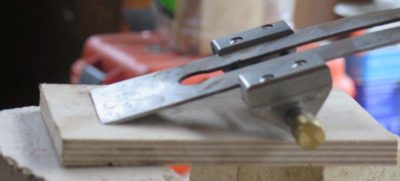
Let me begin by stating the obvious — this is an LN tool after all — the guide is well-made and easy to use. Establishing the desired angle is a accomplished by placing the blade loosely in the guide and using a reference surface, in my case a scrap of baltic birch plywood that sits above the sharpening station. Then you tighten the nut and get to work.
I find the guide most useful when I am establishing the bevel angle on the blade. I do not make any fuss over the exact numerical value of the angle as I think it is irrelevant within normal limits. Like Steve Branham has said, I believe accurately, the precise angle does not really matter — the level of edge preparation and sharpness does. For me it is just “shallow, steep, or medium?”

So, I set an angle with the guide and wail away on some 50 grit sandpaper mounted to my granite plate. It gets me to the re-established bevel in short order.
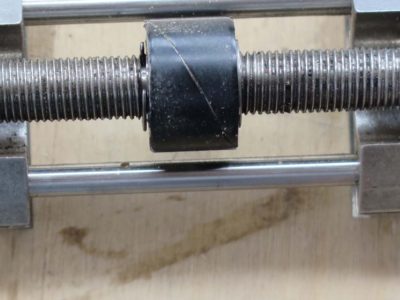
Since I am concerned about tearing up the wheel on the guide during this step I wrap it with some electrical tape to protect it. It takes me 30 seconds and saves the wheel from the coarse grit.
Next time I on this topic I will discuss the rest of my process and the LNT honing guide influence on it, along with a newly adopted additional step that has revolutionized my results..
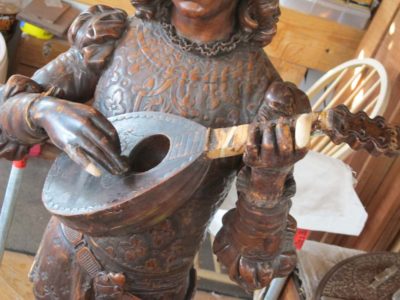
With the structural work and wax fills now complete I turned my attentions to the aesthetic integration of The Lute Player. For the most part the idea of “invisible repairs” is not necessarily part of the lexicon of furniture and wooden object conservation. This is because the quest for perfect appearance usually requires far more intrusion (read: inflicts far more damage) to the artifact than is appropriate, especially when you consider that the preservation of the maximum possible fabric and character of the artifact is the primary goal. In that context I usually strive for the repair to be unobtrusive rather than invisible. The furniture conservator’s guide is the “Six Foot, Six Inch Rule.” This is a shorthand way to describe repairs that are unobtrusive or unnoticeable upon standard viewing in a museum gallery setting (the “Six Foot” part) yet be identifiable on close inspection (the “Six Inch” part). The interpretation of this rule is variable, unique to each object.
In devising an inpainting strategy for a complex wooden object like The Lute Player there is a definite hierarchy to the importance of each of the components of appearance. As long as I first got the gray value right (almost always the single most important component of successful wooden object inpainting) and reasonably close in the gloss (usually the second most important component, unless the primary lighting for the object in from behind in which case it is the most important) I had tremendous latitude in my use of hue, chroma, transparency, uniformity, etc.

My first task in this final process was to bring the new elements into visual continuity with the remaining surfaces, which were themselves in less than pristine condition. I accomplished this with a combination of materials and techniques built up in multiple thin layers, including gauche with water, gauche in aqueous shellac, and pigments and dyes in solvent borne shellac applied with a fairly dry brush. One of the problems in this case was the varying gloss of the object surface and the inpainting surface as I was working. I often lightly swabbed the surrounding areas with odorless mineral spirits to impart saturation and gloss to assist me in my work.
Since the fingerboard and lute neck had been so badly damaged and frequently worked over I had a fairly free hand to attack the problem more aggressively than would have been the case if the adjacent surfaces were original or pristine. Once those regions were completed I gave the entire object a cleaning first with a 1% aqueous detergent solution followed by a damp wipe with distilled water, then followed by a swabbing with naphtha. With that it was ready for the final assault.
I applied a clear paste wax over the entire surface, followed by a pigmented paste wax to both push the overall tonality in the right direction and impart a degree of uniformity to the sun damaged areas vis-a-vie the object as a whole. I buffed the wax application with a large house painter’s bristle brush.
And then it was done.
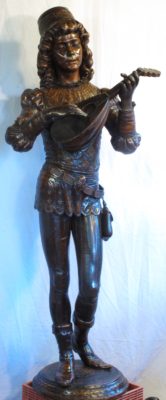
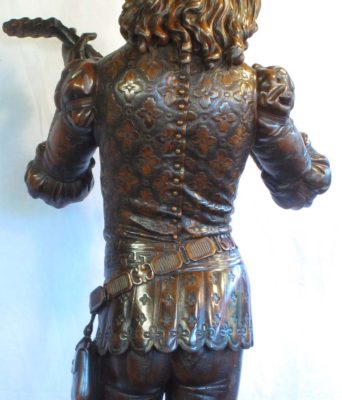
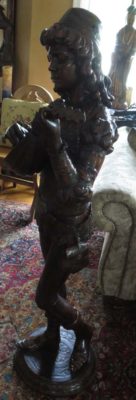
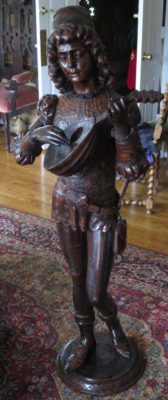
The setting when he got back home wasn’t conducive to the best photography, but he looked pretty good there.
As we are thick in the silly season of politics wherein we are presumably going to witness a contest between two loathsome and cartoonish figures, it is worth reflecting seriously on the document encapsulating the ideas that founded the greatest nation ever known to man (the US Constitution WAS NOT a founding document for the nation, it merely established the rules for its governance [admittedly now generally unknown and ignored] which is not the same thing). I pray you will read and reflect on the ideas expressed by men who pledged their lives, their fortunes, and their sacred honor to pursue the path of liberty. Reading it is like reading the Minor Prophets of the Old Testament; more up-to-date regarding the human condition than tomorrow’s headlines.
========================================================
IN CONGRESS, July 4, 1776.
The unanimous Declaration of the thirteen united States of America,
When in the Course of human events, it becomes necessary for one people to dissolve the political bands which have connected them with another, and to assume among the powers of the earth, the separate and equal station to which the Laws of Nature and of Nature’s God entitle them, a decent respect to the opinions of mankind requires that they should declare the causes which impel them to the separation.
We hold these truths to be self-evident, that all men are created equal, that they are endowed by their Creator with certain unalienable Rights, that among these are Life, Liberty and the pursuit of Happiness.–That to secure these rights, Governments are instituted among Men, deriving their just powers from the consent of the governed, –That whenever any Form of Government becomes destructive of these ends, it is the Right of the People to alter or to abolish it, and to institute new Government, laying its foundation on such principles and organizing its powers in such form, as to them shall seem most likely to effect their Safety and Happiness. Prudence, indeed, will dictate that Governments long established should not be changed for light and transient causes; and accordingly all experience hath shewn, that mankind are more disposed to suffer, while evils are sufferable, than to right themselves by abolishing the forms to which they are accustomed. But when a long train of abuses and usurpations, pursuing invariably the same Object evinces a design to reduce them under absolute Despotism, it is their right, it is their duty, to throw off such Government, and to provide new Guards for their future security.–Such has been the patient sufferance of these Colonies; and such is now the necessity which constrains them to alter their former Systems of Government. The history of the present King of Great Britain is a history of repeated injuries and usurpations, all having in direct object the establishment of an absolute Tyranny over these States. To prove this, let Facts be submitted to a candid world.
He has refused his Assent to Laws, the most wholesome and necessary for the public good.
He has forbidden his Governors to pass Laws of immediate and pressing importance, unless suspended in their operation till his Assent should be obtained; and when so suspended, he has utterly neglected to attend to them.
He has refused to pass other Laws for the accommodation of large districts of people, unless those people would relinquish the right of Representation in the Legislature, a right inestimable to them and formidable to tyrants only.
He has called together legislative bodies at places unusual, uncomfortable, and distant from the depository of their public Records, for the sole purpose of fatiguing them into compliance with his measures.
He has dissolved Representative Houses repeatedly, for opposing with manly firmness his invasions on the rights of the people.
He has refused for a long time, after such dissolutions, to cause others to be elected; whereby the Legislative powers, incapable of Annihilation, have returned to the People at large for their exercise; the State remaining in the mean time exposed to all the dangers of invasion from without, and convulsions within.
He has endeavoured to prevent the population of these States; for that purpose obstructing the Laws for Naturalization of Foreigners; refusing to pass others to encourage their migrations hither, and raising the conditions of new Appropriations of Lands.
He has obstructed the Administration of Justice, by refusing his Assent to Laws for establishing Judiciary powers.
He has made Judges dependent on his Will alone, for the tenure of their offices, and the amount and payment of their salaries.
He has erected a multitude of New Offices, and sent hither swarms of Officers to harrass our people, and eat out their substance.
He has kept among us, in times of peace, Standing Armies without the Consent of our legislatures.
He has affected to render the Military independent of and superior to the Civil power.
He has combined with others to subject us to a jurisdiction foreign to our constitution, and unacknowledged by our laws; giving his Assent to their Acts of pretended Legislation:
For Quartering large bodies of armed troops among us:
For protecting them, by a mock Trial, from punishment for any Murders which they should commit on the Inhabitants of these States:
For cutting off our Trade with all parts of the world:
For imposing Taxes on us without our Consent:
For depriving us in many cases, of the benefits of Trial by Jury:
For transporting us beyond Seas to be tried for pretended offences
For abolishing the free System of English Laws in a neighbouring Province, establishing therein an Arbitrary government, and enlarging its Boundaries so as to render it at once an example and fit instrument for introducing the same absolute rule into these Colonies:
For taking away our Charters, abolishing our most valuable Laws, and altering fundamentally the Forms of our Governments:
For suspending our own Legislatures, and declaring themselves invested with power to legislate for us in all cases whatsoever.
He has abdicated Government here, by declaring us out of his Protection and waging War against us.
He has plundered our seas, ravaged our Coasts, burnt our towns, and destroyed the lives of our people.
He is at this time transporting large Armies of foreign Mercenaries to compleat the works of death, desolation and tyranny, already begun with circumstances of Cruelty & perfidy scarcely paralleled in the most barbarous ages, and totally unworthy the Head of a civilized nation.
He has constrained our fellow Citizens taken Captive on the high Seas to bear Arms against their Country, to become the executioners of their friends and Brethren, or to fall themselves by their Hands.
He has excited domestic insurrections amongst us, and has endeavoured to bring on the inhabitants of our frontiers, the merciless Indian Savages, whose known rule of warfare, is an undistinguished destruction of all ages, sexes and conditions.
In every stage of these Oppressions We have Petitioned for Redress in the most humble terms: Our repeated Petitions have been answered only by repeated injury. A Prince whose character is thus marked by every act which may define a Tyrant, is unfit to be the ruler of a free people.
Nor have We been wanting in attentions to our Brittish brethren. We have warned them from time to time of attempts by their legislature to extend an unwarrantable jurisdiction over us. We have reminded them of the circumstances of our emigration and settlement here. We have appealed to their native justice and magnanimity, and we have conjured them by the ties of our common kindred to disavow these usurpations, which, would inevitably interrupt our connections and correspondence. They too have been deaf to the voice of justice and of consanguinity. We must, therefore, acquiesce in the necessity, which denounces our Separation, and hold them, as we hold the rest of mankind, Enemies in War, in Peace Friends.
We, therefore, the Representatives of the united States of America, in General Congress, Assembled, appealing to the Supreme Judge of the world for the rectitude of our intentions, do, in the Name, and by Authority of the good People of these Colonies, solemnly publish and declare, That these United Colonies are, and of Right ought to be Free and Independent States; that they are Absolved from all Allegiance to the British Crown, and that all political connection between them and the State of Great Britain, is and ought to be totally dissolved; and that as Free and Independent States, they have full Power to levy War, conclude Peace, contract Alliances, establish Commerce, and to do all other Acts and Things which Independent States may of right do. And for the support of this Declaration, with a firm reliance on the protection of divine Providence, we mutually pledge to each other our Lives, our Fortunes and our sacred Honor.
The 56 signatures on the Declaration appear in the positions indicated:
Column 1
Georgia:
Button Gwinnett
Lyman Hall
George Walton
Column 2
North Carolina:
William Hooper
Joseph Hewes
John Penn
South Carolina:
Edward Rutledge
Thomas Heyward, Jr.
Thomas Lynch, Jr.
Arthur Middleton
Column 3
Massachusetts:
John Hancock
Maryland:
Samuel Chase
William Paca
Thomas Stone
Charles Carroll of Carrollton
Virginia:
George Wythe
Richard Henry Lee
Thomas Jefferson
Benjamin Harrison
Thomas Nelson, Jr.
Francis Lightfoot Lee
Carter Braxton
Column 4
Pennsylvania:
Robert Morris
Benjamin Rush
Benjamin Franklin
John Morton
George Clymer
James Smith
George Taylor
James Wilson
George Ross
Delaware:
Caesar Rodney
George Read
Thomas McKean
Column 5
New York:
William Floyd
Philip Livingston
Francis Lewis
Lewis Morris
New Jersey:
Richard Stockton
John Witherspoon
Francis Hopkinson
John Hart
Abraham Clark
Column 6
New Hampshire:
Josiah Bartlett
William Whipple
Massachusetts:
Samuel Adams
John Adams
Robert Treat Paine
Elbridge Gerry
Rhode Island:
Stephen Hopkins
William Ellery
Connecticut:
Roger Sherman
Samuel Huntington
William Williams
Oliver Wolcott
New Hampshire:
Matthew Thornton
I’m in the midst of a project with lots of hand planing (the client requested a small writing desk reflecting the style and technology of 2nd quarter 19th century) so I spent a little time upgrading both the planing beam and the faux Studley workbench.
My main issue with the planing beam was that the flat head screws I had installed as the planing stops were inadequate for the job. Even though they were #14 screws, they were modern #14 screws so they bent under hard use, rendering them useless as retractable pins. In exasperation I got them out and threw them across the room into the trash where they belonged. For a while I just clamped a piece of scrap stock on the end, which worked for some things but was in the way for others.
I decided to come up with a permanent and robust solution.
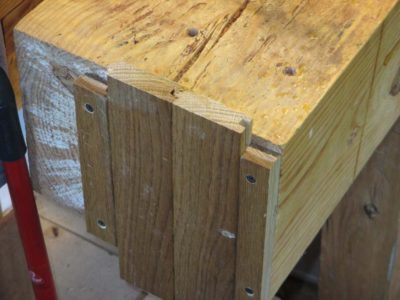
My intention was to make a rising stop that was housed on the end of the beam. A great idea and easy enough to do. Being lazy I found an even easier method than I had thought initially. Since I seem to be genetically incapable of throwing stuff out, when I was puttering around up on the fourth floor looking for some wood to use for the shelf underneath the Roubo bench I was making, I did indeed find two boxes of tongue-and-groove flooring scraps left over from creating the floor of the classroom. Scraps too small to use for anything. Not only did I have enough for a open slat shelf under the new workbench, but another couple of pieces were perfect for the new planing stop.
I made three 10″ pieces of the tongue-and-groove, glued two of them together and ripped one in half. These became the sliding stop and the shouldered housing. I held them against the end of the planing beam, affixed the shoulders with screws to the end of the beam and was making shavings seconds later. I must’ve taken almost six or seven minutes of my time to get it done.
For this desk project I had to prepare some mahogany boards that were about 18″ wide so the planing beam was not the workplace of choice for getting them done. But, it was a perfect application for the broad expanse of the Studley slab I made last year. The only thing missing was an end vise and some bench dogs, so that was the task of the hour.
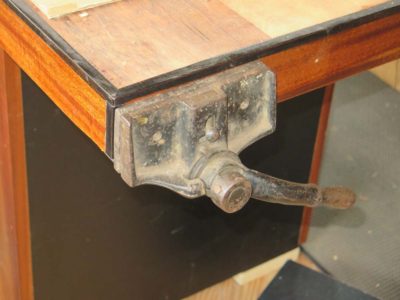
I mounted the Sheldon vise at the end location, but was hampered by the fact that the Sheldon was so small it did not come close to the top of the bench. (I was not confident the Sheldon would serve my needs so am resistant to the notion of excavating the underside of the slab until I know for sure.)
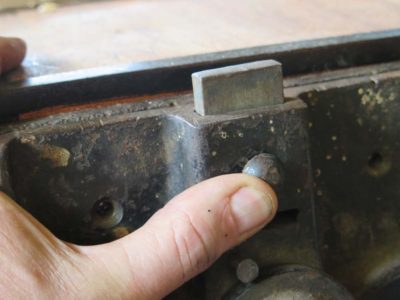
Even with the sliding dog in the fully extended position it only came proud of the top by about 1/32″, certainly not enough to work.

So I made a new dog out of some anonymous tropical hardwood I had in the scrap bin, and made it so that it was even with the top when fully retracted and almost 3/4″ proud when fully extended.
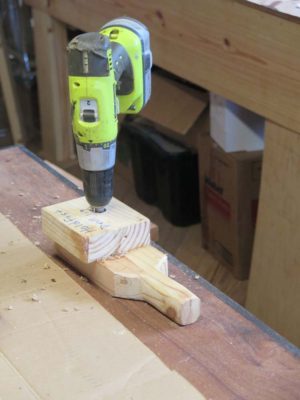
To pair with the new sliding vise dog I took my 3/4″ holdfast boring jig and drilled a series of six holes into which 3/4″ oak dowels were inserted. Works like a dream, but I am still not sure the Sheldon is up to snuff as the permanent solution. I’m still holding out for a piano-maker’s end vise, even if I have to make it myself. But that won’t be happening any time soon.
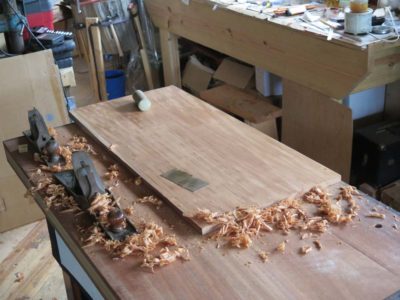
So for now my faux Studley workbench is fully functional and in heavy and fairly constant use, and the planing beam remains one of my favorite work stations.


With the bench up on its feet I reached for my favorite Japanese timber frame joint saw and trimmed off the tops of the legs that were projecting through the bench slab.


I added wedges to the voids alongside the leg tenons (definitely need to avoid using my chop saw for fabricating the mortise lamina in the future) and even with no glue the joint was tight and the bench devoid of wiggle. We’ll see if I need to wick in some adhesive after a few seasonal cycles.

With my 10″ circular saw I trimmed the ends, leaving about 3/32″ to finish the cut.
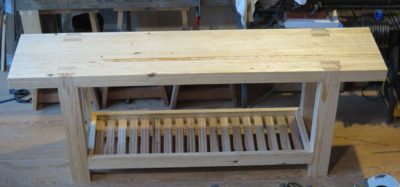
A slat shelf mounted to the stretchers and a quick session with a toothing plane wrapped up the construction. When I get the time I will add the crochet and drill the holes for the holdfasts, but for now the core bench is done.
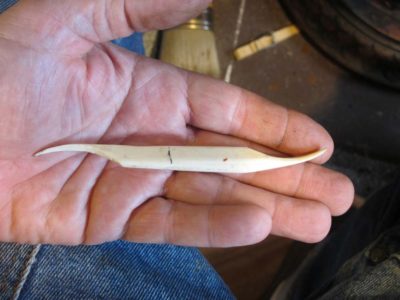
Since one of the critical components for conserving The Lute Player was filling several cracks with pigmented wax for cosmetic purposes, I spent a fair bit of time with my favorite tool I have ever made. Made from a scrap of vintage ivory I bought from David Warther, this combination spatula and scraper was made just for working wax, and made just for fitting my hand.
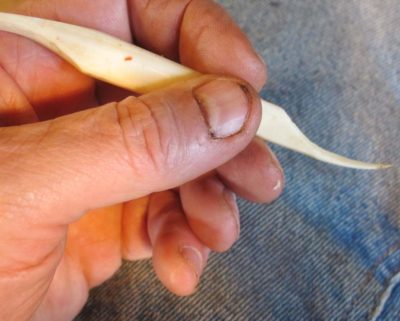
I made the tips as curved, one wide (~1/4″) and one narrow (~1/8″), and roughly triangular in cross section. The flat surface, on the outside of the curve, provides excellent material manipulation and flattening. The edges work magnificently at trimming wax fills.
I shaped the blades with files and sandpaper, then polished them sharp with 600grit sandpaper wrapped around a 1″ dowel. For maintenance I do the same with even finer sandpaper.
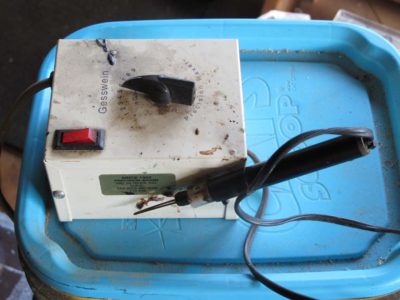
When it comes to making wax fills in cracks, my favorite tool is this variable-heat stylus that is made to use in assembling wax models for lost-wax metal casting. While I do use it for that purpose, I find I use it more often for melting wax for linear fills.
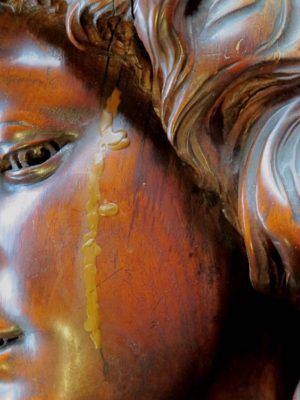
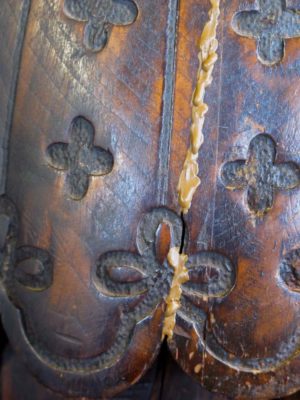
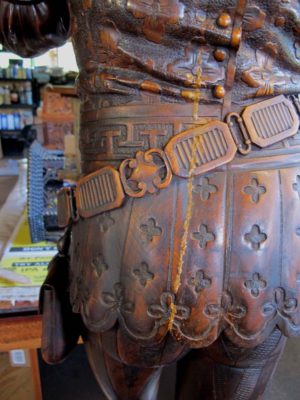
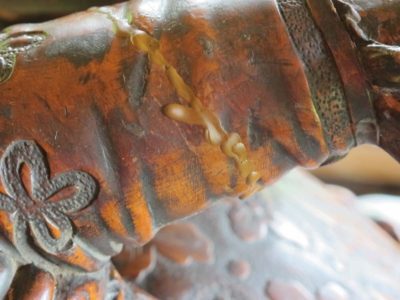
Using this tool I flow in an excess of usually pigmented wax into the crack.
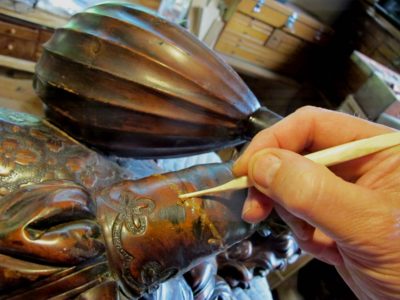
Then with my ivory tool I carefully scrape off the excess. The tool is so great that It rarely disturbs the material on either side of the fill.
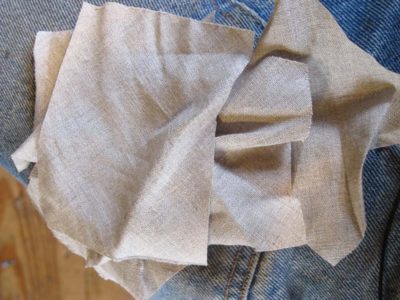
Once the gross removal is complete I burnish the area with coarse weave linen to pick up any last little bit of the excess wax.
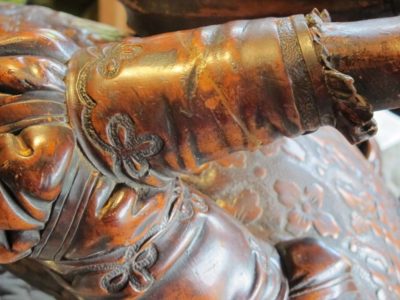
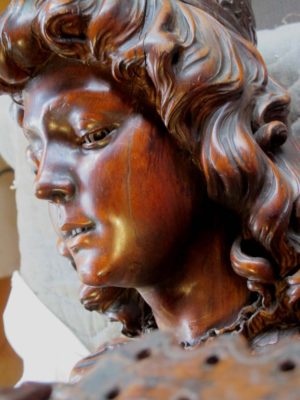
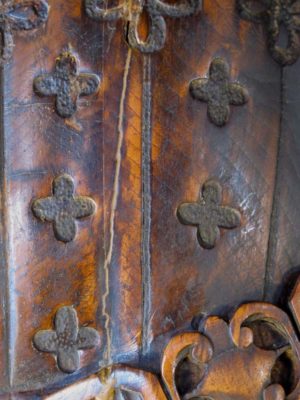
And with that the wax filling is complete and the surface is ready for inpainting and final toning.
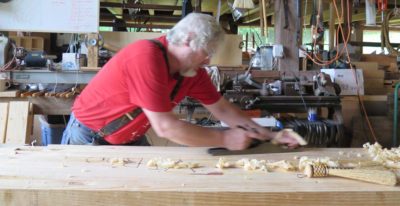
With the legs ready for installation on/into the slab top, my next step was to get the underside of the bench reasonably flat. It did not need to be particularly smooth, and definitely did not need to be “finished” but it did need to be amenable to seating the legs into the mortises cleanly. Using a scrub plane and a #6 I got the underside ready to go.
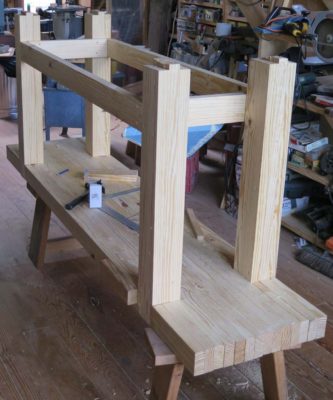
With the slab top still upside-down but placed on lower stools, I simply put the leg tenons where they belonged and drove them into place. On one of the legs I was especially pleased that I had left the legs a little long so the results from the pounding with a sledge hammer could be excised. On two of the legs they went into place with just a bit of tapping with a wooden mallet, one took a bit more persuasion, and one was really tight. Often you do not know these things until it is too late to do anything about it except reach for a bigger hammer.
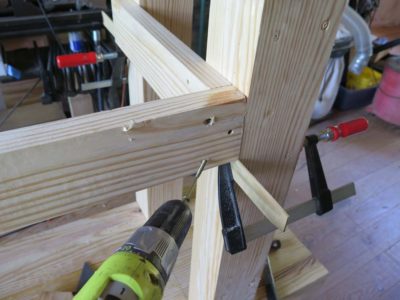
I am not particularly bullish on through-mortised stretchers for this type of bench, first because the bench does not need them for stability as the only real purpose for the stretchers is to hold a shelf underneath, and second it adds another element of unnecessary complexity to the project. In this prototype I cut some pieces of 4-inch wide 2x stock from the inventory, planed them lightly by hand, and affixed them to the legs with 3-inch deck screws for the short end stretchers and angled 4-inch deck screws for the longitudinal stretchers.
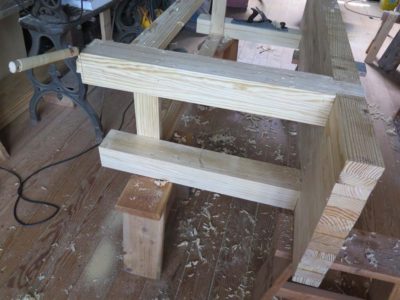
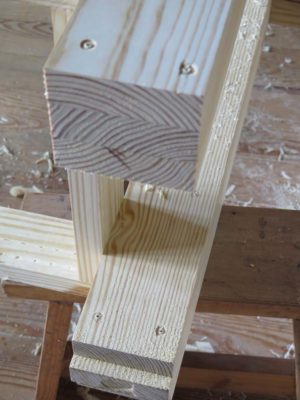
Laying over the bench on the low stools allowed me to hand plane the faces of the slab easily, and measure and saw off the legs to the length I wanted. I chose 36″ somewhat arbitrarily, we will try to fit each bench to their maker when we do this for real in July.
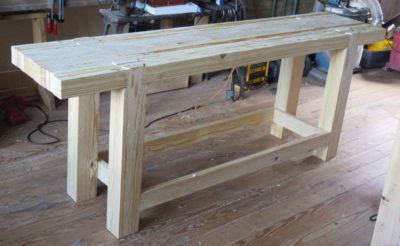
And with that, the bench was rotated another quarter-turn and sat upright on the floor. It does not budge a bit.
Next time I’ll finish up the core bench.
===========================================
If you are interested in joining me for a workbench building week at The Barn July 25-29, drop me a line.
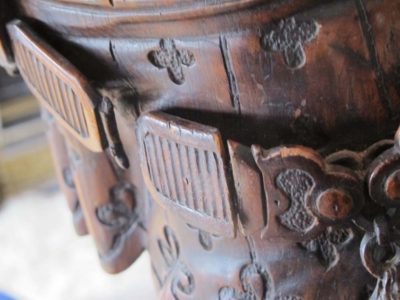
Nowhere was Besarel’s virtuosity as a woodcarving sculptor more evident than in his rendering of the belt. This was all done with extreme delicacy as it was not only all short grain but also sculpted with a void from the torso in one six-inch stretch. It should be no surprise that the area had been broken numerous times, and when I encountered the sculpture the broken belt section was merely nailed to the torso and a small section of the loop was missing altogether.
To address this damage I embarked down a path that was entirely consistent with my conservatorial principles even though it might strike you as odd. I disassembled the damaged area and tacked the pieces back together with hot hide glue. This was entirely inadequate for the structural integrity of the object. Its only purpose was to provide fixed alignment for the elements.
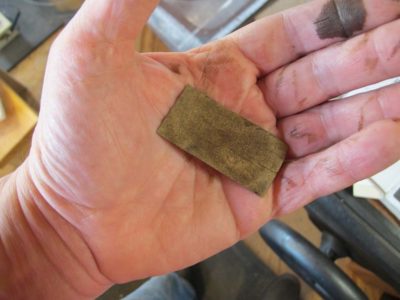
To impart the necessary structural support I needed to augment the area, yet I did not want to “contaminate” it nor spend a lifetime executing something exotic. Instead I backed the damaged area with a material that was not only rheologically sympathetic but also even more stable longevity-wise than the wood — linen rag paper. I took a piece of 60-lb rag paper and cut it to the right size for the repair, then tinted it with gauche.
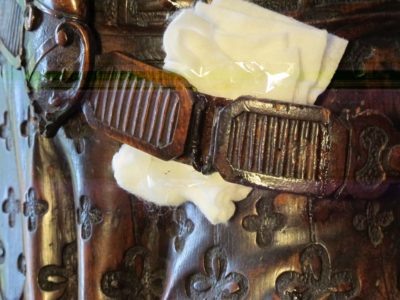
I slathered hot hide glue on the paper, slipped it behind the affected area, and slid some mylar and packed cotton wadding underneath that to provide complete contact with the verso of the damaged belt. (Yes I know it is a lousy picture, my camera was in the process of self-euthanization)
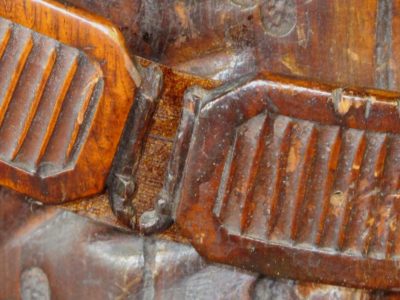
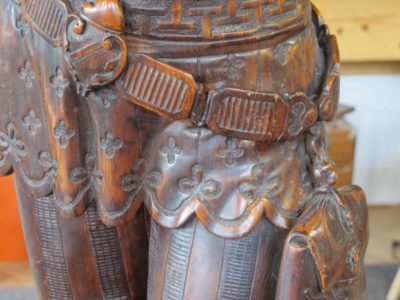
After the glue set over night I removed the wadding and the mylar barrier sheet, and stood back to assess the results. I was not displeased. It fits the furniture conservator’s “Six Foot, Six Inch Rule'” in that it is visually harmonious and not glaringly visible at standard viewing distance but readily apparent at close examination. Invisible repairs are rarely my goal, structural robustness and aggregate aesthetic integration are what I am shooting for.


Recent Comments